
How Advanced Search Filters Transform Your Lead Generation Process
Most B2B lead generation processes fail at the same point: too many unqualified contacts flooding the top of the funnel. Advanced search filters fix this by letting you layer multiple signals simultaneously, so every prospect on your list matches your ICP before you spend a single outreach credit. According to Sopro, in 2024, 45% of B2B companies reported that generating enough leads was their biggest challenge, and 48% struggled to convert them to revenue. Better filtering directly addresses both problems.
If you're building a smarter lead generation strategy, advanced filters are the highest-leverage change you can make. This article breaks down exactly how they work, which filter combinations drive the most ROI, and how SDRs, AEs, and RevOps teams use them to build pipeline faster.

Let Apollo Find Your Next Buyer
Tired of burning hours on manual research just to hit dead ends? Apollo surfaces verified contacts instantly so your reps spend time selling, not searching. Join 600K+ companies building pipeline faster.
Start Free with Apollo →Key Takeaways
- Layering intent signals with firmographic and technographic filters dramatically improves lead quality before any outreach begins.
- Poor data quality is a measurable revenue problem, and tight filter logic with verification gates is a direct countermeasure.
- SDRs using multi-signal filters spend less time researching and more time booking meetings with accounts already showing buying intent.
- Advanced filters apply beyond list-building: they accelerate mid-funnel pipeline, expansion plays, and retention targeting using the same logic.
- AI-powered platforms now translate natural-language queries into complex filter combinations, making precision prospecting accessible to every rep on your team.
What Are Advanced Search Filters in Lead Generation?
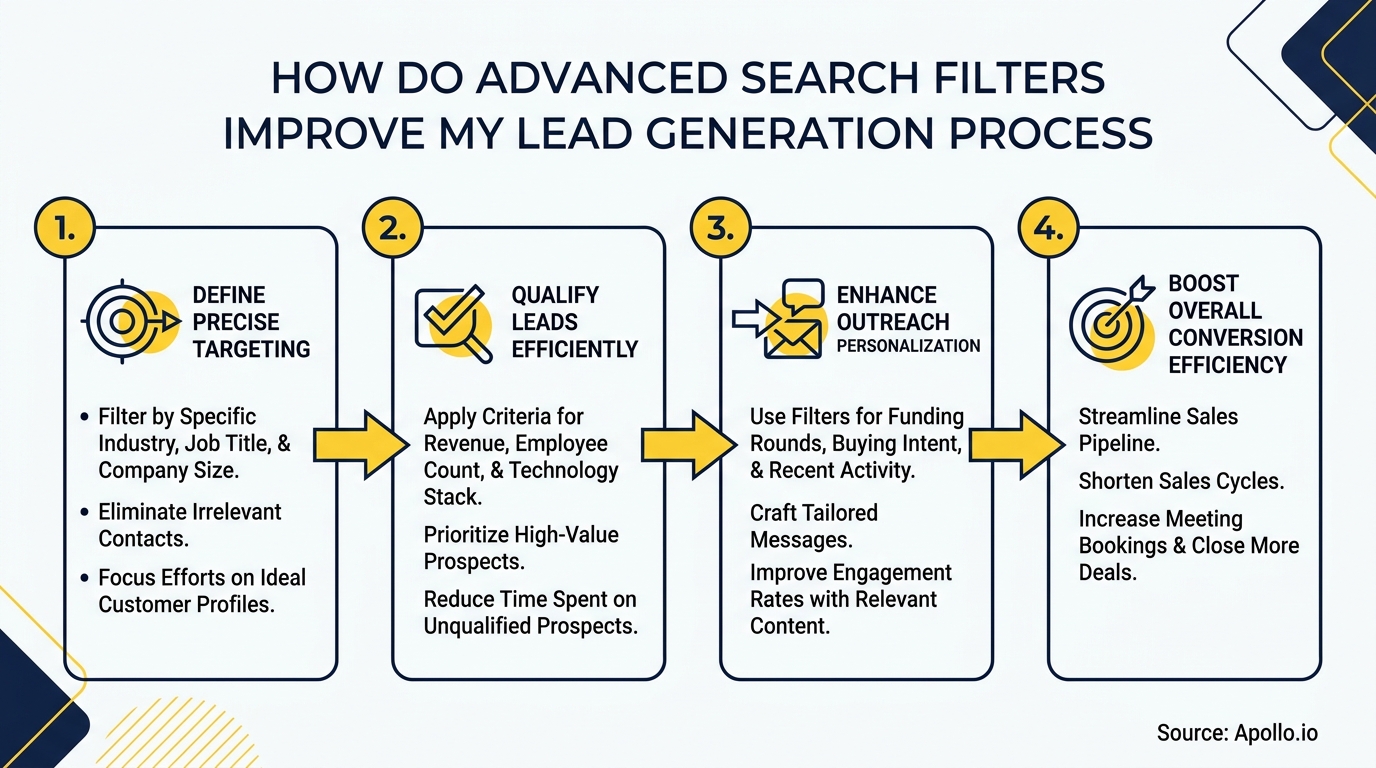
Advanced search filters are multi-dimensional criteria you apply to a contact or company database to return only the records that match your ideal customer profile. Basic filters include job title, company size, and industry.
Advanced filters layer in technographic data (tools the company uses), intent signals (topics they're actively researching), headcount growth, funding stage, seniority level, and engagement recency.
The shift happening in 2026 is from static firmographic filtering toward signal-based filtering: combining real-time buying intent, web activity, and trigger events with traditional ICP criteria. This approach prioritizes accounts showing active interest rather than simply matching a demographic profile. Explore how Apollo's advanced filters help you pinpoint prospects with precision using 65+ filter attributes across people and companies.
How Do Advanced Search Filters Improve Lead Quality?
Advanced filters improve lead quality by eliminating mis-targeted outreach before it happens, not after. Instead of building a broad list and letting SDRs disqualify manually, filters enforce qualification criteria at the data layer.
Research from SalesHive found that 93% of B2B marketers report higher conversion rates using intent data, and 82% say sales teams convert intent-based leads faster. The mechanism is simple: intent filters surface accounts researching your category right now, so your message arrives when the buying window is open.
Key filter combinations that improve lead quality:
- Intent + seniority + company size: Targets decision-makers at companies actively researching your solution category.
- Funding recency + headcount growth: Identifies companies in active investment and hiring cycles, a strong proxy for budget availability.
- Tech stack fit + job function: Finds contacts whose current tools create a direct integration opportunity or replacement need.
- Recency window: Restricts lists to contacts verified within the last 90 days, cutting bounce rates from stale data.
- Exclusion filters: Removes existing customers, competitors, and contacts already in active sequences to prevent wasted touches.
A sales professional wrote on Reddit that combining keyword search with an activity filter (contacts who posted in the last 90 days) dramatically reduced a large result set to only the genuinely relevant prospects. The same logic applies across any B2B database: recency and behavioral filters do the heavy qualification work so reps don't have to.
Struggling to find qualified leads fast enough? Search Apollo's 230M+ contacts with 65+ precision filters and build your next list in minutes.
Turn Weak Leads Into Pipeline That Closes
Quota stress keeping you up at night? Apollo surfaces verified, in-market prospects so your reps stop chasing dead ends and start booking meetings that matter. Nearly 100K paying customers trust Apollo to build predictable pipeline.
Start Free with Apollo →How Do SDRs Use Advanced Filters to Book More Meetings?
SDRs use advanced filters to replace manual research with pre-qualified lists, spending their time on outreach rather than data cleanup. The practical workflow: set a saved filter combination that matches your ICP, apply an intent layer for your solution category, restrict to contacts not yet in your CRM, and export a verified list directly into a sequence.
According to Reach Marketing, companies utilizing AI-powered lead generation tools have experienced a 35% increase in conversion rates compared to traditional methods. For SDRs, that lift comes from starting every sequence with contacts who already match the ICP instead of working a generic list and hoping for fit.
For RevOps leaders, advanced filters also serve a governance function. By standardizing the filter logic used to build lists, you create a consistent definition of a qualified lead across the entire team.
This eliminates the variability where one rep's ICP doesn't match another's, which is a leading cause of inaccurate pipeline forecasts.
For AEs managing enterprise accounts, filters support expansion plays: use technographic and headcount filters to find new buying centers within existing accounts, then route those contacts into a targeted nurture sequence rather than a cold outreach motion.

What Filter Logic Patterns Drive the Most ROI?
The highest-ROI filter patterns combine positive inclusion criteria with deliberate exclusion rules and a data quality gate.
| Filter Pattern | What It Does | Best Used By |
|---|---|---|
| Intent + seniority threshold | Surfaces decision-makers researching your category | SDRs, AEs |
| Funding trigger + headcount growth | Identifies companies with fresh budget and hiring momentum | SDRs, Founders |
| Tech stack disqualifier | Excludes companies locked into a competitor's ecosystem | RevOps, Marketing |
| Verified-last-90-days gate | Removes stale contacts before list export | RevOps, SDRs |
| Existing customer exclusion | Prevents outreach to accounts already in CRM | All roles |
| Engagement recency filter | Prioritizes contacts active on professional networks recently | SDRs, AEs |
A commenter added in a Reddit discussionabout paid lead gen that filtering at the conversion-feedback level (SQLs, not raw form fills) is what actually improves lead quality: "if you can't do that, it'll keep buying cheap junk forever." The same principle applies to outbound filtering: don't measure filter performance by list size, measure it by SQL conversion rate downstream.
Data quality gates are especially important as teams add more intent data sources. With more signals comes more noise.
A recency window (only records verified in the last 90 days), a role-validation check, and a deduplication pass before export are the three governance steps that keep filter logic reliable at scale.
How Do Filters Support Mid-Funnel and Expansion Plays?
Advanced filters extend beyond top-of-funnel list-building into pipeline acceleration, expansion targeting, and retention risk identification. The same filter logic that builds a cold outreach list can identify which open opportunities have buying-group gaps (missing economic buyer, missing technical evaluator) and which existing customers show signals of churn risk or expansion readiness.
Practical mid-funnel applications:
- Pipeline acceleration: Filter for open opportunities where a new stakeholder joined the buying company in the last 30 days. New stakeholders often restart or delay deals, and early outreach to them can prevent stalls.
- Expansion plays: Filter existing customers by headcount growth or new office openings to identify accounts ready for upsell conversations.
- Retention: Filter customers by declining engagement signals or leadership change triggers, then route to CSM for proactive outreach.
This is where a complete lead generation strategy becomes a full-funnel revenue motion, not just a prospecting exercise. The filter framework you build for new business applies across the entire customer lifecycle with minor adjustments to the criteria.
How Does Apollo's Filtering Fit Into a Unified GTM Stack?
Apollo consolidates contact search, data enrichment, sequencing, and pipeline management into one platform, which means filter logic built during prospecting carries through to outreach execution without manual data transfer between tools. Teams using Apollo report consolidating their sales tech stack significantly: "We reduced the complexity of three tools into one" (Predictable Revenue) and "Having everything in one system was a game changer" (Cyera).
Apollo's 65+ filters cover firmographics, technographics, intent topics, funding data, headcount signals, and contact verification status. The waterfall enrichment capability runs contacts through multiple data sources automatically, keeping filter-dependent fields accurate without manual maintenance.
For RevOps teams managing multiple reps, saved filter sets create a standardized ICP definition that every SDR uses, eliminating the list-quality variability that corrupts pipeline reporting. You can explore the full Apollo B2B lead generation tool to see how filters connect directly to automated sequences and CRM sync.
How to Get Started With Advanced Filter-Driven Lead Generation
Start with your highest-converting closed-won accounts and reverse-engineer the filter criteria they share: industry, company size, tech stack, seniority of the buying contact, and any trigger events that preceded the deal. That pattern becomes your baseline filter set.
Then add one intent or behavioral layer to your baseline and measure SQL conversion rate against your previous approach. This single-variable test gives you a clean signal on whether the new filter is adding value or just reducing volume without improving quality.
Resources to build your filter-driven prospecting motion:
- Find and close the right leads faster with a proven prospecting framework.
- Outbound prospecting guide covering how to find, reach, and win B2B leads.
- How to build a sales prospecting list that converts using verified data and ICP criteria.
- Lead generation tools that drive measurable ROI for B2B GTM teams.

Start Building Smarter Lists Today
Advanced search filters transform lead generation from a volume game into a precision motion. By layering intent signals, firmographic criteria, data quality gates, and exclusion rules, your team reaches the right contacts at the right moment in their buying journey, without wasting outreach on contacts that were never going to convert.
Apollo gives B2B GTM teams, from SDRs to enterprise RevOps, the filter depth and unified platform to execute this approach without stitching together multiple tools. Ready to put precision filtering to work for your pipeline? Request a Demo and see how Apollo's 65+ filters and 230M+ verified contacts can sharpen your lead generation process starting today.
Prove Pipeline ROI From Day One
ROI pressure killing your tool budget? Apollo delivers measurable pipeline impact fast — no lengthy ramp, no guesswork. Leadium 3x'd their annual revenue. See your returns before the next budget review.
Start Free with Apollo →Don't miss these
Sales
Inbound vs Outbound Marketing: Which Strategy Wins?
Sales
What Is a Sales Funnel? The Non-Linear Revenue Framework for 2026
Sales
What Is a Go-to-Market Strategy? The 2026 GTM Playbook
See Apollo in action
We'd love to show how Apollo can help you sell better.
By submitting this form, you will receive information, tips, and promotions from Apollo. To learn more, see our Privacy Statement.
4.7/5 based on 9,690 reviews
