
How Can Integration Reduce Time Spent on Manual Data Entry in 2026?
Sales reps are losing hours every week to a problem that integration solves directly: re-entering the same data across disconnected systems. According to Saleslion, 32% of sales reps spend more than an hour a day on manual data entry alone. That is time that cannot be spent selling, building pipeline, or closing deals. The fix is not working faster; it is connecting your systems so data flows automatically between them. Understanding how data sync improves B2B sales and marketing ROI is the first step toward reclaiming that lost capacity.

Research Less, Pipeline More With Apollo
Tired of your reps burning hours verifying contact info instead of selling? Apollo delivers accurate business contacts so your team skips the research and goes straight to conversations. Start building pipeline today.
Start Free with Apollo →Key Takeaways
- Integration eliminates duplicate data entry by syncing records automatically across CRM, email, calendar, and engagement tools, so reps stop re-keying the same information.
- Sales reps spend an average of 5.5 hours per week entering data into CRM systems; integrated platforms can reclaim most of that time for selling.
- AI agents require connected systems to function properly. Disconnected tools amplify bad data, not productivity.
- RevOps and sales leaders see the clearest ROI when integration reduces reconciliation loops across payroll, finance, and operations, not just CRM.
- Apollo consolidates prospecting, engagement, enrichment, and CRM sync into one unified GTM platform, cutting the tech stack that creates manual entry in the first place.
What Is the Real Cost of Manual Data Entry for Sales Teams?
Manual data entry costs sales teams selling time, data accuracy, and revenue. Research from Overton Collective shows sales reps spend an average of 5.5 hours per week on manual data entry into CRM systems. That is more than a full workday every two weeks spent on administration rather than pipeline. The Salesforce 2026 State of Salesreport puts the problem in sharper context: the average seller spends only 40% of their time actually selling.
The impact extends beyond time. Manual entry introduces errors, creates duplicate records, and breaks the data quality that AI tools depend on.
For RevOps leaders trying to forecast accurately or run attribution reporting, dirty data from manual processes is a direct blocker to reliable insights.
- SDRs and BDRs lose prospecting time to CRM logging after every call and email
- Account Executives re-enter meeting notes, deal updates, and contact changes across multiple tools
- RevOps teams spend cycles reconciling data between systems that should already be in sync
- Marketing leaders work from incomplete lead records because enrichment and CRM updates happen manually
How Does Integration Reduce Time Spent on Manual Data Entry?
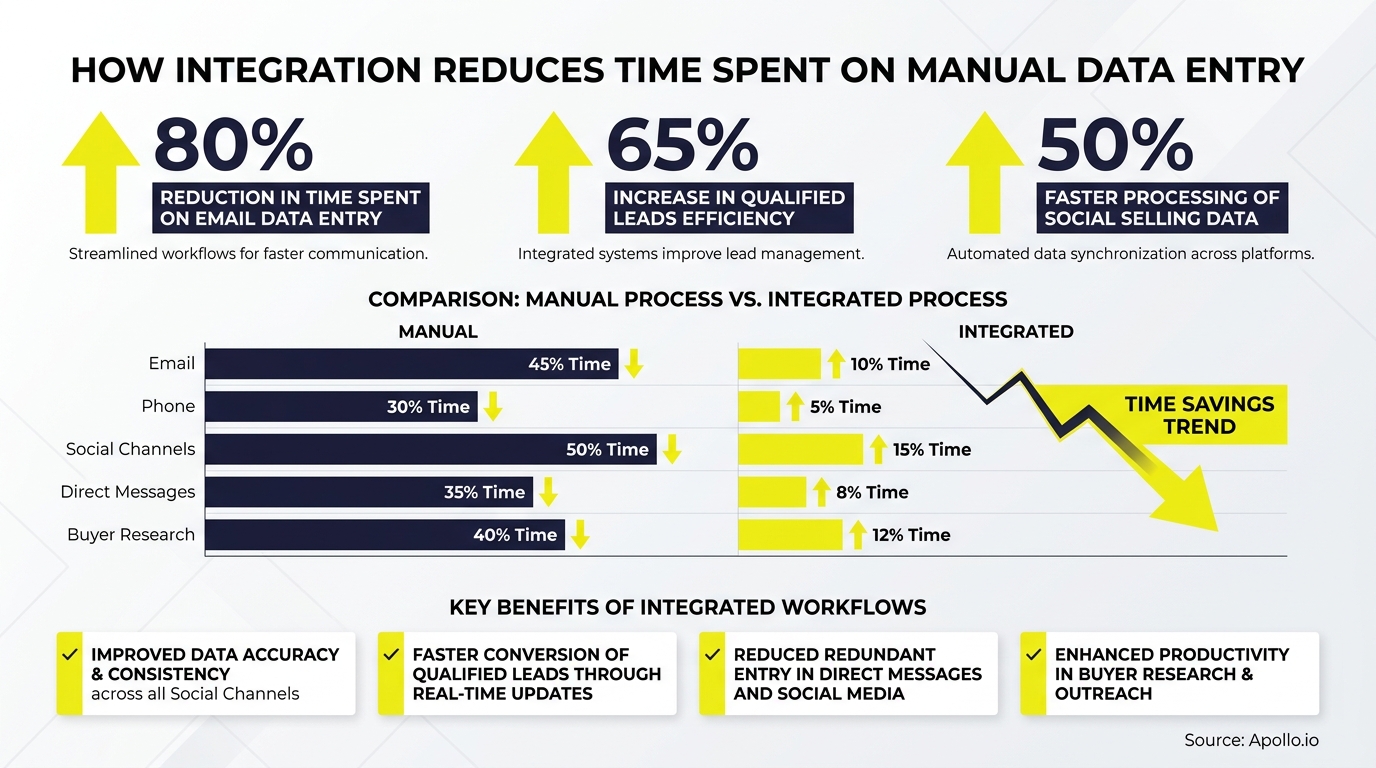
Integration reduces manual data entry by creating automated data flows between systems, so information entered once in one tool instantly appears in every connected platform. Instead of a rep logging a call in a dialer, then re-entering notes in CRM, then updating a sequence tool, an integrated stack handles all three updates from a single trigger.
The mechanics work through APIs, native connectors, or iPaaS middleware that sync records bidirectionally. When a contact's job title changes, an enrichment integration updates the CRM automatically.
When a meeting is booked, calendar integration logs the activity without manual input. When a deal moves stages, connected tools reflect the change in real time.
| Without Integration | With Integration |
|---|---|
| Rep logs call manually in CRM | Dialer syncs call outcome automatically |
| Contact data re-entered across tools | Enrichment pushes updates to all connected systems |
| Meeting notes copied from calendar to CRM | Calendar integration populates CRM activity log |
| Deal stage updated in three separate tools | Single pipeline update syncs everywhere |
| Lead routing done manually by RevOps | Workflow rules route and assign automatically |
Tired of your reps wasting time on manual CRM updates? Automate your entire outreach and data capture workflow with Apollo's multi-channel sales engagement platform.
How Do SDRs and RevOps Teams Benefit Most from Integration?
SDRs benefit from integration by eliminating the CRM logging that interrupts their prospecting rhythm, while RevOps teams gain clean, reconciled data without manual cleanup cycles. These two functions carry the highest volume of repetitive data tasks in any B2B GTM team.
For SDRs, integration means call dispositions, email opens, reply data, and sequence status all sync back to CRM without a single manual entry. Data from EverReady AI shows sales reps spend an average of 3.4 hours a week entering customer information into CRM systems. Integrated platforms eliminate most of that time entirely.
For RevOps leaders, integration closes the reconciliation loop. Instead of pulling exports from five tools and cross-referencing spreadsheets, connected systems maintain a single source of truth. This is the prerequisite for reliable forecasting, accurate attribution, and scalable lead routing. It is also the foundation that makes AI agents useful rather than error-prone: as the Salesforce 2026 State of Sales report notes, 51% of sales leaders with AI say tech silos delay or limit their AI initiatives.
Understanding how contact data enrichment drives ROI is critical for RevOps teams building the integrated data layer that modern GTM motions require.
Turn Funnel Gaps Into Pipeline Gold
Pipeline forecasting a guessing game because quality leads never convert? Apollo surfaces in-market buyers the moment they're ready — so your team stops chasing cold leads and starts closing. 600K+ companies trust Apollo to fill their funnel.
Start Free with Apollo →What Data Needs Integration to Eliminate Manual Entry?
The data categories that generate the most manual entry are contact and account records, activity logs, pipeline updates, and enrichment signals. Integrating these four categories covers the majority of repetitive entry work across a typical B2B sales team.
- Contact and account data: Job titles, emails, phone numbers, company firmographics. These decay constantly and require ongoing enrichment synced to CRM. Building a data enrichment strategy ensures this happens automatically.
- Activity data: Calls, emails, meetings, and sequence steps. Integration between engagement tools and CRM eliminates manual logging entirely.
- Pipeline and deal data: Stage changes, close dates, deal values. Connected deal management tools sync updates without requiring reps to log in to multiple systems.
- Intent and behavioral signals: Website visits, content engagement, buying signals. These should flow directly into CRM and trigger automated workflows rather than requiring manual review and entry.
Marketing teams face a similar burden. Research from Coupler.io found that over 36% of marketing team time goes toward data collection and preparation rather than analysis or strategy. Integrating marketing automation, CRM, and enrichment tools directly addresses that imbalance.

Is Integration Enough, or Do You Also Need Data Enrichment?
Integration alone is not enough: you also need data enrichment to ensure the records flowing between your systems are accurate and complete. Integration moves data; enrichment makes that data trustworthy.
A CRM sync between a dialer and your CRM transfers whatever data exists in each system. If a contact's email is outdated or a job title is stale, integration propagates that bad data automatically.
Enrichment adds a verification and update layer that keeps records current as contacts change roles, companies, or contact details. Together, integration plus enrichment eliminates both the manual entry problem and the data quality problem simultaneously.
Apollo addresses both in a unified platform. Apollo's CRM enrichment tool automatically updates contact and account records using 230M+ verified profiles, pushing clean data into connected CRM and engagement systems without manual intervention. As Cyera's team put it: "Having everything in one system was a game changer."
Struggling to keep CRM data clean and current? Enrich your CRM automatically with Apollo's verified B2B contact database.
How Does Apollo Consolidate Integration and Eliminate Manual Data Tasks?
Apollo eliminates manual data entry by unifying prospecting, enrichment, engagement, and CRM sync into a single GTM platform, removing the tool sprawl that creates duplicate entry in the first place. The Apollo integrations layer connects natively with Salesforce, HubSpot, and other CRMs so every prospecting action, sequence step, and contact update syncs automatically.
Rather than managing separate subscriptions for a data provider, an engagement tool, an enrichment service, and a dialer, Apollo consolidates all of these into one workspace. Predictable Revenue described the result directly: "We reduced the complexity of three tools into one." Census added: "We cut our costs in half."
Key integration capabilities Apollo provides for GTM teams:
- Automatic CRM sync: Contact, account, and activity data flows to Salesforce or HubSpot without manual logging
- Continuous enrichment:Job change alerts and enrichment keep records current as contacts move roles or companies
- Sequence activity capture: Email opens, replies, and call outcomes log automatically against the right CRM record
- Workflow automation: Triggers route leads, assign tasks, and update fields based on data changes, not manual review

Conclusion: Stop Paying the Manual Entry Tax
Manual data entry is a capacity problem disguised as an admin problem. Every hour a rep spends re-entering data is an hour not spent in front of buyers.
Integration solves this by connecting the systems where work happens so data moves automatically, records stay accurate, and teams focus on revenue rather than reconciliation.
The clearest path forward for B2B GTM teams is a unified platform that handles prospecting, enrichment, engagement, and CRM sync together, rather than stitching together tools that create the manual entry problem in the first place. Explore what data enrichment looks like when it is done right, and see how Apollo's integrated approach compares to managing a fragmented stack.
Ready to cut manual data entry and reclaim your team's selling time? Schedule a Demo and see how Apollo unifies your GTM data in one platform.
Prove Pipeline ROI With Apollo
ROI pressure killing your next budget approval? Apollo delivers measurable pipeline impact your leadership can't ignore. Leadium 3x'd annual revenue — see what Apollo does for your numbers.
Start Free with Apollo →Don't miss these
Sales
Inbound vs Outbound Marketing: Which Strategy Wins?
Sales
What Is a Sales Funnel? The Non-Linear Revenue Framework for 2026
Sales
What Is a Go-to-Market Strategy? The 2026 GTM Playbook
See Apollo in action
We'd love to show how Apollo can help you sell better.
By submitting this form, you will receive information, tips, and promotions from Apollo. To learn more, see our Privacy Statement.
4.7/5 based on 9,690 reviews
