
How Can Integration Improve the Accuracy of Sales Forecasts in 2026?
Most forecast misses are not a methodology problem. They are a data fragmentation problem. When your CRM, ERP, conversation intelligence, and finance systems operate in silos, every number flowing into your forecast carries hidden error. Understanding how sales analytics drives revenue growth starts with fixing the data layer underneath it. Integration is that fix.
Research from Kixie shows CRM systems can increase sales forecasting accuracy by 32% to 42% when properly connected, transforming forecasting from guesswork into a data-driven science. The question is not whether to integrate, but where to start and in what order.

Apollo Turns Hours of Research Into Seconds
Tired of your reps burning the day verifying contacts instead of closing deals? Apollo delivers 230M+ accurate business contacts so your team skips the research and gets straight to revenue. Start building pipeline today.
Start Free with Apollo →Key Takeaways
- Forecast errors trace directly to data defects: inconsistency, latency, missing fields, and silos — not just poor sales discipline.
- CRM-ERP integration is the highest-leverage starting point, giving teams real-time visibility into financial performance and pipeline provenance.
- AI forecasting only works reliably once the underlying data layer is consolidated and governed.
- RevOps leaders who follow an integration maturity sequence — from CRM history to hierarchy design — see compounding accuracy gains over time.
- Consolidating your sales tech stack reduces data fragmentation and gives forecasting models a single trusted source of truth.
Why Does Data Fragmentation Break Sales Forecasts?
Forecast variance traces to four specific data defects: inconsistency across platforms, inaccurate records, data latency, and silos that block cross-functional access. Each defect introduces a different type of error into your forecast inputs before any model or manager ever touches them.
Despite the benefits, research shows only 35% of sales professionals fully trust their CRM data's accuracy. That means most revenue teams are forecasting from a foundation they do not believe in. Salesforce's 2026 State of Sales report found that 51% of sales leaders using AI say tech silos delay or limit their AI initiatives — confirming that fragmentation is a structural blocker, not just an inconvenience.
- Data inconsistency: The same deal or contact has conflicting values across systems.
- Data latency: Pipeline updates take hours or days to propagate, making snapshots stale.
- Missing fields: Close dates, deal amounts, or stage criteria are incomplete in CRM records.
- Integration gaps: Finance, product usage, and customer-success signals never reach the forecast model.
Fixing forecasts means fixing these inputs. Model selection is secondary.
What Is the Integration Maturity Model for Sales Forecasting?
The integration maturity model is a five-level sequence that connects systems in a specific order so each layer validates and enriches the next, rather than adding noise on top of existing errors.
| Level | What to Connect | Forecast Benefit |
|---|---|---|
| 1. CRM History | Historical win/loss rates, stage durations, deal velocity | Establishes baseline conversion benchmarks |
| 2. Pipeline Provenance | Marketing attribution, SDR source data, lead origin | Identifies which pipeline segments close reliably |
| 3. Finance Bookings | CRM-ERP integration: invoices, payments, renewals | Aligns revenue recognition with pipeline movement |
| 4. Hierarchy and MDM | Geographic, product, and channel aggregation rules | Prevents double-counting and rollup errors |
| 5. Scenario Inputs | Intent signals, product usage, customer-success health scores | Adds leading indicators for expansion and churn risk |
According to Nix United, integrating CRM and ERP systems provides greater visibility into customer behavior, inventory trends, and financial performance, enabling accurate sales forecasting and strategic planning. Level 3 in the model above is where most RevOps teams unlock their first major accuracy improvement.
How Does CRM-ERP Integration Improve Forecast Accuracy Directly?
CRM-ERP integration improves forecast accuracy by closing the gap between what sales thinks will close and what finance actually books. Without this connection, pipeline figures in the CRM carry no financial validation — reps can mark deals as committed without any billing, contract, or delivery signal to confirm them.
As Inteltech notes, this integration allows for real-time data access, leading to faster, more informed decisions and improved sales forecast accuracy. For AEs managing complex enterprise deals with multi-year contracts or usage-based components, real-time finance visibility changes how they report expected revenue — and how managers can trust those reports.
Key outcomes from CRM-ERP integration:
- Closed deals in CRM automatically validated against finance bookings
- Renewal and expansion revenue surfaced inside pipeline views
- Inventory or capacity constraints flagged before deals are forecasted as winnable
- Revenue recognition aligned with sales-stage definitions
Struggling to track pipeline health across disconnected systems? Get complete pipeline visibility with Apollo's deal management tools.
How Do RevOps Leaders Use Integration to Reduce Forecast Variance?
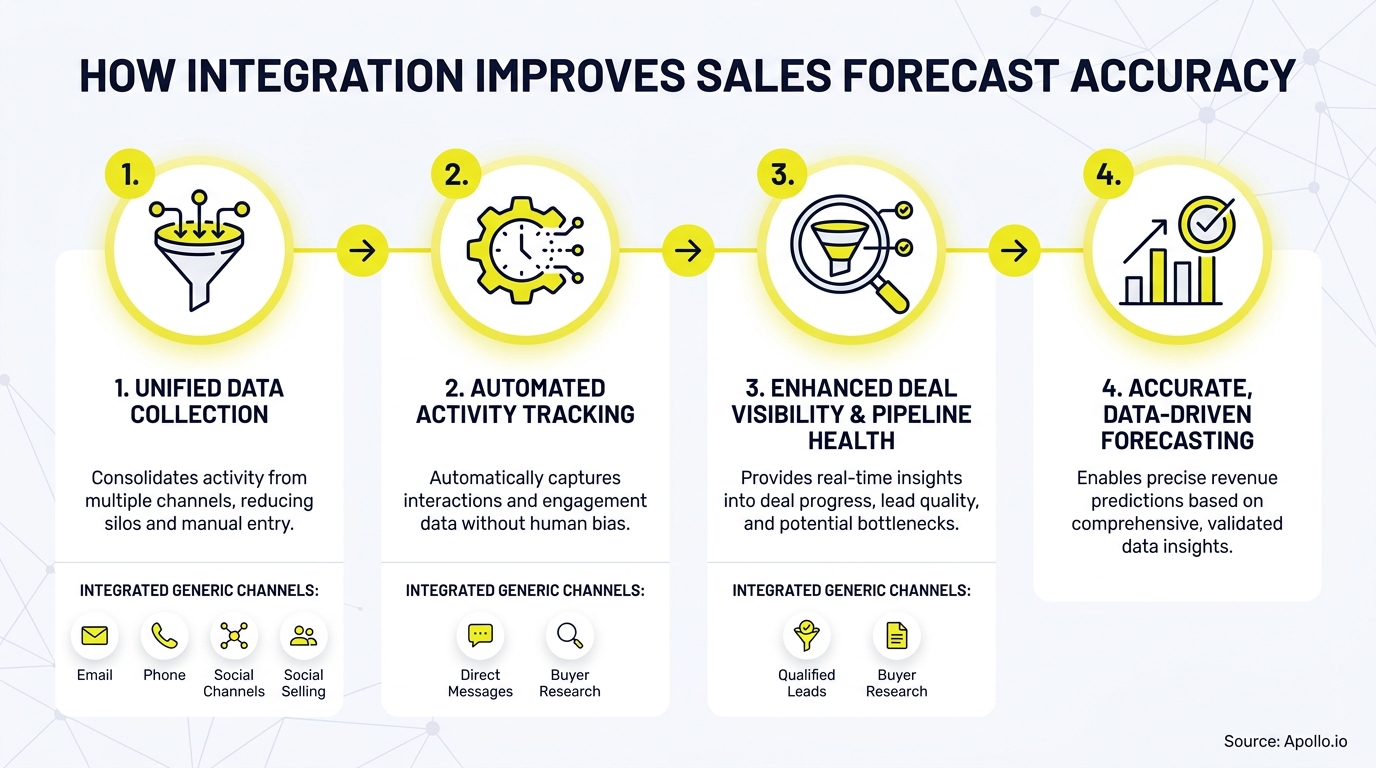
RevOps leaders use integration to create a single data layer that eliminates the manual reconciliation that introduces error at every handoff. When CRM, engagement, conversation intelligence, and finance data flow into one platform, forecast variance drops because inputs are consistent, timely, and complete.
This approach directly supports the broader goal of improving sales efficiency with RevOps. Practical steps RevOps teams take to reduce variance:
- Define pipeline provenance rules: Tag every deal with its source channel so historical close rates apply correctly by segment.
- Automate stage-update triggers: Connect conversation intelligence to CRM so deal stages update based on meeting outcomes, not rep memory.
- Set hierarchy and aggregation logic: Align geographic, product, and business-unit rollups to prevent double-counting in top-line forecasts.
- Govern field-completion standards: Require close date, amount, and next step before any deal enters a forecast-eligible stage.
A timely proof point: in April 2026, Clari and Salesloft announced integrations connecting pipeline movement, deal activity, call sentiment, and payment history in one workflow, so forecast risk directly triggers rep actions. This closed-loop model is where RevOps architecture is heading.
Building this kind of sales tech stack that scales revenue requires deliberate integration sequencing, not just adding more tools.

How Can AI Improve Forecast Accuracy Once Integration Is Complete?
AI improves forecast accuracy only after the underlying data is consolidated, governed, and trusted. Applied to fragmented data, AI produces faster wrong answers, not better predictions.
Research from ASRC Conference found that organizations implementing integrated predictive analytical systems achieved forecasting accuracy of 91.8%, compared to 72.6% among those using conventional forecasting systems. That 26.4% improvement reflects the combination of integration and AI working together, not AI alone.
Once your data layer is clean and connected, AI can layer in:
- Deal-risk scoring based on engagement patterns and sentiment signals
- Anomaly detection for deals that deviate from historical close patterns
- Scenario modeling across product, channel, and geography aggregations
- Automated deal-stage suggestions based on conversation and activity data
HubSpot's Spring 2026 Smart Deal Progression feature illustrates this: it combines meeting transcripts, CRM history, emails, and pipeline definitions to suggest close-date and stage updates automatically — turning conversation data into forecast inputs without manual entry.
Want your pipeline data working harder for your forecast? Build a cleaner, more predictable pipeline with Apollo.
Turn Funnel Guesswork Into Pipeline Wins
Pipeline forecasting a guessing game because quality leads dry up before they reach your AEs? Apollo surfaces in-market buyers the moment they're ready, so your funnel fills with opportunities that actually convert. Nearly 100K paying customers stopped guessing and started closing.
Schedule a Demo →Integration Checklist for Sales Forecast Accuracy
Use this checklist to audit your current integration state and identify the highest-priority gaps. Each item maps to a specific forecast error type.
| Integration Layer | Checklist Item | Error Type Addressed |
|---|---|---|
| CRM History | Historical win/loss data accessible in forecasting tool | Benchmark error |
| Pipeline Provenance | Deal source tagged and tracked from first touch | Segment mix error |
| CRM-ERP | Closed deals validated against finance bookings in real time | Recognition gap |
| Conversation Intelligence | Call outcomes trigger CRM stage updates automatically | Latency error |
| Hierarchy/MDM | Geographic and product rollup rules defined and enforced | Double-count error |
| Intent and CS Signals | Expansion, churn, and intent data feeding pipeline views | Blind-spot error |
This checklist connects directly to the sales transformation process RevOps leaders are driving across modern B2B organizations.
How Should Revenue Leaders Start Improving Forecast Accuracy Today?
Revenue leaders should start by auditing data quality in their CRM before adding any new integrations or AI tools. Connecting broken data to more systems scales the problem, not the solution.
The priority sequence is straightforward: clean and govern your CRM data first, integrate finance bookings second, add conversation and engagement signals third, then layer AI on top of a trusted foundation. This mirrors what the sales acceleration formula recommends — build reliable inputs before optimizing outputs.
For SDRs and AEs, the practical implication is simpler: keep CRM records current, complete required fields at every stage gate, and trust that the pipeline data you enter today is the forecast your leadership relies on next quarter. Data hygiene is not an admin task.
It is a revenue activity.

Conclusion: Integration Is the Foundation of Forecast Accuracy in 2026
Forecast accuracy does not improve by switching models or adding manager reviews. It improves when the data flowing into your forecast is consistent, timely, complete, and connected across systems.
The integration maturity model gives RevOps and revenue leaders a sequenced path: start with CRM history, connect finance, govern hierarchy, then apply AI.
Apollo's all-in-one GTM platform consolidates prospecting, engagement, conversation intelligence, and pipeline management into one workspace, reducing the data fragmentation that distorts forecasts. As Cyera put it: "Having everything in one system was a game changer." Ready to build a more accurate, integrated revenue engine? Start a Trial with Apollo today.
Prove Pipeline ROI Before Next QBR
ROI pressure killing your tool budget? Apollo delivers measurable pipeline impact your leadership can see — fast. Leadium 3x'd annual revenue. Get results you can defend in any budget review.
Schedule a Demo →Don't miss these
Sales
Inbound vs Outbound Marketing: Which Strategy Wins?
Sales
What Is a Sales Funnel? The Non-Linear Revenue Framework for 2026
Sales
What Is a Go-to-Market Strategy? The 2026 GTM Playbook
See Apollo in action
We'd love to show how Apollo can help you sell better.
By submitting this form, you will receive information, tips, and promotions from Apollo. To learn more, see our Privacy Statement.
4.7/5 based on 9,690 reviews
