
How Can Integrating with My CRM Improve Data Consistency in 2026?
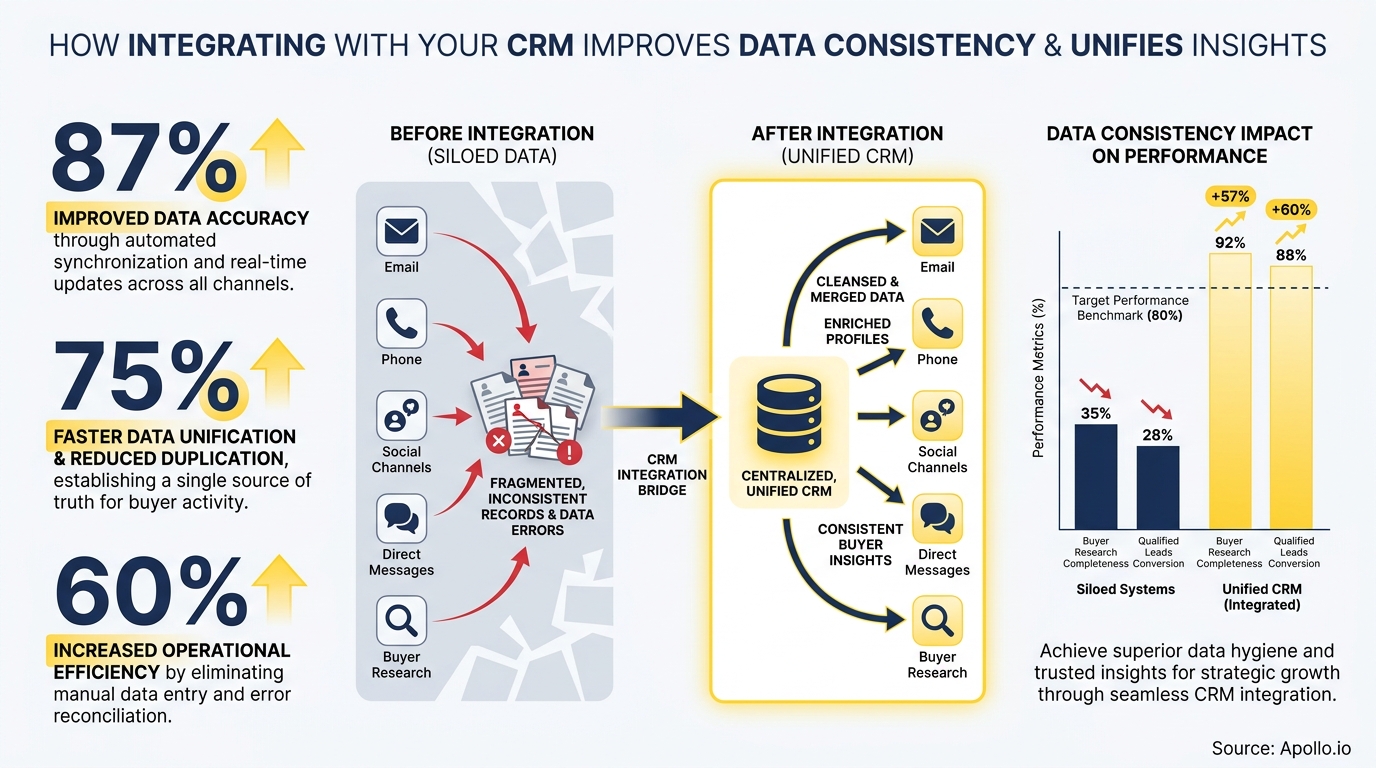
CRM integration improves data consistency by creating a single source of truth: every connected tool writes to the same records, applies the same field rules, and eliminates the manual re-entry that produces duplicates, stale contacts, and mismatched formats. If your sales, marketing, and RevOps teams are working from different versions of the same account, you don't have a workflow problem — you have a data architecture problem. A clear CRM integration strategy is the fastest way to fix it.
The stakes are higher than most teams realize. A 2025 Validity report found that organizations lose an average of 16 sales deals per quarter due to poor-quality CRM data, and workers spend 13 hours per week searching for basic CRM information.
Integration closes that gap by enforcing consistency at every entry point.

Scale Smarter With Apollo's AI Engine
Tired of slow lead research eating your selling time? Apollo automates prospecting across 230M+ verified contacts so your team spends time closing, not searching. Start building scalable pipeline today.
Start Free with Apollo →Key Takeaways
- CRM integration creates a single source of truth, so every team works from the same verified contact and account data.
- Most data inconsistency enters through manual entry and disconnected tools — integration enforces field mapping and normalization rules that prevent it at the source.
- Poor CRM data directly costs revenue: lost deals, wasted rep hours, and broken marketing-to-sales handoffs are all measurable outcomes.
- RevOps and sales leaders who add data governance (stewards, deduplication rules, QA metrics) on top of integration see lasting consistency gains.
- Clean, integrated CRM data is now an AI-readiness requirement — AI agents, lead scoring, and forecasting tools fail on inconsistent records.
What Does "Data Consistency" Actually Mean in a CRM?
CRM data consistency means every record is accurate, complete, formatted the same way, deduplicated, and up to date across all connected systems. It is not just about avoiding typos.
It covers five dimensions:
| Dimension | What It Means | Common Failure Point |
|---|---|---|
| Accuracy | Field values reflect reality | Outdated job titles, wrong phone numbers |
| Completeness | Required fields are populated | Missing industry, revenue, or lead source |
| Standardization | Formats match across records | "VP Sales" vs. "Vice President of Sales" |
| Deduplication | One record per contact or account | Same contact entered from three tools |
| Freshness | Records reflect current state | Contacts who changed companies 18 months ago |
According to SyncMatters, an integrated CRM creates a "single source of truth" for customer information, centralizing data and ensuring all teams access accurate, up-to-date records. Without integration, each tool maintains its own version — and they drift apart fast.
How Does Integration Mechanically Improve Data Consistency?
Integration improves consistency by enforcing field mapping, normalization, and master data rules at the point of sync rather than relying on humans to enter data correctly. Here is where inconsistency enters and how integration addresses each entry point:
- Manual entry: Reps type the same contact differently in different tools. Integration replaces manual entry with automated sync using predefined field maps.
- Marketing-to-sales handoffs: Lead source, campaign attribution, and consent fields get dropped or mismatched. Bidirectional CRM sync propagates these fields automatically.
- Enrichment gaps: Contacts enter with only an email address. Automated data enrichment fills missing firmographic and contact fields on write.
- Multi-tool duplication: A contact exists in your email tool, your dialer, and your CRM as three separate records. Integration with deduplication rules merges on a shared identifier (email or domain).
Data from MarketingBrainbox shows that real-time data integration across CRM, ERP, and other platforms is becoming standard practice, ensuring data is current and actionable across GTM systems. This shift reflects a broader move from periodic batch syncs to continuous, event-driven data flows.
Tired of contacts entering your CRM with missing fields and wrong formats? Apollo's data enrichment fills gaps automatically across 230M+ verified business contacts.
What Is the Revenue Impact of CRM Data Inconsistency?
CRM data inconsistency directly reduces revenue through lost deals, wasted rep time, and broken pipeline visibility. The Validity 2025 CRM data report found that 37% of organizations lose revenue due to poor data quality, and 1 in 4 experience a 20% or greater annual revenue drop tied to it.
For B2B GTM teams, the pipeline effects are concrete:
- SDRs waste prospecting time calling contacts who changed roles or companies, reducing connect rates and booked meetings.
- AEs enter discovery calls without a complete account history because activity from marketing automation never synced to the CRM opportunity record.
- RevOps leaders cannot trust pipeline forecasts when deal stages, close dates, and amounts are entered inconsistently across reps.
- Marketing teams attribute revenue to the wrong campaigns because lead source fields are blank or non-standardized.
Research from SLT Creative shows CRM systems improve sales forecasting accuracy by 42% — but that gain depends on consistent data going in. Inconsistent records erase the benefit.
See how data sync improves B2B sales and marketing ROI when every tool shares the same verified records.
Turn Funnel Guesswork Into Pipeline Wins
Tired of watching marketing leads stall before they ever reach your pipeline? Apollo surfaces high-intent prospects and arms your team with the signals to act first. 600K+ companies stopped guessing and started closing.
Start Free with Apollo →How Do RevOps Teams Build a Data Governance Layer That Makes Consistency Stick?
RevOps teams make data consistency stick by combining integration with a governance layer: defined field standards, assigned data stewards, deduplication rules, and regular QA metrics. Integration alone prevents new inconsistency from entering; governance fixes what is already broken and maintains quality over time.
Governance checklist for RevOps leaders:
- Field standards document: Define every required field, its format, and acceptable values (picklists, not free text where possible).
- Deduplication rules: Set a primary merge key (email for contacts, domain for accounts) and automate merge logic on import and sync.
- Data steward assignment: Name one owner per data domain (contacts, accounts, deals) who approves exception handling and schema changes.
- Enrichment cadence: Schedule automated re-enrichment for records older than 90 days. Use a structured data enrichment strategy to keep firmographics current.
- QA metrics: Track completeness rate, duplicate rate, and field accuracy score in a monthly RevOps dashboard.
- Exception workflow: Define who flags, who fixes, and the SLA for resolving records that fail validation rules.
Teams that pair integration with governance see compounding returns. Contact data enrichment fills gaps at the source, while governance rules prevent them from reappearing.

Why Is Integrated CRM Data Now an AI-Readiness Requirement?
Integrated CRM data is an AI-readiness requirement because AI agents, lead scoring models, and forecasting tools fail when records are duplicated, incomplete, or inconsistently formatted. In November 2025, Salesforce completed its acquisition of Informatica specifically to bring data quality and master data management into the CRM layer — a signal that data consistency is now the foundation for AI outputs, not a separate initiative.
Salesforce's 2026 State of Sales report found that 46% of sales professionals using AI agents say data-quality issues hurt their sales results. AI amplifies whatever is in your CRM: clean data produces better recommendations; inconsistent data produces worse ones at scale.
For B2B GTM teams, the AI-readiness checklist maps directly to data consistency:
- Deduplicated records so AI models train on unique entities, not duplicates.
- Standardized field values so classification and segmentation logic runs correctly.
- Complete firmographic data so ICP scoring and routing rules fire accurately.
- Real-time sync so AI next-best-action recommendations use current engagement signals, not stale activity data.
Explore how Apollo's CRM integration connects Salesforce and HubSpot to keep contact and account data enriched and in sync automatically.
How Does Apollo Help B2B Teams Maintain CRM Data Consistency?
Apollo improves CRM data consistency by combining a 230M+ contact database, automated enrichment, and native CRM integrations into one unified platform — reducing the number of disconnected tools that create inconsistency in the first place. As Cyera noted, "Having everything in one system was a game changer."
Key capabilities for data consistency:
- Bi-directional CRM sync: Apollo pushes enriched contact and account data to Salesforce and HubSpot in real time, keeping records current without manual updates. Connect HubSpot, Salesforce, and Apollo fast.
- Automated enrichment on import: When a new contact enters Apollo or your CRM, Apollo's enrichment engine fills missing fields automatically using verified business data.
- Deduplication on sync: Apollo matches on email and domain to prevent duplicate records from entering your CRM from prospecting activity.
- 65+ data attributes: Firmographics, technographics, and contact details populate fields your reps would otherwise leave blank.
Struggling to keep your CRM clean across your whole GTM stack? Apollo's enrichment tool keeps your CRM accurate, complete, and AI-ready automatically.

Start Building a Consistent CRM Data Foundation Today
CRM integration improves data consistency by eliminating manual entry errors, enforcing field mapping and normalization rules, and keeping every connected tool in sync. Governance layers — field standards, deduplication rules, data stewards, and QA metrics — make those gains permanent.
And in 2026, consistent CRM data is not just an operational improvement: it is the prerequisite for AI tools that actually work.
Apollo consolidates prospecting, enrichment, engagement, and CRM sync into one platform so your team works from clean, consistent data without maintaining a fragmented tool stack. As Census put it, "We cut our costs in half" by moving to a unified platform.
Ready to make your CRM the single source of truth your GTM team can trust? Get Leads Now and see how Apollo keeps your data consistent from first touch to closed deal.
Prove Pipeline ROI Before Q Ends
ROI pressure killing your next tool renewal? Apollo delivers measurable pipeline impact fast — with real results like +50% YoY growth and +10% win rates. Start your free trial and show the numbers today.
Start Free with Apollo →Don't miss these
Sales
Inbound vs Outbound Marketing: Which Strategy Wins?
Sales
What Is a Sales Funnel? The Non-Linear Revenue Framework for 2026
Sales
What Is a Go-to-Market Strategy? The 2026 GTM Playbook
See Apollo in action
We'd love to show how Apollo can help you sell better.
By submitting this form, you will receive information, tips, and promotions from Apollo. To learn more, see our Privacy Statement.
4.7/5 based on 9,690 reviews
