
How Can You Verify the Accuracy of Contact Information from a Sales Database in 2026?
Bad contact data is a silent revenue killer. According to Landbase, poor data quality costs U.S. businesses an estimated $3.1 trillion annually, with individual organizations losing between $12.9 million and $15 million per year from wasted spend and missed pipeline. Before you build sequences, run campaigns, or invest in a sales tech stack, you need to know your contact data is accurate and current.
In 2026, verification is no longer a one-time list cleanup. Google, Yahoo, and Microsoft have tightened bulk-sender enforcement, meaning bounces and complaints now threaten domain reputation directly.
This guide gives you a practical, field-by-field framework to verify contact accuracy and keep it that way.

Apollo Turns Hours of Research Into Minutes
Tired of your reps burning their day verifying contact info instead of selling? Apollo delivers 230M+ business contacts with 97% email accuracy so your team hits the phones faster. Start building real pipeline today.
Start Free with Apollo →Key Takeaways
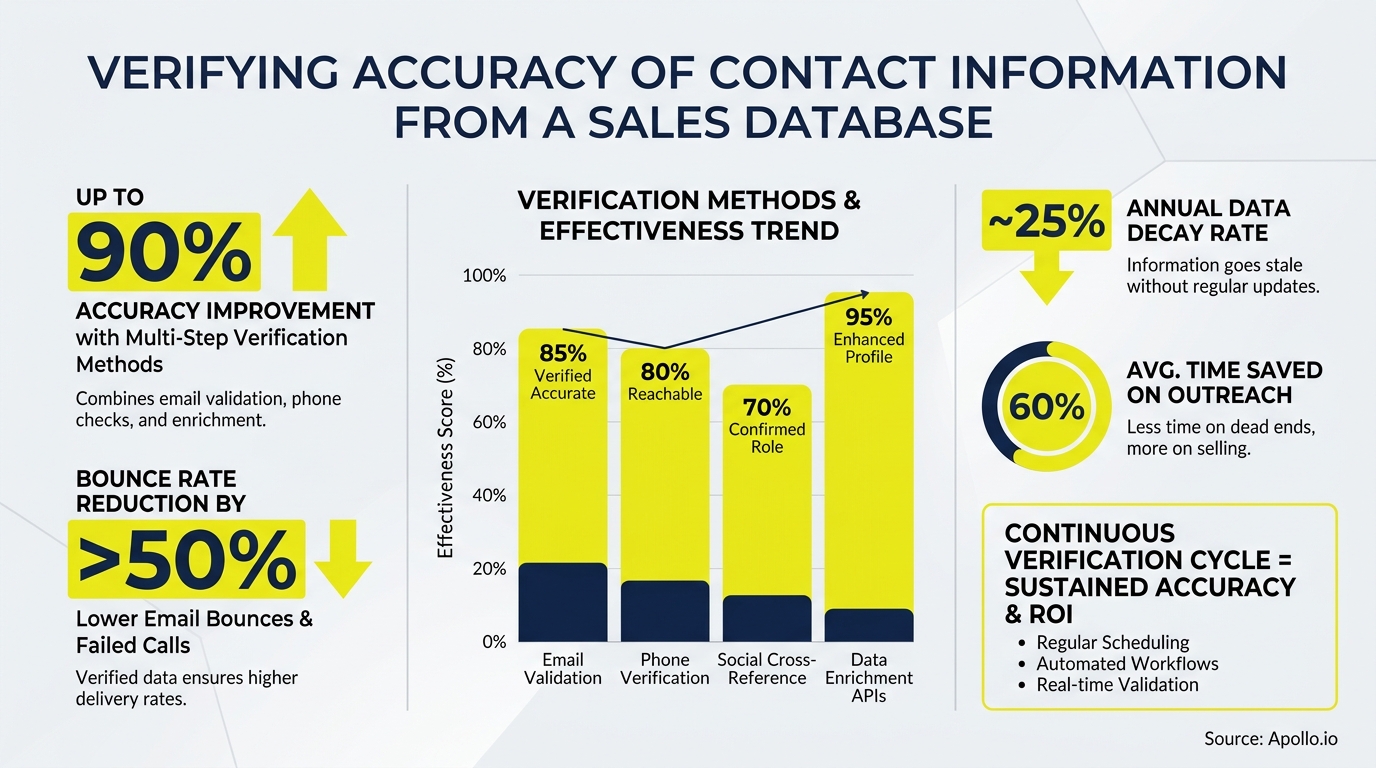
- Contact data decays faster than most teams realize: up to 30% of email addresses go stale annually, driven by job changes and company restructuring.
- Verification must cover four attributes: email, phone, job/role, and company, not just email syntax.
- Cadence matters as much as method: tech-sector contacts require more frequent re-verification than other segments due to shorter average tenure.
- RevOps teams should build a governance model with SLAs, freshness thresholds, and automated refresh triggers, not just periodic scrubs.
- Apollo consolidates contact verification, enrichment, and outreach into one platform, eliminating the need for multiple disconnected tools.
Why Does Contact Data Decay So Fast?
Contact data decays because people change jobs, companies restructure, and email systems migrate, all faster than most databases refresh. Research from Landbase shows email decay accelerated to 3.6% monthly as of late 2024, meaning nearly three-quarters of a prospect database can become outdated within 12 months. Separately, research on B2B database decay notes the average employee tenure in tech is approximately 2.5 years, meaning roughly 40% of tech contacts may change roles annually.
For SDRs and BDRs, this translates directly to wasted dials, bounced emails, and missed quota. For RevOps leaders, it means CRM data that actively misleads scoring and routing models.
A static database is not a neutral asset: it is a liability that grows over time without active verification.
What Is a Multi-Attribute Contact Verification Framework?
A multi-attribute contact verification framework validates four distinct data fields per contact record: email address, phone number, job title and role, and company association. Verifying only email misses the other three vectors of decay.
Here is how each field should be handled:
| Attribute | Verification Method | Key Signal of Decay |
|---|---|---|
| Syntax check, domain MX lookup, SMTP mailbox ping | Hard bounce, catch-all flag, domain deactivated | |
| Phone | Line-type lookup, carrier validation, real-time dial test | Disconnected, reassigned, or VoIP mismatch |
| Job Title / Role | Signal-based refresh (promotion alerts, news mentions, company signals) | Title mismatch, departed employee, org restructure |
| Company | Domain activity check, firmographic enrichment, acquisition signals | Acquisition, rebrand, domain redirect |
Platforms like Apollo use multi-step automated verification combined with signal-based refresh, flagging records when job-change or company-change signals are detected. This is far more reliable than batch-only annual scrubs. For a deeper look at email-specific verification methods, including SMTP checks and catch-all handling, that guide covers the full process.
Tired of contacts that bounce before you even hit send? Start free with Apollo's 230M+ verified business contacts and see verified accuracy rates before you export.
How Should RevOps Teams Set a Verification Cadence?
RevOps teams should set verification cadence based on segment tenure patterns, not arbitrary quarterly schedules. Because tech-sector contacts turn over roughly every 2.5 years, a quarterly re-verification cycle for tech ICPs is appropriate.
For more stable industries like manufacturing or government, semi-annual cycles may suffice.
A practical cadence framework by segment:
- High-velocity segments (tech, SaaS, startups): Re-verify every 60 to 90 days. Trigger immediate re-verification on job-change signal, hard bounce, or 90-day inactivity.
- Mid-velocity segments (financial services, healthcare): Re-verify every 120 to 180 days. Trigger on role-change news or company acquisition signal.
- Low-velocity segments (government, manufacturing): Re-verify every 180 to 270 days. Trigger on domain redirect or bounce event.
RevOps leaders should also establish a freshness SLA: a policy that blocks outreach sequences for any contact whose verification age exceeds a defined threshold (for example, 90 days for email in a high-velocity ICP segment). This connects data governance directly to pipeline execution. For teams building out this function, improving sales efficiency with RevOps covers how data quality connects to broader operational performance.
Turn Funnel Guesswork Into Pipeline Wins
Quota pressure mounting while leads stall between marketing and sales? Apollo surfaces high-intent prospects and keeps your pipeline moving with real-time signals. 600K+ companies stopped forecasting blind.
Start Free with Apollo →How Do SDRs and AEs Spot Bad Data Before It Wastes Their Time?
SDRs and AEs can catch bad data early by watching for four warning signals in their outreach workflows. Proactive identification prevents wasted effort and protects sender reputation before bulk-sender policies penalize the team.
- Immediate hard bounce: Remove from sequence and flag for re-enrichment. Do not retry without a verified replacement address.
- Catch-all domain flag: Treat as unverified. Use phone or direct outreach until a confirmed address is available.
- Title mismatch on reply: If a prospect replies with a corrected title or says they left the role, update the record immediately and re-route to the correct contact.
- Phone disconnect on first dial: Trigger a phone re-verification workflow rather than leaving a voicemail to an inactive number.
According to Leads at Scale, sales representatives waste approximately 27% of their time on bad data, amounting to around 500 hours per rep annually. For an SDR team of five, that is a full-time headcount equivalent lost to avoidable data problems. Sales analytics dashboards that surface bounce rate, connect rate, and data coverage by segment make this waste visible and actionable.

What Governance Model Should B2B Teams Use for Contact Verification?
A contact verification governance model defines who owns data quality, what thresholds trigger action, and how exceptions are logged and resolved. Without governance, verification becomes reactive and inconsistent across teams.
Core governance components:
- Data owner: RevOps or Sales Ops owns the verification policy and SLA definitions.
- Coverage target: Define a minimum verified-contact percentage per ICP segment (for example, 85% of active pipeline contacts must have a verified email within 90 days).
- Exception handling: Any record failing verification gets flagged in CRM with a status tag (Unverified, Stale, Bounced) and routed for enrichment before re-engagement.
- Audit trail: Log verification method, date, and source for every record. This supports both operational decisions and compliance review.
- Source provenance: Document where each contact originated. In 2026, with increased enforcement scrutiny around browser-extension-sourced data, knowing your data provenance is both a compliance and operational requirement.
Platforms that surface verification labels, confidence scores, and refresh timestamps per record give RevOps the audit trail needed to enforce these policies at scale. Apollo's contact enrichment tools keep records current automatically, reducing the manual governance burden on RevOps teams.
What Key Metrics Should You Track for Contact Data Quality?
Measuring contact data quality requires tracking metrics that connect directly to pipeline outcomes, not just raw record counts. The right KPIs make the business case for ongoing verification investment visible to leadership.
| Metric | Definition | Target Threshold |
|---|---|---|
| Email Bounce Rate | Hard bounces as % of emails sent | Below 2% per campaign |
| Verified Coverage Rate | % of active contacts with verified email within SLA window | Above 85% for active pipeline |
| Connect Rate (Phone) | Live connects as % of total dials | Track trend; flag drops as data signal |
| Stale Record Rate | % of records exceeding freshness SLA | Below 10% of active ICP segments |
| Re-verification Cycle Time | Average days to re-verify a flagged record | Under 5 business days |
These metrics feed directly into sales transformation initiatives where RevOps leaders need to show how data quality improvements translate to pipeline velocity and rep productivity gains.
How Does Apollo Help You Verify and Maintain Contact Accuracy?
Apollo is an all-in-one GTM platform that consolidates contact verification, enrichment, prospecting, and outreach into a single workspace. Instead of running a separate email verification tool, a data enrichment service, and an outreach platform, teams using Apollo work from one unified system where verification is built into the data layer.
Apollo's approach to contact accuracy includes:
- 97% email accuracy backed by multi-step automated verification across 230M+ business contacts and 30M+ companies.
- Signal-based record refresh that updates contacts when job-change or company-change signals are detected, keeping records current between manual re-verification cycles.
- Waterfall enrichment that sequences multiple data sources to maximize match rates for hard-to-find contacts.
- Verification labels and confidence indicators surfaced at the record level, giving SDRs and RevOps the transparency to act on data quality signals in real time.
Trusted by nearly 100,000 paying customers including Anthropic, Smartling, and Redis, Apollo gives teams the data foundation and the execution layer in one place. As Cyera noted, "Having everything in one system was a game changer." For teams currently running separate tools for data, verification, and engagement, the consolidation alone removes significant operational overhead. Learn more about how sales automation integrates with verified data to run more effective outreach at scale.

Start Verifying Smarter in 2026
Verifying the accuracy of contact information from a sales database requires a structured, ongoing approach: multi-attribute checks across email, phone, role, and company, combined with segment-specific cadences and a governance model that keeps verification connected to pipeline execution. One-time list scrubs no longer meet the standard that bulk-sender enforcement and AI-powered sales motions demand.
Apollo gives B2B GTM teams a single platform to prospect on verified data, enrich and re-verify records automatically, and execute outreach without switching tools. The result is less time wasted on bad data and more time on pipeline that converts. Start a free trial of Apollo and see how verified contact data changes the quality of every sequence you run.
Prove Pipeline ROI With Apollo
ROI pressure killing your next tool renewal? Apollo delivers measurable pipeline impact from day one — so your numbers speak for themselves. Leadium 3x'd revenue. You're next.
Start Free with Apollo →Don't miss these
Sales
Inbound vs Outbound Marketing: Which Strategy Wins?
Sales
What Is a Sales Funnel? The Non-Linear Revenue Framework for 2026
Sales
What Is a Go-to-Market Strategy? The 2026 GTM Playbook
See Apollo in action
We'd love to show how Apollo can help you sell better.
By submitting this form, you will receive information, tips, and promotions from Apollo. To learn more, see our Privacy Statement.
4.7/5 based on 9,690 reviews
