
How to Justify the Cost of Prospecting Software to Your Manager in 2026
Your manager wants a business case, not a feature list. The good news: prospecting software is one of the easiest tools to justify because the ROI connects directly to pipeline, quota attainment, and rep capacity. You just need the right numbers and framing. This guide gives you a ready-to-use argument, built around data your finance team will actually respect. If you're already exploring how sales automation software drives revenue, this is the next step.

Research Less, Close More With Apollo
Tired of your reps burning hours hunting down contact info that bounces? Apollo delivers 97% email accuracy across 230M+ verified contacts. Stop losing selling time to manual research.
Start Free with Apollo →Key Takeaways
- Prospecting software pays for itself by converting wasted admin time into customer-facing selling hours.
- Data quality is a revenue risk: bad contact data costs teams real pipeline, not just efficiency.
- The strongest justification connects tool features directly to quota attainment, not just activity volume.
- A 30-day pilot with defined KPIs is the fastest way to overcome manager skepticism.
- Consolidating your tech stack with an all-in-one platform reduces both cost and operational complexity.
What Is the Real Cost of Not Having Prospecting Software?
The cost of inaction is the most persuasive argument you can make. HubSpot's 2024 Sales Trends Report found that sellers spend just 33% of their time actively selling, meaning two-thirds of a rep's paid hours go toward non-revenue tasks like manual research, list building, and data entry.
Put that in financial terms for your manager: if a rep costs $80,000/year fully loaded, roughly $54,000 of that salary is spent on work that doesn't directly generate revenue. Prospecting software attacks that number directly by automating list building, enriching contact data, and triggering outreach sequences automatically.
According to Insight Mark Research, AI tools save sales representatives 11 to 12 hours per week by automating repetitive tasks. That's nearly a third of a standard work week returned to selling.
How Do SDRs and AEs Build the ROI Case for Their Manager?
The most effective approach is to translate time savings into pipeline dollars using your team's own numbers. Use this simple framework:
| Input | Example Value | Your Team's Value |
|---|---|---|
| Fully loaded rep cost (annual) | $80,000 | $______ |
| Hours/week saved by automation | 10 hours | $______ |
| % of saved time converted to selling | 50% | $______ |
| Average deal value | $15,000 | $______ |
| Current meetings booked per week/rep | 4 | $______ |
SDRs building this case should focus on meetings booked per hour of prospecting effort. AEs should focus on how faster, more accurate data shortens discovery cycles and improves close rates. Salesgenie reports that automation and AI can free up about 20% of a sales team's capacity, which translates directly into more pipeline without adding headcount.
Struggling to show your manager what modern prospecting looks like in practice? Search Apollo's 230M+ contacts with 65+ filters and build a sample target list before your next meeting.

Why Does Data Quality Matter to Your Finance Team?
Poor data quality is a revenue risk, not just an operational inconvenience. When reps work from stale or inaccurate contact lists, they waste dials, bounce emails, and miss the right buyers entirely.
This erodes pipeline quality at the source.
For RevOps leaders making this case, the argument is straightforward: every bounced email and wrong-number call represents paid rep time with zero return. Prospecting platforms with built-in data enrichment and verified contact information eliminate this waste systematically.
Apollo maintains 97% email accuracy across its 230M+ contact database, which means fewer bounces, better sender reputation, and more messages reaching real decision-makers. For teams using intent data and enrichment together, the quality improvement compounds across every outreach touchpoint.
Turn Funnel Guesswork Into Real Pipeline
Pipeline forecasting a guessing game because your leads never convert? Apollo surfaces high-intent prospects so every rep works deals that actually close. Nearly 100K paying customers stopped guessing and started growing.
Start Free with Apollo →How Does Prospecting Software Connect to Quota Attainment?
The strongest justification links tool features to quota outcomes, not just activity metrics. Here's the direct feature-to-outcome map to present to your manager:
| Feature | Time Saved | Quota Impact |
|---|---|---|
| Automated list building | Hours/week on manual research | More time on outreach and follow-up |
| Contact enrichment | Eliminates bad-data dead ends | Higher connect rates, more qualified conversations |
| Intent signals | Removes cold guesswork | Reps prioritize in-market buyers first |
| Sequenced multi-channel outreach | Reduces manual follow-up scheduling | Consistent touchpoints without rep effort |
| Lead scoring | Cuts time spent on low-fit accounts | Focus shifts to highest-probability deals |
Research from Kixie shows companies leveraging AI in sales report a 10-20% increase in ROI, demonstrating that streamlined processes directly impact revenue and growth. Pair this with your team's current quota attainment rate and the case becomes concrete. See how the sales acceleration formula connects tool investment to revenue outcomes.
What Does a 30-Day Pilot Plan Look Like?
A time-boxed pilot removes the risk objection entirely. Propose this structure to your manager instead of asking for a full annual commitment upfront.
- Week 1: Define baseline metrics (meetings booked/week, emails sent, reply rate, pipeline created)
- Week 2-3: Run sequences using the new tool with a subset of the team (2-3 reps)
- Week 4: Compare pilot metrics to baseline; calculate per-rep pipeline delta
- Success criteria: Measurable improvement in meetings booked or pipeline generated vs. the control group
- Decision gate: Full rollout only if pilot KPIs are met
This approach works especially well for RevOps leaders and sales managers who need to show governance and accountability before committing budget. It also gives Finance a defined evaluation window rather than an open-ended spend. Explore how teams approach sales efficiency improvements through RevOps to strengthen your pilot framework.
How Can Tool Consolidation Strengthen the Business Case?
One of the strongest budget arguments in 2026 is eliminating redundant tools. If your team currently pays for separate data, sequencing, and enrichment subscriptions, an all-in-one platform replaces those line items with a single contract.
Apollo customers have seen this consolidation benefit directly. Collin Stewart at Predictable Revenue noted, "We reduced the complexity of three tools into one," and the Census team reported "We cut our costs in half" after consolidating their stack. Read the full Predictable Revenue case study for a detailed cost comparison your manager can review.
When presenting to Finance, list every current tool in your prospecting stack, their annual costs, and which Apollo capabilities replace them. This turns the conversation from "new spend" to "smarter spend."
Spending hours managing multiple outreach tools manually? Consolidate your stack and automate sequences with Apollo's multi-channel engagement platform.
How Do You Present the Justification to Your Manager?
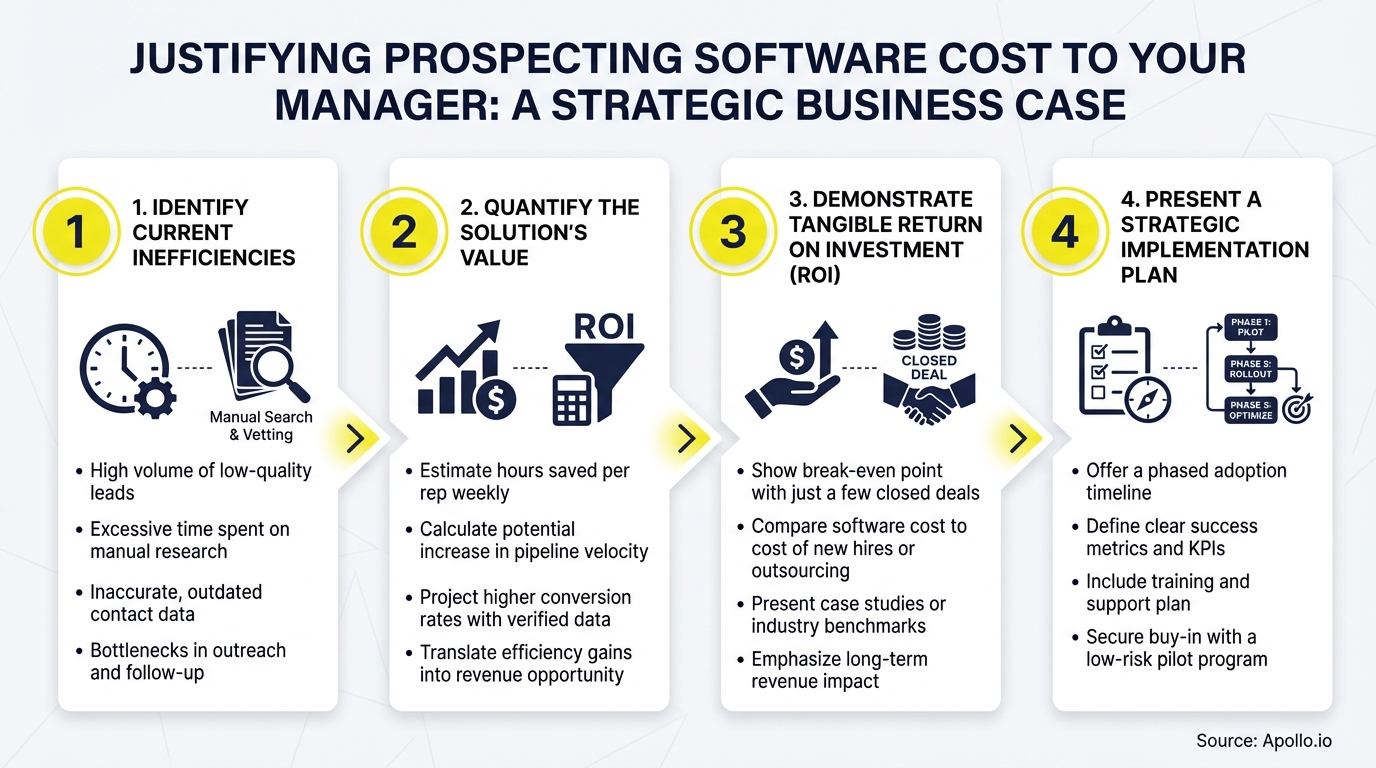
Structure your business case in three layers that match how different stakeholders evaluate software purchases: operational impact for your manager, financial ROI for Finance, and risk reduction for RevOps or IT.
- For your direct manager: Show the time-to-pipeline calculation using your team's current metrics. Connect hours saved to meetings booked.
- For Finance: Present the tool consolidation savings and the 30-day pilot plan with defined KPIs and a clear exit if targets aren't met.
- For RevOps or IT: Highlight data quality improvements, CRM integration, and governance features that reduce manual data hygiene work.
Support your case with external benchmarks. A study from Martal found that AI-powered prospecting tools can reduce research time by 50%, a number that translates directly into rep capacity gains when applied to your headcount costs. For a deeper look at how to structure your prospecting tool evaluation, review what top-performing teams prioritize.

Build Your Business Case and Get Started
Justifying prospecting software comes down to one thing: connecting the tool's capabilities to your team's specific revenue gaps. Time wasted on manual research, bad data eroding pipeline, and missed quota from low-priority outreach are all quantifiable problems with quantifiable solutions.
The strongest cases combine a time-to-pipeline ROI calculation, a tech stack consolidation analysis, and a risk-limited 30-day pilot. Present all three and you give your manager a reason to say yes and a safety net if they're hesitant.
Apollo gives B2B GTM teams, from SDRs to RevOps leaders, a unified platform for prospecting, enrichment, sequencing, and pipeline management. Nearly 100,000 paying companies use Apollo to cut their tech stack and generate more pipeline with less overhead.
Get Leads Now and build the data your manager needs to say yes.
Ramp Reps Faster, Scale Revenue With Apollo
ROI pressure mounting while new reps take months to hit quota? Apollo gives every rep a proven playbook from day one. Teams like Leadium tripled revenue by turning slow ramp into instant productivity.
Start Free with Apollo →Don't miss these
Sales
Inbound vs Outbound Marketing: Which Strategy Wins?
Sales
What Is a Sales Funnel? The Non-Linear Revenue Framework for 2026
Sales
What Is a Go-to-Market Strategy? The 2026 GTM Playbook
See Apollo in action
We'd love to show how Apollo can help you sell better.
By submitting this form, you will receive information, tips, and promotions from Apollo. To learn more, see our Privacy Statement.
4.7/5 based on 9,690 reviews
