
How Can I Find Prospects Who Are Actually Interested in 2026?
Most outbound pipelines leak at the same point: reps chase volume, not signal. The hard truth is that the vast majority of your target market isn't actively buying right now. Your job isn't to find the needle in a haystack by cold-calling every name on a list. It's to build a system that surfaces accounts showing real buying behavior before your competitors notice. If you're serious about finding better buyer leads, signal-driven prospecting is where you start.

Research Less, Close More With Apollo
Tired of your reps burning hours on manual lead research instead of selling? Apollo surfaces verified contacts instantly so your team spends time closing, not digging. Join 600K+ companies building pipeline faster.
Start Free with Apollo →Key Takeaways
- Most B2B buyers are not actively purchasing at any given moment, so interest signals matter more than contact volume.
- Interested prospects self-discover content, so being findable and credible is a core prospecting strategy.
- Buying decisions involve multiple stakeholders, meaning account-level signals beat individual-level MQL scoring.
- Speed-to-contact when intent spikes is a major differentiator, especially with AI-powered workflow automation.
- Lead qualification quality directly impacts revenue: poor qualification is a leading cause of lost sales.
What Does "Actually Interested" Mean for a B2B Prospect?
"Interested" in B2B rarely means "ready to buy today." It means a buyer is actively researching, forming a shortlist, or building internal consensus. According to The Insight Collective, B2B buyers conduct an average of 12 online searches before visiting a specific brand's website. That research trail is your signal. Interest exists on a spectrum from passive awareness to active evaluation, and the goal is to intercept accounts at the right stage.
Buying groups have also expanded significantly. A single prospect can appear uninterested individually while their account is deep in an evaluation. This is why account-level signals and multi-stakeholder tracking matter far more than scoring one contact's email opens. Understanding how intent data is collected and used is foundational to building this kind of visibility.
What Are the Most Reliable Interest Signals to Track?
Not all signals are equal. High-quality signals reflect active research, committee involvement, or product validation behavior. Prioritize these over vanity metrics like page views.
| Signal Type | What It Indicates | Signal Strength |
|---|---|---|
| Trial activation / POC usage | Active product evaluation | Very High |
| Multiple stakeholders engaging content | Buying committee forming | High |
| Repeat visits to pricing or comparison pages | Late-stage research | High |
| Webinar or event registration | Category-level interest | Medium |
| Content download (self-discovered) | Early-stage research | Medium |
| Single email open | Weak / unreliable | Low |
According to Landbase, 67% of lost sales result from inadequate lead qualification. Chasing low-signal contacts is expensive. Build your scoring model around the behaviors in the top half of this table.
Struggling to prioritize which prospects to call first? Filter Apollo's 230M+ contact database by intent signals, job title, and buying triggers to surface accounts already showing research behavior.

How Do SDRs and AEs Build a Signal-First Prospecting System?
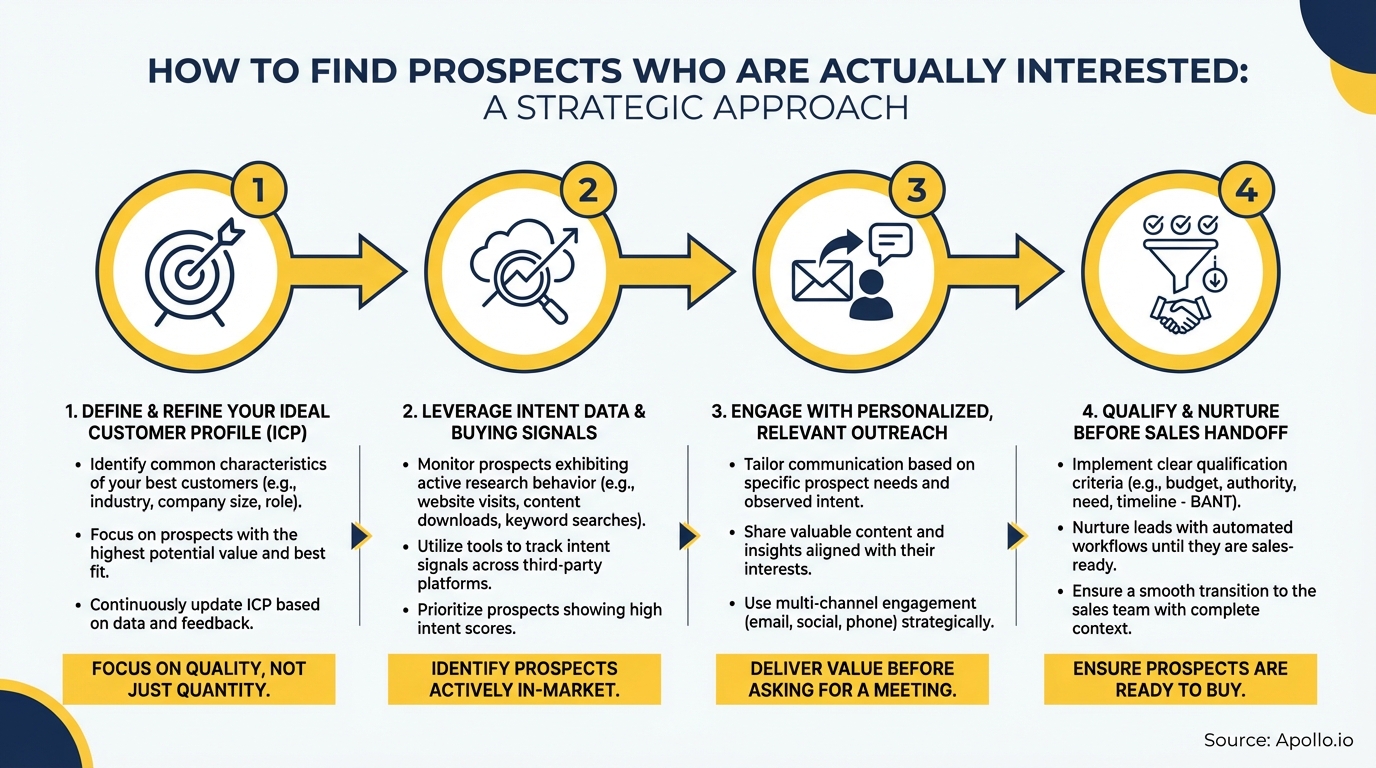
SDRs and AEs who consistently book meetings aren't sending more emails. They're targeting smarter. A signal-first system has three layers: identify, prioritize, and act fast. Research from Trykondo found that engaging a lead within 60 seconds can boost conversion by almost 400%. Speed-to-contact when intent spikes is the differentiator.
Here's how to structure the workflow:
- Identify: Use intent data and firmographic filters to build a target account list. Focus on accounts where multiple contacts are engaging, not just one.
- Prioritize: Apply lead scoring to rank accounts by signal strength, ICP fit, and buying-stage behavior. Deprioritize single-touch contacts.
- Act fast: Trigger automated sequences the moment a high-value signal fires. AI-powered workflow tools now make this the default, not the exception.
For AEs managing active deals, expand your view to the full buying committee. One champion's enthusiasm doesn't close the deal.
Track engagement across all stakeholders in the account before forecasting.
See Every Deal Clearly. Close With Confidence.
Pipeline forecasting a guessing game? Apollo surfaces real-time buyer signals so your team knows exactly where deals stand — before the quarter slips. Join 600K+ companies turning pipeline chaos into predictable revenue.
Schedule a Demo →Why Does Content Strategy Directly Affect Who Raises Their Hand?
Interested prospects self-discover your content before they ever talk to a rep. Your content is a prospecting asset, not just a marketing one.
To attract buyers who are genuinely in-research mode, your content needs to be findable, credible, and easy to circulate internally to a buying committee.
Practical format priorities:
- Short-form content: Quick to consume and easy to share across a buying group during early evaluation.
- Video: Short-form social video is increasingly used by B2B buyers to inform purchasing decisions. Sales videos work especially well for product explanations and social proof.
- Benchmarks and data assets: Buyers trust methodology-backed content over marketing collateral. Thought leadership that shows your data sources builds credibility faster than feature sheets.
- Webinars and gated events: High-value registrations generate first-party signals you can act on directly.
Distributing content across multiple channels matters because B2B buying journeys now span many touchpoints. Mapping your content to the channels where buyers actually research gives you more surfaces to capture interest signals.
How Can RevOps Leaders Measure Interest Signals Beyond Form Fills?
RevOps leaders know that form fills are lagging indicators. By the time someone fills a demo request, they've already made a shortlist decision.
The more valuable measurement layer tracks first-party behavioral signals earlier in the journey.
Key metrics to build into your dashboard:
- Account-level page depth and return visits (especially pricing and comparison pages)
- Multi-contact engagement rate per account (buying committee proxy)
- Content asset consumption by stage (are late-stage assets being consumed by early-stage accounts?)
- Time-to-sequence-trigger after intent signal fires
- Pipeline sourced from intent-triggered outreach vs. cold outreach
Companies with strong lead nurturing programs see measurable improvements in pipeline quality and cost-per-lead. According to SalesGenie, companies with strong lead nurturing generate 50% more sales-ready leads at approximately 33% less cost than competitors. That gap comes directly from measuring and acting on the right signals. Improving sales efficiency with RevOps starts by building this measurement layer into your GTM stack.
Spending hours manually tracking which accounts are engaging? Apollo's AI sales automation triggers sequences the moment a prospect signals intent, so your team acts at the right moment every time.
How Do You Turn Interested Prospects into Pipeline Faster?
Identifying interest is only half the equation. Converting that interest into meetings requires personalized, timely outreach across the right channels.
Generic sequences kill conversion. Personalization at the account level, referencing specific signals ("I noticed your team has been evaluating X category..."), drives response rates far above average cold outreach.
Three execution principles that work in 2026:
- Multi-channel sequences: Combine email, phone, and social outreach. Interested buyers respond across different channels depending on their role and stage.
- Timing to signal: Reach out within hours of a high-intent signal, not days. Agentic AI in modern sales stacks automates this timing layer.
- Humor and human tone: Robotic outreach gets ignored even by interested buyers. Clever, human outreach wins attention when buyers are evaluating multiple vendors simultaneously.
Apollo users can consolidate prospecting, sequencing, intent data, and pipeline tracking in one workspace, replacing the fragmented tool stacks that slow GTM teams down. As Cyera noted, "Having everything in one system was a game changer."

Start Finding Prospects Who Actually Want to Hear from You
Finding interested prospects isn't about outworking competitors. It's about outsmarting them with better signals, faster action, and content that earns trust before the first outreach.
Build your system around account-level intent, multi-stakeholder tracking, and speed-to-contact when signals fire.
Apollo gives SDRs, AEs, and RevOps teams a unified platform to identify high-intent accounts, run multi-channel sequences, and measure pipeline impact, all without juggling five separate tools. Whether you're an SDR trying to book more qualified meetings or a revenue leader building a predictable pipeline, try Apollo free and start prospecting with signal, not just volume.
Prove Pipeline ROI With Apollo
ROI pressure killing your next tool renewal? Apollo delivers measurable pipeline impact your leadership can see — fast. Leadium 3x'd their annual revenue. Start your free trial and show results before the next budget review.
Start Your Free Trial →Don't miss these
Sales
Inbound vs Outbound Marketing: Which Strategy Wins?
Sales
What Is a Sales Funnel? The Non-Linear Revenue Framework for 2026
Sales
What Is a Go-to-Market Strategy? The 2026 GTM Playbook
See Apollo in action
We'd love to show how Apollo can help you sell better.
By submitting this form, you will receive information, tips, and promotions from Apollo. To learn more, see our Privacy Statement.
4.7/5 based on 9,690 reviews
