
How Can Healthcare Companies Connect With Hospital Administrators in 2026
Hospital administrators are among the most guarded buyers in any sector. They sit at the intersection of financial pressure, workforce strain, regulatory complexity, and patient outcomes — and they have little patience for generic vendor pitches. Building a B2B marketing funnel that actually reaches this audience requires meeting a specific evidence threshold before they'll take a meeting. This article gives you the framework to do exactly that.

Accurate Leads, Less Research, More Pipeline
Tired of burning hours verifying contact info that goes nowhere? Apollo surfaces verified business contacts so your team spends time selling, not searching. Join 600K+ companies building predictable pipeline.
Start Free with Apollo →Key Takeaways
- Hospital administrators prioritize proven outcomes, peer testimonials, and financial ROI over innovation claims — your outreach must lead with evidence, not features.
- Healthcare software buying is shortlist-driven: getting on the initial 3–5 vendor shortlist is often the deciding factor in winning a deal.
- Buying decisions now involve the CFO, CIO, clinical champion, and AI governance lead — not just the administrator. Multi-threaded outreach is essential.
- Thought leadership and high-value content (case studies, whitepapers, ROI calculators) influence administrator decisions before the RFP is ever issued.
- Personalized, omnichannel outreach consistently outperforms generic campaigns when reaching senior healthcare executives.
What Do Hospital Administrators Need Before They Talk to Vendors?
Hospital administrators need proof before they engage — specifically outcome studies, peer testimonials, product comparisons, and concise executive summaries. Generic innovation claims are filtered out immediately.
AHA's survey of 127 hospital and health-system leaders confirmed this directly: administrators prefer evidence-backed content over marketing language. PHTI's 2024 health-system buyer data reinforced it, with 84% ranking proven track record, 76% ranking cost, 68% ranking customer support, and 65% ranking financial ROI as important vendor-selection factors.
With hospital expenses growing 7.5% in 2025 according to AHA's March 2026 report, and hospitals spending $43B trying to collect payments from insurers, every vendor conversation must translate into margin protection or cost reduction. The table below shows what evidence types map to each administrator priority:
| Administrator Priority | Required Proof Type | Content Format |
|---|---|---|
| Financial ROI | Cost savings, collections lift, denial reduction | ROI calculator, case study with dollar figures |
| Proven track record | Peer health system testimonials | Video testimonials, named case studies |
| Workforce relief | Labor efficiency, staffing ratio improvement | Before/after metrics, workflow comparison |
| Patient outcomes | Clinical data, satisfaction scores | Outcome study, published research |
| Customer support | Implementation timeline, ongoing SLA | Implementation guide, support tier sheet |
Research from ACR Journal confirms that high-value content such as clinical case studies, whitepapers, and educational webinars significantly influences early-stage research by B2B healthcare buyers. Build this proof pack before you begin outreach.
How Do SDRs and Sales Teams Get on the Hospital Administrator Shortlist?
SDRs and sales teams get on the hospital administrator shortlist by publishing buyer-enablement content before the RFP process begins, because Gartner's research found 92% of healthcare software buyers start with a 3–5 vendor shortlist and 59% select from that initial list.
This means the deal is often won or lost before the first sales call. SDRs targeting hospital administrators should focus on pre-shortlist visibility through these channels:
- Thought leadership publications: HFMA, AHA Trustee, Becker's Hospital Review, and Health Affairs carry credibility with administrators. The Harris Poll found executives estimate a 14x return on investment from effective thought leadership.
- Peer referral networks: ACHE regional chapter events, HIMSS, and health system CEO roundtables create warm introductions that cold outreach cannot replicate.
- AI search optimization:Phantom IQ reports that 40% of B2B buyers now initiate vendor research using AI tools. Your content must be structured to surface in AI-generated answers, not just Google rankings.
- Executive-level email sequences:Content-driven prospecting emails that lead with a relevant outcome study outperform feature-based pitches with this audience.
Struggling to identify and reach the right hospital administrators by title, health system size, and service line? Search Apollo's 230M+ verified contacts with 65+ filters to build your healthcare prospect list.

Who Else Is on the Hospital Buying Committee in 2026?
The hospital buying committee now includes the administrator, CFO, CIO, clinical champion, revenue-cycle leader, compliance officer, and an emerging AI governance role — not just the administrator alone.
HFMA's 2025 CFO report showed healthcare CFOs are spending more time on technology decision-making, revenue cycle, and workforce strategy. AMN Healthcare's 2026 Leadership Trends survey found 63% of executives need a clear AI strategy, 48% are focused on clinician adoption, and 41% are prioritizing data infrastructure.
Each stakeholder needs different proof:
- CFO: Collections lift, denial rate reduction, payer underpayment recovery
- CIO: EHR integration specs, data security, interoperability compliance
- Clinical champion: Workflow fit, staff adoption rates, patient outcome data
- AI governance lead: Model accuracy, audit trail, training acceptance plan
- Revenue-cycle leader: Automation rate, days in A/R reduction, claim accuracy
Account Executives managing hospital deals should build separate proof assets for each stakeholder and sequence outreach to each role using intent data to identify which committee members are actively researching solutions.
Turn Weak Leads Into Qualified Pipeline
Pipeline forecasting a guessing game because marketing leads never convert? Apollo surfaces high-intent prospects so your team works opportunities that actually close. Nearly 100K paying customers stopped guessing and started winning.
Start Free with Apollo →What Does an Admin-Ready KPI Scorecard Look Like?
An admin-ready KPI scorecard maps your solution's impact to the four metrics hospital administrators actually report to their boards: patient satisfaction, clinical outcomes, utilization efficiency, and financial performance.
Use this template structure when building case studies or executive summary one-pagers:
| KPI Category | Example Metric | How to Present It |
|---|---|---|
| Patient Satisfaction | HCAHPS score change, NPS improvement | Before/after comparison with timeframe |
| Clinical Outcomes | Readmission rate, length of stay | Peer-reviewed or audited data preferred |
| Utilization Efficiency | Bed utilization, OR throughput, staff ratio | Operational dashboard screenshot or summary |
| Financial Impact | Cost per case, collections rate, labor cost | Dollar figure + percentage improvement |
Attach this scorecard format to every case study you publish. Administrators forward concise, metric-driven summaries to their boards — make that easy for them. Calculating your return on sales using industry benchmarks can help you frame these numbers compellingly.
How Should Healthcare Vendors Frame Category-Specific Messages?
Healthcare vendors should frame each product category around the specific financial or operational risk it resolves for administrators, not around the technology itself.
Three categories require distinct message bridges in 2026:
- Cybersecurity: After the 2024 Change Healthcare cyberattack, AHA's survey of nearly 1,000 hospitals found 94% reported financial impact and nearly 60% of those with revenue impact saw losses of $1 million per day or more. Frame cybersecurity solutions around cash-flow continuity and revenue protection, not IT compliance.
- AI and automation: HFMA reported in May 2026 that 27% of health system finance leaders are deploying AI at scale and 53% are piloting it. Administrators want proof of workflow fit, governance controls, and staff adoption — not AI capability claims. HIMSS26 reinforced this: the winning message is "we fit your EHR environment," not "we have AI."
- Workforce solutions: ACHE's 2024 survey of community hospital CEOs ranked financial and workforce challenges as tied for the top concern. Connect any staffing or scheduling solution to labor cost as a percentage of total hospital expenses and quantify the relief in staff hours or overtime reduction.
Spending hours building manual outreach sequences for multiple hospital stakeholders? Automate your multi-channel sequences with Apollo's sales engagement platform and reach the right committee members with the right message at the right time.
Which Outreach Channels Work Best for Reaching Hospital Administrators?
Email, executive events, peer networks, and omnichannel digital campaigns are the most effective channels for reaching hospital administrators — used together, not in isolation.
According to Digital Silk, healthcare email campaigns average a 41% open rate with a 2.6% conversion rate, making personalized email sequences a high-value starting point. Research from BRG shows personalized outreach directly influences decisions for 95% of B2B buyers, including healthcare leaders.
Channel priorities by use case:
- Email: Lead with a relevant outcome stat from a peer health system. Link to a one-page executive summary, not a product demo page.
- Executive events: HIMSS, ACHE Congress, HFMA Annual — sponsor speaking slots or roundtables, not just booths. Administrators attend sessions, not vendor halls.
- Peer referrals: A warm introduction from a respected CMO or CFO at a comparable health system is the highest-conversion channel available.
- Video prospecting:Video outreach tailored to a specific hospital's service line or recent news stands out in crowded executive inboxes.
- Omnichannel sequences: As noted by Active Marketing, seamless integration across digital, traditional, and experiential channels is crucial for unified messaging and a smooth buyer journey.
How Can Healthcare GTM Teams Build a Repeatable Hospital Outreach System?
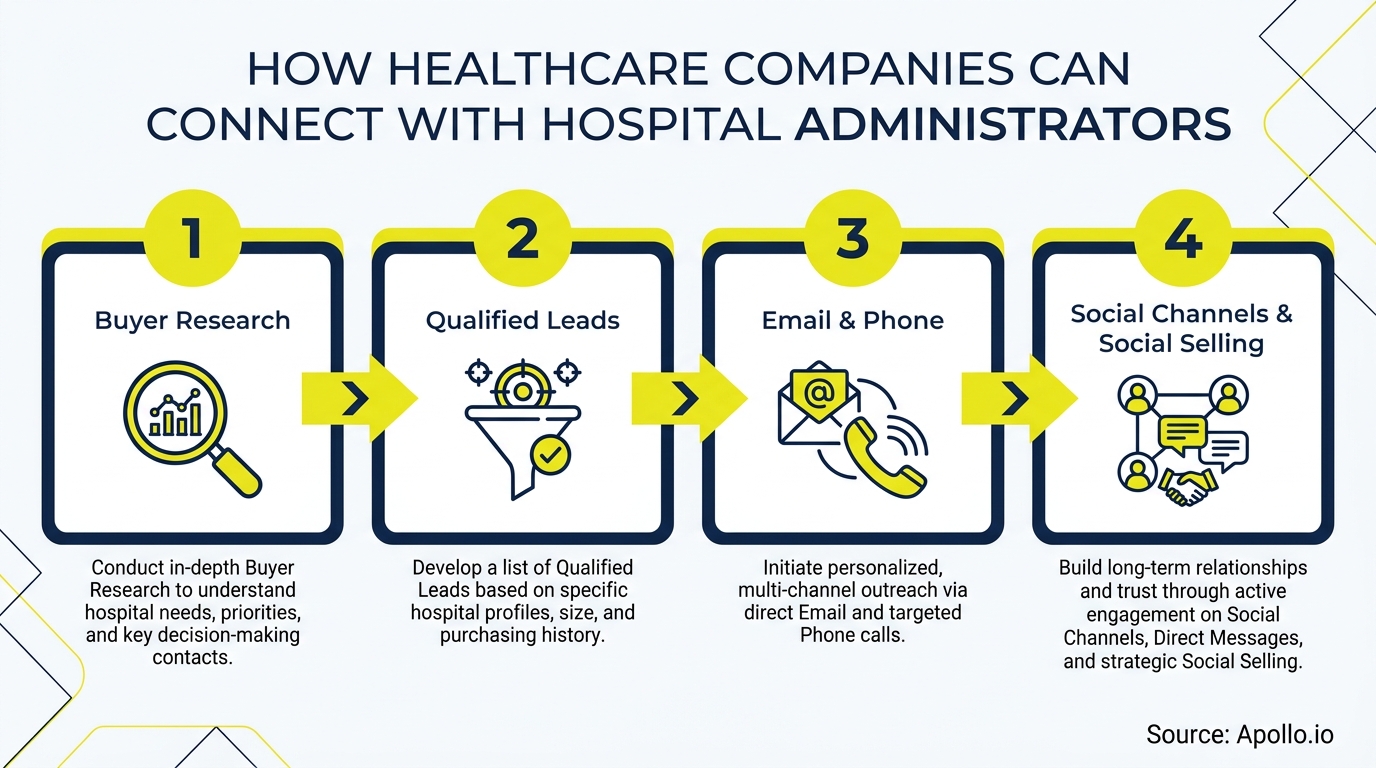
Healthcare GTM teams build a repeatable hospital outreach system by combining verified contact data, account-specific personalization, and sequenced multi-channel follow-up into a single workflow — not three separate tools.
RevOps leaders managing healthcare GTM programs know the pain of fragmented data: stale titles, missing direct lines, and no visibility into which accounts are actively in a buying cycle. Improving sales efficiency in healthcare sales starts with clean, enriched data on the right decision-makers across the full buying committee.
A repeatable system includes four components:
- Targeted contact lists: Filter by health system size, geography, bed count, service line, and administrator title to build account-specific lists.
- Proof asset library: Maintain a current set of case studies, ROI calculators, and peer testimonials mapped to each buying committee role.
- Sequenced outreach: Run parallel sequences for each stakeholder role, timed to industry events and health system fiscal calendars (most hospital fiscal years end June 30).
- Intent signals: Monitor which target accounts are researching relevant keywords to prioritize outreach timing. Sales transformation in healthcare requires moving from reactive to signal-driven prospecting.

Start Connecting With Hospital Administrators in 2026
Healthcare companies that connect with hospital administrators in 2026 will be the ones that lead with financial proof, map their message to the full buying committee, and earn their place on the initial vendor shortlist before the RFP drops.
The margin pressure is real, the buying committee is larger than ever, and administrators are filtering out vendors who can't speak their language. Build your proof pack, personalize your outreach by stakeholder, and use the right tools to execute at scale.
Apollo gives healthcare GTM teams a unified platform to find verified hospital administrator contacts, enrich account data, and run multi-channel sequences — all without stitching together a fragmented tech stack. Schedule a Demo and see how Apollo helps you reach the right healthcare decision-makers faster.
Prove Pipeline ROI From Day One
ROI pressure killing your tool budget before it even starts? Apollo delivers measurable pipeline impact fast — 35% increase in bookings with AI-powered messaging. Nearly 100K paying customers justified the spend. You can too.
Start Free with Apollo →Don't miss these
Sales
Inbound vs Outbound Marketing: Which Strategy Wins?
Sales
What Is a Sales Funnel? The Non-Linear Revenue Framework for 2026
Sales
What Is a Go-to-Market Strategy? The 2026 GTM Playbook
See Apollo in action
We'd love to show how Apollo can help you sell better.
By submitting this form, you will receive information, tips, and promotions from Apollo. To learn more, see our Privacy Statement.
4.7/5 based on 9,690 reviews
