
How AI Identifies New Accounts Similar to Your Best Customers
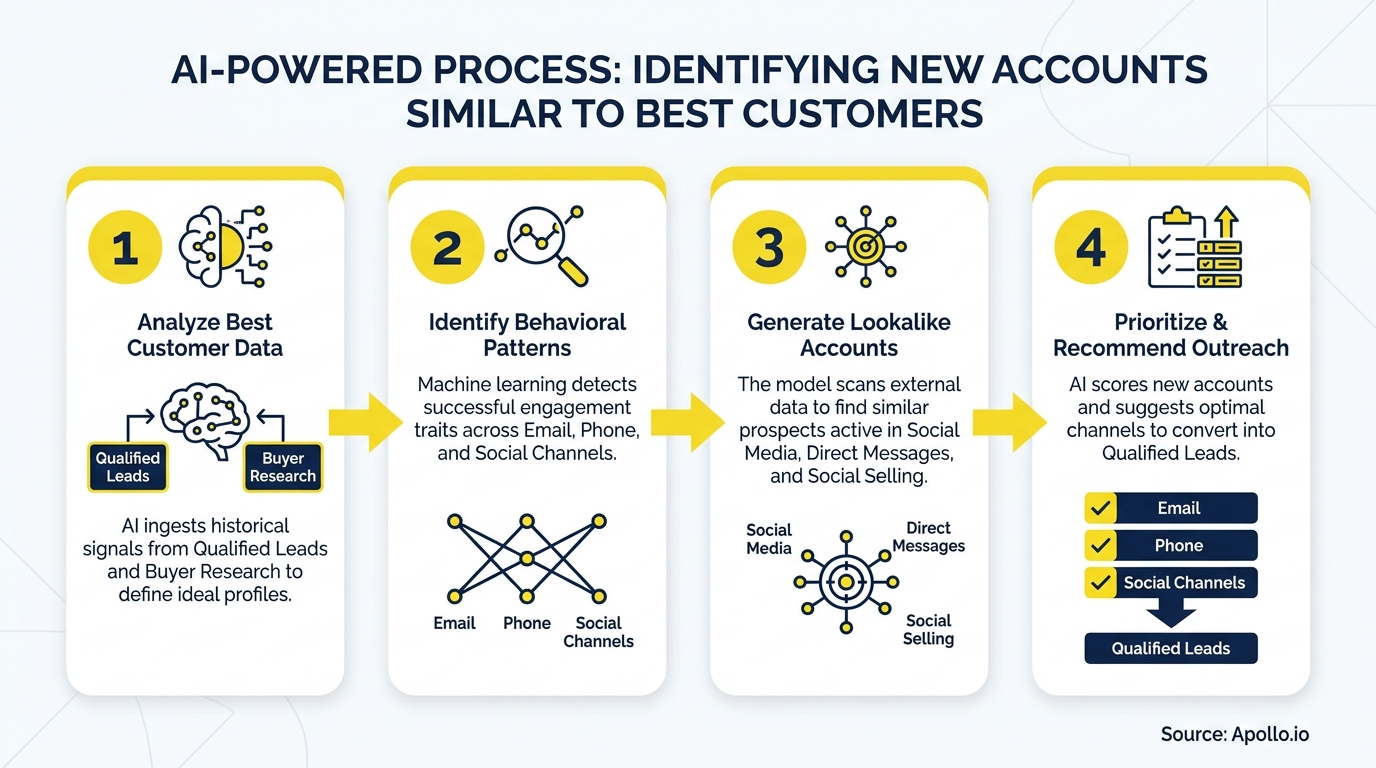
Your best customers share a data fingerprint: industry codes, headcount bands, tech stack, growth signals, and buying behavior patterns that made them convert and stay. AI can now read that fingerprint and surface accounts that match it across a database of millions of companies, before those accounts ever raise their hand.
This is not list building. This is pipeline prioritization, and the difference shows up in deal quality, close rates, and quota attainment. If you want to understand how to build a sharp Ideal Customer Profile before running any model, that foundation matters here too.

Research Less, Pipeline More With Apollo
Tired of burning hours verifying contacts while your pipeline sits empty? Apollo surfaces accurate, ready-to-engage prospects so your team sells instead of searches. Join 600K+ companies building predictable pipeline from day one.
Start Free with Apollo →Key Takeaways
- AI identifies lookalike accounts by analyzing closed-won customer data for shared firmographic, technographic, and behavioral signals, then scoring new accounts against that fingerprint.
- The seed set (your best-customer definition) determines model quality. Garbage in, garbage out applies directly here.
- Layering intent signals on top of fit scores separates accounts that match your ICP from accounts that are actively in-market right now.
- SDRs and AEs need next-best-action outputs, not just ranked lists, to drive seller adoption and quota impact.
- Governance and data quality checks are non-negotiable when AI models consume third-party, intent, or behavioral data.
How Does AI Identify Accounts Similar to Your Best Customers?
AI identifies similar accounts by analyzing your closed-won customer data to extract shared signals, then scoring a broader universe of companies against those signals. As noted by Aviso, AI-powered platforms automate this by analyzing closed-won customer data to identify shared firmographic, technographic, and go-to-market signals.
The signals AI typically evaluates include:
- Firmographics: Industry vertical, employee count, annual revenue, geography, company age
- Technographics: Current tools in their stack, recent technology additions or removals
- Growth signals: Hiring velocity, funding events, leadership changes, product launches
- Behavioral signals:Intent data, web visits, ad engagement, content consumption patterns
According to The Matrix Point, AI analyzes best customers to identify characteristics linked to fit, conversion, and long-term value, creating a sharper and more current target profile for segmentation and prioritization.
How Do You Build the Seed Set Before Running Any Model?
The seed set is the curated list of your best customers that trains the similarity model. Most teams skip this step and wonder why their lookalike lists underperform.
Build your seed set using these criteria:
- Closed-won accounts with the highest lifetime value or shortest time-to-value
- Accounts with strong retention and expansion revenue
- Customers who refer others or become advocates
- Exclude outliers: one-off enterprise deals, heavily discounted accounts, or customers acquired through channels you cannot replicate
A sales professional wrote on Reddit that the workflow that worked best was pulling top customers into a list, letting the platform enrich everything including industry, headcount, tech stack, and hiring signals, then running the AI assistant on that list. The AI surfaces the traits those accounts share and turns them into filters you can go hunt with.
Struggling to find qualified lookalike accounts? Search Apollo's 230M+ contacts with 65+ filters to build your lookalike list.
What Is Explainable Account Scoring and Why Does It Matter?
Explainable account scoring tells sellers why an account ranked highly, not just that it did. A black-box score of 87 means nothing to an SDR without context.
Effective explainable scoring surfaces the top contributing factors per account, for example:
- "Matches your top customers on headcount range and tech stack"
- "Showing intent for keywords related to your product category"
- "Recent Series B funding in the last 90 days"
- "Decision-maker seniority matches your typical buyer persona"
Research from Optif.ai shows AI predictive lead scoring achieves 89% accuracy compared to 60-68% for traditional models, reducing false positives by 40%. The accuracy advantage only translates to pipeline impact when sellers understand and trust the scores enough to act on them.
A commenter added in a Reddit discussion that AI gets the surface-level stuff right, like identifying your category and general use cases, but typically misses the nuanced reasons certain customers actually buy. The gap is usually around buying intent and timing, not firmographic fit.
Turn Funnel Guesswork Into Pipeline Wins
Pipeline forecasting a guessing game because marketing leads never convert? Apollo surfaces high-intent prospects that actually become opportunities. Over 600K companies stopped guessing and started closing.
Start Free with Apollo →How Do SDRs and AEs Turn Scored Accounts Into Pipeline?
SDRs and AEs need next-best-action outputs, not just ranked lists. Converting scored accounts into pipeline requires a clear handoff from model output to seller workflow.
A practical tiering approach:
| Tier | Score Range | Recommended Action | Owner |
|---|---|---|---|
| Tier 1 (Hot) | High fit + active intent | Immediate outreach, personalized sequence | AE or senior SDR |
| Tier 2 (Warm) | High fit, low intent | Nurture sequence, monitor for intent surge | SDR |
| Tier 3 (Watch) | Moderate fit, any intent | Add to ABM audience, light content touch | Marketing |
For Account Executives managing a named account list, this tiering directly informs where to invest relationship-building time versus where to run automated sequences. RevOps leaders use the same tiers to route accounts into the right CRM stages and campaign tracks automatically, reducing manual triage. This is a core component of effective sales transformation led by RevOps.
Data from Reach Marketing indicates AI-driven lead scoring improves efficiency by 40% and reduces time spent on low-quality leads. For SDRs working high-volume outbound, that efficiency gain translates directly to more conversations with accounts that are actually likely to convert.
Spending hours manually triaging accounts? Automate account scoring and outreach workflows with Apollo's AI sales automation.

What Data Governance Rules Should You Follow for AI Account Targeting?
AI account targeting requires a governance layer, especially when the model consumes third-party data, intent signals, or behavioral identifiers. Skipping this creates legal and trust risk.
A minimum viable governance checklist:
- Data sources: Document every data type feeding the model (CRM fields, enrichment providers, intent vendors)
- Refresh cadence: Set a schedule for re-running the model as your customer base evolves
- Score decay: Define when a scored account should drop tiers if no engagement occurs
- Human review: Require seller sign-off before Tier 1 accounts enter a sequence
- Audit trail: Log which accounts were scored, when, and on what criteria
Apollo's approach to responsible data handling is covered in detail in How Apollo Protects Your Data. For teams building or scaling their sales tech stack, governance should be a selection criterion, not an afterthought.
How Can You Put This All Together in One Platform?
The most common failure mode for AI account identification is tool sprawl: one tool for enrichment, another for intent, a third for scoring, and a fourth for sequences. Each handoff is a place where data degrades and context gets lost.
Apollo consolidates the full workflow into one platform. Pull your best customers into a list, enrich with 65+ firmographic and technographic attributes, surface shared traits with AI, build a matched account list, and push it directly into a multi-channel sequence, all without switching tools.
As Census put it: "We cut our costs in half." Cyera echoed the operational benefit: "Having everything in one system was a game changer."
For teams thinking through lead generation best practices, the consolidation argument is straightforward: fewer integrations means cleaner data, faster iteration, and better seller adoption. Apollo serves B2B GTM teams from startups through enterprise, including SDRs, AEs, RevOps, marketing leaders, and enterprise GTM teams who need advanced routing, governance, and admin controls.

Start Finding Your Best-Fit Accounts Today
AI-powered lookalike account identification moves your prospecting from gut feel to a repeatable, data-driven system. The playbook is clear: define your best customers precisely, enrich and model that seed set, layer intent signals on top of fit scores, deliver explainable next-best-actions to sellers, and govern the process so it stays accurate over time.
The teams winning in 2026 are not buying bigger lists. They are building smarter models on top of the customers they already have, and acting on those signals faster than their competitors.
Ready to build your lookalike account engine? Start a free trial with Apollo and turn your best customers into your best prospecting list.
Prove Pipeline ROI With Apollo
ROI pressure killing your next tool approval? Apollo delivers measurable pipeline impact from day one — no guesswork, no slow ramp. Leadium 3x'd annual revenue. Your CFO wants numbers. Apollo gives you them.
Start Free with Apollo →Don't miss these
Sales
Inbound vs Outbound Marketing: Which Strategy Wins?
Sales
What Is a Sales Funnel? The Non-Linear Revenue Framework for 2026
Sales
What Is a Go-to-Market Strategy? The 2026 GTM Playbook
See Apollo in action
We'd love to show how Apollo can help you sell better.
By submitting this form, you will receive information, tips, and promotions from Apollo. To learn more, see our Privacy Statement.
4.7/5 based on 9,690 reviews
