
Full Sales Cycle: How to Shorten Your Path to Revenue
The full sales cycle determines how fast your team turns prospects into revenue. In 2026, Optif.ai reports that the median B2B SaaS sales cycle is 84 days, having lengthened 22% since 2022 due to larger buying committees (6.8 stakeholders, up from 5.4) and increased security due diligence. Sales leaders who master each stage—from prospecting to close—shorten cycles and hit quota consistently. This guide breaks down the full sales cycle, shows you how to optimize each phase, and reveals how top-performing teams are using sales analytics and unified platforms to accelerate deals.

Reclaim 4+ Hours Daily With Apollo's Automation
Tired of spending 4+ hours daily hunting for contact info? Apollo delivers 224M verified contacts with 96% email accuracy. Join 550K+ companies who automated their prospecting.
Start Free with Apollo →Key Takeaways
- The full sales cycle spans prospecting, qualification, presentation, objection handling, closing, and follow-up—each stage requires distinct tactics
- B2B cycles now involve 6.8 stakeholders on average, making multi-threaded selling and stakeholder mapping critical
- Cycle compression in 2026 requires rep-free content, unified data, and AI-powered automation to move deals faster
- Consolidating your tech stack cuts costs and eliminates handoff errors that slow deals
What Is the Full Sales Cycle?
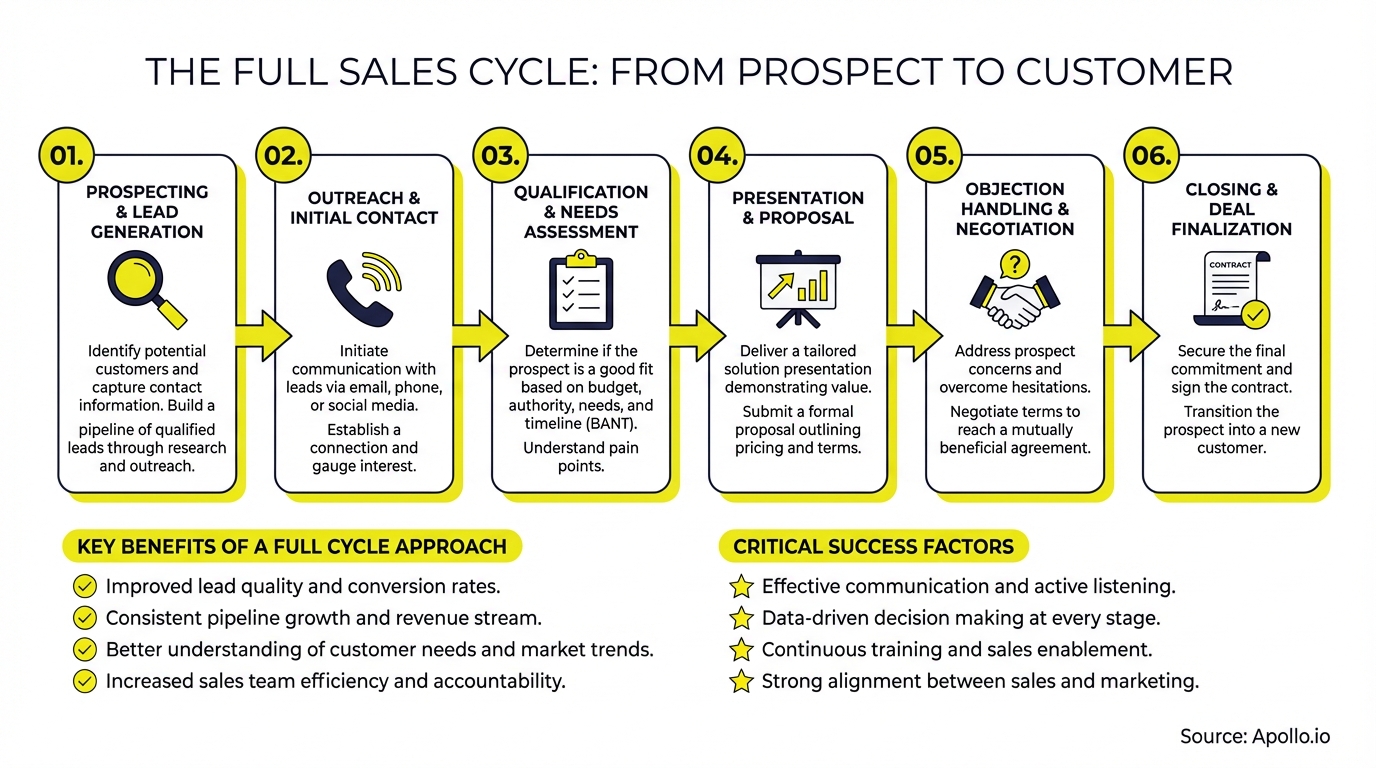
The full sales cycle is the complete journey from identifying a prospect to closing a deal and nurturing the customer relationship. It includes prospecting, lead qualification, needs discovery, solution presentation, objection handling, negotiation, closing, and post-sale follow-up.
Each stage requires specific actions, content, and metrics to move buyers forward.
According to Highspot, the average sales cycle for B2B teams typically ranges between 60 to 120 days. However, Landbase notes that B2B sales cycles vary by deal size: 1-3 months for SMB deals, and 6+ months for enterprise deals. Understanding your specific cycle length helps you forecast accurately and allocate resources.
What Are the Stages of the Full Sales Cycle?
The full sales cycle consists of seven core stages. Each stage has clear entry and exit criteria, making it measurable and repeatable.
| Stage | What Happens | Key Activities |
|---|---|---|
| 1. Prospecting | Identify and research potential buyers | Build target lists, enrich contact data, prioritize accounts |
| 2. Qualification | Determine if prospect fits your ICP | Run BANT/MEDDIC frameworks, score leads, disqualify mismatches |
| 3. Needs Discovery | Uncover pain points and business goals | Ask open-ended questions, map stakeholders, document requirements |
| 4. Presentation | Demonstrate how your solution solves their problem | Deliver custom demos, share case studies, align to their use case |
| 5. Objection Handling | Address concerns and competitive threats | Preempt objections, provide proof points, engage champions |
| 6. Closing | Finalize terms and secure commitment | Negotiate pricing, draft contracts, obtain signatures |
| 7. Post-Sale Follow-Up | Ensure smooth onboarding and identify expansion opportunities | Schedule QBRs, track product adoption, request referrals |
For SDRs and BDRs, the first three stages (prospecting, qualification, discovery) consume most of your time. Account Executives own stages four through seven, where deal value and velocity are won or lost.
Turn Forecast Chaos Into Revenue Clarity
Pipeline forecasting a guessing game? Apollo delivers real-time deal visibility and intent signals that make quota predictable. Built-In increased win rates 10% with Apollo's scoring.
Start Free with Apollo →Why Are Sales Cycles Getting Longer in 2026?
Sales cycles are lengthening due to larger buying committees, increased risk aversion, and more rigorous security reviews. Research from SaleSso shows that 58% of B2B professionals reported their sales cycles had gotten longer over the past year across industries.
Three factors drive this trend:
- Buying committee expansion: Decisions now involve 6.8 stakeholders on average, up from 5.4 in 2022
- Security and compliance scrutiny: IT and legal teams add weeks to evaluation timelines
- Budget approval complexity: CFOs demand tighter ROI justification in uncertain economic conditions
Sales leaders are responding by building multi-stakeholder content libraries and using enterprise sales solutions to track engagement across buying committees. Struggling to keep deals moving with multiple stakeholders? Track every touchpoint and stakeholder interaction with Apollo's deal management.

How Do Account Executives Shorten the Full Sales Cycle?
Account Executives shorten sales cycles by improving qualification, enabling buyers with self-serve content, and eliminating internal handoff delays. The fastest-closing AEs focus on three high-impact tactics.
1. Front-load qualification and disqualify faster.
Spending time on unqualified deals is the number one cycle killer. Use frameworks like MEDDIC to assess metrics, economic buyer, decision criteria, decision process, identify pain, and champion strength before investing in custom demos.
2. Provide rep-free decision content.
Buyers prefer self-serve evaluation. Create pricing calculators, ROI models, security documentation, and implementation timelines they can access without scheduling meetings.
This aligns with the shift toward seller-optional journeys.
3. Consolidate tools to reduce handoff errors.
Every tool switch introduces delay. Teams using fragmented sales stacks (separate prospecting, engagement, and deal management platforms) lose deals to friction.
Apollo consolidates prospecting, engagement, intelligence, and pipeline tracking in one workspace. As Predictable Revenue reports: "We reduced the complexity of three tools into one."
For Account Executives managing enterprise deals, proven strategies for breaking into enterprise accounts can accelerate complex, multi-stakeholder cycles.
What Sales Automation Tools Speed Up the Full Sales Cycle?
Sales automation tools eliminate manual tasks in prospecting, outreach, follow-up, and data entry—freeing reps to focus on high-value activities. The right automation stack can compress cycles by weeks.
Key automation capabilities that accelerate the full sales cycle:
- Prospecting automation: Auto-enrich contact data, build target lists with filters, score leads based on fit and intent
- Engagement automation: Multi-channel sequences (email, phone, social) with personalized templates and follow-up triggers
- Meeting automation: Calendar links, automated reminders, and no-show recovery sequences
- Data sync automation: Real-time CRM updates, activity logging, and pipeline reporting
RevOps leaders implementing sales automation software report measurable time savings and faster deal velocity. Spending hours on manual prospecting and data entry? Automate prospecting, outreach, and follow-up with Apollo's AI-powered workflows.
How Can Sales Leaders Optimize Each Stage of the Cycle?
Sales leaders optimize the full sales cycle by implementing stage-specific KPIs, coaching frameworks, and content systems. Each stage requires different metrics and enablement.
| Stage | Key Metric | Optimization Tactic |
|---|---|---|
| Prospecting | Qualified leads per rep per week | Implement account scoring, provide ideal customer profile templates |
| Qualification | SQL-to-opportunity conversion rate | Standardize qualification frameworks, audit disqualification reasons |
| Discovery | Stakeholder mapping completeness | Create discovery call scripts, mandate multi-threading documentation |
| Presentation | Demo-to-proposal conversion rate | Build use-case-specific demo tracks, record and review top performer demos |
| Objection Handling | Objection resolution time | Develop objection libraries, role-play competitive scenarios |
| Closing | Proposal-to-close rate and average discount | Standardize pricing, automate contract generation, track negotiation patterns |
| Post-Sale | Time to first value and expansion revenue | Align CS and sales on success metrics, track product adoption signals |
Founders and CEOs building outbound teams should focus on cycle-length benchmarks by deal size and industry. Use the sales acceleration formula to model how improving conversion rates at each stage compounds into revenue growth.

Start Optimizing Your Full Sales Cycle Today
The full sales cycle in 2026 demands tighter qualification, rep-free buyer enablement, and unified data across every stage. Teams that consolidate tools, automate repetitive tasks, and coach to stage-specific metrics close deals faster and more predictably.
Apollo provides the all-in-one platform to execute every stage of your full sales cycle. Prospect with 224M+ verified contacts, engage buyers across email and phone, track stakeholder interactions, and manage deals without switching tools.
Census reports: "We cut our costs in half." Cyera adds: "Having everything in one system was a game changer."
Start Free with Apollo and compress your sales cycle today.
Prove Apollo's ROI In Your First 30 Days
Budget approval stuck on unclear metrics? Apollo delivers measurable pipeline impact from day one—track time saved, meetings booked, and revenue generated. Built-In increased win rates 10% and ACV 10% with Apollo's scoring.
Start Free with Apollo →Don't miss these
Sales
Inbound vs Outbound Marketing: Which Strategy Wins?
Sales
What Is a Sales Funnel? The Non-Linear Revenue Framework for 2026
Sales
What Is a Go-to-Market Strategy? The 2026 GTM Playbook
See Apollo in action
We'd love to show how Apollo can help you sell better.
By submitting this form, you will receive information, tips, and promotions from Apollo. To learn more, see our Privacy Statement.
4.7/5 based on 9,690 reviews
