
How to Choose Free Sales Pipeline Software That Scales With Your Team
Sales teams waste 15+ hours weekly on spreadsheets and manual pipeline tracking. Free sales pipeline software eliminates this busywork while giving you visual deal tracking, automation, and forecasting. The catch? Most free tools limit features or users, leaving growing teams stuck between overpaying or losing visibility. This guide shows you how to evaluate free pipeline software within a RevOps framework, integrate with your existing deal management tools, and scale without breaking your budget.

Apollo Eliminates 4+ Hours Of Daily Research
Tired of spending 4+ hours daily hunting for contact info? Apollo delivers 224M verified contacts with 96% email accuracy instantly. Join 550K+ companies who replaced manual research with predictable pipeline.
Start Free with Apollo →Key Takeaways
- Free sales pipeline software provides visual deal tracking and basic automation without upfront costs, but typically limits users, contacts, or features
- High-performing sales organizations are 1.5x more likely to base forecasts on data-driven insights, making pipeline software essential for revenue predictability
- Companies deploying RevOps frameworks grow revenue 3x faster, and free pipeline tools can support this growth when properly integrated
- Tool consolidation matters: 69% of marketers prefer delivered insights over adding more technology to their stack
- Successful implementations require clear data governance, CRM integration, and a migration plan for when your team outgrows free tiers
What Is Free Sales Pipeline Software?
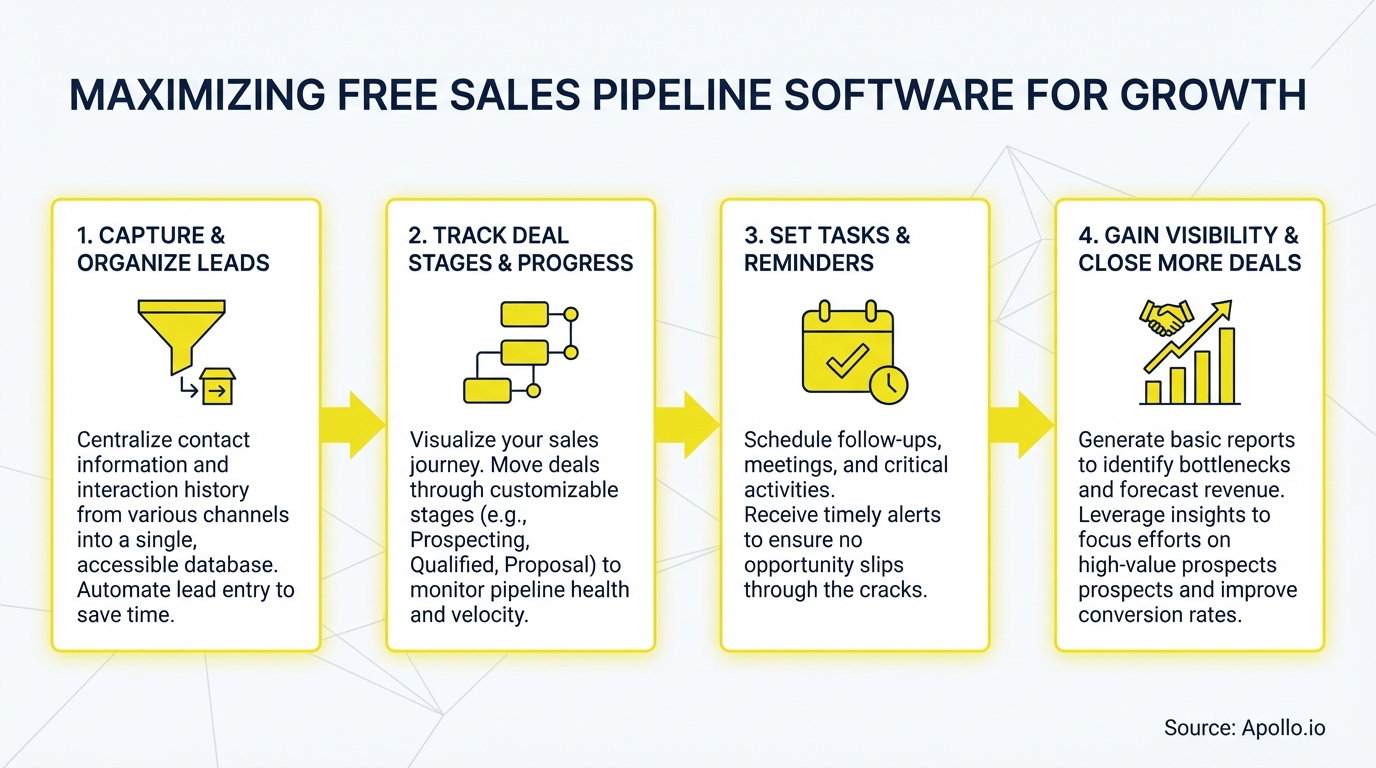
Free sales pipeline software is a visual deal management platform that tracks prospects through your sales stages without requiring upfront payment. It displays opportunities in columns or stages (prospecting, qualification, proposal, negotiation, closed) so sales teams can see deal status at a glance.
These platforms typically include drag-and-drop deal movement, basic task automation, contact management, and reporting dashboards. According to Gitnux research, 91% of companies with more than 11 employees now use CRM software, and free pipeline tools provide an entry point for teams not ready for enterprise platforms.
The "free" model comes in three forms: freemium (limited features or users), free trials (temporary full access), or open-source (free software requiring technical setup). Most B2B teams start with freemium options from providers like HubSpot, Zoho, or Apollo's free pipeline tools.
Why Do Sales Teams Need Pipeline Software in 2026?
Sales teams need pipeline software because manual tracking creates blind spots that kill revenue. When Account Executives manage deals in spreadsheets, leadership can't forecast accurately, reps forget follow-ups, and deals slip through cracks.
Data from Gitnux shows that high-performing sales organizations are 1.5 times more likely to base forecasts on data-driven insights. Pipeline software provides this visibility by centralizing deal data, tracking stage movement, and flagging stalled opportunities.

For SDRs and BDRs, pipeline software answers critical questions: Which leads are ready for outreach? What's my conversion rate by source?
Where do deals typically stall? For Sales Leaders, it provides forecast accuracy, rep performance comparisons, and early warning signals when pipelines thin.
Research by MarTech reveals that 69% of marketers prefer delivered insights over adding new tools to their tech stack. This matters because effective pipeline software shouldn't just store data; it should surface actionable insights without requiring teams to build custom reports.
What Features Should RevOps Teams Prioritize in Free Tools?
RevOps teams should prioritize three non-negotiable features: CRM integration, custom pipeline stages, and API access or webhook support. Without these, free tools become data silos that duplicate work instead of streamlining operations.
Essential features for RevOps alignment include:
- Bi-directional CRM sync: Salesforce, HubSpot, or Pipedrive integration that updates both systems automatically
- Custom fields and objects: Map your unique sales process, not a vendor's template
- Role-based permissions: Control who sees sensitive deal data and forecasts
- Activity tracking: Log emails, calls, and meetings without manual entry
- Reporting and dashboards: Pre-built reports for pipeline health, conversion rates, and velocity
- Mobile access: Reps update deals from anywhere, keeping data current
RevOps leaders managing cross-functional teams should also evaluate data export capabilities. Free tiers often restrict bulk exports, making it difficult to run custom analyses or migrate data later. Companies that deploy Revenue Operations grow revenue 3 times faster, according to Gitnux, so tool flexibility directly impacts growth trajectory.
Turn Guesswork Into Predictable Revenue
Pipeline forecasting a guessing game? Apollo delivers real-time deal visibility and intent signals so you forecast with confidence. Built-In increased win rates 10% using Apollo's scoring.
Start Free with Apollo →How Do Free Tiers Compare to Paid Pipeline Software?
Free tiers provide core pipeline visualization and basic automation but restrict users, contacts, features, or support. Paid versions unlock advanced forecasting, custom reporting, workflow automation, and dedicated account management.
| Feature | Free Tier | Paid Tier |
|---|---|---|
| Users | 1-3 users | Unlimited or 10+ |
| Contacts/Deals | 100-1,000 records | Unlimited or 50,000+ |
| Pipeline Stages | Pre-set or limited custom | Fully customizable |
| Automation | Basic task reminders | Workflow automation, sequences |
| Reporting | Standard dashboards | Custom reports, forecasting |
| Integrations | 1-3 native integrations | API access, 50+ integrations |
| Support | Community forums, docs | Email, phone, dedicated CSM |
The real cost difference appears in hidden inefficiencies. Free tools often lack bulk actions, forcing reps to update deals one-by-one.
They may exclude AI-powered insights that identify at-risk deals or suggest next actions. For teams managing 100+ active opportunities, these limitations add 5-10 hours of manual work weekly.

Struggling to track deals across a growing team? Apollo's deal management platform combines pipeline tracking with 224M+ verified contacts in one workspace.
How Can Sales Leaders Integrate Free Pipeline Software with Existing CRMs?
Sales Leaders can integrate free pipeline software with existing CRMs through native integrations, third-party connectors like Zapier, or API connections. The goal is bi-directional data sync so updates in one system automatically reflect in the other.
Integration steps for common CRMs:
- Map data fields: Match pipeline stages to CRM opportunity stages, custom fields to CRM properties
- Configure sync rules: Decide which records sync (all deals vs. specific stages), sync frequency (real-time vs. hourly)
- Test with sample data: Create test deals, move through stages, verify CRM updates correctly
- Set up error handling: Configure alerts for sync failures, duplicate records, or field mismatches
- Train teams on dual workflows: Clarify which system is the source of truth for specific data types
For teams using sales automation software, integration unlocks powerful workflows. When a deal reaches "Proposal" stage in your pipeline tool, it can trigger automated sequences in your engagement platform, assign tasks to Account Executives, and update forecasts in your CRM.
RevOps teams should document integration logic and maintain a data dictionary. When free tools limit custom field mapping, use standardized naming conventions across systems to prevent data fragmentation.
What Data Quality Standards Should Teams Implement?
Teams should implement three data quality standards: required fields at deal creation, regular duplicate detection, and stage progression rules. Without governance, pipeline data degrades within weeks, making forecasts unreliable.
Critical data quality practices include:
- Mandatory fields: Deal name, value, close date, owner, and source before saving records
- Standardized values: Dropdown menus for stage names, deal types, loss reasons (not free text)
- Stage criteria: Define what qualifies a deal to advance (e.g., "Demo Completed" required before "Proposal" stage)
- Stale deal policies: Flag deals with no activity in 30+ days, auto-archive after 90 days
- Weekly audits: RevOps reviews deals missing key data, corrects errors, identifies training needs
By 2025, 70% of B2B sales organizations will rely on data integrity services to combat bad data, according to Gitnux. Free pipeline tools rarely include automated data cleansing, so manual governance becomes critical.
For small business sales teams, start with basic hygiene: require deal value and close date, standardize stage names, and review pipeline weekly. As you scale, add validation rules and integrate data enrichment tools.
When Should Growing Teams Upgrade from Free to Paid?
Growing teams should upgrade from free to paid pipeline software when they hit user limits, need advanced automation, or spend more than 5 hours weekly working around feature restrictions. The right trigger depends on your growth stage and pain points.
Clear upgrade signals include:
- User limits: Adding SDRs or AEs but free tier caps at 3 users
- Contact/deal limits: Approaching record maximums, forced to delete historical data
- Forecast accuracy: Sales Leaders can't trust pipeline reports due to limited analytics
- Integration needs: Require connections to multiple tools (email, calendar, phone system)
- Automation gaps: Reps spend hours on manual follow-ups that paid tools automate
- Support requirements: Blocked by technical issues with no direct support access
Calculate your "free tier tax": hours spent on manual workarounds multiplied by average hourly cost. If your team loses 10 hours weekly at $50/hour, that's $2,000 monthly in hidden costs.
Most paid pipeline tools cost $50-150 per user monthly, making upgrades cost-positive surprisingly fast.
Founders and CEOs building outbound motions should also consider tool consolidation strategies. Running separate tools for prospecting, pipeline management, and engagement increases costs and data fragmentation. Platforms like Apollo combine all three, cutting tech stack complexity and costs.
Ready to Build a Scalable Sales Pipeline?
Free sales pipeline software provides essential deal tracking and visibility for early-stage teams, but sustainable growth requires integration, data governance, and a clear upgrade path. The best approach combines free tools with smart workflows and realistic expectations about limitations.
As your team scales from 3 to 10+ reps, pipeline software transitions from "nice to have" to "revenue critical." Focus on tools that integrate with your existing CRM, support your unique sales process, and provide a growth path that doesn't force painful migrations.
Looking for pipeline software that grows with you? Start free with Apollo's all-in-one platform and get deal management, 224M+ verified contacts, and sales engagement in one workspace. No credit card required.
Prove Apollo's ROI In Your First Month
Budget approval stuck on unclear metrics? Apollo tracks every dollar: pipeline generated, meetings booked, deals closed. Built-In increased win rates 10% and ACV 10% with measurable impact.
Start Free with Apollo →Don't miss these
Sales
Inbound vs Outbound Marketing: Which Strategy Wins?
Sales
What Is a Sales Funnel? The Non-Linear Revenue Framework for 2026
Sales
What Is a Go-to-Market Strategy? The 2026 GTM Playbook
See Apollo in action
We'd love to show how Apollo can help you sell better.
By submitting this form, you will receive information, tips, and promotions from Apollo. To learn more, see our Privacy Statement.
4.7/5 based on 9,690 reviews
