
Enterprise Sales Software: How to Choose the Right Platform for Your Team
Choosing the right enterprise sales software in 2026 means evaluating AI capabilities, verified reviews, and total cost of ownership—not just features. According to Gartner, the worldwide enterprise software market reached $900 billion in 2024, with 60.1% of revenue from cloud subscriptions. As enterprise sales solutions evolve toward multimodal AI interfaces, sales leaders need a framework that weighs ROI against implementation complexity.

Stop Manual Research—Apollo Finds Leads Instantly
Tired of spending 4+ hours daily hunting for contact info? Apollo delivers 224M verified contacts with 96% email accuracy. Join 550K+ companies who eliminated manual prospecting.
Start Free with Apollo →Key Takeaways
- Enterprise sales software in 2026 must offer AI-powered automation, verified contact data, and seamless CRM integration to compete
- Multimodal AI interfaces will transform 80% of enterprise applications by 2030, making early adoption critical for competitive advantage
- Tool consolidation saves companies up to 50% on software costs while improving data accuracy and team productivity
- 98% of buyers read reviews before purchasing, making third-party verification essential for vendor credibility
- ROI models should account for hidden costs like data migration, training, and ongoing governance
What Is Enterprise Sales Software?
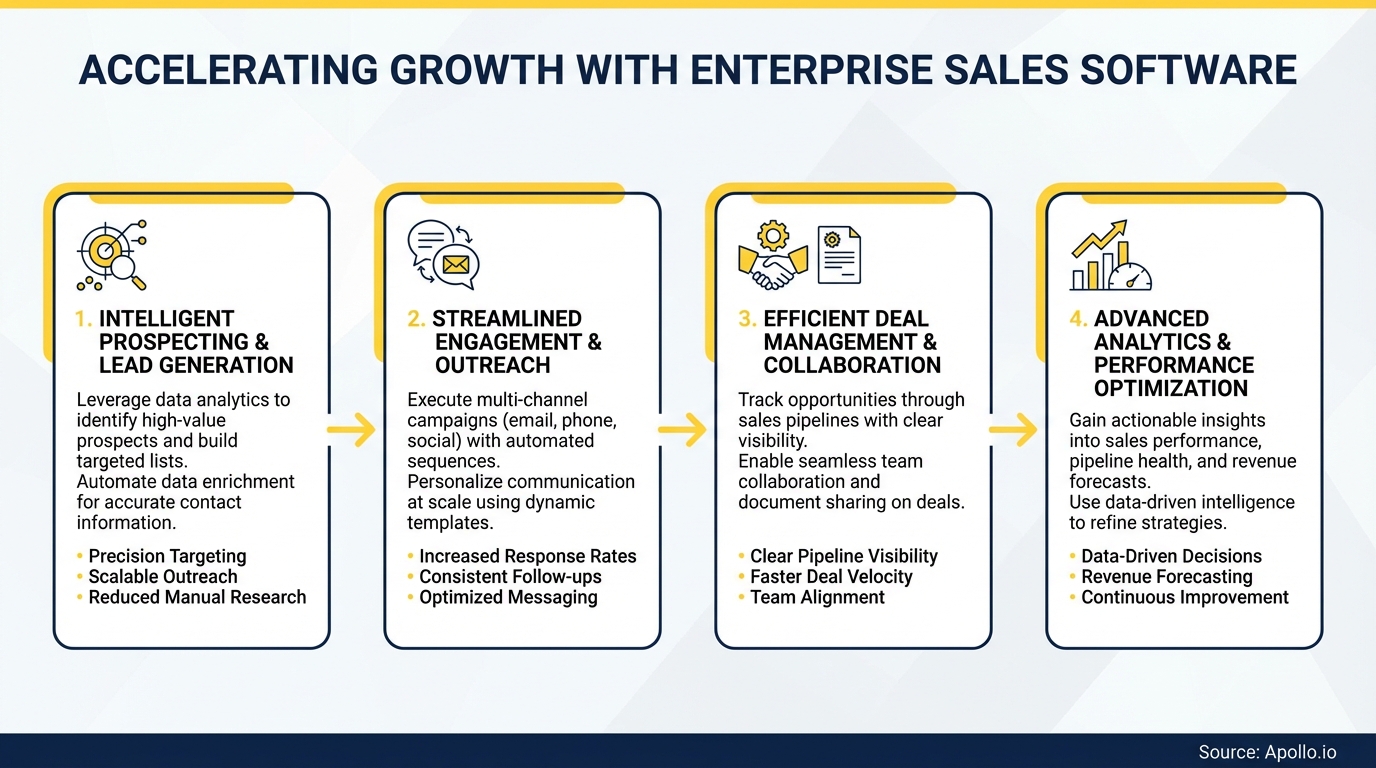
Enterprise sales software is a unified platform that manages prospecting, outreach, pipeline tracking, and deal management for large sales teams. It combines contact databases, engagement automation, conversation intelligence, and analytics in one system.
For Account Executives managing complex deals, these platforms replace 3-5 separate tools with a single workspace.
Research by Gartner shows the enterprise SaaS market expanded by 16.7% in 2024, reaching $218.5 billion, with CRM accounting for 51.4% of revenue. Modern platforms integrate AI sales tools that automate research, personalize messaging, and predict pipeline outcomes.
Why Are Multimodal AI Features Critical in 2026?
Multimodal AI features allow sales teams to interact with software using text, voice, and visual inputs simultaneously. According to Gartner, 80% of enterprise applications will be multimodal by 2030, up from less than 10% in 2024. This shift transforms how SDRs conduct research and how RevOps leaders analyze performance.
Key multimodal capabilities include:

- Voice-activated prospecting: Search contact databases using natural language queries
- Visual dashboard customization: Drag-and-drop pipeline views without technical skills
- AI-generated call summaries: Automatic transcription with action item extraction
- Natural language reporting: Ask questions like "Which accounts are at risk?" and get instant answers
Struggling to keep up with manual research? Automate prospecting with Apollo's AI Research Agent—46% more meetings booked.

How Do Sales Leaders Evaluate Vendor Credibility?
Sales leaders evaluate vendor credibility through third-party reviews, customer references, and proof of compliance. Data from Gartner indicates that 98% of buyers read reviews before purchasing, and 92% trust reviews written in the past year. RevOps teams prioritize vendors with documented SOC 2 compliance and transparent data sourcing.
| Evaluation Criterion | What to Verify | Red Flags |
|---|---|---|
| Third-Party Reviews | G2, TrustRadius scores with 100+ reviews | Fewer than 50 reviews or unverified claims |
| Customer References | Case studies from similar company size and industry | Generic testimonials without metrics |
| Data Accuracy | Published email/phone accuracy rates with methodology | "Most accurate" claims without proof |
| Security Compliance | SOC 2 Type II, GDPR documentation | Vague "compliance guaranteed" language |
Apollo holds SOC 2 Type II certification and maintains 96% email accuracy across 224M+ business contacts. Customers like Cyera report, "Having everything in one system was a game changer," while Census notes, "We cut our costs in half" through tech stack consolidation.
Turn Forecast Chaos Into Revenue Confidence
Forecasts unreliable because deal data isn't updated in real time. Apollo tracks every prospect interaction automatically, giving you accurate pipeline visibility across your entire team. Built-In increased win rates 10% with Apollo's scoring.
Start Free with Apollo →What ROI Metrics Should RevOps Teams Track?
RevOps teams should track cost per qualified lead, sales cycle length, win rate by source, and total cost of ownership. For Founders building outbound motion, ROI models must account for software licensing, data enrichment costs, integration fees, training time, and ongoing maintenance.
The goal is measuring incremental revenue against total investment.
Critical ROI metrics include:
- Time to first value: Days until first qualified meeting booked
- Cost per acquisition: Total software spend divided by closed deals
- Tool consolidation savings: Replaced subscriptions minus new platform cost
- Data accuracy impact: Reduction in bounce rates and wasted outreach
- Team productivity gains: Hours saved on manual tasks per rep per week
Predictable Revenue reduced complexity by consolidating three tools into Apollo, while maintaining full visibility across prospecting, engagement, and deal management.
How Do SDRs Use Enterprise Sales Software Effectively?
SDRs use enterprise sales software to identify ideal prospects, automate multi-channel sequences, and track engagement signals in real time. Effective usage combines database searches with AI-powered personalization and systematic follow-up.
SDRs using Apollo report 35% more bookings when leveraging AI messaging compared to generic templates.
Best practices for SDRs include:
- Build targeted lists: Use 65+ filters to find prospects matching ICP criteria
- Enrich contact data: Verify emails and phone numbers before outreach
- Create sequences: Mix email, LinkedIn, and calls across 7-10 touchpoints
- Monitor engagement: Track opens, clicks, and replies to prioritize hot leads
- Refine messaging: A/B test subject lines and value propositions
Apollo's sales automation software helps SDRs book meetings faster by combining prospecting, engagement, and analytics in one workspace. Teams using Apollo cut research time by 50% while improving meeting conversion rates.
What Implementation Challenges Should Sales Leaders Expect?
Sales leaders should expect data migration complexity, CRM integration testing, team training requirements, and workflow redesign during implementation. The biggest challenge is maintaining sales velocity while transitioning from legacy systems.
Successful implementations prioritize phased rollouts with clear success metrics at each stage.
Common implementation obstacles:
- Data migration: Cleaning and mapping contact records from multiple sources
- CRM sync configuration: Ensuring bidirectional data flow without duplicates
- Team adoption resistance: Overcoming "we've always done it this way" mindset
- Workflow optimization: Redesigning processes to leverage new capabilities
- Reporting setup: Building dashboards that match existing KPIs
Apollo integrates with Salesforce, HubSpot, and other leading CRMs through native connections. The platform's waterfall enrichment automatically fills missing contact data, reducing manual cleanup by 80%.
Sales Leaders appreciate consolidated reporting that tracks activity from first touch to closed deal.
Why Does Tool Consolidation Matter for Enterprise Sales Teams?
Tool consolidation matters because it reduces software costs, eliminates data silos, simplifies training, and improves team efficiency. When sales teams use 5+ separate tools for prospecting, engagement, calling, and analytics, data becomes fragmented and workflows break down.
Unified platforms provide a single source of truth that accelerates decision-making.
Benefits of consolidation:
- Cost savings: Replace $50K+ annual spend on multiple tools with one platform
- Data accuracy: Eliminate sync errors between disconnected systems
- Faster onboarding: Train new reps on one interface instead of five
- Better insights: Unified reporting across the entire sales funnel
- Reduced IT burden: Fewer integrations to maintain and troubleshoot
Companies switching to Apollo from ZoomInfo + Outreach + Gong report 40-60% cost reductions while improving data quality. The platform combines prospecting, enterprise sales execution, and conversation intelligence in one workspace.
Start Building Your AI-Ready Sales Stack
Enterprise sales software in 2026 requires multimodal AI capabilities, verified data accuracy, and seamless integration with existing workflows. Sales Leaders evaluating platforms should prioritize vendors with proven ROI, strong third-party reviews, and transparent pricing models.
The shift toward unified platforms eliminates costly tool sprawl while improving team productivity.
Apollo provides 2M+ users with 224M verified business contacts, AI-powered automation, and complete pipeline visibility in one platform. Teams using Apollo consolidate their tech stack, reduce costs by 50%, and accelerate time to revenue. Ready to transform your sales process? Start Your Free Trial.
Prove Apollo's ROI In Your First 30 Days
Budget approval stuck on unclear metrics? Apollo tracks every dollar of pipeline impact automatically—time saved, meetings booked, deals closed. Customer. io achieved 50% YoY growth with measurable results from day one.
Start Free with Apollo →Don't miss these
Sales
Inbound vs Outbound Marketing: Which Strategy Wins?
Sales
What Is a Sales Funnel? The Non-Linear Revenue Framework for 2026
Sales
What Is a Go-to-Market Strategy? The 2026 GTM Playbook
See Apollo in action
We'd love to show how Apollo can help you sell better.
By submitting this form, you will receive information, tips, and promotions from Apollo. To learn more, see our Privacy Statement.
4.7/5 based on 9,690 reviews
