
What Is an Ecommerce Sales Funnel? B2B Strategy, Stages, Optimization (2026)
An ecommerce sales funnel maps the journey from anonymous website visitor to closed customer, converting browsers into buyers through targeted content and self-serve experiences. In 2026, B2B ecommerce funnels must support rep-free buying journeys, handle complex procurement workflows, and deliver role-specific content that addresses finance, IT, security, and executive stakeholders. The modern B2B sales funnel prioritizes buyer enablement over seller control, recognizing that most purchase decisions happen before sales conversations begin.

Apollo Eliminates 4+ Hours Of Daily Research
Tired of spending 4+ hours daily hunting for contact info? Apollo delivers 224M verified contacts with 96% email accuracy instantly. Join 550K+ companies who stopped manual prospecting.
Start Free with Apollo →Key Takeaways
- B2B ecommerce sales funnels now support rep-free buying journeys, with buyers completing 69% of their purchase process before engaging sellers
- Conversion optimization requires role-specific content libraries covering procurement, security, compliance, and technical integration needs
- Governance frameworks ensure content consistency, versioning control, and alignment between digital assets and sales enablement materials
- Self-serve procurement capabilities must handle complex evaluation workflows, including ROI calculators, implementation guides, and contract terms
- Sales intelligence platforms consolidate prospecting, engagement, and pipeline management to reduce tool sprawl and accelerate funnel velocity
What Is an Ecommerce Sales Funnel in 2026?
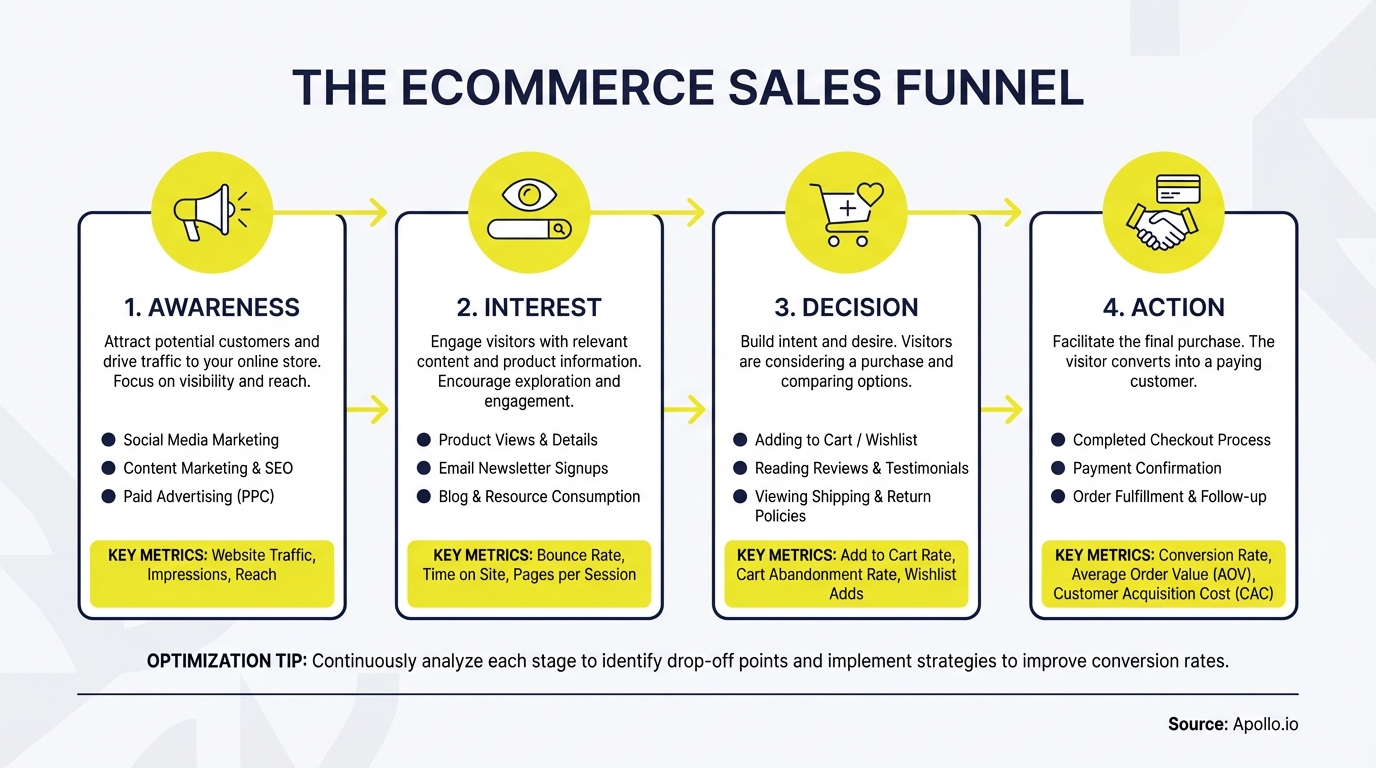
An ecommerce sales funnel is the structured path that guides prospects from initial awareness through consideration, evaluation, and purchase in a digital buying environment. Unlike traditional sales funnels, ecommerce funnels prioritize self-serve experiences and buyer-controlled research over rep-led interactions.
According to SERPSculpt, B2B e-commerce converts at just 1.8%, which is a 311% difference compared to the highest performers. This conversion gap highlights the need for optimized funnel strategies that address buyer friction points across awareness, evaluation, and procurement stages.
The modern B2B ecommerce funnel operates across five core stages:
- Awareness: Anonymous research, category exploration, problem identification
- Consideration: Vendor shortlist formation, feature comparison, requirements definition
- Evaluation: Deep technical review, stakeholder alignment, proof validation
- Decision: Procurement workflows, contract negotiation, risk assessment
- Retention: Onboarding, expansion, renewal optimization
How Do B2B Buyers Navigate Ecommerce Funnels?
B2B buyers conduct extensive self-directed research before engaging sales teams. Research from Wezesha Marketing shows B2B buyers typically consume 13 pieces of content on average before finalizing a purchase (8 pieces from the vendor, 5 from third parties). This behavior requires ecommerce funnels to deliver comprehensive, role-specific content libraries that answer technical, financial, and operational questions without requiring sales conversations.

Modern B2B buying committees include multiple stakeholders with distinct content needs:
| Stakeholder Role | Primary Concerns | Required Funnel Assets |
|---|---|---|
| Procurement | Terms, pricing, vendor risk | Contract templates, payment terms, SLAs |
| IT/Security | Integration, compliance, data handling | Technical specs, security documentation, API guides |
| Finance | ROI, TCO, budget impact | ROI calculators, cost comparison models, case studies |
| Executive | Strategic fit, risk mitigation | Executive briefs, competitive analysis, implementation timelines |
Struggling to identify decision makers across buying committees? Search Apollo's 224M contacts with role, department, and seniority filters to map complete buying committees.
How Do Sales Leaders Build Rep-Free Funnel Assets?
Sales leaders building ecommerce funnels must create self-serve asset libraries that replace traditional sales conversations. The rep-free funnel strategy recognizes that buyers prefer independent research and want sales interactions only when they have specific questions or need negotiation support.
Essential rep-free funnel assets by stage:
Awareness Stage:
- Educational blog content and lead generation strategies
- Industry research reports and trend analysis
- Problem-solution mapping frameworks
- Category comparison content
Consideration Stage:
- Feature comparison matrices
- Implementation methodology documentation
- Customer proof points and case studies
- Total cost of ownership models
Evaluation Stage:

- Technical integration guides and API documentation
- Security and compliance certifications
- Data handling and privacy policies
- Service level agreements and support tiers
Decision Stage:
- Pricing and packaging details
- Contract terms and master service agreements
- Implementation timelines and resource requirements
- Risk mitigation and contingency planning
What Content Governance Framework Supports Ecommerce Funnels?
Content governance ensures ecommerce funnel assets remain accurate, consistent, and aligned with sales messaging. Without governance, organizations create content silos where website materials contradict sales collateral, leading to buyer confusion and deal friction.
A complete governance framework includes:
- Content Taxonomy: Standardized categorization by funnel stage, buyer role, and content type
- Version Control: Change tracking, approval workflows, and deprecation protocols
- Single Source of Truth: Centralized repository for product specs, pricing, and positioning
- Cross-Functional Alignment: Shared content calendar between marketing, sales, product, and legal teams
- Performance Measurement: Asset engagement tracking, conversion impact analysis, and content ROI calculation
RevOps leaders should implement quarterly content audits to identify gaps, remove outdated materials, and validate that funnel assets match current product capabilities and sales analytics insights.
Turn Forecast Guesswork Into Revenue Certainty
Missing quota because your pipeline data is always outdated? Apollo delivers real-time deal intelligence and buying signals so you can forecast with confidence. Built-In increased win rates 10% with Apollo's scoring.
Start Free with Apollo →How Do SDRs Accelerate Ecommerce Funnel Velocity?
SDRs accelerate ecommerce funnel velocity by identifying high-intent prospects, delivering personalized outreach at the right funnel stage, and routing qualified opportunities to account executives. In 2026, SDRs operate as funnel intelligence specialists who analyze buyer behavior signals and trigger contextual engagement.
Modern SDR funnel responsibilities include:
- Monitoring website visitor behavior and content consumption patterns
- Identifying accounts moving from awareness to consideration stages
- Delivering stage-appropriate content based on buyer journey position
- Qualifying leads using BANT (Budget, Authority, Need, Timeline) criteria
- Coordinating multi-threaded outreach across buying committee members
A study by The Digital Bloom found that for B2B SaaS companies (small-to-midsize, $10M-$100M ARR), typical funnel progression shows a visitor-to-lead conversion of 1.4%. SDRs improve this baseline by applying sales intelligence to prioritize accounts showing intent signals like repeat visits, technical documentation downloads, or pricing page engagement.
Spending hours researching prospects manually? Build qualified pipelines faster with Apollo's intent data and automated prospecting workflows.
What Metrics Measure Ecommerce Funnel Performance?
Ecommerce funnel performance requires stage-specific metrics that reveal conversion bottlenecks, content effectiveness, and revenue impact. Tracking macro conversion rates alone misses critical insights about where prospects disengage and which assets drive buyer progression.
Core ecommerce funnel metrics by stage:
| Funnel Stage | Primary Metrics | Optimization Focus |
|---|---|---|
| Awareness | Traffic volume, bounce rate, time on site | Content relevance, page speed, navigation clarity |
| Consideration | Content downloads, return visitor rate, pages per session | Asset quality, cross-linking strategy, personalization |
| Evaluation | Demo requests, pricing page views, technical doc engagement | Proof availability, technical depth, stakeholder coverage |
| Decision | Proposal requests, contract reviews, close rate | Procurement friction, pricing transparency, risk mitigation |
Account executives managing deal pipelines should track funnel velocity metrics including average time in stage, stage conversion rates, and deal value by entry source. These metrics reveal whether marketing generates qualified pipeline and whether sales processes align with buyer timelines.
How to Optimize Ecommerce Funnels for Enterprise Procurement
Enterprise procurement adds complexity to ecommerce funnels through extended buying cycles, multi-stakeholder approval chains, and rigorous vendor evaluation processes. Funnels optimized for enterprise buyers must address legal review, security audits, technical validation, and executive sign-off requirements.
Enterprise funnel optimization strategies:
- Procurement-Ready Documentation: Pre-packaged vendor questionnaires, security attestations, and compliance certifications
- Technical Validation Support: Sandbox environments, proof-of-concept frameworks, and integration testing protocols
- Legal Acceleration Assets: Redlined contract templates, data processing agreements, and service level commitments
- Executive Engagement Content: Business case templates, competitive positioning briefs, and strategic roadmap presentations
- Implementation Planning Tools: Resource estimation calculators, timeline projections, and change management frameworks
Founders and CEOs building B2B SaaS sales funnels should create industry-specific proof packages that address vertical-specific procurement requirements. Healthcare buyers need HIPAA compliance documentation, financial services require SOC 2 attestations, and manufacturing demands integration specifications for legacy systems.
Conclusion
Building an effective ecommerce sales funnel in 2026 requires a rep-free, buyer-enablement approach that delivers role-specific content across awareness, consideration, evaluation, and decision stages. Modern B2B buyers complete most of their purchase journey independently, consuming vendor content and third-party research before engaging sales teams.
Organizations that optimize for self-serve experiences, implement content governance frameworks, and provide procurement-ready assets will outperform competitors relying on traditional seller-led funnels.
Sales leaders should focus on creating comprehensive content libraries that address procurement, technical, financial, and security concerns across buying committee stakeholders. SDRs accelerate funnel velocity by applying sales intelligence to identify high-intent prospects and deliver stage-appropriate outreach.
Account executives close deals faster when marketing provides qualified pipeline and funnel assets that reduce buyer friction during evaluation and procurement stages.
Ready to consolidate your sales tech stack and accelerate funnel velocity? Apollo combines prospecting, engagement, and pipeline management in one platform, helping teams reduce tool complexity while improving conversion rates. "We reduced the complexity of three tools into one," reports Collin Stewart at Predictable Revenue. Request a Demo to see how Apollo streamlines your entire sales funnel.
Prove Apollo's ROI In Your First 30 Days
Budget approval stuck on unclear metrics? Apollo tracks every touchpoint from prospect to closed deal, giving you measurable pipeline impact. Built-In increased win rates 10% and ACV 10% with Apollo's scoring.
Start Free with Apollo →Don't miss these
Sales
Inbound vs Outbound Marketing: Which Strategy Wins?
Sales
What Is a Sales Funnel? The Non-Linear Revenue Framework for 2026
Sales
What Is a Go-to-Market Strategy? The 2026 GTM Playbook
See Apollo in action
We'd love to show how Apollo can help you sell better.
By submitting this form, you will receive information, tips, and promotions from Apollo. To learn more, see our Privacy Statement.
4.7/5 based on 9,690 reviews
