
What Does CRM Mean in Sales? Definition, Strategy, and ROI (2026)
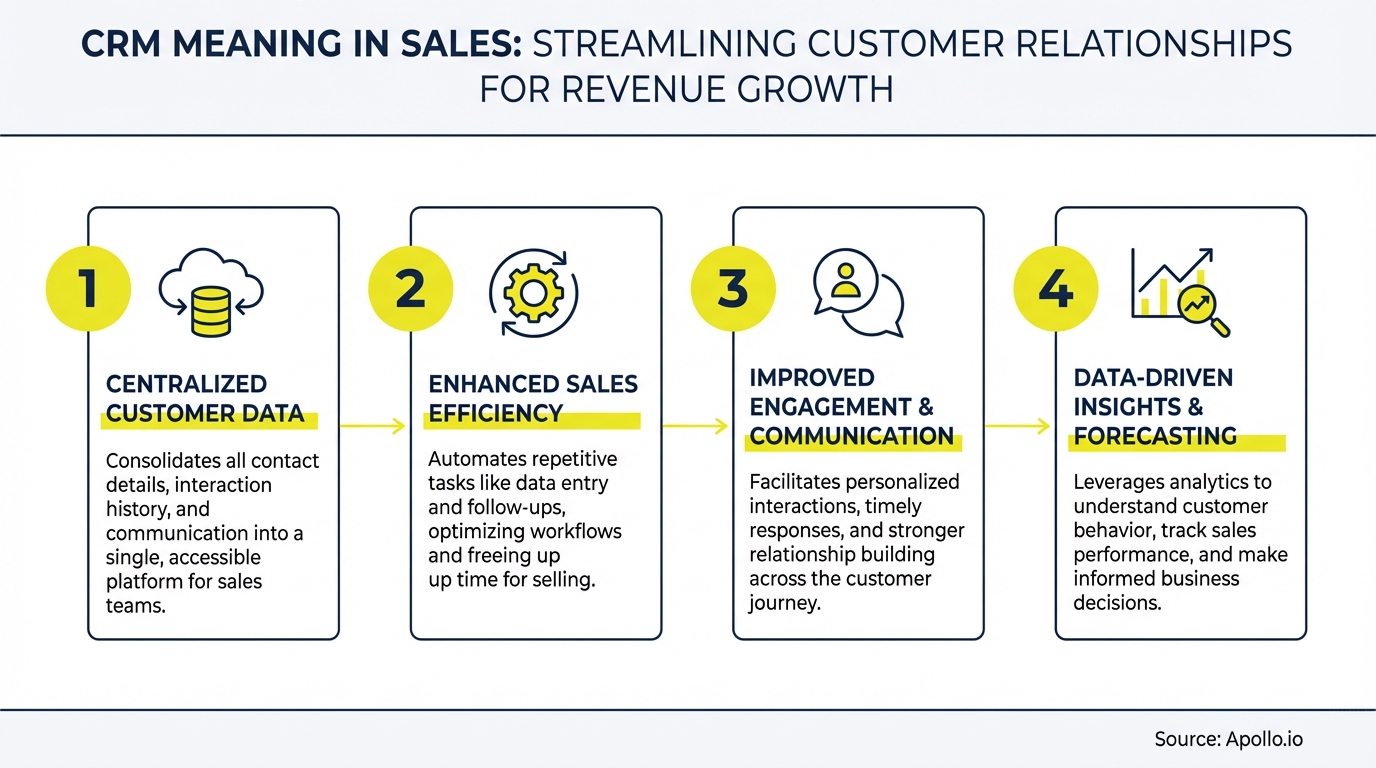
CRM stands for Customer Relationship Management. In sales, it means the system, strategy, and workflows your team uses to track prospects, manage pipeline, and close deals. But the definition has evolved. Today, CRM meaning in sales goes beyond logging calls — it's the operational backbone connecting your CRM integration strategy, data quality, AI workflows, and quota attainment into one unified system.
According to Salesgenie, 91% of businesses with over 11 employees use CRM. Yet most teams still struggle to make CRM translate directly into revenue. This guide closes that gap.

Accurate Data, More Deals Closed
Tired of burning hours verifying contact info that goes nowhere? Apollo surfaces verified business contacts so your team sells instead of searches. 90K+ paying customers trust Apollo to keep their pipeline moving.
Start Free with Apollo →Key Takeaways
- CRM in sales is a system of action, not just a system of record — it should drive next steps, not just log past ones.
- Data quality is the #1 CRM failure point: poor data directly causes revenue leakage and limits AI effectiveness.
- 70% of companies fail to integrate their sales plays into CRM workflows, leaving measurable growth on the table.
- RevOps leaders who treat CRM as a single source of truth see stronger forecast accuracy and coaching outcomes.
- Consolidating your sales tech stack into one platform eliminates data silos and makes CRM ROI measurable.
What Is CRM Meaning in Sales?
CRM in sales is the combination of software, processes, and data governance that helps reps manage relationships from first touch to closed deal. The core objects in any sales CRM are Contacts, Accounts, Opportunities (Deals), and Activities.
Each object maps to a stage in your pipeline and a rep behavior you want to reinforce.
CRM is often confused with a contact database — it is not. A database stores records. A CRM drives action: it surfaces who to call, flags stalled deals, and tells sales leaders where pipeline is at risk. Understanding this distinction is foundational to B2B sales execution.
| CRM Object | Sales Purpose | Owner |
|---|---|---|
| Contact | Track individual buyer relationships | SDR / AE |
| Account | Manage company-level intelligence | AE / RevOps |
| Opportunity | Track deal stage, value, and close date | AE |
| Activity | Log calls, emails, and meetings | All reps |
Why Is CRM Data Quality a Revenue Problem?
CRM value collapses without clean data. Validity's 2024 research of 600+ CRM admins found 31% said poor-quality data costs them at least 20% of annual revenue.
Duplicate records, missing fields, and stale contacts make forecasting unreliable and AI features ineffective.
A practical data governance framework has four layers:
- Ownership: Assign a named data steward per object type (contacts, accounts, deals).
- Entry standards: Required fields at each pipeline stage prevent incomplete records from advancing.
- Deduplication: Run automated dedup rules on import and weekly as a scheduled job.
- Enrichment: Use automated enrichment to fill gaps on firmographics, titles, and contact details.
Tired of dirty data killing your pipeline? Start free with Apollo's 224M+ verified business contacts and keep your CRM records accurate automatically.

How Do RevOps Teams Build a Playbook-to-CRM Blueprint?
A Bain study in 2025 found 70% of companies fail to effectively integrate their sales plays into revenue tech tools including CRM. The fix is mapping each play to specific CRM fields, stage exit criteria, and automated next steps.
Here's a simple blueprint RevOps leaders use:
- Define the play: Name it, assign it to a pipeline stage, and list the required actions (e.g., multi-threaded email sequence + discovery call).
- Map to CRM fields: Each play action corresponds to a required field or activity log entry. No field filled = deal can't advance.
- Set exit criteria: A deal moves from Discovery to Proposal only when specific fields are populated (budget confirmed, decision-maker identified).
- Build a coaching dashboard: Track stage conversion rates, average deal age per stage, and activity volume per rep.
This approach turns your sales analytics from vanity metrics into coaching levers that directly impact quota attainment.
Turn Funnel Gaps Into Qualified Pipeline
Tired of watching marketing leads stall before they ever reach your reps? Apollo surfaces high-intent prospects and keeps your pipeline moving with real-time signals. 550K+ companies trust Apollo to hit their numbers.
Start Free with Apollo →How Does AI Change CRM Meaning for Sales Teams in 2026?
CRM has shifted from a system of record to a system of action. AI features now route leads, generate follow-up emails, surface next-best actions, and flag at-risk deals — all inside the CRM. According to Sellerscommerce, the global AI in CRM market is expected to reach $11.04 billion in 2025, reflecting how central AI has become to CRM strategy.
The catch: AI only works when data is clean and unified. The Salesforce State of Sales (2026 edition) reports 51% of sales leaders with AI say tech silos delay or limit their AI initiatives.
Consolidating your tech stack removes those silos.
For SDRs and AEs, AI-powered CRM means:
- Automated activity logging so reps spend less time on admin.
- AI-generated email drafts tailored to contact context and deal stage.
- Predictive deal scoring that highlights which opportunities need attention now.
- Real-time coaching triggers when a rep's talk pattern or follow-up cadence slips.
Learn how to connect your CRM with AI-powered outreach by reading the Apollo for HubSpot and Salesforce users guide.
What CRM ROI Should Sales Leaders Expect?
CRM ROI is measurable when tied to specific behaviors and outcomes. Research from Cirrus Insight shows the average ROI for CRM systems has grown to $8.71 for every dollar spent, up from $5.60 in 2011.
For sales leaders, the key metrics to track are:
| Metric | What It Measures | Coaching Action |
|---|---|---|
| Stage conversion rate | Where deals stall most | Targeted play reinforcement |
| Average deal age | Pipeline velocity health | Urgency coaching for slow deals |
| Activity-to-meeting ratio | Outreach effectiveness per rep | Messaging or targeting adjustments |
| Forecast accuracy | Commit vs. close alignment | Deal review cadence tightening |
Struggling to get pipeline visibility without spreadsheets? Get complete deal management with Apollo's pipeline tracking and coach your team from real data.
How Does Apollo Fit Into Your CRM Strategy?
Apollo acts as an all-in-one GTM platform that layers on top of or alongside your CRM to handle prospecting, outreach, enrichment, and engagement — without requiring five separate tools. Customers report significant consolidation benefits: "We reduced the complexity of three tools into one" (Predictable Revenue), "We cut our costs in half" (Census), and "Having everything in one system was a game changer" (Cyera).
Apollo integrates natively with Salesforce and HubSpot, syncing contacts, activities, and deal stages bidirectionally. This means your CRM stays clean, your reps stay in one workspace, and your RevOps team has a true single source of truth. Explore the full Apollo CRM integration setup to see how the sync works in practice.
For founders and sales leaders building outbound from scratch, Apollo also replaces the need for a separate prospecting database, sequencing tool, and enrichment service — reducing both cost and integration complexity. See all the ways teams use Apollo in the sales tech stack guide.
What Is the CRM Meaning in Sales? Key Takeaways and Next Steps
CRM meaning in sales has evolved from "contact database" to "revenue execution platform." The teams winning in 2026 treat CRM as their operational source of truth: they govern data quality rigorously, map sales plays to specific fields and exit criteria, and use AI to surface the right actions at the right time.
The formula is straightforward: clean data plus embedded plays plus AI-powered actions equals predictable pipeline and quota attainment. Every element in this article builds toward that outcome.
Ready to make your CRM strategy work harder? Try Apollo free and connect your CRM to 224M+ verified business contacts, AI-powered sequencing, and real-time pipeline intelligence — all in one platform.
Prove Pipeline ROI With Apollo
Budget approval stuck on metrics you can't quantify? Apollo gives sales teams clear pipeline impact from day one. Leadium 3x'd their annual revenue — see your ROI before your next review.
Start Free with Apollo →Don't miss these
Sales
Inbound vs Outbound Marketing: Which Strategy Wins?
Sales
What Is a Sales Funnel? The Non-Linear Revenue Framework for 2026
Sales
What Is a Go-to-Market Strategy? The 2026 GTM Playbook
See Apollo in action
We'd love to show how Apollo can help you sell better.
By submitting this form, you will receive information, tips, and promotions from Apollo. To learn more, see our Privacy Statement.
4.7/5 based on 9,690 reviews
