
Can Your Platform Trigger Emails After a Prospect Visits Your Website?
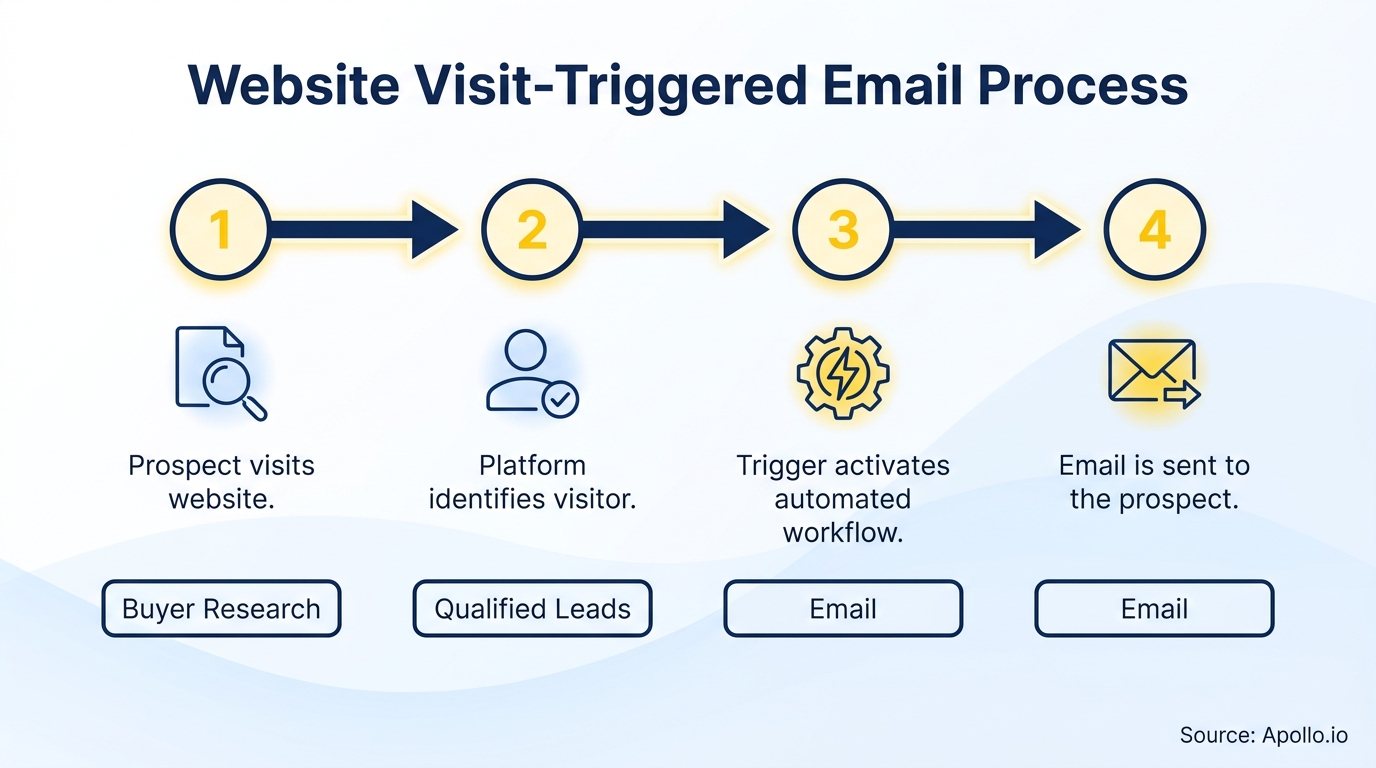
Yes, a platform can trigger emails after a prospect visits your website, but only when the visitor can be tied to a known contact, CRM record, or resolved identity. Anonymous traffic alone is not enough.
Understanding this distinction, and building the right guardrails around it, is what separates high-performing behavior-triggered outreach from workflows that hurt deliverability and buyer trust.
As the B2B buyer journey has shifted dramatically in 2026, prospects research solutions extensively before ever engaging a sales rep. That makes website behavior one of the strongest first-party intent signals available to GTM teams.

Let Apollo Find Your Next Buyer
Tired of burning hours on manual research just to get a bounced email? Apollo delivers verified contacts instantly so your team sells instead of searches. Nearly 100K paying customers have already made the switch.
Start Free with Apollo →Key Takeaways
- Platforms can trigger emails from website visits, but only for identified contacts, not anonymous visitors.
- Behavior-triggered emails significantly outperform broadcast sends in open rates, clicks, and revenue contribution.
- CAN-SPAM applies to B2B emails with no exceptions, making compliance and suppression logic non-negotiable.
- Relevance and timing matter as much as automation: delayed, contextual follow-up outperforms instant generic outreach.
- SDRs and RevOps teams that combine visitor signals with verified contact data close pipeline faster with fewer wasted touches.
Can a Platform Trigger Emails After a Prospect Visits Your Website?
Yes, but the trigger only fires when the visitor is a known, identified contact. Major platforms including HubSpot, Salesforce Marketing Cloud, and Adobe Marketo document web-behavior triggers that enroll contacts into email workflows when a tracked page is visited.
The key requirement: the visitor must already exist as a cookie-matched subscriber, CRM record, or account-resolved identity before any email can send.
According to Insight Mark Research, automated behavior-triggered emails represent only around 2.6% of total sends but generate nearly 47% of email sales in some benchmarks. The performance gap is real, but it depends entirely on the quality of identity resolution behind the trigger.
What Is the Decision Tree for Anonymous vs. Known Visitors?
Whether you can email after a site visit depends on which of four identity states applies to the visitor.
| Visitor Type | Can You Email? | What the Platform Needs |
|---|---|---|
| Known contact (cookie match) | Yes | Email cookie tied to CRM record or subscriber list |
| Form-fill on this visit | Yes | Consent captured at form submission |
| Account-resolved (IP/firmographic ID) | Sales alert only | Matched company domain, not individual identity |
| Fully anonymous | No | No actionable identity signal available |
Account-level identification tells you which company is on your site. It does not tell you who to email. For SDRs, this is the moment to trigger a sales alert and route the account, not send an automated email to a guessed contact. Struggling to turn anonymous account signals into actionable outreach? Apollo's multi-channel sales engagement platform lets you sequence known contacts across email, phone, and social from a single workspace.

How Do SDRs and RevOps Teams Build a Safe Trigger-to-Email Workflow?
A safe, high-performing trigger workflow requires more than an automation rule. RevOps leaders need a checklist covering consent, suppression, frequency, and intent thresholds before any triggered send goes live.
- Consent source: Confirm the contact opted in via form, event, or prior engagement. CAN-SPAM has no B2B exception, and the FTC states each non-compliant commercial email can carry penalties up to $53,088.
- Suppression list: Exclude unsubscribes, current customers, active opportunities (unless appropriate), and DNC contacts before the trigger fires.
- Intent threshold: Not every page visit warrants an email. Pricing, comparison, security, and integration pages signal higher intent than a blog post. Set minimum visit depth or time-on-page rules.
- Frequency cap: Limit triggered sends per contact per rolling 7 or 30 days to avoid complaint spikes.
- Timing window: A sales professional shared on Reddit that receiving a follow-up call four hours after a site visit felt reasonable, but an immediate response would have felt invasive. Build in a delay of at least two to four hours for triggered emails.
- One-click unsubscribe: Required for Google and Microsoft bulk senders. Include it in every triggered send.
For prospect nurturing to convert hesitant leads, these guardrails are what keep automation from becoming a liability.
Turn Funnel Guesswork Into Closed Deals
Pipeline forecasting a guessing game because marketing leads never convert? Apollo surfaces high-intent prospects already primed to buy. Top revenue teams use Apollo to build pipeline that actually closes.
Schedule a Demo →Why Do Triggered Emails Outperform Standard Campaigns?
Triggered emails outperform because they are contextually relevant at the moment of intent. Data from IndustrySelect shows triggered email campaigns achieve a 70.5% higher open rate and 152% higher clicks compared to standard email newsletters. That performance edge comes from timing and relevance, not volume.
Research from Cirrus Insightalso shows companies using automated lead nurturing report a 451% increase in qualified leads. The caveat: those results require the right identity data and message relevance, not just an automation trigger set to fire on any page view.
A Reddit user shared firsthand results from testing visitor-triggered outreach for two months, reporting nearly doubled sales volume by engaging known contacts who had revisited the site. The impact is real, but it requires identified visitors, not anonymous traffic.
What Are the Deliverability Requirements for Automated Website-Triggered Emails?
Deliverability is the most overlooked risk in triggered email automation. Google requires senders above 5,000 daily Gmail messages to use SPF, DKIM, DMARC, TLS, aligned From domains, and one-click unsubscribe.
Microsoft enforced similar requirements for Outlook.com and Hotmail starting May 5, 2025. Triggered emails that skip authentication will fail to reach inboxes regardless of how relevant the content is.
Key deliverability requirements for any triggered send program:
- Authentication: SPF, DKIM, and DMARC records must be configured and aligned before scaling.
- Spam rate: Keep complaint rates below 0.3% for Gmail. Even a small surge in triggered-email complaints can damage domain reputation across all sends.
- Clean contact data: Triggering on stale or unverified emails inflates bounce rates. Use verified B2B contact data to ensure triggered sends reach real inboxes.
- Engagement QA: Monitor open rates, click rates, and unsubscribe rates per trigger workflow, not just per campaign.
Need to ensure your outreach hits verified inboxes? Apollo's data enrichment layer provides 97% email accuracy across 230M+ business contacts, so your triggered sends are based on verified data, not guesswork.
How Should Account Executives and Revenue Teams Orchestrate Website Intent?
For Account Executives managing active pipeline, a prospect revisiting a pricing or security page mid-cycle is a critical signal, not a trigger for another automated email. The right response depends on where the account sits in the buying process.
Use this routing logic for website intent signals:
- No CRM record: Enrich the company, build an ICP-matched contact list, and enroll in a cadence via automated prospecting tools.
- In active opportunity: Alert the AE directly. Do not trigger an automated email that may conflict with ongoing conversations.
- Closed-lost or churned: Route to a re-engagement sequence with appropriate suppression checks.
- Cold contact (known but dormant): Trigger a contextual email referencing the page category visited, not the specific URL.
RevOps leaders who consolidate visitor signals, CRM data, and outreach in one system avoid the misrouting and duplication that comes from stitching together multiple tools. As Cyera noted, "Having everything in one system was a game changer."

How to Get the Most From Website-Triggered Email in 2026
The highest-performing B2B teams in 2026 treat website visits as one signal in a broader intent picture, not a standalone trigger. Pair visit data with email engagement history, CRM stage, and ICP fit before deciding whether the next action is an automated email, a sales alert, or suppression.
Refer to timing best practices for email and calls when setting trigger delays. Combine that with email personalization strategies that match message content to the page category visited, not just a generic follow-up. And always build your workflow automation with suppression, frequency caps, and deliverability checks built in from the start.
Apollo brings prospecting, enrichment, engagement, and workflow automation into a unified GTM platform, so SDRs, AEs, and RevOps teams can act on website intent signals without juggling multiple tools. Schedule a Demo to see how Apollo helps B2B teams turn website visits into qualified pipeline, with the identity data, sequencing, and compliance controls already built in.
Prove Pipeline ROI With Apollo
ROI pressure killing your tool budget? Apollo delivers measurable pipeline impact from day one. Leadium 3x'd annual revenue — see results leadership can't argue with.
Start Free with Apollo →Don't miss these
Sales
Inbound vs Outbound Marketing: Which Strategy Wins?
Sales
What Is a Sales Funnel? The Non-Linear Revenue Framework for 2026
Sales
What Is a Go-to-Market Strategy? The 2026 GTM Playbook
See Apollo in action
We'd love to show how Apollo can help you sell better.
By submitting this form, you will receive information, tips, and promotions from Apollo. To learn more, see our Privacy Statement.
4.7/5 based on 9,690 reviews
