
Business Sales Leads: How to Find and Convert High-Quality Prospects
Business sales leads are the lifeblood of revenue growth in 2026, but the rules have changed. With 61% of B2B buyers preferring rep-free experiences and engaging sellers at 68.3% of the way through their journey, teams must rethink how they identify, qualify, and convert leads.
The shift from static contact lists to signal-based selling requires platforms that consolidate data, engagement, and intelligence in one workspace.
Struggling to find qualified leads? Search Apollo's 224M+ contacts with 65+ filters and cut your tech stack by replacing multiple tools with one all-in-one GTM platform.

Apollo Eliminates Hours Of Daily Research
Tired of spending 4+ hours daily hunting for contact info? Apollo delivers enriched data with 96% email accuracy instantly. Join 2M+ users closing more deals with less effort.
Start Free with Apollo →Key Takeaways
- Business sales leads now prioritize buying signals over form fills, with teams tracking intent, behavior, and first-party data to identify high-value prospects
- Sales and marketing alignment drives measurable results, with organizations achieving 208% higher marketing revenue when teams coordinate effectively
- Modern lead generation consolidates prospecting, enrichment, and engagement into unified platforms, reducing costs and accelerating pipeline velocity
- SDRs and AEs benefit from AI-powered scoring and multi-channel outreach that adapts to buyer preferences in real time
What Are Business Sales Leads?
Business sales leads are potential customers who have expressed interest in your product or service through specific actions or fit your ideal customer profile. In 2026, leads are defined by verified buying signals rather than basic contact information.
These signals include website visits, content downloads, intent data, job changes, funding announcements, and technology adoption patterns.
According to Medium, 51% of website traffic for B2B companies comes from organic search, making content-led lead capture a critical strategy. Teams now layer behavioral data with firmographic and technographic filters to identify prospects actively researching solutions.
Modern lead generation moves beyond MQL/SQL frameworks. Research from Gradient Works shows MQL to SQL conversion rates range from 16-20%, pushing teams to focus on signal strength and buying stage rather than arbitrary qualification thresholds.
How Do SDRs Generate More Business Sales Leads?
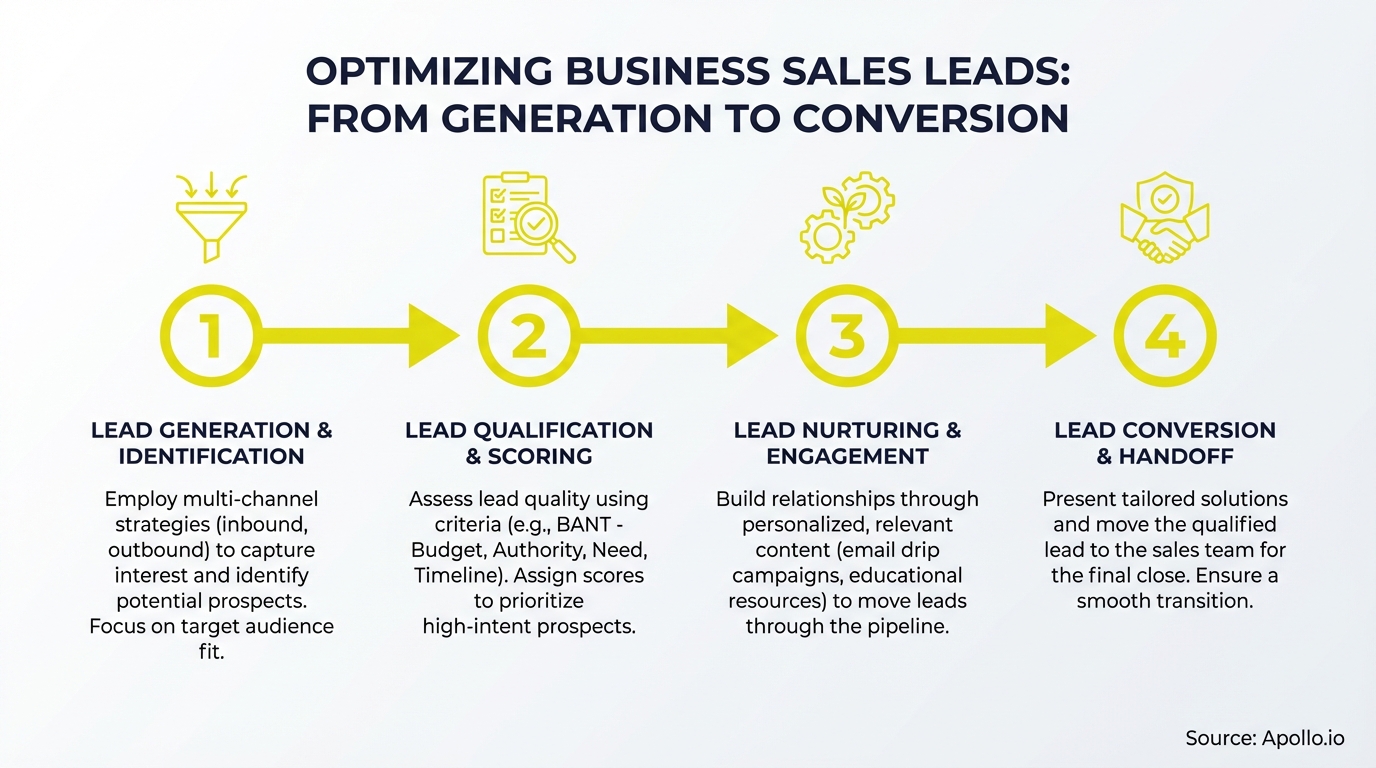
SDRs generate business sales leads by combining targeted prospecting with multi-channel engagement. The most effective approach involves identifying high-fit accounts using intent signals, enriching contact data with verified information, and orchestrating personalized outreach across email, phone, and social channels.
Top-performing SDRs in 2026 use these tactics:
- Signal-based prioritization: Focus on accounts showing active buying signals rather than cold outreach to static lists
- Multi-threaded engagement: Connect with multiple stakeholders within target accounts to accelerate deal velocity
- Personalized sequences: Craft messaging that references specific pain points, recent company news, or technology gaps
- Speed-to-lead execution: Contact prospects within minutes of identifying buying signals to maximize conversion rates
Teams using sales automation tools report measurable time savings by eliminating manual research and enabling SDRs to focus on high-value conversations. The key is balancing automation with authentic personalization that resonates with modern buyers who avoid irrelevant outreach.
Why Is Sales and Marketing Alignment Critical for Lead Quality?
Sales and marketing alignment directly impacts lead quality, conversion rates, and revenue outcomes. When teams coordinate on ICP definitions, lead scoring criteria, and handoff processes, they eliminate the friction that stalls pipeline progression.
Brainstorm Club reports organizations with strong sales and marketing alignment achieve 208% higher marketing revenue than those with poor alignment. This performance gap stems from consistent messaging, shared data, and coordinated buyer experiences across all touchpoints.
The cost of misalignment is substantial. According to LXA Hub, B2B companies' inability to align sales and marketing teams costs 10% or more of revenue per year. This loss manifests through wasted ad spend, abandoned leads, conflicting messaging, and duplicated efforts.
RevOps leaders solve alignment challenges by implementing:
- Unified lead definitions and scoring models accessible to both teams
- Shared dashboards tracking pipeline health and conversion metrics
- Regular sync meetings reviewing lead quality and feedback loops
- Single source of truth platforms that eliminate data silos
"We reduced the complexity of three tools into one," reports Collin Stewart from Predictable Revenue, highlighting how platform consolidation improves alignment by giving teams shared visibility into prospect interactions and pipeline status.

What Lead Generation Strategies Work in 2026?
Lead generation strategies in 2026 prioritize quality over volume, signals over forms, and omnichannel presence over single-touch campaigns. The most effective approaches combine content marketing, intent data, AI-powered personalization, and strategic account targeting.
What Role Does Content Marketing Play?
Content marketing drives cost-effective lead generation at scale. Huble found content marketing generates over three times as many leads as outbound marketing and costs 62% less. This efficiency comes from creating assets that answer buyer questions at each journey stage.
Winning content strategies include SEO-optimized blog posts, comparison guides, ROI calculators, implementation checklists, and customer case studies. These assets work 24/7 to attract, educate, and qualify prospects before sales conversations begin.
How Do Teams Use Intent Data?
Intent data identifies prospects actively researching solutions in your category. Teams layer first-party signals (website behavior, email engagement) with third-party intent indicators (content consumption, review site visits) to prioritize outreach timing and messaging. Learn more about intent data strategies that power smarter prospecting.
What Makes Multi-Channel Outreach Effective?
Modern buyers interact across an average of 10 channels during their journey. Effective multi-channel strategies coordinate touchpoints across email, phone, social selling, direct mail, and events to maintain consistent presence without overwhelming prospects. Social selling tactics complement traditional outreach by building relationships before asking for meetings.
Turn Forecasting Guesswork Into Revenue Certainty
Missing deals because your pipeline data is never current? Apollo delivers real-time deal intelligence and buying signals that make forecasting reliable. Built-In increased win rates 10% with Apollo's scoring.
Start Free with Apollo →How Can AEs Convert Business Sales Leads Faster?
Account Executives convert business sales leads faster by entering conversations with deep prospect intelligence, addressing specific pain points, and demonstrating clear ROI aligned to buyer priorities. The key is leveraging pre-meeting research to personalize demos and proposals for each stakeholder.
High-performing AEs implement these conversion accelerators:
- Pre-call intelligence: Review recent company announcements, tech stack data, and competitor usage before every conversation
- Multi-stakeholder mapping: Identify decision makers, influencers, and champions early to build consensus across buying committees
- Objection pre-emption: Address common concerns proactively with case studies, ROI data, and implementation timelines
- Clear next steps: End every interaction with specific commitments and calendar holds to maintain momentum
Teams using deal management software gain visibility into pipeline health, identify at-risk opportunities, and coach reps on proven closing tactics. "Having everything in one system was a game changer," says the Cyera team, emphasizing how unified platforms reduce context switching and accelerate deal velocity.
What Tools Do Sales Teams Need for Lead Generation?
Sales teams need integrated platforms that combine prospecting, enrichment, engagement, and analytics in one workspace. The tool consolidation trend reflects teams' desire to reduce costs, eliminate data silos, and streamline workflows.
Tired of juggling multiple tools? Build your pipeline with Apollo's unified GTM platform and replace separate prospecting, enrichment, and engagement tools with one solution.
| Capability | Purpose | Impact |
|---|---|---|
| Contact Database | Access verified business contacts with accurate email, phone, and firmographic data | Reduces research time and improves connect rates |
| Sales Engagement | Orchestrate multi-channel sequences with personalized messaging at scale | Increases response rates and booking velocity |
| Data Enrichment | Automatically append missing contact and company information to CRM records | Maintains data quality and enables better segmentation |
| Intent Signals | Identify prospects showing active buying behavior through content consumption and research patterns | Improves targeting and conversion rates |
| Analytics & Reporting | Track pipeline metrics, rep performance, and campaign effectiveness | Enables data-driven optimization and forecasting |
"We cut our costs in half," reports the Census team, demonstrating how platform consolidation delivers financial benefits beyond operational efficiency. Learn how to build a sales tech stack that scales revenue without multiplying vendor relationships.
How Do Sales Leaders Measure Lead Generation Success?
Sales leaders measure lead generation success through outcome-based metrics that connect marketing activities to pipeline and revenue. The shift from vanity metrics (MQL volume, form fills) to business outcomes (pipeline influenced, cost per qualified meeting) reflects the need for accountability and ROI clarity.
Key metrics for 2026 include:
- Cost per qualified meeting: Total lead gen spend divided by meetings booked with ICP accounts
- Signal-to-meeting conversion: Percentage of intent signals that result in scheduled conversations
- Speed-to-lead: Time elapsed between signal detection and first outreach attempt
- Pipeline velocity: How quickly leads progress through each sales stage
- Win rate by source: Closed-won percentage segmented by lead origin channel
Teams leverage sales analytics platforms to track these metrics in real time, identify bottlenecks, and allocate budget to highest-performing channels. The goal is creating feedback loops that continuously improve lead quality and conversion efficiency.
Start Generating Higher-Quality Business Sales Leads
Business sales leads in 2026 require signal-based prospecting, multi-channel engagement, and unified platforms that eliminate tool sprawl. The teams winning pipeline prioritize buying intent over static lists, align sales and marketing around shared definitions, and measure success through outcome-based metrics tied to revenue.
SDRs benefit from consolidated workflows that surface high-intent prospects automatically. AEs accelerate deal velocity with pre-meeting intelligence and multi-stakeholder engagement.
RevOps leaders gain visibility into what's actually driving pipeline through integrated analytics and reporting.
Apollo consolidates prospecting, enrichment, engagement, and analytics in one all-in-one GTM platform, helping teams replace multiple tools with a single workspace. With 224M+ verified business contacts, AI-powered sequences, and real-time intent signals, Apollo enables teams at every stage to build pipeline faster and close more deals.
Ready to transform your lead generation? Request a Demo and see how Apollo helps 90K+ paying customers cut their tech stack and accelerate revenue growth.
Prove Apollo's Value In Your First Week
Budget approval stuck on unclear metrics? Apollo tracks every touchpoint from first email to closed deal. Built-In increased win rates 10% and ACV 10% with Apollo's scoring.
Start Free with Apollo →Don't miss these
Sales
Inbound vs Outbound Marketing: Which Strategy Wins?
Sales
What Is a Sales Funnel? The Non-Linear Revenue Framework for 2026
Sales
What Is a Go-to-Market Strategy? The 2026 GTM Playbook
See Apollo in action
We'd love to show how Apollo can help you sell better.
By submitting this form, you will receive information, tips, and promotions from Apollo. To learn more, see our Privacy Statement.
4.7/5 based on 9,690 reviews
