
Best Sales Software Tools to Accelerate Revenue in 2026
Choosing sales software in 2026 means navigating a crowded market where platforms now blend CRM, engagement, AI automation, and revenue intelligence into unified systems. According to Mordor Intelligence, the global sales software market was valued at USD 31.26 billion in 2025 and is projected to reach USD 71.83 billion by 2031, growing at a CAGR of 14.86% from 2026 to 2031. With buyers completing most research before engaging reps, teams need tools that consolidate prospecting, outreach, and pipeline management into one workspace. This guide helps SDRs, AEs, RevOps leaders, and sales teams evaluate the best sales automation software for 2026.

Apollo Turns Research Hours Into Revenue
Tired of your reps burning half their day verifying contact info instead of closing deals? Apollo delivers 96% email accuracy across 224M contacts so your team sells from minute one. Join 550K+ companies building pipeline faster.
Start Free with Apollo →Key Takeaways
- Modern sales software consolidates CRM, engagement, data enrichment, and AI into unified platforms
- Agentic AI now executes prospecting, outreach, and CRM updates autonomously, not just suggests actions
- Data quality and integration capabilities directly impact pipeline velocity and conversion rates
- Platform pricing models shift from per-seat to usage-based as AI agents handle more work
- Teams save costs by replacing 3-5 separate tools with all-in-one GTM platforms
What Is Sales Software and Why Does It Matter in 2026?
Sales software encompasses platforms that help teams find prospects, engage buyers, manage pipelines, and close deals. In 2026, the category has evolved from standalone CRM systems to integrated go-to-market platforms that combine contact databases, multi-channel engagement, conversation intelligence, and AI automation.
Research from BookYourData shows lead conversion rates can increase by up to 300% with a well-utilized CRM system. The shift matters because buyers now complete 61% of their journey before contacting sellers, making software that enables self-serve research and personalized outreach essential. For SDRs and BDRs prospecting daily, the right platform means finding qualified contacts faster and automating repetitive tasks.
Struggling to find qualified leads across multiple tools? Search Apollo's 224M+ contacts with 65+ filters in one workspace.
What Are the Core Categories of Sales Software?
Sales software in 2026 spans five core categories, though leading platforms now integrate multiple capabilities:
| Category | Primary Function | Key Users |
|---|---|---|
| CRM & Pipeline Management | Track deals, forecast revenue, manage customer relationships | AEs, Sales Leaders, RevOps |
| Sales Engagement | Automate outreach sequences across email, phone, and social channels | SDRs, BDRs, AEs |
| Sales Intelligence & Data | Access verified contact databases, enrich leads, track buyer signals | SDRs, Marketing, RevOps |
| Conversation Intelligence | Record calls, analyze meetings, surface insights from customer conversations | AEs, Sales Leaders, Enablement |
| Sales Enablement | Content management, training, coaching, and performance analytics | Sales Leaders, Enablement, RevOps |
According to Enhencer, by 2025, 85% of business applications are expected to be SaaS-based, up from 70% in 2023. This cloud-first shift means teams expect seamless integrations, mobile access, and real-time data sync across their sales tech stack.

How Do SDRs and AEs Use Sales Software Differently?
SDRs and AEs have distinct workflows that require different software capabilities. SDRs focus on high-volume prospecting and booking meetings, while AEs manage longer sales cycles and close deals.
For SDRs building pipeline:
- Advanced search filters to identify ideal customer profiles across 224M+ contacts
- Automated sequences that mix email, phone, and social touchpoints
- Real-time data enrichment to personalize outreach at scale
- Activity tracking to hit daily prospecting quotas (calls, emails, meetings booked)
For Account Executives closing deals:
- Deal management software with pipeline visibility and forecasting
- Meeting intelligence that surfaces talking points and next steps automatically
- Buying signals that indicate when prospects are ready to engage
- Integration with proposal and contract tools to accelerate close
Data from Sales Odyssey shows sales representatives using a CRM exceed the annual sales target by 24%. The key difference: SDRs need velocity tools, while AEs need relationship and deal intelligence.
Turn Weak Leads Into Real Pipeline
Tired of marketing leads that never convert to opportunities? Apollo surfaces in-market buyers with precision targeting so your team stops chasing dead ends. Join 550K+ companies building predictable pipeline.
Start Free with Apollo →What Are the Must-Have Features in 2026 Sales Software?
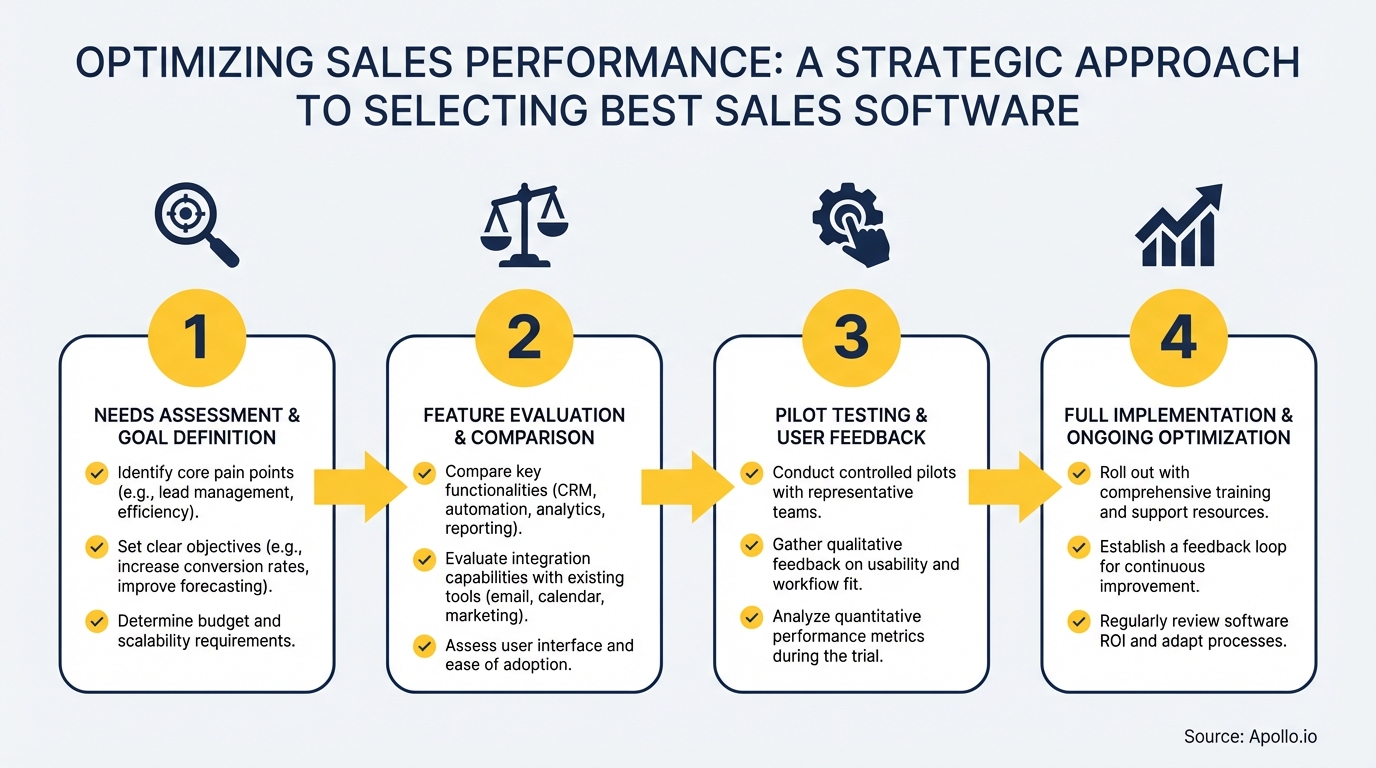
Evaluating sales software in 2026 requires assessing both table-stakes features and emerging AI capabilities:
Essential capabilities:
- Verified contact database: Access to accurate B2B data with 96%+ email accuracy
- Multi-channel engagement: Unified sequences across email, phone, and social
- Native CRM or deep integrations: Bi-directional sync with Salesforce, HubSpot, or built-in pipeline management
- Data enrichment: Automatic contact and company data updates
- Reporting and analytics: Activity tracking, conversion metrics, and revenue attribution
AI and automation (2026 differentiators):
- Agentic AI: Autonomous prospecting, research, and follow-up (not just suggestions)
- Conversation intelligence: AI call assistants that take notes and suggest next steps
- Intent signals: Buyer behavior tracking that surfaces hot accounts
- Smart routing: Automatic lead assignment based on fit and engagement
For RevOps teams managing tech stacks, integration depth and data governance matter as much as features. Platforms that consolidate multiple point solutions reduce admin overhead and improve data quality.
How Does Apollo Consolidate Your Sales Tech Stack?
Apollo combines sales intelligence, engagement, and pipeline management into one platform, eliminating the need for separate prospecting, enrichment, and outreach tools. Teams at Predictable Revenue report, "We reduced the complexity of three tools into one," while Census notes, "We cut our costs in half."
What Apollo offers in one workspace:
- 224M+ verified contacts and 30M+ companies: Built-in database with 96% email accuracy
- Sales engagement platform: Multi-channel sequences with email, phone, and social
- AI-powered automation: Agentic AI for prospecting, personalization, and follow-up
- Conversation intelligence:AI call assistant that summarizes meetings and suggests actions
- Deal management: Pipeline tracking, forecasting, and revenue operations
Spending hours juggling separate tools for data, outreach, and CRM updates? Consolidate your GTM stack with Apollo's all-in-one platform.
For teams evaluating sales software for small businesses or enterprise sales execution, Apollo scales from startups to mid-market and enterprise organizations. Cyera's team noted, "Having everything in one system was a game changer" when describing their shift to a unified platform.
What Should Sales Leaders Evaluate When Choosing Software?
Sales leaders and founders selecting software for their teams should prioritize these decision factors:
| Evaluation Criteria | Why It Matters | What to Look For |
|---|---|---|
| Data Quality | Poor data costs organizations millions in wasted outreach and missed opportunities | Email accuracy rates, data refresh frequency, verification processes |
| Ease of Adoption | Complex tools slow onboarding and reduce rep productivity | Intuitive UI, training resources, time-to-first-value under 1 week |
| Integration Ecosystem | Disconnected tools create data silos and manual work | Native CRM sync, Slack/Teams integration, API access for custom workflows |
| Total Cost of Ownership | Hidden costs emerge from add-ons, user limits, and separate tool subscriptions | Transparent pricing, included features, cost per consolidated tool replaced |
| AI Governance | Autonomous AI requires controls to prevent spam or compliance issues | Admin settings, approval workflows, audit logs for AI-generated actions |
For teams managing outbound sales programs, software that provides both velocity (automation) and control (governance) enables sustainable scale. Sales leaders should also assess vendor support quality, uptime SLAs, and customer success resources.
Conclusion: Choose Sales Software That Consolidates and Scales
The best sales software in 2026 eliminates tool sprawl by combining prospecting, engagement, intelligence, and pipeline management in one platform. With the market growing to $71.83 billion by 2031 and agentic AI transforming how teams work, the right choice comes down to data quality, integration depth, and total cost of ownership.
For SDRs booking meetings, AEs closing deals, and RevOps leaders managing tech stacks, platforms that consolidate capabilities deliver faster onboarding, cleaner data, and measurable cost savings. Teams report cutting costs in half and reducing complexity from three tools to one when they move to unified GTM platforms.
Ready to see how Apollo consolidates your sales tech stack? Start a free trial and access 224M+ verified contacts, multi-channel sequences, and AI-powered automation in one workspace.
Prove Pipeline ROI With Apollo
Budget approval stuck on unclear metrics? Apollo surfaces measurable pipeline impact from day one — so you walk into every renewal conversation with proof. Leadium 3x'd revenue. Your board meeting could look the same.
Start Free with Apollo →Don't miss these
Sales
Inbound vs Outbound Marketing: Which Strategy Wins?
Sales
What Is a Sales Funnel? The Non-Linear Revenue Framework for 2026
Sales
What Is a Go-to-Market Strategy? The 2026 GTM Playbook
See Apollo in action
We'd love to show how Apollo can help you sell better.
By submitting this form, you will receive information, tips, and promotions from Apollo. To learn more, see our Privacy Statement.
4.7/5 based on 9,690 reviews
