
Best Sales Engagement Platforms for RevOps Teams That Own Sequencing and Routing
RevOps teams that own sequencing and routing face a problem most sales engagement platforms weren't built to solve: governance. Reps want freedom to prospect; RevOps needs control over suppression lists, frequency caps, ICP entry rules, and routing SLAs.
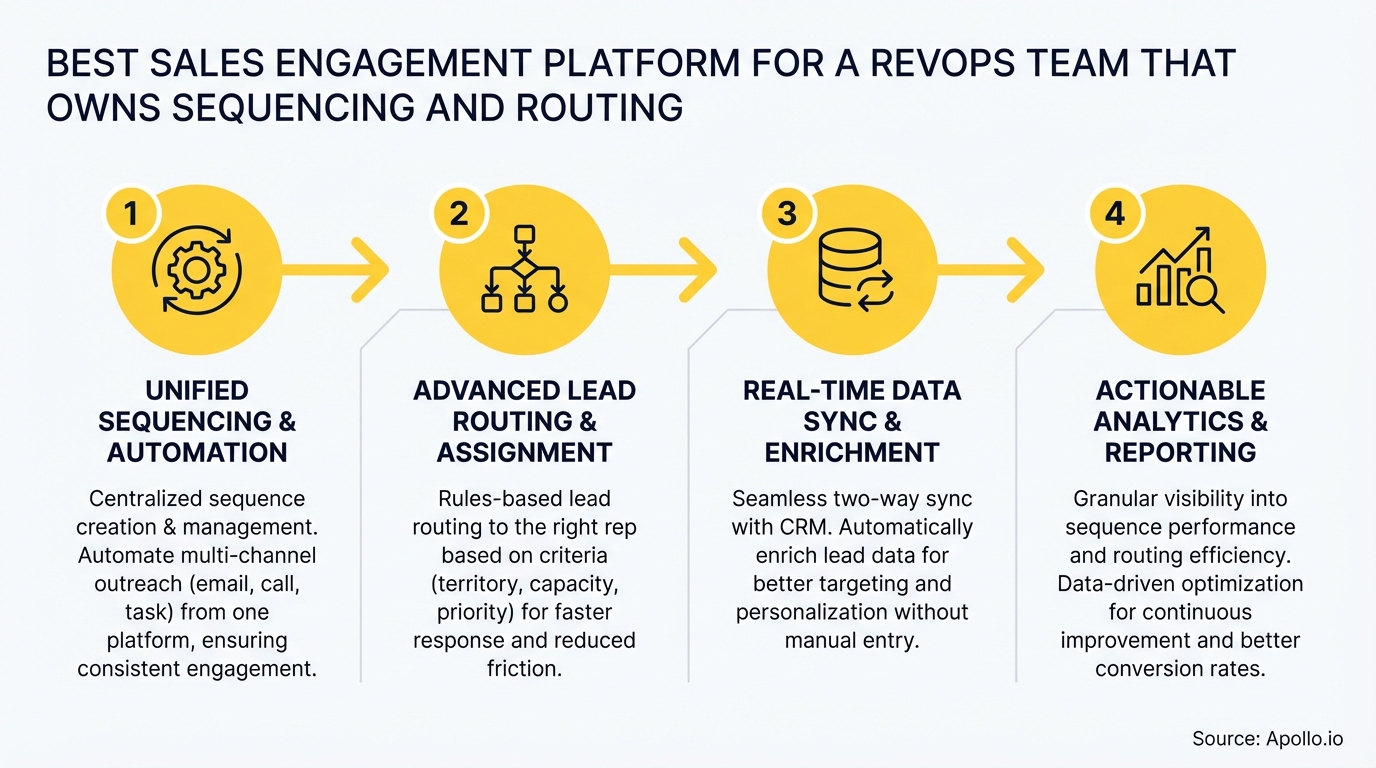
Most tools give you one or the other. The best sales engagement platform for a RevOps team that owns sequencing and routing gives you both, inside a single unified workspace.
The market pressure is real. According to Grand View Research, the global RevOps market was estimated at USD 4.39 billion in 2024 and is projected to reach USD 16.98 billion by 2033. RevOps is no longer a back-office function. It owns the pipeline. And the platform it chooses for sequencing and routing determines whether that pipeline is clean, compliant, and converting. See how RevOps can lead sales transformation at your organization.

Research Less, Pipeline More With Apollo
Tired of burning hours verifying contacts before a single email goes out? Apollo surfaces accurate, ready-to-work leads so your reps spend time selling — not searching. Join 600K+ companies building pipeline faster.
Start Free with Apollo →Key Takeaways
- The best platform for RevOps-owned sequencing combines governance controls (suppression, frequency caps, approval workflows) with flexible multi-channel automation, not just rep-facing cadence tools.
- Routing precision matters more than routing speed: the goal is time-to-first-relevant-touch, not just assignment speed.
- A Gartner survey found 73% of B2B buyers actively avoid suppliers who send irrelevant outreach, making RevOps governance a direct revenue lever.
- Platform consolidation reduces integration debt: teams that unify sequencing, routing, data, and AI in one workspace eliminate the governance gaps that siloed tools create.
- Apollo gives RevOps teams a single platform for prospecting, sequencing, workflow automation, and routing, trusted by nearly 100K paying customers including Anthropic, Cyera, and Census.
Why Do RevOps Teams Need a Different SEP Evaluation Rubric?
RevOps teams evaluate sales engagement platforms differently than individual reps because they're responsible for system-wide governance, not just personal productivity. A rep wants a tool that makes outreach easy.
RevOps needs a platform that enforces ICP rules, prevents duplicate enrollment, manages opt-out suppression, and routes leads to the right rep based on fit and intent signals, not just round-robin assignment.
A Gartner survey of 632 B2B buyers found that 73% actively avoid suppliers who send irrelevant outreach. That statistic has a direct operational implication: without RevOps-controlled sequence governance, reps burning through contacts with off-ICP messaging destroys pipeline quality and sender reputation.
The platform has to support policy enforcement, not just workflow flexibility.
The Clari and Salesloft merger (completed December 2025) signals where the market is heading: engagement execution bundled with revenue context and forecasting governance. RevOps teams evaluating platforms in 2026 should prioritize this convergence of workflow execution and policy control.
What Is the RevOps Governance Rubric for Sequencing and Routing?
The RevOps governance rubric for sequencing and routing is a structured evaluation framework covering suppression logic, frequency controls, approval workflows, routing rules, and auditability, applied before any platform purchase decision.
| Governance Criterion | What to Evaluate | Why It Matters |
|---|---|---|
| Suppression Logic | Global opt-out lists, domain suppression, CRM sync | Prevents outreach to customers, competitors, or opted-out contacts |
| Frequency Caps | Daily/weekly contact limits, step spacing rules | Protects sender reputation and buyer experience |
| Sequence Approval Workflows | Admin review before sequences go live | Ensures messaging aligns with ICP and brand standards |
| Routing Rules Engine | Territory, segment, intent-based, round-robin with fallback | Routes based on fit and signal, not just availability |
| Audit Trails | Log of who enrolled whom, which step triggered, when | Enables QA, compliance review, and attribution |
| AI Guardrails | Human approval before AI-drafted steps send, tone controls | Prevents off-brand or non-compliant AI-generated outreach |
Research from Konnectify shows that organizations with acceptable data quality are 50% more likely to use automatically integrated platforms and 60% more likely to implement custom solutions. Data fidelity isn't just a hygiene issue; it directly determines whether your routing rules and suppression lists actually work.
How Do RevOps Leaders Align Lifecycle Definitions with Routing Rules?
RevOps leaders align lifecycle definitions with routing rules by mapping each lead status (MQL, SQL, SAL) to a specific sequence entry condition and routing trigger, so the platform enforces the definition automatically rather than relying on rep judgment.
A Gartner survey of 243 CSOs found that 49% say Sales' definition of a qualified lead differs greatly from Marketing's. That misalignment creates broken routing handoffs: leads that Marketing calls MQL get worked differently by each rep, sequences overlap, and SLAs go unenforced.
The fix is codifying definitions inside the platform's workflow engine, not just in a shared doc.
Practical lifecycle-to-routing blueprint:
- MQL trigger: Intent signal + ICP fit score threshold met → auto-enroll in inbound nurture sequence → route to SDR queue with 5-minute SLA alert
- SQL trigger: SDR qualifies via discovery call → status update in CRM → auto-route to AE with account context attached
- Disqualified: Contact suppressed from all active sequences; flagged in CRM; removed from routing queue
- Re-engagement: 90-day dormant signal → auto-enroll in re-engagement sequence only if not currently owned by AE
Apollo's workflow automation engine lets RevOps codify these rules directly in the platform, tying CRM field changes, intent signals, and contact properties to sequence enrollment and routing actions without custom code.

How Should RevOps Teams Govern Omnichannel Sequencing?
RevOps teams govern omnichannel sequencing by setting channel-specific rules within the sequence builder: which channels activate at which step, what signals trigger a branch, and what frequency limits apply per channel per contact.
McKinsey's 2024 B2B Pulse Survey of nearly 4,000 decision makers found buyers use an average of 10 interaction channels in the buying journey. A sequence that only covers email and phone misses how modern buyers actually engage.
RevOps-owned sequences need branching logic tied to engagement signals: if a contact opens an email but doesn't reply, branch to a call step; if they click a pricing link, trigger an instant meeting booking workflow.
Omnichannel governance checklist for RevOps:
- Define which channels are permitted per segment (e.g., no cold calls for enterprise accounts in sequence step 1)
- Set global frequency caps per channel (e.g., max 2 emails per week per contact)
- Configure signal-based branching: engagement actions trigger next-best steps automatically
- Apply suppression rules across all channels simultaneously, not per-channel
- Audit channel mix quarterly against reply rate and meeting conversion data
Spending hours manually managing sequence steps and channel switches? Automate your multi-channel sequences with Apollo's sales engagement platform and let RevOps set the rules once, at scale.
Turn Funnel Guesswork Into Pipeline Confidence
Tired of watching marketing leads stall before they ever reach your pipeline? Apollo surfaces in-market buyers with the signals your team needs to act first. 600K+ companies stopped guessing and started closing.
Start Free with Apollo →How Do SDRs and RevOps Leaders Use Apollo Together for Sequencing and Routing?
SDRs use Apollo's sequence builder to execute outreach inside RevOps-defined guardrails, while RevOps leaders use Apollo's workflow engine and analytics layer to enforce governance, monitor compliance, and iterate on sequence performance, all in one platform.
This division of labor is critical.
SDRs get pre-approved sequence templates and contact pools filtered by ICP rules.
RevOps controls which sequences can be activated, who can enroll contacts, and what suppression lists apply globally. AEs get routed leads with full contact history, prior sequence touchpoints, and CRM context already populated.
Apollo consolidates the entire workflow: multichannel sales engagement, verified contact data from 230M+ people, AI-assisted messaging, and routing automation in one workspace. As Cyera put it, "Having everything in one system was a game changer." Census added: "We cut our costs in half." Predictable Revenue noted: "We reduced the complexity of three tools into one."
For RevOps leaders evaluating platforms, see the full Apollo vs. Outreach vs. Salesloft comparison to understand governance capabilities side by side.
What AI Guardrails Should RevOps Require in a Sequencing Platform?
RevOps should require human-in-the-loop approval before AI-drafted sequence steps send, plus role-based permissions that restrict which reps can activate AI personalization, and full audit logs of AI-generated content.
Agentic AI is moving from suggesting next steps to executing them automatically. That shift raises the governance bar.
When an AI agent can draft, personalize, schedule, and advance a sequence step, RevOps needs controls that prevent off-brand messaging, non-compliant claims, or outreach to suppressed contacts from slipping through. The platform must log what the AI generated, who approved it, and when it sent.
AI governance checklist for RevOps:
- AI-drafted steps require admin or manager approval before activation
- Tone and messaging guardrails configured at the sequence template level
- AI personalization limited to approved data fields (title, company, industry), not inferred attributes
- Full audit trail: AI-generated vs. human-written steps clearly labeled in sequence logs
- Opt-out and suppression logic applies to AI-triggered steps, same as manual steps
Apollo's AI sales automation is tailored based on input and context provided by your team, with RevOps-controlled templates ensuring AI output stays within your defined parameters.
Teams using Apollo's AI-powered messaging have seen a 35% increase in bookings.
How Should RevOps Measure ROI from Sequencing and Routing Governance?
RevOps should measure ROI from sequencing and routing governance by tracking time-to-first-relevant-touch, sequence-to-meeting conversion by segment, routing SLA compliance rate, and sequence opt-out rate as primary indicators.
Research from Forecastio indicates that implementing RevOps can lead to a 10-20% increase in sales productivity. That productivity gain compounds when sequencing governance reduces wasted touches on off-ICP contacts and routing precision cuts time-to-first-relevant-touch from days to minutes.
| Metric | What It Measures | Target Benchmark |
|---|---|---|
| Time-to-First-Relevant-Touch | Speed from routing trigger to first personalized outreach | Under 5 minutes for inbound MQLs |
| Sequence-to-Meeting Rate | % of enrolled contacts who book a meeting | Varies by segment; track trends over time |
| Routing SLA Compliance | % of routed leads worked within defined SLA window | 90%+ for inbound leads |
| Sequence Opt-Out Rate | % of contacts who opt out per sequence | Declining trend signals governance improvement |
| Suppression Hit Rate | Contacts blocked by suppression rules before enrollment | Rising rate = governance working correctly |
For deeper guidance on building the full tech stack around these metrics, see How to Build a Sales Tech Stack That Scales Revenue and explore the top 3 sales sequences in Apollo with real examples.

Which Platform Is Best for a RevOps Team That Owns Sequencing and Routing in 2026?
Apollo is the best sales engagement platform for a RevOps team that owns sequencing and routing in 2026 because it combines verified contact data, multi-channel sequence automation, AI-assisted messaging, workflow-based routing, and governance controls in a single workspace, eliminating the integration debt that siloed tools create.
According to Arovy, 48% of companies now have a RevOps function, up 15% from the prior year. As RevOps ownership expands, the platform it selects for sequencing and routing becomes the operational backbone of the entire GTM motion. A platform that forces RevOps to stitch together a separate sequencing tool, a separate routing layer, and a separate data provider creates three governance gaps instead of one unified policy layer.
Apollo gives RevOps teams:
- Sequencing governance: Template-level controls, suppression list enforcement, frequency caps, and approval workflows
- Signal-based routing: Workflow automation triggered by CRM fields, intent data, and engagement signals
- AI with guardrails: AI messaging tailored to RevOps-defined parameters, with audit trails
- Unified data: 230M+ verified contacts with 65+ filters, so routing rules apply to clean, enriched records
- Stack consolidation: Prospecting, sequencing, dialer, meeting booking, and analytics in one platform
Trusted by nearly 100K paying customers including Anthropic, Smartling, and Cyera, Apollo earned the 2026 MarTech Breakthrough Award for Best AI-Powered Sales Solution and the G2 2026 Best Software Award. For RevOps teams ready to own sequencing and routing with real governance controls, schedule a demo and see Apollo in action.
Prove Pipeline ROI From Day One
ROI pressure killing your tool budget before it even launches? Apollo delivers measurable pipeline impact fast — 4x more meetings, +10% win rates, +50% YoY growth. Real results your CFO can't argue with.
Schedule a Demo →Don't miss these
Sales
Inbound vs Outbound Marketing: Which Strategy Wins?
Sales
What Is a Sales Funnel? The Non-Linear Revenue Framework for 2026
Sales
What Is a Go-to-Market Strategy? The 2026 GTM Playbook
See Apollo in action
We'd love to show how Apollo can help you sell better.
By submitting this form, you will receive information, tips, and promotions from Apollo. To learn more, see our Privacy Statement.
4.7/5 based on 9,690 reviews
