
What Is the Best Sales CRM for Small Business in 2026?
Choosing the best sales CRM for small business in 2026 is more consequential than ever. With AI agents now executing workflows across pipeline, outreach, and forecasting, the wrong pick doesn't just cost money; it costs pipeline. If you're evaluating options for your team, start with small business sales software that actually scales rather than tools built for enterprise complexity.
The good news: CRM ROI is real. Nucleus Research reports CRM returns $3.10 for every $1 spent. The challenge is getting there. A Bain 2025 survey of 1,200+ senior commercial executives found 70% of companies fail to effectively integrate their sales plays into CRM and revenue technology tools, and only about 20% have realized full value.

Accurate Leads, Less Research With Apollo
Tired of burning hours verifying contact info that goes nowhere? Apollo delivers 97% email accuracy so your team spends time selling, not searching. Nearly 100K paying customers have already made the switch.
Start Free with Apollo →Key Takeaways
- The best sales CRM for small business in 2026 must combine contact data, pipeline tracking, and outreach in one place to avoid tool sprawl.
- CRM ROI depends on activation, not just adoption. Most SMBs underuse what they buy.
- AI features are now a buying criterion, but governance and data quality determine whether those features actually work.
- According to Happsales, companies using CRM systems have observed a 17% increase in lead conversions, a 16% boost in customer retention, and a 21% improvement in sales productivity.
- The total cost of ownership goes beyond seat price. AI bundles, credits, and integrations add up fast.
What Makes a CRM the Best Choice for Small Business Sales Teams?
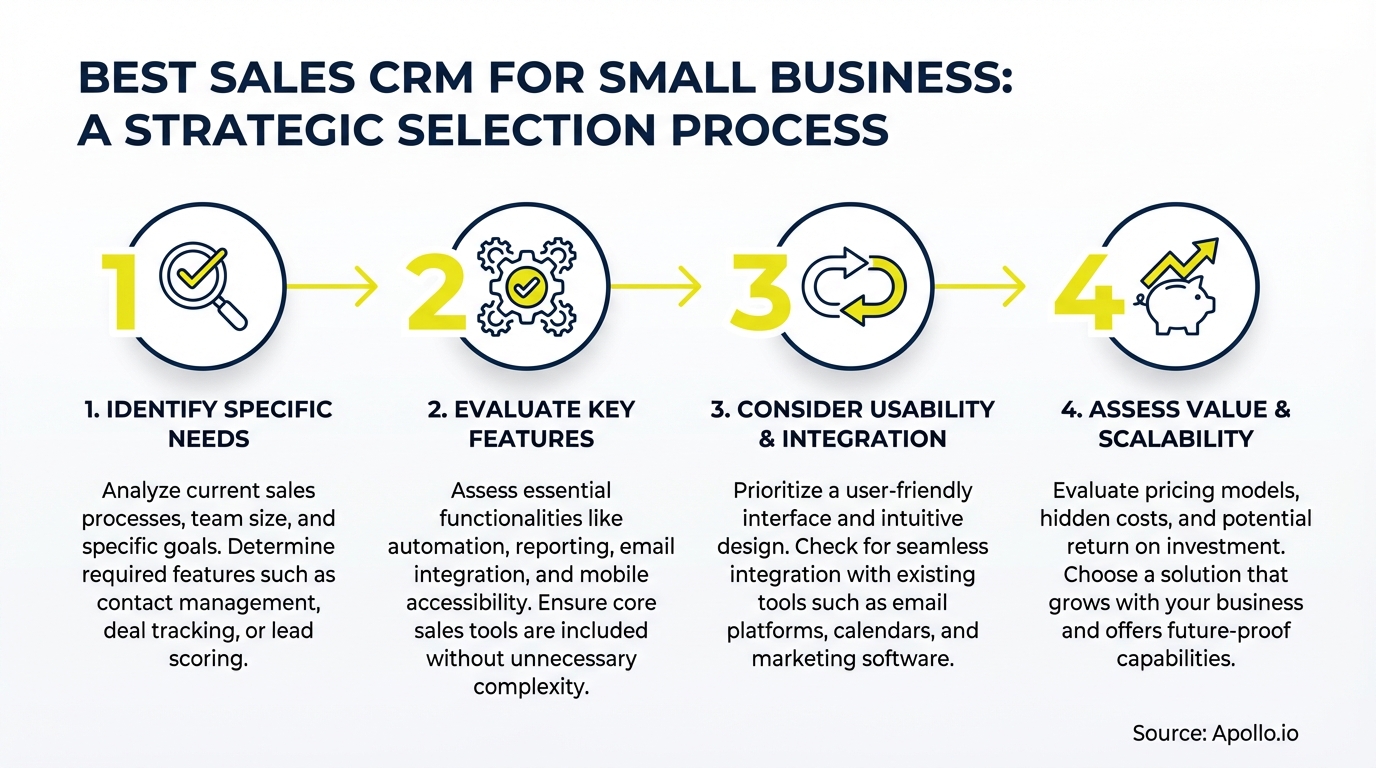
The best sales CRM for a small business is one your team will actually use, and that connects prospecting, outreach, and pipeline without requiring five separate tools. According to CX Today, ease of use, scalability, integration capabilities, mobile accessibility, and customization options are critical considerations for small businesses selecting a CRM.
For B2B teams, the feature bar is higher. Capsule CRM notes that important CRM features for B2B sales include account-based contact management, customizable sales pipelines, quote and proposal management, contract and deal value tracking, role-based permissions, and integration with ERP and support systems.
| Must-Have Feature | Why It Matters for SMBs |
|---|---|
| Contact & account management | Single source of truth for your book of business |
| Pipeline visualization | Forecast revenue and prioritize deals at a glance |
| Email & sequence automation | Scale outreach without adding headcount |
| Native integrations | Avoid manual data entry between tools |
| AI-assisted workflows | Speed up prospecting, scoring, and follow-up |
How Should SDRs and Founders Evaluate CRM Options in 2026?
SDRs and founders building outbound need to evaluate CRM differently than enterprise buyers. The priority is speed to pipeline, not configuration flexibility.
For SDRs, the question is: can I prospect, sequence, and track replies without switching tabs? For founders, it's: does this replace three tools or add a fourth?
In 2026, the evaluation has shifted from feature checklists to governance and AI controllability. Vendors are moving from AI assistants to AI agents that take actions across CRM objects.
That raises the stakes on data quality, audit trails, and who controls what the agent does. Before buying, ask vendors to show you exactly how their AI acts on your pipeline, not just how it drafts emails.
- SDRs: Prioritize built-in sequences, contact enrichment, and call logging in one workspace.
- AEs: Look for deal management, activity tracking, and forecast visibility without manual updates.
- RevOps: Require a clean CRM integration strategy with your existing stack before committing.
- Founders: Prioritize consolidation. "We reduced the complexity of three tools into one" (Predictable Revenue).
Struggling to find qualified leads before they even enter your CRM? Search Apollo's 230M+ contacts with 65+ filters and pipe them directly into your pipeline.

What Is the True Total Cost of Ownership for an SMB CRM?
Seat price is the starting point, not the finish line. In 2026, AI features are increasingly bundled into higher tiers or sold as usage-based add-ons. "Cheap per seat" can become expensive fast when you factor in credits, automation limits, and enrichment costs.
A practical TCO framework for SMBs:
- Base seats: Per-user monthly cost at your current team size and projected 12-month headcount
- AI tier premium: What does the AI plan cost vs. the standard plan?
- Integration costs: Native vs. third-party connectors, and who maintains them
- Data enrichment: Does the CRM include contact data, or do you pay a separate vendor?
- Switching costs: Data migration, retraining, and productivity loss during transition
Metrigy's 2026 research found that among companies evaluating CRM replacements, cost (37.2%) and end-of-contract re-evaluations (39.7%) are the top two drivers. Negotiate annual contracts with renewal caps and insist on transparent AI credit pricing before signing.
Turn Funnel Gaps Into Pipeline Gold
Pipeline forecasting a guessing game? Apollo surfaces high-intent prospects and moves them from lead to opportunity faster. Nearly 100K paying customers have already replaced guesswork with predictable revenue.
Start Free with Apollo →How Does a 30/60/90-Day CRM Activation Plan Work for Small Teams?
Most SMBs buy a CRM and never fully activate it. Bain's research makes this concrete: only about 20% of companies have realized full value from their revenue technology.
An activation-first approach closes that gap.
| Phase | Focus | Key Actions |
|---|---|---|
| Days 1-30 | Foundation | Import contacts, define pipeline stages, set required fields, connect email |
| Days 31-60 | Activation | Build first sequence, enable lead scoring, create one dashboard per role |
| Days 61-90 | Optimization | Review conversion rates by stage, activate AI features, audit data hygiene |
Data quality is the prerequisite for AI. Before turning on any AI-assisted feature, audit your contact records for completeness, remove duplicates, and standardize field formats.
AI quality depends entirely on clean, connected context in your CRM.
For guidance on connecting your tools without rebuilding everything, see how to connect HubSpot, Salesforce, and Apollo fast.
Why Do Most Small Businesses Underperform with Their CRM?
The gap between CRM adoption and CRM value is an activation problem, not a features problem. SMB CRM adoption sits at 52.5% for firms under 250 employees, compared to 78.4% for larger companies (Metrigy, Jan 2026).
Even among adopters, most teams only use basic contact and deal tracking.
Common failure patterns:
- No defined pipeline stages aligned to actual buyer behavior
- Manual data entry that creates inconsistent records
- AI features enabled before data quality is validated
- No role-specific dashboards, so reps ignore the tool
- Integrations stitched together with third-party connectors that break on updates
For RevOps leaders, the fix starts with a clean data sync strategy that keeps your CRM and engagement tools in alignment. "Having everything in one system was a game changer" (Cyera).
Spending hours on manual outreach that never makes it back into your CRM? Automate your sequences with Apollo's multi-channel platform and keep every touchpoint synced automatically.

How Does Apollo Fit Into a Small Business Sales Stack?
Apollo is an all-in-one GTM platform that consolidates prospecting, outreach, enrichment, and pipeline management in one workspace. For small B2B teams, this matters because it eliminates the cost and complexity of stitching together a separate data vendor, engagement tool, and CRM.
Apollo integrates natively with Salesforce and HubSpot, so teams that already have a CRM can use Apollo as the prospecting and engagement layer on top. Teams without a CRM can use Apollo's built-in deal management to track pipeline from first contact to close. Either way, the result is fewer tools, cleaner data, and faster ramp for new reps.
Apollo serves 2M+ users across 600K+ companies. Nearly 100K are paying customers, including teams at Anthropic, Superside, and Cyera. For a full picture of how the platform connects to your existing stack, see Apollo's AI GTM system for CRM integration and outreach.
What Is the Best Next Step for Choosing a Sales CRM?
The best sales CRM for your small business in 2026 is the one your team activates fully, not just the one with the longest feature list. Start with your activation plan before you evaluate vendors.
Define your pipeline stages, required fields, and the three workflows you need running in 30 days. Then match those requirements to tools, not the other way around.
For teams building outbound from scratch, consolidating a fragmented stack, or looking to add AI-driven prospecting without adding another vendor, Apollo gives you contact data, sequences, enrichment, and pipeline in one place. "We cut our costs in half" (Census).
Ready to see how Apollo fits your sales motion? Request a Demo and get a walkthrough built around your team size and goals.
Prove Pipeline ROI With Apollo
Budget approval stuck on unclear metrics? Apollo surfaces measurable pipeline impact from day one. Leadium 3x'd their annual revenue — your CFO will thank you.
Start Free with Apollo →Don't miss these
Sales
Inbound vs Outbound Marketing: Which Strategy Wins?
Sales
What Is a Sales Funnel? The Non-Linear Revenue Framework for 2026
Sales
What Is a Go-to-Market Strategy? The 2026 GTM Playbook
See Apollo in action
We'd love to show how Apollo can help you sell better.
By submitting this form, you will receive information, tips, and promotions from Apollo. To learn more, see our Privacy Statement.
4.7/5 based on 9,690 reviews
