
Best CRM for Sales Reps: Top Platforms Compared for 2026
Sales reps need a CRM that handles prospecting, pipeline tracking, and deal management in one place. The right platform eliminates manual data entry, provides AI-driven insights, and integrates with your existing tech stack. In 2026, 100% of B2B sales enablement leaders use generative AI in their CRM systems, with 48% reporting increased revenue and 51% noting shorter sales cycles. The best CRM for sales reps combines contact data, engagement tools, and analytics without forcing you to juggle multiple platforms.

Apollo Delivers 96% Email Accuracy Instantly
Tired of bounced emails and disconnected numbers? Apollo verifies 224M+ contacts in real-time so every outreach connects. Join 550K+ companies closing more deals with accurate data.
Start Free with Apollo →Key Takeaways
- AI-powered CRMs deliver measurable impact, with high-adoption companies seeing 27% ARR growth versus 11% for low-adoption teams
- Modern sales reps need unified platforms that combine prospecting, engagement, and deal management to eliminate tool sprawl
- Mobile CRM access increases the likelihood of exceeding sales goals by 150%, making field sales capabilities essential
- Integration with existing workflows and verified contact data reduces manual research time by significant margins
- The right CRM choice depends on team size, industry vertical, and whether you prioritize data accuracy or automation features
What Is the Best CRM for Sales Reps in 2026?
The best CRM for sales reps is a platform that combines verified contact data, multi-channel engagement, and AI-powered automation in a single workspace. It eliminates the need for separate prospecting tools, dialers, and email platforms.
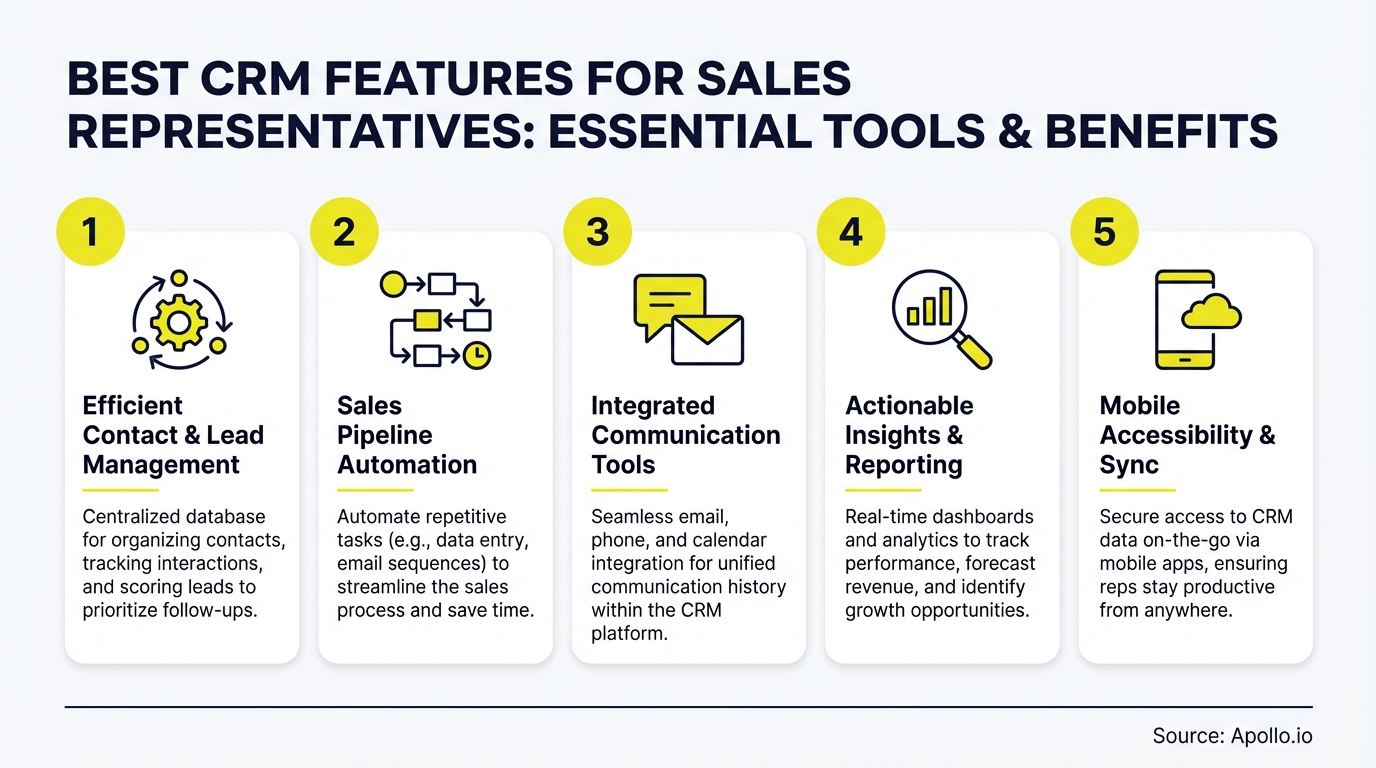
Sales reps need systems that reduce manual research, automate repetitive tasks, and provide actionable insights without switching between multiple applications.
According to recent industry research, companies with high CRM adoption experienced 27% average annual recurring revenue growth, compared to 11% for those with low adoption. The gap between these outcomes stems from data quality, ease of use, and how well the CRM integrates into daily workflows. Modern CRM integration strategies focus on connecting data sources rather than adding more tools.
Top-performing sales reps prioritize CRMs with:
- Access to verified business contacts and accurate phone numbers
- Built-in dialing, email sequencing, and meeting scheduling
- AI-driven lead scoring and next-best-action recommendations
- Mobile access for field sales and remote work scenarios
- Native integrations with existing sales tools
How Do SDRs Choose Between CRM Platforms?
SDRs evaluate CRMs based on prospecting efficiency, data accuracy, and how quickly they can book meetings. The primary decision criteria include contact database size, email deliverability rates, sequence automation capabilities, and whether the platform requires stitching together multiple tools.
SDRs managing high daily outreach volumes need platforms that minimize clicks and maximize productive selling time.
Research from CRM.org shows that 70% of businesses now utilize mobile CRM systems, leading to a 150% higher likelihood of exceeding sales goals. For SDRs working remotely or in hybrid environments, mobile functionality determines whether they can prospect effectively outside the office. Sales and marketing teams using unified platforms report significant time savings compared to managing separate systems.
Key evaluation factors for SDRs:
- Database coverage: Access to 100M+ verified contacts with direct dials and mobile numbers
- Sequence automation: Multi-channel cadences combining email, phone, and social outreach
- Research efficiency: AI-powered company and contact insights that reduce manual prospecting
- Integration depth: Native connections to calendars, dialers, and email platforms
Struggling to find qualified leads? Search Apollo's 224M+ contacts with 65+ filters for precise targeting.
What Features Do Account Executives Need in a CRM?
Account Executives require deal management capabilities, pipeline visibility, and pre-meeting intelligence that helps close deals faster. Unlike SDRs focused on top-of-funnel activities, AEs need systems that track deal stages, forecast accuracy, and relationship history across buying committees.
The best CRM for AEs surfaces context about accounts, identifies expansion opportunities, and automates administrative tasks that don't directly drive revenue.
For Account Executives managing complex B2B sales cycles, deal management software becomes the central hub for tracking conversations, next steps, and stakeholder engagement. AEs report that unified platforms eliminate the friction of updating multiple systems after every customer interaction. Job change alerts help AEs identify warm opportunities when contacts move to new companies.
| Feature Category | Why AEs Need It | Impact on Sales Cycle |
|---|---|---|
| Pipeline Visualization | Track deal stages and forecast accuracy | Identifies stalled deals requiring intervention |
| Buying Committee Mapping | Understand all decision-makers and influencers | Reduces surprise blockers late in sales process |
| Activity Automation | Log calls, emails, and meetings automatically | Saves 60-90 minutes daily on CRM hygiene |
| AI Call Intelligence | Capture action items and sentiment analysis | Improves follow-up speed and message relevance |
Why Does CRM Data Quality Matter for Sales Performance?
CRM data quality directly impacts sales productivity because reps waste hours chasing wrong numbers, bounced emails, and outdated contact information. Poor data quality leads to missed quotas, frustrated teams, and inaccurate forecasting.
Sales leaders report that data enrichment and verification capabilities determine whether their teams spend time selling or cleaning up records.
The most effective CRMs provide real-time data enrichment that updates contact records automatically as information changes. This includes job changes, new phone numbers, company acquisitions, and technology stack updates. CRM integration strategies that prioritize data quality reduce the manual work that keeps reps from hitting their numbers.
Data quality benchmarks that matter:

- Email accuracy: Platforms should guarantee 95%+ deliverability to reduce bounce rates
- Phone number verification: Direct dials and mobile numbers with recent verification dates
- Real-time updates: Automatic alerts when contacts change roles or companies
- Enrichment depth: Technographic, firmographic, and intent data beyond basic contact info
Tired of dirty data? Start free with Apollo's 224M+ verified business contacts and 96% email accuracy.

Turn Forecast Guesswork Into Revenue Certainty
Pipeline forecasting feel like a coin flip? Apollo tracks every deal stage in real-time so you predict revenue with confidence. Built-In boosted win rates 10% with Apollo's scoring.
Start Free with Apollo →How Do Sales Leaders Evaluate CRM ROI and Tech Stack Consolidation?
Sales leaders calculate CRM ROI by measuring time saved, revenue impact, and cost reduction from consolidating multiple tools into one platform. The total cost of ownership includes subscription fees, integration maintenance, training time, and productivity losses from context-switching between systems.
Forward-thinking leaders prioritize platforms that replace 3-5 separate tools rather than adding another subscription to an already bloated tech stack.
Organizations using unified go-to-market platforms report significant operational benefits. As one customer noted, "We reduced the complexity of three tools into one" (Predictable Revenue), while another shared, "We cut our costs in half" (Census). Building a sales tech stack that scales requires evaluating whether each tool truly drives revenue or simply creates more administrative overhead.
ROI evaluation framework for sales leaders:
- Tool consolidation savings: Calculate monthly costs of prospecting database + engagement platform + dialer + enrichment service
- Productivity gains: Measure time saved on manual data entry, research, and system-switching
- Revenue acceleration: Track improvements in meeting bookings, pipeline velocity, and win rates
- Team adoption rates: Monitor daily active usage and feature utilization across the sales org
What CRM Capabilities Support Remote and Hybrid Sales Teams?
Remote and hybrid sales teams need CRMs with robust mobile apps, cloud-based access, and collaboration features that work across distributed environments. The shift to virtual selling requires conversation intelligence, video meeting integration, and asynchronous communication tools that keep teams aligned without constant meetings.
Sales reps working from home offices, co-working spaces, or on the road need the same capabilities as in-office teams.
AI call assistants have become essential for remote teams that need automatic call summaries, action items, and coaching insights without managers listening to every conversation. Sales cadence automation ensures consistent outreach even when reps work different schedules across time zones.
Essential features for distributed teams:
- Mobile apps with full feature parity to desktop versions
- Cloud dialer with local presence and call recording
- Real-time pipeline visibility for managers coaching remotely
- Automated activity logging that captures all touchpoints
- Collaboration tools for sharing accounts and warm introductions
How Can RevOps Teams Choose a CRM That Scales With Growth?
RevOps teams evaluate CRMs based on data governance, reporting flexibility, and how well the platform supports cross-functional workflows between sales, marketing, and customer success. Scalability means handling increased user counts, maintaining data quality as the database grows, and supporting more complex go-to-market motions without performance degradation.
The right CRM provides a single source of truth that eliminates data silos between teams.
RevOps leaders prioritize platforms with robust APIs, webhook capabilities, and native integrations that reduce the burden of maintaining custom middleware. Sales performance management strategies depend on accurate data flowing between systems without manual intervention. As one customer shared, "Having everything in one system was a game changer" (Cyera).
| Scalability Factor | Why It Matters | Questions to Ask Vendors |
|---|---|---|
| Data Architecture | Supports millions of contacts without performance issues | What are database size limits and search speed benchmarks? |
| User Management | Handles team growth with role-based permissions | How do you manage access controls across business units? |
| API Rate Limits | Enables high-volume integrations and automation | What are API call limits and webhook reliability SLAs? |
| Reporting Flexibility | Custom dashboards for different stakeholder needs | Can we create custom objects and fields without developer help? |
Start Using the Best CRM for Sales Reps Today
The best CRM for sales reps in 2026 combines verified contact data, AI-powered automation, and deal management in one unified platform. Sales teams using consolidated systems report measurable improvements in productivity, pipeline velocity, and quota attainment.
The key is choosing a platform that eliminates tool sprawl rather than adding another subscription to your tech stack.
For SDRs booking more meetings, Account Executives closing faster, and Sales Leaders driving predictable revenue, the right CRM transforms how your team operates. Look for platforms that provide accurate data, automate repetitive tasks, and integrate naturally into your existing workflows. Sales leaders using Apollo report significant improvements in team performance and cost efficiency.
Ready to consolidate your sales tech stack and accelerate revenue? Start a Trial of Apollo's all-in-one platform with 224M+ verified contacts, AI automation, and deal management built in.
Prove Apollo's ROI In Your First 30 Days
Budget approval stuck on unclear metrics? Apollo tracks pipeline impact from day one—quantifiable time savings, deal velocity, and win rates. Built-In boosted win rates 10% and ACV 10% with Apollo's scoring.
Start Free with Apollo →Don't miss these
Sales
Inbound vs Outbound Marketing: Which Strategy Wins?
Sales
What Is a Sales Funnel? The Non-Linear Revenue Framework for 2026
Sales
What Is a Go-to-Market Strategy? The 2026 GTM Playbook
See Apollo in action
We'd love to show how Apollo can help you sell better.
By submitting this form, you will receive information, tips, and promotions from Apollo. To learn more, see our Privacy Statement.
4.7/5 based on 9,690 reviews
