
Best Cold Outreach Software for Teams That Also Need a Dialer (2026)
Most cold outreach tools handle email well. Most dialers handle calls well.
But teams that need both in one place — without duct-taping two vendors together — face a harder choice. The market has shifted: buyers are more skeptical, compliance stakes are higher, and parallel dialing is becoming a premium add-on rather than a standard feature.
This guide cuts through the noise so SDRs, sales managers, and RevOps leaders can pick the right unified platform for 2026.
Looking to combine prospecting data, email sequences, and calling in one workspace? Apollo's outbound sales software handles all three — without requiring a separate vendor for each layer.

Research Less, Close More With Apollo
Tired of your reps burning hours on manual research instead of selling? Apollo delivers verified contacts instantly so your team spends time closing, not digging. Join 600K+ companies building pipeline faster.
Start Free with Apollo →Key Takeaways
- The best cold outreach software for teams that also need a dialer unifies contact data, email sequences, and calling in a single platform — reducing tool sprawl and admin overhead.
- Compliance is no longer optional: with over 258 million active DNC registrations in the U.S., outreach platforms must operationalize suppression, not just offer it as a setting.
- Parallel and power dialers deliver higher call throughput, but should be paired with intent signals and quality controls — not just volume targets.
- Sales managers need platform-level governance: call recording, coaching workflows, analytics by rep, and audit trails — not just a dialer feature checkbox.
- Apollo recently expanded its Advanced Dialer suite (power + parallel dialing) with built-in DNC screening for the US, UK, and Germany — positioning it as a compliance-aware, all-in-one option for growing teams.
Why Does Compliance Matter More Than Ever for Outreach + Dialer Teams?
Compliance matters more than ever because outbound calling volume and regulatory enforcement are both rising simultaneously. The U.S. National Do Not Call Registry had over 258 million active registrations as of September 2025, and the FTC received more than 2.6 million DNC complaints in FY2025 (per the FTC DNC Data Book). Separately, YouMail reported 32.5 billion robocalls in just the first seven months of 2025, up approximately 9.2% year-over-year.
This environment means call answer rates suffer when numbers appear as spam or unknown. Teams relying on high-volume dialing without suppression controls, STIR/SHAKEN compliance, or number health monitoring are taking on measurable risk.
Choosing an outreach platform that operationalizes compliance — not just checks a box — is now a procurement requirement, not a nice-to-have.
Key compliance features to require from any platform:
- Automated DNC suppression applied before calls are placed
- STIR/SHAKEN support to authenticate caller ID and reduce spam flags
- Branded calling or local presence options to improve answer rates
- Audit trails for call attempts, consent records, and suppression events
- Role-based controls so managers can govern which reps dial which lists
What Should SDRs and Sales Managers Look for in a Dialer?
SDRs need speed and context; sales managers need visibility and governance. The right dialer serves both without requiring separate tools.
For SDRs, the core requirements are:
- Power or parallel dialing to increase live conversations per hour
- Pre-call prospect context (company, title, recent activity) surfaced automatically
- Voicemail drop to avoid repeating the same message manually
- Automatic CRM logging after each call — no manual entry
- Call scripts or talk tracks accessible during the call
For sales managers and RevOps leaders, the requirements shift toward oversight:
- Call recording and AI-assisted call summaries for coaching
- Rep-level analytics: connect rate, talk time, conversion by list segment
- Governance controls: which numbers can be dialed, suppression enforcement
- Campaign-level reporting to identify which sequences drive connected calls
Research from Outreach Bloom found that integrated solutions for sales calls demonstrated 40% better adoption rates compared to standalone tools that require manual data entry. This matters for managers: if reps resist logging calls, reporting breaks down and coaching becomes guesswork.
Spending hours stitching together call notes, CRM updates, and sequence steps manually? Apollo's AI call assistant handles call summaries and next steps automatically — so reps stay focused on conversations, not admin.

When Should Teams Use a Parallel Dialer vs. a Single-Line Dialer?
Parallel dialing is best for high-volume prospecting lists where contact data is verified and intent signals are present; single-line dialing suits high-value, research-heavy accounts where conversation quality matters more than throughput.
According to SkipCall, a parallel dialer can triple live conversations per hour with the same rep effort compared to manual dialing. That throughput gain is real — but it comes with tradeoffs.
| Dialer Type | Best For | Key Risk | Compliance Consideration |
|---|---|---|---|
| Manual / Click-to-Call | Enterprise accounts, high-context calls | Low throughput | Lowest risk |
| Power Dialer | Mid-market prospecting, verified lists | Rep fatigue at scale | Moderate — needs DNC suppression |
| Parallel Dialer | High-volume SDR campaigns, inbound follow-up | Abandoned call rates, spam flags | Highest — requires robust governance |
Apollo's 2025–2026 product updates introduced a power + parallel dialing suite as an Advanced Dialer add-on, paired with DNC screening for the US, UK, and Germany. This approach — packaging throughput features alongside compliance controls — reflects where the market is heading: faster dialing is only viable when governance is built in, not bolted on.
Turn Funnel Gaps Into Pipeline Wins
Pipeline forecasting a guessing game? Apollo surfaces in-market buyers the moment they're ready, turning weak top-of-funnel into real opportunities. Top revenue teams use Apollo to hit quota with confidence.
Schedule a Demo →How Do You Evaluate Cold Outreach Software That Includes a Dialer?
The best cold outreach software for teams that also need a dialer scores well across four dimensions: data quality, engagement execution, dialer capability, and platform governance. Teams that evaluate on features alone often miss the governance and analytics gaps that surface after go-live.
Use this framework when comparing vendors:
| Evaluation Dimension | What to Test | Red Flags |
|---|---|---|
| Contact Data Quality | Verified business emails and direct dials, enrichment depth | No in-platform data; relies entirely on imports |
| Outreach Execution | Multi-step sequences: email, call, social tasks | Email-only sequences; dialer is a separate login |
| Dialer Capability | Power/parallel modes, voicemail drop, local presence | Click-to-call only; no throughput options |
| Compliance + Governance | DNC suppression, call recording, audit logs, role controls | Manual suppression lists; no audit trail |
| Analytics + Coaching | Rep-level call metrics, AI summaries, manager dashboards | Aggregate-only reporting; no call review workflow |
| CRM Integration | Bidirectional sync, auto-logging, sequence triggers from CRM | One-way sync; manual field mapping required |
Data from Persistence Market Research projects the global sales engagement platform market at US$9.2 billion in 2026, growing to US$26.6 billion by 2033 — driven in part by consolidation toward unified data, sequencing, and calling platforms. Growth like that creates vendor noise; a structured evaluation framework cuts through it.
Need a platform that passes all six dimensions? Apollo's sales engagement platform combines sequences, dialing, and 230M+ verified contacts in one workspace — so your team isn't switching tabs between tools.
Why Do RevOps Leaders Prefer All-in-One Platforms Over Best-of-Breed Stacks?
RevOps leaders prefer all-in-one platforms because fragmented stacks create attribution gaps, data hygiene problems, and integration maintenance overhead that compounds as teams scale. When prospecting data, email sequences, and calling all live in separate systems, connecting activity to pipeline outcomes requires manual reconciliation — and errors accumulate.
Apollo customers have described the shift directly: "We reduced the complexity of three tools into one" (Predictable Revenue), "We cut our costs in half" (Census), and "Having everything in one system was a game changer" (Cyera). These aren't marketing claims — they reflect what RevOps teams consistently encounter when consolidating outreach and dialing into a single platform.
For teams evaluating the top sales engagement platforms, the consolidation argument is increasingly decisive: fewer integrations to maintain, one source of truth for activity data, and a single vendor relationship for support and compliance updates.
See also: how to build a sales tech stack that scales revenue — a practical playbook for teams rationalizing their outreach infrastructure.
What Are the Must-Have Features in Cold Outreach Software for Multi-Rep Teams in 2026?
For multi-rep teams in 2026, the must-have features go beyond basic sequencing and click-to-call. The shift toward manager-led, data-driven outreach means platform requirements now include team-level governance, AI-assisted execution, and omnichannel orchestration tied to buyer signals.
- Intent-signal triggers: Automatically surface prospects showing buying behavior and route them into call-priority sequences
- AI call summaries and next-step automation: Reduce post-call admin; ensure CRM records stay current across all reps
- Omnichannel sequences: Coordinate email, phone, and social touchpoints based on engagement signals — not just a fixed calendar
- Number health monitoring: Flag numbers at risk of being marked as spam before they damage connect rates
- Manager coaching workflows: Call recording with timestamped comments, rep scorecards, and trend views across the team
- Lead scoring integration: Prioritize dial lists using enriched firmographic and behavioral data
For teams building or refining their calling approach alongside outreach, resources like the best cold calling tips for 2026 and cold call scripts that actually work provide tactical support beyond the platform layer.
Timing matters too: pairing the right platform with data on the best times to call and email prospects can meaningfully improve connect rates without changing a single feature.

Which Platform Is Best for Teams That Need Cold Outreach and a Dialer in 2026?
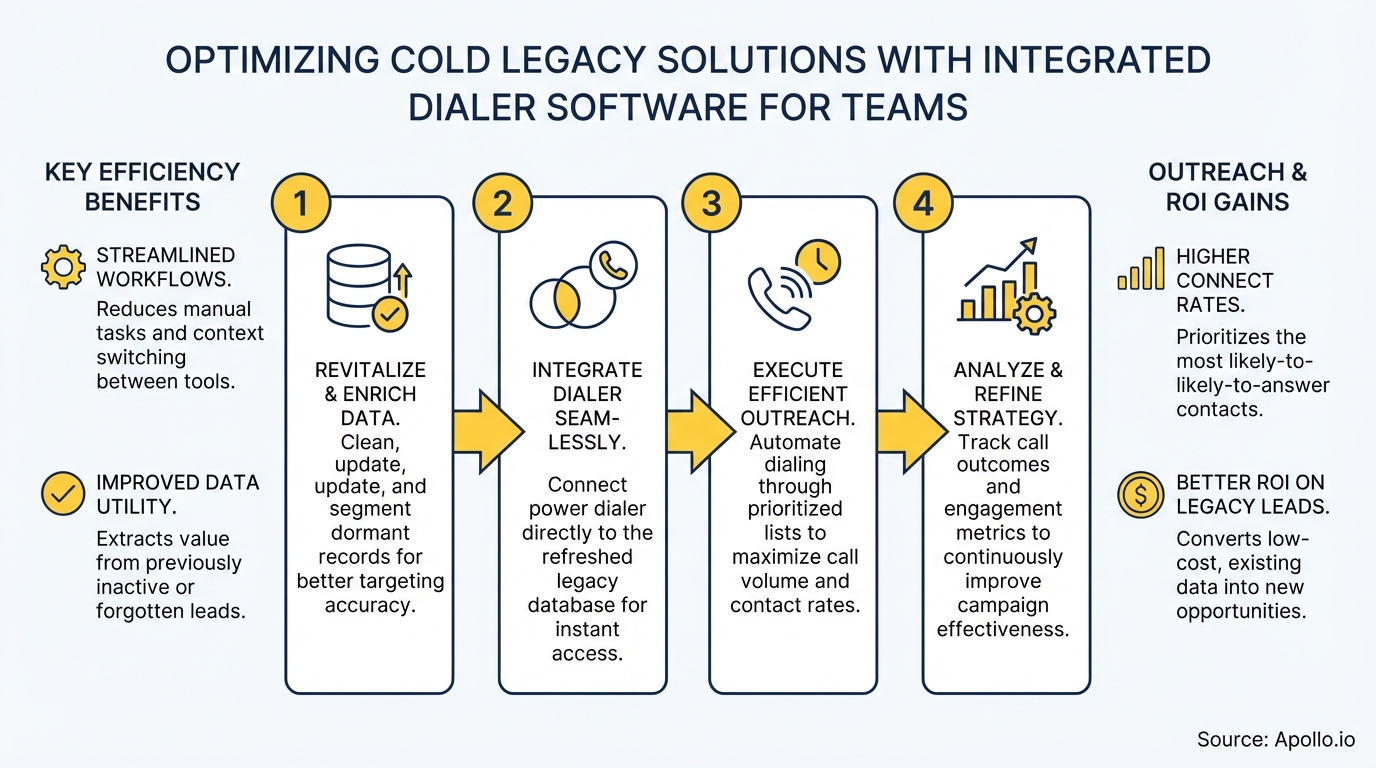
Apollo is the strongest option for B2B GTM teams that need cold outreach software with an integrated dialer in 2026 — particularly for SDRs, AEs, RevOps, and sales managers at growing companies who want to consolidate prospecting data, email sequences, and calling into one workspace.
Apollo's dialer software for sales teams now includes power and parallel dialing modes via the Advanced Dialer add-on, with built-in DNC screening across the US, UK, and Germany. Combined with 230M+ verified contacts, 65+ prospecting filters, AI-powered sequences, and call recording with AI summaries, Apollo gives teams a single platform from list building through connected conversation — without the integration overhead of a separate dialer vendor.
For teams at the enterprise level, Apollo's Organization tier adds advanced routing, governance controls, admin permissions, and security configurations that support larger GTM operations. Trusted by nearly 100,000 paying customers including Anthropic, Smartling, and Redis, Apollo earned the 2026 MarTech Breakthrough Award for Best AI-Powered Sales Solution.
The question for most teams isn't whether to add a dialer — it's whether to manage it as a separate tool or unify it with the rest of the outreach stack. For the majority of B2B sales teams, unification wins on cost, adoption, and data quality.
Ready to run cold outreach and dialing from one platform? Start prospecting with Apollo — free.
Prove Pipeline ROI With Apollo
ROI pressure killing your tool budget before it even starts? Apollo delivers measurable pipeline impact from day one — no guesswork, no waiting. Leadium 3x'd annual revenue. You're next.
Start Free with Apollo →Don't miss these
Sales
Inbound vs Outbound Marketing: Which Strategy Wins?
Sales
What Is a Sales Funnel? The Non-Linear Revenue Framework for 2026
Sales
What Is a Go-to-Market Strategy? The 2026 GTM Playbook
See Apollo in action
We'd love to show how Apollo can help you sell better.
By submitting this form, you will receive information, tips, and promotions from Apollo. To learn more, see our Privacy Statement.
4.7/5 based on 9,690 reviews
