
Best B2B Database for Technographic-Based Account List Building
By the time your SDR makes first contact, the deal may already be lost. A 2024 survey of 2,509 buyers found that 81% already had a preferred vendor at first contact and 85% had largely established their requirements.
The only way to win before that moment is to identify stack-fit accounts earlier, using technographic signals to build lists that reach buyers during their research phase, not after it.
The right B2B database for technographic-driven account lists combines signal fidelity, activation speed, and workflow integration. This guide breaks down exactly what to look for and how to build lists that convert. For a broader look at how list building fits into your overall strategy, see 4 Ways to Build Better B2B Lists.

Research Less, Pipeline More With Apollo
Tired of burning hours verifying contact info instead of closing deals? Apollo delivers accurate business contacts so your team spends time selling, not searching. Join 600K+ companies building pipeline faster.
Start Free with Apollo →Key Takeaways
- Technographic signals are most valuable when acted on early, before buyers self-select a preferred vendor.
- The best B2B database combines web-detected and job-posting-derived technographics with firmographic and intent signals for sharper list targeting.
- SDRs and RevOps teams benefit most from databases that connect signals directly to sequences and CRM workflows, not just exports.
- 75% of B2B marketers rely on technographic data for personalization, making signal quality a competitive differentiator, not a nice-to-have.
- Waterfall enrichment (coverage, verify, fill gaps across providers) outperforms any single-vendor approach for account list completeness.
What Are Technographic Signals and Why Do They Matter for Account Lists?
Technographic signals are data points that reveal which technologies a company currently uses, has recently adopted, or is actively evaluating. For teams building account lists, they answer the most important qualification question: does this account's tech stack make them a fit for what we sell?
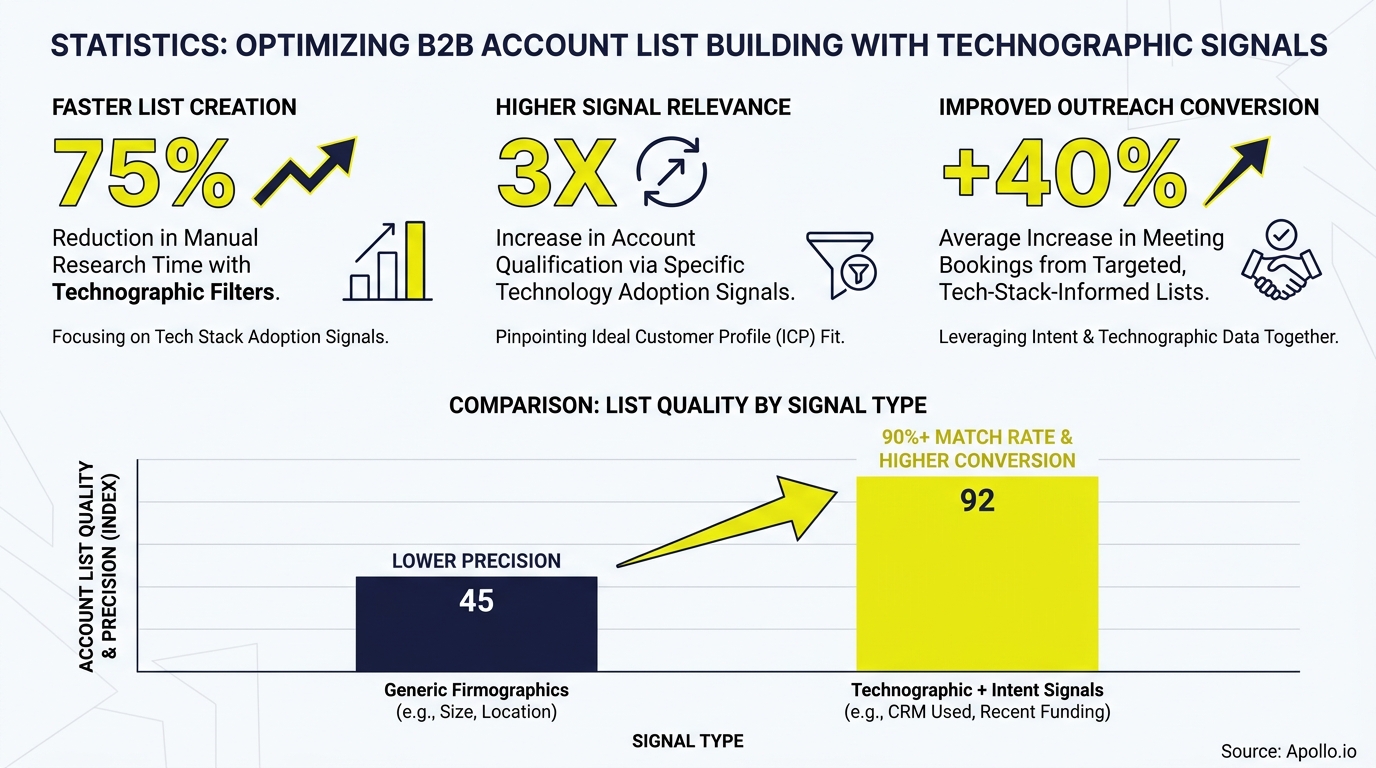
Research from OnFire.ai shows that 75% of B2B marketers rely on technographic data for personalization efforts, reflecting how central these signals have become to modern outbound. Technographics are not just a filter; they are a go-to-market motion. When paired with firmographic data and intent signals, they let your team prioritize accounts that are genuinely ready to evaluate a solution like yours. The shift in the B2B buyer journey in 2026 has made pre-contact identification the most important stage of the sales cycle.
What Are the Two Types of Technographic Data, and Which Should You Use?
Technographic data comes from two primary sources, and understanding the difference determines how you build and validate your account lists.
| Type | How It Is Collected | Strengths | Limitations |
|---|---|---|---|
| Web-detected technographics | Crawling public-facing websites for scripts, tags, and stack signals | Broad coverage, fast refresh, no access needed | Only captures front-end/visible technologies |
| Install-base / job-posting-derived | Partner ecosystems, job posting AI extraction, direct integrations | Reflects actual adoption and rollout intent | Narrower coverage, requires AI or partner data |
In 2026, Apollo expanded its technographic coverage by using AI to extract signals from 10M+ job postings. When a company posts a role requiring Salesforce administration or Snowflake engineering, that is a proof signal of active adoption, often more reliable than web-crawl detection alone. For teams building sales lead lists that convert, combining both signal types produces the most defensible account lists.
How Do SDRs and RevOps Teams Build Account Lists from Technographic Signals?
SDRs and RevOps leaders use technographic filters to narrow a database down to accounts that match a specific tech stack profile, then layer in firmographic and intent signals to prioritize outreach order.
A practical signal-sequencing framework looks like this:
- Tier 1 (Highest Priority): ICP firmographic match + technographic fit + active intent signal (e.g., job posting for the tech you replace or integrate with)
- Tier 2: Technographic fit + firmographic match, no current intent signal detected
- Tier 3: Partial stack fit, monitor for stack change or hiring trigger
RevOps leaders find that routing Tier 1 accounts directly into sequences, while placing Tier 3 in a nurture workflow, produces measurably better pipeline efficiency. According to SuperAGI, 45% of selling professionals cite incomplete data as a significant obstacle, which is why combining signal types, rather than relying on a single filter, is now standard practice.
Struggling to build tech-stack-filtered account lists at scale? Search Apollo's 230M+ contacts with 65+ filters, including technographics.

What Should You Look for in the Best B2B Database for Technographic List Building?
The best B2B database for technographic-driven account lists scores well across five criteria, not just record count.
| Evaluation Criteria | What to Assess |
|---|---|
| Signal sources | Web-crawl, job postings, partner ecosystems, direct integrations |
| Refresh frequency | How often technographic records are updated (stale data wastes outbound budget) |
| Activation integration | Can signals trigger sequences, CRM routing, or ad audiences directly? |
| Coverage breadth | Technology categories covered across your ICP's typical stack |
| Enrichment waterfall support | Does the platform support multi-source enrichment to fill coverage gaps? |
The market has shifted from evaluating databases by size to evaluating them by signal fidelity and activation speed. A database that surfaces a technographic match but cannot route that account into a sequence the same day has limited GTM value. This is why many teams now treat the best B2B database as a workflow outcome, not a data export. See the best B2B marketing tools for 2026 for how databases fit into a modern GTM stack.
Turn Funnel Guesswork Into Real Pipeline
Tired of watching marketing leads stall before they ever reach your pipeline? Apollo surfaces in-market buyers with precision targeting so your team acts on real signals, not gut feel. Nearly 100K paying customers stopped guessing and started closing.
Start Free with Apollo →Why Is Apollo the Best B2B Database for Technographic Account Lists?
Apollo is the best B2B database for teams building technographic account lists because it combines AI-extracted technographic signals, 230M+ verified business contacts, and built-in activation tools in a single platform, eliminating the need to stitch together a separate data provider, engagement tool, and enrichment service.
Key differentiators for technographic list building:
- AI-powered technographic extraction from 10M+ job postings, capturing adoption signals beyond what web crawls detect
- 65+ search filters including technographic, firmographic, and intent signals for precise ICP targeting
- Waterfall enrichment as a default workflow, covering gaps across providers before a record enters your CRM
- Direct sequence activation, meaning a filtered account list can trigger an outbound sequence without leaving the platform
- 97% email accuracy on verified business contacts
Cyera's team captured this consolidation value directly: "Having everything in one system was a game changer." For teams managing enterprise sales solutions, that consolidation reduces both cost and operational complexity. Apollo serves B2B GTM teams from startups through enterprise, with strong fit for SDRs, AEs, RevOps, and marketing leaders at growing companies.
Ready to cut your tech stack and build smarter account lists? Start free with Apollo's verified contact database and technographic filters.

How Should You Govern and Validate Technographic Data at Scale?
Governance for technographic enrichment means establishing clear rules for data freshness, source attribution, and CRM field ownership before signals trigger automated workflows.
A practical governance checklist for RevOps teams:
- Set a maximum data age threshold for technographic fields (e.g., flag records not refreshed in 90+ days)
- Document which signal source populated each technographic field for auditability
- Use waterfall enrichment to verify records across multiple sources before routing to sequences
- Establish a review cadence for technology categories that shift rapidly (AI tooling, cloud infrastructure)
- Align with IT/InfoSec on permissible data attributes before connecting enrichment to CRM automation
Data from The Insight Collective found that 88% of marketers saw an increase in conversion rates through data-oriented tactics in 2024. That lift depends entirely on data quality governance. For teams using Apollo's CRM enrichment tools, automated refresh rules and source tracking are built into the enrichment workflow, reducing manual governance overhead.
What Is the Best Way to Evaluate a B2B Database Before Committing?
The most reliable evaluation method is a two-week bake-off using a known truth set of accounts from your existing customer base.
- Step 1: Select 50 current customers with known tech stacks
- Step 2: Run those accounts through the candidate database and check technographic accuracy against what you know
- Step 3: Measure coverage rate (how many accounts returned a technographic record) and accuracy rate (how many matched known stacks)
- Step 4: Test activation: how quickly can a matched account enter a sequence or CRM workflow?
This empirical approach reflects how leading GTM teams now select data providers, prioritizing measurable outcomes over vendor-claimed record counts. Pair this with a review of B2B sales techniques to ensure your sequences are optimized once the list is built.
Start Building Smarter Account Lists with Technographic Signals
Technographic-driven account lists are the highest-leverage input for modern B2B outbound. The teams winning pipeline in 2026 are those that identify stack-fit accounts before buyers have self-selected a preferred vendor, then activate those accounts through sequences that match their current tech context.
Apollo brings technographic signals, verified contact data, enrichment workflows, and outbound sequences into one platform, so your SDRs spend time on outreach, not data assembly. As Census put it: "We cut our costs in half." That is what consolidating your data and engagement stack into a single platform delivers.
Start Your Free Trial and build your first technographic account list today.
Prove Pipeline ROI With Apollo
Budget approval stuck on unclear metrics? Apollo delivers measurable pipeline impact from day one — so you walk into every review with hard numbers, not estimates. Leadium 3x'd revenue. Your turn.
Start Free with Apollo →Don't miss these
Sales
Inbound vs Outbound Marketing: Which Strategy Wins?
Sales
What Is a Sales Funnel? The Non-Linear Revenue Framework for 2026
Sales
What Is a Go-to-Market Strategy? The 2026 GTM Playbook
See Apollo in action
We'd love to show how Apollo can help you sell better.
By submitting this form, you will receive information, tips, and promotions from Apollo. To learn more, see our Privacy Statement.
4.7/5 based on 9,690 reviews
