
B2B Sales Experience: How to Create Buyer Journeys That Convert in 2026
B2B sales experience in 2026 is the complete journey buyers go through when evaluating, purchasing, and implementing business solutions. According to Gartner, 61% of B2B buyers prefer an overall rep-free buying experience, and 73% actively avoid suppliers that send irrelevant outreach. The shift toward self-directed buying means sales teams must design experiences that balance digital convenience with human expertise. Modern B2B sales strategies now focus on decision enablement, omnichannel orchestration, and buying-group alignment to reduce deal stalls and post-purchase regret.

Get Verified Contacts In Seconds With Apollo
Tired of spending 4+ hours daily hunting for contact info? Apollo delivers 224M+ verified contacts with 96% email accuracy. Join 550K+ companies who eliminated manual research.
Start Free with Apollo →Key Takeaways
- B2B buyers now use 10+ channels during their journey, requiring seamless omnichannel coordination across digital and human touchpoints
- Deal stalls and buyer dissatisfaction stem from misaligned buying groups and inconsistent messaging, not product features
- Winning sales experiences combine self-serve resources with strategic human intervention at high-value decision points
- Sales teams must provide decision enablement tools like mutual action plans and stakeholder alignment templates to reduce friction
What Is B2B Sales Experience?
B2B sales experience encompasses every interaction a prospect has with your company throughout their buying journey. This includes website visits, content downloads, sales conversations, product demos, contract negotiations, and post-purchase onboarding. Research from Valve+Meter shows 80% of B2B sales interactions are projected to occur through digital channels by 2025.
Unlike traditional B2B sales techniques that focused on rep-led processes, modern experiences prioritize buyer autonomy. Prospects research independently, compare alternatives, and build internal consensus before engaging sellers. This shift demands that sales teams create friction-free pathways while remaining available for strategic guidance.
Why Does B2B Sales Experience Matter in 2026?
Poor sales experiences directly impact revenue. Buyers abandon purchases when they encounter friction, inconsistent messaging, or misaligned expectations within their buying committees.
The cost of experience failure extends beyond lost deals to damaged brand reputation and wasted sales resources.

According to Sana Commerce, 73% of all B2B buyers prefer to buy online, while Martal Group reports 97% of B2B buyers state that fast, simple, and accurate online experiences are important. Companies that deliver seamless experiences gain competitive advantage through higher conversion rates, shorter sales cycles, and stronger customer retention.
How Do SDRs and AEs Deliver Better Sales Experiences?
SDRs and Account Executives face the challenge of engaging buyers who've already completed significant research. Success requires shifting from product pitches to decision enablement.
SDRs must qualify not just accounts but entire buying committees, identifying stakeholders, understanding their priorities, and mapping decision criteria.
Account Executives managing complex deals need tools that reduce buyer uncertainty.
This includes mutual action plans that outline next steps, stakeholder alignment templates that surface hidden objections, and business case frameworks that help champions secure internal approval.
Teams using structured sales funnels can track buying-group progress and intervene strategically.
Struggling to coordinate multi-stakeholder deals? Manage complex buying groups with Apollo's deal management tools.
Turn Forecast Guesswork Into Revenue Certainty
Pipeline forecasting a guessing game? Apollo delivers real-time deal visibility and intent signals that make revenue predictable. Built-In boosted win rates 10% with Apollo's scoring.
Start Free with Apollo →What Are the Key Components of Modern B2B Sales Experience?
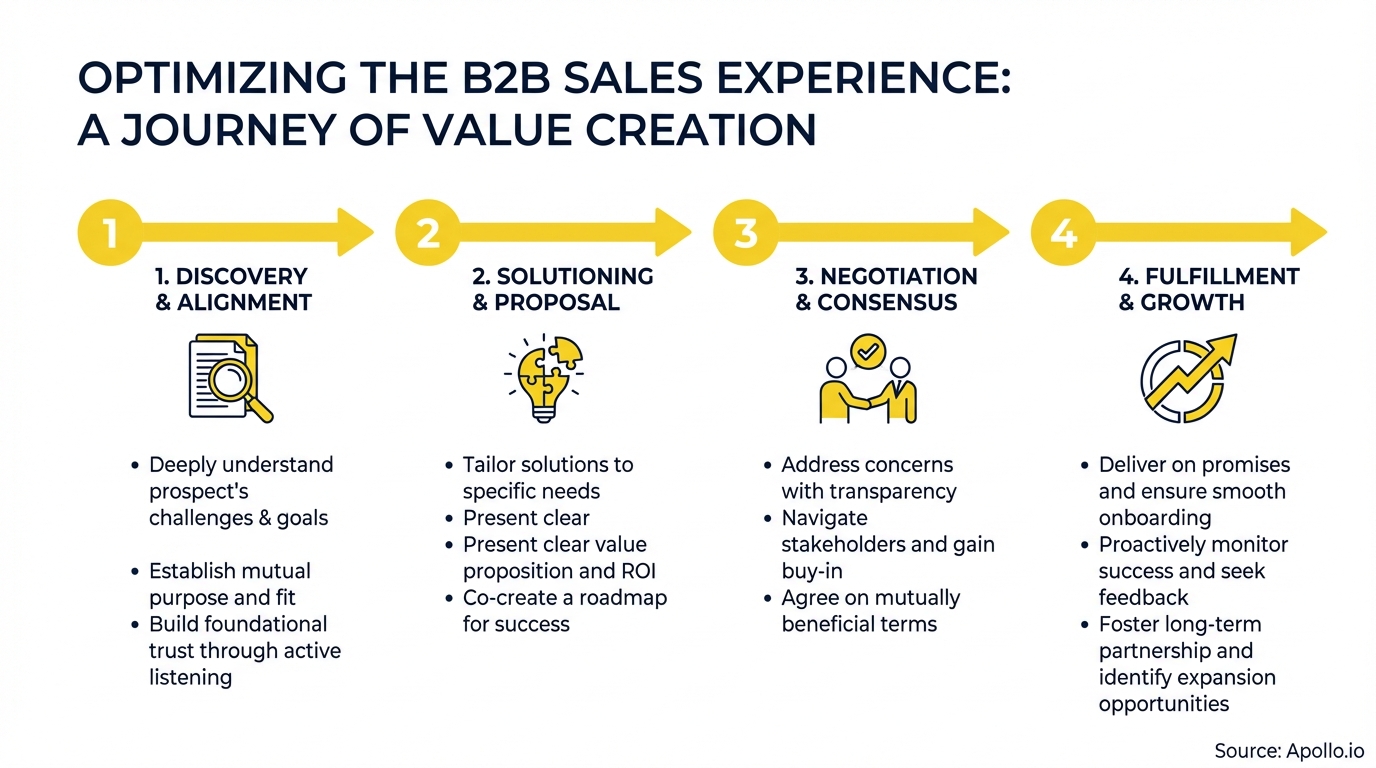
Effective B2B sales experiences in 2026 integrate five core elements that address buyer needs across the entire journey.
| Component | Purpose | Implementation |
|---|---|---|
| Decision Enablement | Reduce buyer uncertainty | Mutual action plans, ROI calculators, comparison guides |
| Omnichannel Coordination | Seamless channel switching | Unified messaging across web, email, phone, social |
| Buying-Group Alignment | Surface hidden objections | Stakeholder maps, consensus-building templates |
| Self-Serve Resources | Enable independent research | Interactive demos, product tours, documentation |
| Strategic Human Touch | Guide complex decisions | Executive briefings, custom workshops, negotiation support |
Sales Leaders and RevOps teams must orchestrate these components into a cohesive experience. Apollo customers report significant improvements by consolidating their tech stack. As one customer shared, "We reduced the complexity of three tools into one."
How Can Sales Teams Prevent Deal Stalls and Buyer Regret?
Deal stalls occur when buying groups fail to reach consensus or when uncertainty outweighs perceived value. Prevention requires proactive stakeholder management and transparent communication.
Sales teams should identify all decision-makers early, understand their individual priorities, and create alignment through structured frameworks.
Buyer regret stems from mismatched expectations and poor post-purchase experiences. Combat this by setting clear implementation timelines, defining success metrics upfront, and maintaining engagement through onboarding.
Use business case templates that buying committees can present internally, ensuring your champion has the ammunition to defend the decision.
For Founders and CEOs building outbound motion, investing in sales analytics provides visibility into where deals stall and which buyer personas drive decisions. This data informs experience improvements and resource allocation.
What Role Does Technology Play in B2B Sales Experience?
Technology enables personalization at scale while maintaining human connection. AI handles repetitive tasks like data enrichment, email sequencing, and meeting scheduling, freeing sellers to focus on strategic conversations.
However, buyers increasingly value human expertise for complex decisions.
The winning approach combines AI efficiency with human judgment. Use automation for prospecting and qualification, but ensure AEs personally handle discovery calls, demos, and negotiations. Conversation intelligence tools help teams learn from successful interactions and replicate best practices across the organization.

Tired of juggling multiple sales tools? Consolidate your entire go-to-market stack with Apollo's unified platform.
Transform Your B2B Sales Experience in 2026
B2B sales experience is no longer about convincing buyers to purchase. It's about enabling confident decisions through seamless omnichannel journeys, aligned buying groups, and strategic human guidance.
Teams that master decision enablement reduce deal stalls, shorten sales cycles, and build lasting customer relationships.
Start by auditing your current experience: map all buyer touchpoints, identify friction points, and assess message consistency across channels.
Build decision enablement assets like mutual action plans and stakeholder templates.
Most importantly, invest in technology that consolidates your sales stack rather than adding complexity.
Apollo provides the unified platform sales teams need to deliver exceptional B2B experiences. From prospecting to deal management to conversation intelligence, everything works together in one system.
As another customer shared, "Having everything in one system was a game changer."
Prove Apollo's ROI In Your First 30 Days
Budget approval stuck on unclear metrics? Apollo tracks every touchpoint from prospect to closed deal—quantifying time saved, pipeline generated, and win rates improved. Built-In increased ACV 10% with measurable scoring impact.
Start Free with Apollo →Don't miss these
Sales
Inbound vs Outbound Marketing: Which Strategy Wins?
Sales
What Is a Sales Funnel? The Non-Linear Revenue Framework for 2026
Sales
What Is a Go-to-Market Strategy? The 2026 GTM Playbook
See Apollo in action
We'd love to show how Apollo can help you sell better.
By submitting this form, you will receive information, tips, and promotions from Apollo. To learn more, see our Privacy Statement.
4.7/5 based on 9,690 reviews
