
Real-World B2B Sales Examples That Close Deals
B2B sales examples show how companies sell products or services to other businesses through structured processes, multi-stakeholder engagement, and long-term relationships. B2B sales differ fundamentally from consumer sales in complexity, deal size, and decision-making dynamics. According to BookYourData, 80% of B2B sales interactions between suppliers and buyers now occur through digital channels, reshaping how sales teams connect with prospects.

Apollo Turns Research Hours Into Pipeline
Tired of your reps burning the day on manual research instead of selling? Apollo delivers verified contacts instantly, so your team spends time closing — not digging. Join 550K+ companies building predictable pipeline.
Start Free with Apollo →Key Takeaways
- B2B sales involve selling to multiple stakeholders with different priorities and longer buying cycles than B2C transactions
- Digital channels dominate modern B2B sales, with buyers increasingly preferring self-service research over rep-led demos
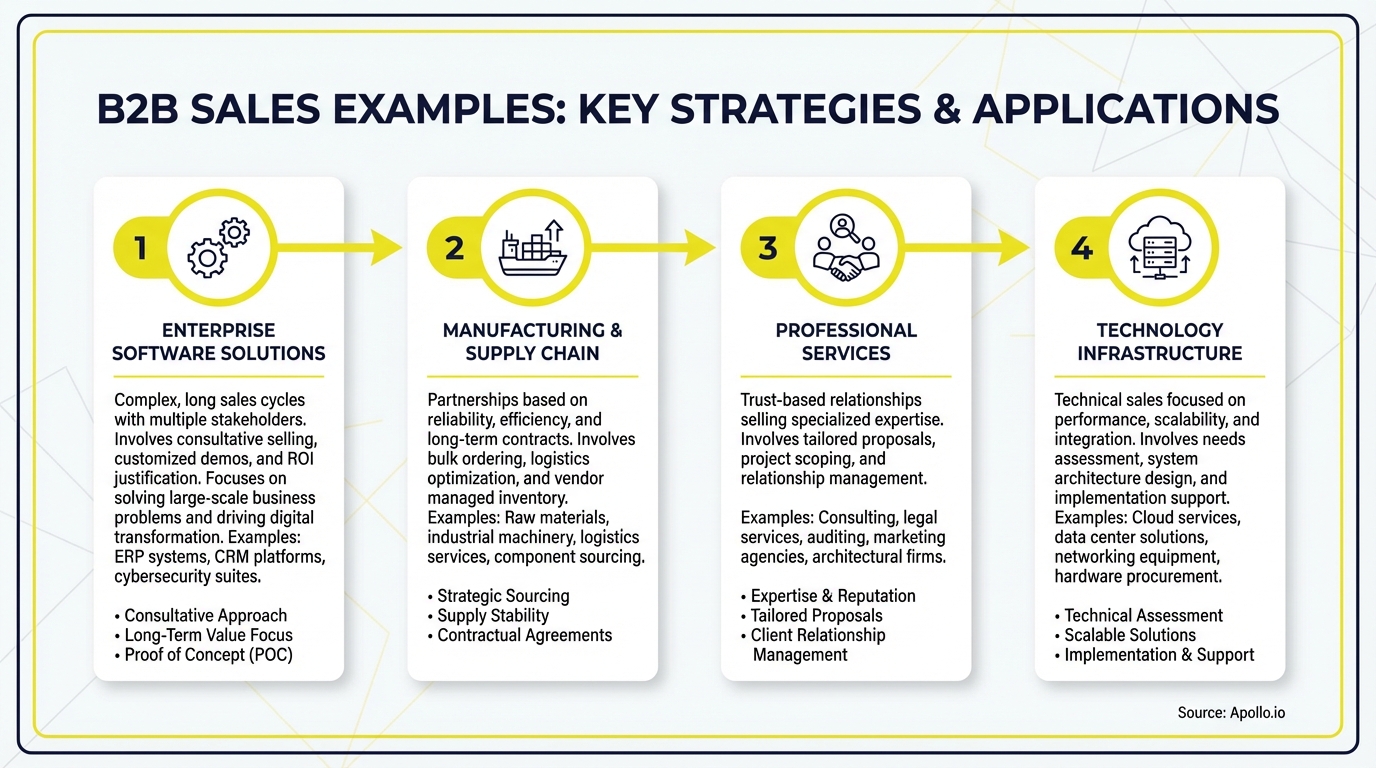
- Successful B2B examples span SaaS platforms, manufacturing supply chains, professional services, and enterprise software implementations
- Account Executives and SDRs using consolidated platforms report faster deal cycles and improved pipeline visibility
- Real-world B2B sales success depends on verified contact data, multi-channel engagement, and alignment across buying committees
What Are B2B Sales Examples?
B2B sales examples are real-world transactions where one business sells products, services, or solutions to another business. These examples illustrate the processes, strategies, and tactics that drive successful business-to-business commerce.
Common B2B sales examples include:
- SaaS and software sales: Companies like Salesforce selling CRM platforms to enterprises, or project management tools sold to marketing agencies
- Manufacturing and supply chain: Industrial equipment suppliers selling machinery to factories, or raw material distributors serving food production companies
- Professional services: Consulting firms selling strategic advisory to Fortune 500 companies, or legal services providers contracting with corporate clients
- Wholesale and distribution: Office supply distributors selling bulk inventory to retailers, or technology resellers providing hardware to school districts
Research from Buttered Toast shows that 83% of B2B buyers prefer online shopping for its convenience and efficiency. This shift drives demand for B2B sales techniques that blend digital touchpoints with human expertise.
How Do B2B Sales Differ From B2C Sales?
B2B sales involve longer decision cycles, multiple stakeholders, higher transaction values, and relationship-driven processes. A single B2B deal often requires approval from procurement, finance, IT, legal, and end-user departments.
| Factor | B2B Sales | B2C Sales |
|---|---|---|
| Decision Makers | 3-7 stakeholders on average | Individual or household |
| Sales Cycle | 3-12+ months | Minutes to days |
| Average Deal Size | $10K-$1M+ | $10-$500 |
| Buying Motivation | ROI, efficiency, risk mitigation | Personal benefit, emotion |
| Relationship Type | Long-term partnerships | Transactional |
B2B sales funnels reflect this complexity with distinct stages for awareness, consideration, evaluation, and negotiation. Account Executives managing enterprise deals must navigate technical evaluations, security reviews, and budget approval cycles that B2C sellers never encounter.

What Are Real-World B2B Sales Examples by Industry?
Real-world B2B sales examples span every industry, from technology to healthcare to logistics. Each sector has unique buying patterns, stakeholder dynamics, and sales motions.
SaaS and Technology Sales
Software companies sell subscriptions, licenses, and cloud services to businesses. Examples include marketing automation platforms sold to demand generation teams, or cybersecurity tools sold to IT departments. B2B SaaS sales funnels often start with free trials, product-led growth, or demo requests.
Manufacturing and Industrial Equipment
Manufacturers sell machinery, components, and materials to production facilities. A CNC machine manufacturer selling to an automotive parts supplier, or a chemical company providing raw materials to pharmaceutical manufacturers, represents classic B2B transactions with long implementation timelines.
Professional Services and Consulting
Service providers sell expertise, labor, and strategic guidance. Management consultancies selling transformation projects to C-suite executives, or accounting firms providing audit services to public companies, exemplify high-touch B2B sales requiring deep relationship building.
Wholesale and Distribution
Distributors sell bulk products to retailers, restaurants, or other businesses. A food service distributor selling ingredients to restaurant chains, or an electronics wholesaler supplying components to consumer electronics brands, demonstrates volume-based B2B commerce.
Struggling to find qualified leads in your target industry? Search Apollo's 224M+ contacts with 65+ filters to find decision-makers in any sector.
Turn Funnel Guesswork Into Real Pipeline
Tired of watching marketing leads stall before they ever reach your pipeline? Apollo surfaces in-market buyers at the right moment, so your team acts on signal — not hope. Join 550K+ companies forecasting with confidence.
Start Free with Apollo →How Do SDRs and AEs Execute B2B Sales in 2026?
SDRs and Account Executives execute B2B sales through multi-channel prospecting, personalized outreach, demo presentations, stakeholder alignment, and contract negotiation. The process begins with identifying target accounts and ends with closed-won deals.
Modern B2B sales execution follows this workflow:
- Prospecting and lead generation: SDRs use intent data and contact databases to identify accounts showing buying signals
- Outreach and engagement: Teams deploy email sequences, social outreach, and phone calls to book discovery meetings
- Discovery and qualification: AEs conduct needs assessments to understand pain points, budget, authority, and timeline
- Solution presentation: Sales teams deliver customized demos addressing specific stakeholder requirements
- Proposal and negotiation: Teams collaborate with legal and finance to finalize terms, pricing, and implementation plans
- Close and handoff: Deals move to customer success for onboarding and expansion opportunities
According to SME Today, 73% of B2B buyers purchase through digital channels. This means SDRs and AEs must excel at virtual selling, digital engagement, and self-service enablement alongside traditional relationship-building.
What B2B Sales Strategies Drive the Best Results?
B2B sales strategies that drive results focus on account-based selling, multi-threading across stakeholders, value-based conversations, and data-driven personalization. Top-performing teams align sales and marketing around target account lists.
Winning B2B sales strategies include:
- Account-based selling (ABS): Targeting specific high-value accounts with coordinated campaigns across sales, marketing, and customer success
- Multi-threading: Building relationships with multiple stakeholders within a buying committee to reduce single-point-of-failure risk
- Value selling: Leading conversations with business outcomes and ROI rather than product features
- Social selling: Using professional networks and social channels to build credibility and warm introductions
- Consultative selling: Positioning as a trusted advisor who solves problems rather than pushing products
Apollo case studies show companies using these strategies report measurable improvements in win rates and deal velocity. "We reduced the complexity of three tools into one," says Collin Stewart from Predictable Revenue, describing how consolidating prospecting, engagement, and analytics accelerates their sales motion.
Spending hours on manual outreach across multiple platforms? Automate your sequences with Apollo's multi-channel platform and consolidate your tech stack.
What Tools Do B2B Sales Teams Use in 2026?
B2B sales teams use all-in-one GTM platforms, CRM systems, sales engagement tools, conversation intelligence software, and data enrichment services. The trend toward tool consolidation helps teams reduce complexity and improve data consistency.
Essential B2B sales technology categories:
- Sales intelligence platforms: Provide contact data, company information, and buyer intent signals for prospecting
- Sales engagement tools: Automate email sequences, call workflows, and multi-channel outreach cadences
- CRM systems: Track deals, manage pipelines, and maintain customer relationship history
- Conversation intelligence: Record, transcribe, and analyze sales calls to surface insights and coaching opportunities
- Sales analytics: Measure team performance, forecast revenue, and identify process bottlenecks
RevOps leaders increasingly prefer unified platforms over point solutions. "We cut our costs in half," reports Census, describing the financial impact of consolidating multiple tools into a single workspace. Sales analytics capabilities built into all-in-one platforms eliminate data silos and provide real-time visibility.
Start Building Your B2B Sales Pipeline
B2B sales examples demonstrate that success requires verified contact data, multi-channel engagement, stakeholder alignment, and value-driven conversations. Whether you're an SDR prospecting for enterprise accounts or a sales leader building a scalable motion, the fundamentals remain consistent: find the right prospects, engage them with relevant messaging, and guide them through a consultative buying process.
The shift toward digital channels and self-service buying experiences means modern B2B sales teams must excel at both high-touch relationship building and low-touch digital engagement. Teams that consolidate their sales technology, maintain clean data, and align around target accounts consistently outperform those using fragmented tools and generic outreach.
Ready to accelerate your B2B sales motion with verified contacts, automated outreach, and unified pipeline management? Start a trial with Apollo and join 550K+ companies building predictable revenue with an all-in-one GTM platform.
Prove Pipeline ROI With Apollo
Budget approval stuck on metrics you can't measure? Apollo surfaces the pipeline impact your leadership demands — fast. Leadium 3x'd their annual revenue after making the switch.
Start Free with Apollo →Don't miss these
Sales
Inbound vs Outbound Marketing: Which Strategy Wins?
Sales
What Is a Sales Funnel? The Non-Linear Revenue Framework for 2026
Sales
What Is a Go-to-Market Strategy? The 2026 GTM Playbook
See Apollo in action
We'd love to show how Apollo can help you sell better.
By submitting this form, you will receive information, tips, and promotions from Apollo. To learn more, see our Privacy Statement.
4.7/5 based on 9,690 reviews
