
ASP Meaning in Sales: Average Selling Price Explained for 2026
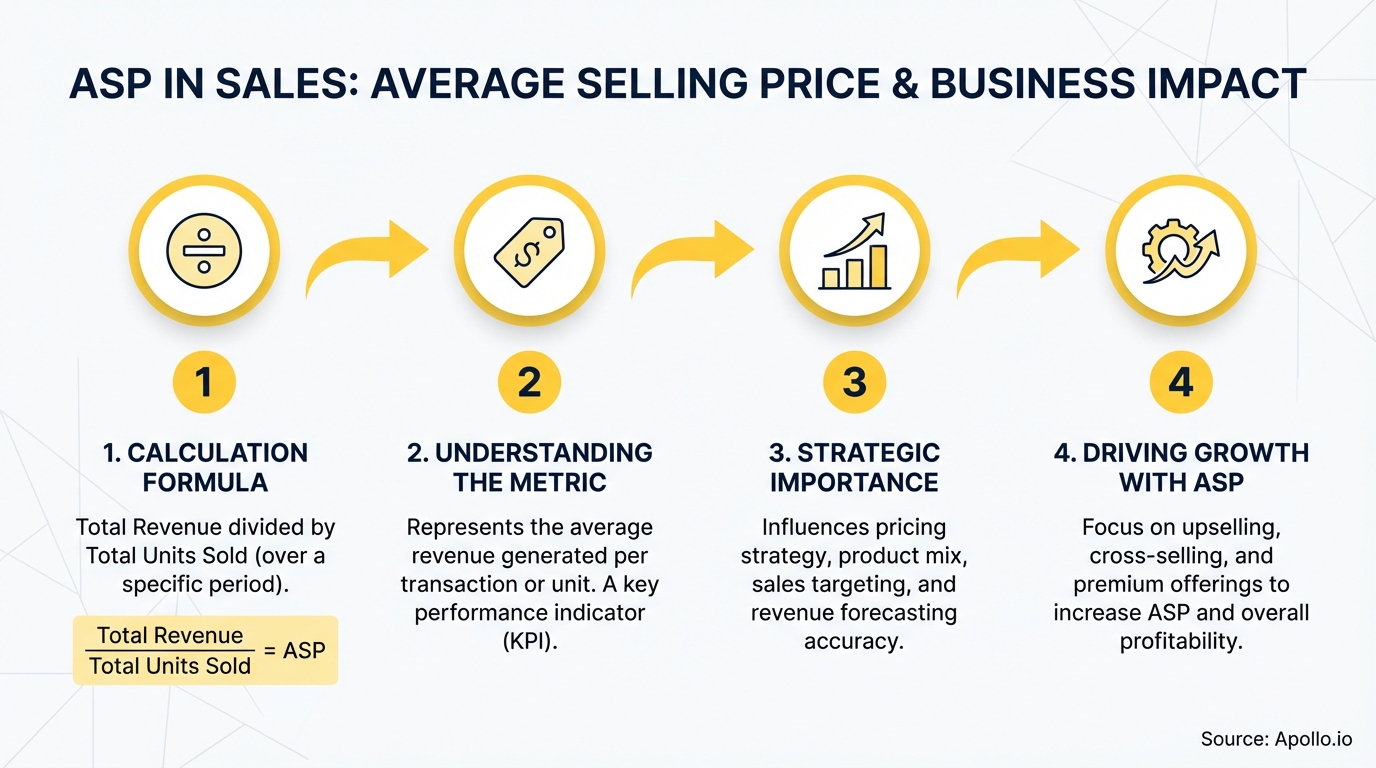
ASP in sales stands for Average Selling Price: the average realized price customers actually pay after discounts, bundles, and channel mix are applied. It is not your list price. It is not your target price. It is what revenue actually lands at, and in 2026, the gap between list price and ASP is widening for most B2B teams. Understanding B2B sales metrics like ASP is the foundation of predictable revenue growth.
With enterprise software vendors removing volume discounts and layering in AI-tier pricing, ASP has become one of the most misread metrics on any RevOps dashboard. Get it wrong, and you'll make bad headcount, quota, and packaging decisions.

Apollo Turns Research Hours Into Pipeline
Tired of your reps burning the day verifying contact info instead of selling? Apollo delivers 96% email accuracy across 224M contacts so your team prospects faster and closes more. Start building real pipeline today.
Start Free with Apollo →Key Takeaways
- ASP (Average Selling Price) is the actual realized price after discounts and mix — not list price.
- Digital-first buying means buyers form price expectations before your sales team engages, making early-stage messaging critical to defending ASP.
- RevOps leaders should track ASP alongside price realization rate and discount leakage by stage for a complete picture.
- AI-bundled pricing and packaging complexity are making ASP harder to measure and easier to misread in 2026.
- High-ASP deals require better ICP targeting, tighter deal qualification, and value-based positioning — not just negotiation skills.
What Is ASP in Sales and How Do You Calculate It?
ASP (Average Selling Price) is calculated by dividing total revenue by the number of units (or deals) sold in a given period. The formula is straightforward: ASP = Total Revenue / Number of Units Sold.
What makes it complex is what goes into "total revenue" — discounts, promotional pricing, bundle credits, and channel variances all reduce your realized price below list.
ASP is not the same as list price, MSRP, or Annual Contract Value (ACV). It reflects actual transaction economics.
In SaaS, ASP is often tracked per seat, per module, or per workload — and the definition must be consistent to be useful. Packaging complexity, including AI add-on tiers and usage-based components, makes careful ASP definition more important than ever.
| Term | Definition | Relationship to ASP |
|---|---|---|
| List Price | Published price before discounts | Always higher than ASP |
| ASP | Average realized price after all adjustments | The metric itself |
| ACV | Annual contract value per customer | Input to ASP calculation |
| Price Realization | ASP as a percentage of list price | Measures discount leakage |
Why Does ASP Matter for Revenue Operations in 2026?
ASP is a leading indicator of revenue health. A declining ASP signals discount pressure, poor deal mix, or misaligned ICP targeting — problems that compound over time. According to Pavilion's B2B SaaS performance benchmarks, deal qualification and value proposition strength are primary levers for moving ASP upward.
For RevOps leaders, tracking ASP alone is insufficient. The 2026 best practice is a three-metric set: ASP by segment, price realization vs. list, and discount leakage by deal stage. This trio exposes where revenue is leaking and which reps or segments are underperforming on realized price. Pair this with sales analytics to surface patterns across your pipeline.
- ASP by segment: Separate SMB, mid-market, and enterprise ASP to avoid averaging away meaningful differences.
- Price realization rate: Track ASP as a percentage of list. A declining rate signals discount creep.
- Discount leakage by stage: Identify which deal stages generate the most concessions and address root causes.
How Does Digital-First Buying Affect ASP?
Buyers form price expectations long before they talk to a seller. Gartner's research on the future of B2B sales found that buyers spend only 17% of their buying journey meeting with potential suppliers — meaning your pricing page, packaging clarity, and self-serve ROI tools do more to set ASP expectations than most sales conversations.
If perceived value is low before first contact, discounting becomes the only lever available.
The 6sense 2025 B2B Buyer Experience Report found that buyers purchase from their Day One shortlist 95% of the time. If your product isn't on that list with a defensible price anchor, you're either locked out or forced to discount to compete. Sellers who engage earlier — with clear value quantification — protect realized ASP at close. This is why ICP targeting matters: reaching the right buyer before the shortlist solidifies is an ASP defense strategy.
Turn Funnel Guesswork Into Real Pipeline
Tired of marketing leads that never convert and forecasts you can't trust? Apollo surfaces in-market buyers with precision so your pipeline reflects reality, not wishful thinking. Join 550K+ companies building predictable revenue.
Start Free with Apollo →How Do AEs and RevOps Leaders Protect ASP During Negotiation?
For Account Executives managing high-value deals, ASP protection starts in qualification — not at the negotiation table. Pursuing deals outside your ICP forces price concessions to compensate for poor fit. According to the Norwest 2024 B2B Sales and Marketing Benchmark Report, companies with ACV between $50,000 and $100,000 reported nearly 9 months to close a deal in 2024, an increase of 3 months from 2023 — longer cycles create more discount pressure. Tighter qualification shortens cycles and protects ASP.
Practical tactics AEs use to defend ASP:
- Anchor on business outcomes, not features: Quantify the cost of inaction before discussing price.
- Use multi-year structure: Offer stability (price locks) in exchange for longer commitments rather than upfront discounts.
- Protect concessions with trade-offs: Every discount should require something in return — faster close, reference rights, expanded scope.
- Track discount approvals: Require manager sign-off above a threshold to create friction and visibility.
Struggling to identify the highest-value prospects before they solidify a shortlist? Search Apollo's 224M contacts with 65+ filters to find and engage your ICP earlier.

What Does ASP Mean Across Different Industries?
ASP carries different implications depending on the industry. Understanding the context prevents misinterpretation when benchmarking or setting targets.
| Industry | ASP Focus | Key ASP Driver |
|---|---|---|
| SaaS / Software | Per seat, per module, or per workload | Packaging, AI tiers, expansion revenue |
| Hardware / Technology | Per unit sold | Component costs, product mix, refresh cycles |
| Manufacturing | Per SKU or product line | Volume discounts, channel mix, raw material costs |
| Professional Services | Per engagement or retainer | Scope clarity, value-based pricing, seniority mix |
A Circana forecast for 2026 projects B2B technology market growth bolstered by "higher average selling prices and a more premium product mix" across enterprise, mid-size, and small business segments, driven by the ongoing PC refresh cycle. In hardware markets, ASP is a supply-side metric as much as a sales one. For high-ticket sales, ASP analysis should be segmented tightly — averaging across segments obscures where real pricing power exists.
How Is AI Changing ASP Management in 2026?
AI is reshaping what ASP even measures. As vendors bundle AI features into tiers or shift to consumption-based pricing, per-seat ASP comparisons break down.
A deal priced at the same list rate as last year may carry a different realized ASP depending on which AI modules are included, how usage is metered, and what concessions were made during renewal.
Research from Kondo's B2B Sales Report 2025 highlights the increasing role of technology in optimizing sales performance and potentially influencing ASP through more effective targeting and pricing strategies. AI-powered tools help sales teams identify higher-value accounts, personalize outreach, and surface pricing signals earlier in the cycle — all of which support ASP improvement without discounting.
For teams using AI sales tools, the opportunity is to use intelligence to prioritize accounts where value fit is strongest — and where ASP defense is most achievable. Governance matters too: set guardrails on AI-generated pricing recommendations and ensure discount authority remains with humans.
Want to stop losing deals on price because your team is reaching the wrong accounts? Build a pipeline of better-fit buyers with Apollo's AI-powered pipeline builder.
What Are the Best Practices for Tracking and Improving ASP?
Improving ASP is a cross-functional effort spanning pricing, sales, and RevOps. The tactics that move the needle most consistently are rooted in better targeting and tighter deal management. Learn how to track the right sales KPIs in 2026 alongside ASP to build a complete revenue health picture.
- Segment your ASP dashboard: Track separately by deal size, industry, and rep to find patterns.
- Set a price realization floor: Alert managers when deals fall below a defined realization threshold.
- Review discount leakage weekly: Identify which deal stages generate the most concessions and coach accordingly.
- Improve packaging clarity: Buyers who understand value before engaging are less likely to negotiate on price alone.
- Use deal management software: Centralize approval workflows to reduce unauthorized discounting. Apollo's deal management tools give revenue leaders full pipeline visibility in one workspace.
According to Kondo's 2025 B2B Sales Trends analysis, revenue growth trends are often attributed to strategic price adjustments and a concentrated focus on expanding revenue from existing accounts — two levers that directly raise ASP without requiring new customer acquisition.

Start Protecting Your ASP with Better Pipeline Intelligence
ASP meaning in sales is simple: it is the price you actually realize, not the price you hoped to charge. In 2026, with AI bundles reshaping packaging and procurement teams pushing back harder on discounts, the spread between list price and realized ASP is the most important gap on your revenue dashboard.
The teams that protect ASP are not the ones with the best negotiators. They are the ones reaching the right buyers earlier, qualifying more tightly, and using data to justify value before price becomes the conversation.
Apollo gives SDRs, AEs, and RevOps teams the contact intelligence, pipeline visibility, and engagement tools to do exactly that, all in one platform — no need to stitch together separate tools for prospecting, outreach, and deal tracking.
"Having everything in one system was a game changer" — Cyera. "We cut our costs in half" — Census.
Start Your Free Trial and see how Apollo helps your team find better-fit buyers, run tighter deal cycles, and protect realized ASP across every segment.
Prove Pipeline ROI With Apollo
ROI pressure killing your tool budget? Apollo delivers measurable pipeline impact your leadership can see — fast. Leadium 3x'd annual revenue. Start your free trial and show results, not promises.
Start Free with Apollo →Don't miss these
Sales
Inbound vs Outbound Marketing: Which Strategy Wins?
Sales
What Is a Sales Funnel? The Non-Linear Revenue Framework for 2026
Sales
What Is a Go-to-Market Strategy? The 2026 GTM Playbook
See Apollo in action
We'd love to show how Apollo can help you sell better.
By submitting this form, you will receive information, tips, and promotions from Apollo. To learn more, see our Privacy Statement.
4.7/5 based on 9,690 reviews
