
AI Sales Assistant: How Artificial Intelligence Transforms Modern Selling
Sales teams face overwhelming pressure: more leads, faster follow-ups, higher quotas. According to professional networks, 56% of sales professionals use AI daily, and these individuals are twice as likely to exceed their sales targets compared to non-users. An AI sales assistant transforms how SDRs, AEs, and sales leaders work by automating research, personalizing outreach, and surfacing deal intelligence. These AI sales tools consolidate your tech stack into one platform, cutting costs and complexity while accelerating quota attainment.

Apollo Cuts Research Time From Hours To Seconds
Tired of spending 4+ hours daily hunting for contact info? Apollo delivers 224M verified contacts with 96% email accuracy instantly. Join 550K+ companies who stopped manual prospecting.
Start Free with Apollo →Key Takeaways
- AI sales assistants automate prospect research, email drafting, and follow-up sequences to save hours daily
- Teams using AI report measurable improvements in win rates, pipeline velocity, and quota attainment
- The best AI sales assistants consolidate multiple tools into one platform, reducing tech stack complexity and cost
- Proper implementation requires governance frameworks, phased rollout plans, and role-specific training
- AI-powered platforms surface buyer intent signals and conversation intelligence that accelerate deal cycles
What Is an AI Sales Assistant?
An AI sales assistant is software that uses artificial intelligence to automate and enhance sales workflows. It handles time-consuming tasks like prospect research, contact discovery, email personalization, meeting scheduling, and call analysis.
Unlike basic automation tools, AI sales assistants learn from data patterns to provide contextual recommendations, predict buyer behavior, and optimize outreach timing.
These platforms integrate directly into your CRM and sales engagement systems. They analyze millions of data points across contacts, companies, and interactions to surface actionable insights. For SDRs, this means pre-researched prospect lists with personalized talking points. For Account Executives, it means real-time battle cards during calls and AI-generated follow-up emails. Bain reports that early AI deployments have boosted win rates by over 30%.
How Does an AI Sales Assistant Work?
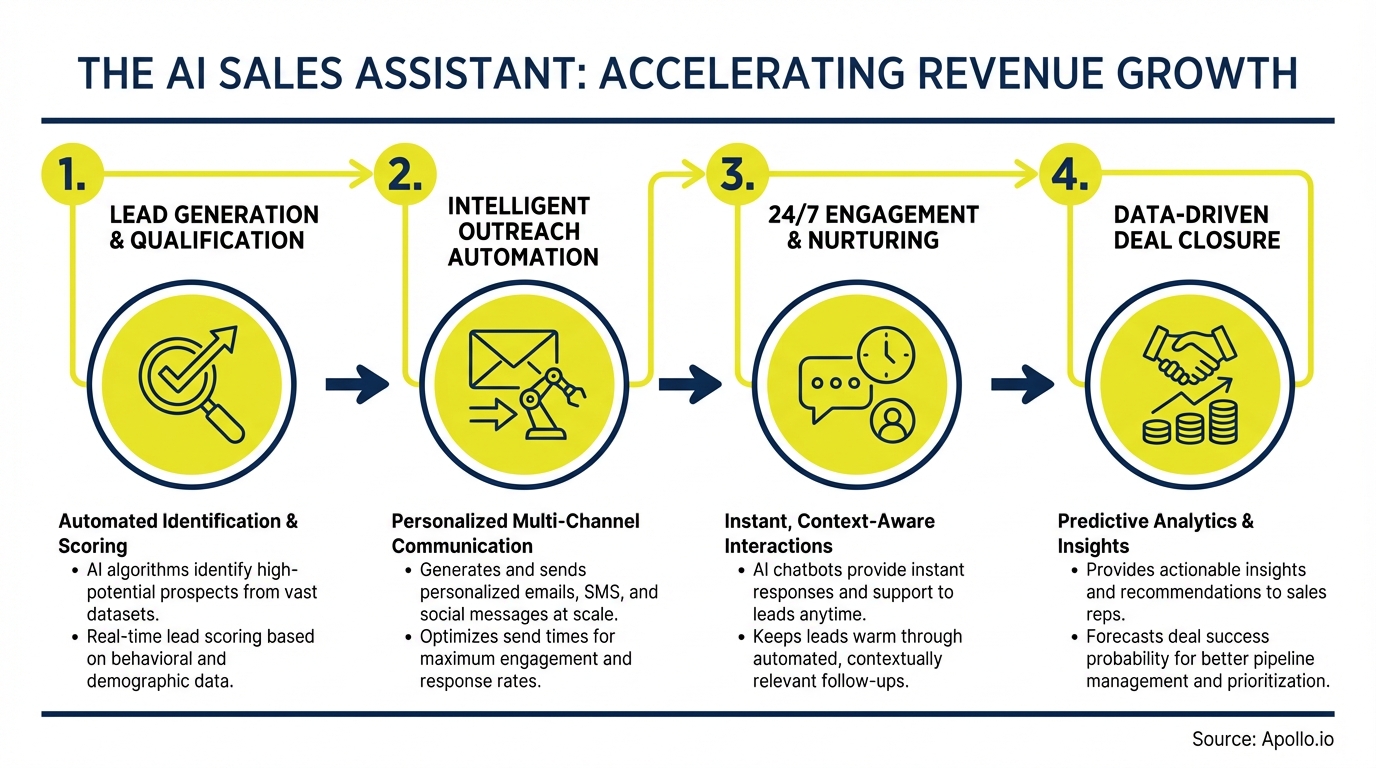
AI sales assistants operate through three core capabilities: data enrichment, workflow automation, and predictive analytics. First, they access B2B databases containing verified business contacts, job titles, company data, and technographic information.
Second, they automate repetitive tasks through sequences, templates, and scheduling logic.
Third, they analyze historical performance data to recommend optimal actions.
The workflow begins with prospecting. The AI assistant identifies accounts matching your ideal customer profile using 65+ filters across firmographics, technographics, and intent signals.
It then enriches contact records with phone numbers, email addresses, social profiles, and recent company news.
Next, it generates personalized outreach messages based on prospect data and your best-performing templates.
Finally, it tracks engagement metrics and suggests next steps based on buyer behavior patterns.
Struggling to find qualified leads? Search Apollo's 224M+ contacts with 65+ filters to build targeted prospect lists in minutes.
Why Do Sales Teams Use AI Assistants in 2026?
Sales teams adopt AI assistants to solve three critical problems: information overload, manual workflow bottlenecks, and inconsistent execution. Research from Rev Empire shows that 87% of companies identified AI as a top priority in their 2025 business plans. The adoption accelerates because AI assistants directly impact quota attainment.
Modern sales roles demand constant context switching between prospecting, outreach, meetings, and pipeline management. AI assistants eliminate this friction by consolidating workflows into one intelligent workspace. RevOps leaders report significant reductions in tool sprawl and subscription costs. Sales leaders gain visibility into team activities and coaching opportunities through sales analytics dashboards that surface performance patterns.
| Challenge | AI Assistant Solution | Impact |
|---|---|---|
| Manual prospect research | Automated contact discovery with enrichment | Hours saved per day |
| Generic outreach messages | AI-generated personalized emails | Higher response rates |
| Missed follow-ups | Automated sequences with smart timing | Increased pipeline velocity |
| Incomplete call notes | AI call summaries and action items | Better deal execution |
| Scattered tech stack | All-in-one platform consolidation | Lower costs, faster ramp |
How Do SDRs Use AI Sales Assistants to Book More Meetings?
SDRs use AI sales assistants to compress hours of research and outreach into minutes. The platform identifies target accounts, finds decision-maker contacts, enriches profiles with verified data, and drafts personalized emails.
An SDR can build a 500-prospect list with custom messaging in under 30 minutes, compared to days of manual work.

The AI assistant tracks email opens, link clicks, and reply sentiment to prioritize follow-ups. It suggests optimal send times based on prospect time zones and engagement patterns.
For multi-channel sequences, it coordinates email, phone, and social touchpoints automatically. SDRs report that AI-powered sequences maintain consistent outreach cadence even during high-volume periods.
The conversation intelligence features provide pre-call briefings with recent company news, mutual connections, and relevant case studies. During calls, real-time transcription captures key points without manual note-taking.
Post-call, the AI assistant generates follow-up emails and CRM updates automatically. As noted by Predictable Revenue: "We reduced the complexity of three tools into one."
See Every Deal Stage In Real Time With Apollo
Pipeline forecasting a guessing game? Apollo gives you live visibility across every deal stage so you can forecast with confidence. Built-In boosted win rates 10% with Apollo's scoring.
Start Free with Apollo →What Features Should You Look for in an AI Sales Assistant?
The most effective AI sales assistants combine four essential capabilities: comprehensive B2B data, intelligent automation, conversation intelligence, and native CRM integration. Look for platforms offering verified contact databases with 200M+ records, not just aggregated web scraping.
Data accuracy directly impacts deliverability and response rates.
Automation features should include multi-channel sequences, dynamic personalization variables, A/B testing, and behavioral triggers. The platform should adapt messaging based on prospect actions like email opens or website visits. Sales automation software that learns from your best performers can replicate winning patterns across the team.
Spending hours on manual outreach? Automate your sequences with Apollo's multi-channel platform and AI-powered personalization.
Must-Have AI Sales Assistant Capabilities
- Contact & Company Database: Access to 224M+ verified business contacts with direct dials and email addresses
- AI Email Writing: Context-aware message generation using prospect data, company news, and performance patterns
- Sequence Automation: Multi-step, multi-channel campaigns with smart timing and personalization at scale
- Conversation Intelligence:AI call assistant features including transcription, summaries, and action item extraction
- Intent Signals: Buyer behavior tracking across web visits, content downloads, and engagement patterns
- CRM Integration: Bi-directional sync with Salesforce, HubSpot, and other platforms for unified data flow
- Analytics Dashboard: Performance metrics, pipeline visibility, and team coaching insights

How Should Teams Implement an AI Sales Assistant?
Successful AI sales assistant implementation follows a phased approach: assessment, pilot, rollout, and optimization. Start by documenting current workflows, identifying bottlenecks, and defining success metrics.
Choose a pilot team of 5-10 reps representing different skill levels and segments.
During the pilot phase, focus on one high-impact use case like prospecting or email personalization. Provide hands-on training with role-specific workflows.
SDRs need different training than AEs or sales leaders.
Create templates, sequences, and playbooks that align with your methodology.
Track metrics like time saved, activities completed, and pipeline generated.
After validating results, expand to the full team with structured onboarding. According to Salesforce, 83% of sales teams using AI saw revenue growth in the past year, versus 66% of teams not using AI. Establish governance policies for data usage, message approval, and quality standards. Schedule weekly check-ins to address questions and share best practices.
| Implementation Phase | Duration | Key Activities |
|---|---|---|
| Assessment | 1-2 weeks | Document workflows, identify use cases, define metrics |
| Pilot | 4-6 weeks | Train pilot team, build templates, validate ROI |
| Rollout | 4-8 weeks | Onboard full team, establish governance, scale playbooks |
| Optimization | Ongoing | Refine sequences, coach based on analytics, iterate templates |
What ROI Can Teams Expect from AI Sales Assistants?
Teams report measurable improvements across productivity, conversion rates, and revenue outcomes. Time savings average 5-10 hours per rep per week through automated research, email drafting, and data entry.
This translates to 20-30% more selling time for activities like calls and meetings.
Conversion metrics improve through better targeting and personalization. Email response rates increase when messages reference specific prospect pain points and recent company activities.
Meeting show rates climb when SDRs send contextual calendar invites with relevant agenda items. Deal cycles shorten when AEs access pre-meeting intelligence and post-call action items automatically.
Tool consolidation delivers significant cost savings. Teams replace 3-5 separate tools with one all-in-one platform, reducing annual software spend while eliminating integration headaches.
As Census shared: "We cut our costs in half." RevOps leaders also report faster rep ramp time since new hires learn one system instead of navigating multiple disconnected tools.
Ready to Accelerate Your Sales with AI?
AI sales assistants have evolved from experimental tools to essential platforms for quota-carrying teams. The combination of verified B2B data, intelligent automation, and conversation intelligence creates a force multiplier for SDRs, AEs, and sales leaders.
Teams that effectively partner with AI report higher win rates, faster pipeline velocity, and improved quota attainment.
The key to success lies in choosing a platform that consolidates your tech stack rather than adding another tool. Look for comprehensive capabilities across prospecting, engagement, enrichment, and analytics.
Implement with clear governance frameworks and role-specific training. Measure impact through time saved, activities completed, and revenue generated.
Apollo provides the all-in-one GTM platform trusted by 550K+ companies and 2M+ users. Access 224M+ verified business contacts, automate multi-channel sequences, leverage AI call intelligence, and manage your entire deal pipeline from one workspace. Our customers report significant tool consolidation and cost savings while accelerating team performance.
Schedule a Demo to see how Apollo's AI sales assistant capabilities can help your team hit quota faster while reducing tech stack complexity.
Prove Apollo's ROI In Your First 30 Days
Budget approval stuck on unclear metrics? Apollo tracks every touchpoint from prospect to close so you can show leadership exactly what's working. Built-In increased win rates 10% and ACV 10% with Apollo's scoring.
Start Free with Apollo →Don't miss these
Sales
Inbound vs Outbound Marketing: Which Strategy Wins?
Sales
What Is a Sales Funnel? The Non-Linear Revenue Framework for 2026
Sales
What Is a Go-to-Market Strategy? The 2026 GTM Playbook
See Apollo in action
We'd love to show how Apollo can help you sell better.
By submitting this form, you will receive information, tips, and promotions from Apollo. To learn more, see our Privacy Statement.
4.7/5 based on 9,690 reviews
