
The AI Assistant That Writes Outbound Sequences from Triggers in 2026
Static sales cadences are losing ground to trigger-based outbound, and for good reason.
Sending the same template to everyone regardless of their buying signals is the fastest path to the spam folder.
A purpose-built AI Sales Assistantthat monitors real-time signals and writes sequences from those triggers changes the equation: outreach reaches prospects at the moment of highest relevance, not on an arbitrary schedule.
According to SalesHive, 83% of sales teams using AI saw revenue growth in the past year, compared to 66% of teams not using AI. The gap between AI-augmented and manual outbound is widening fast. This article covers how trigger-based AI sequence writing works, how to score your triggers, and how to diagnose sequences that aren't converting.

Research Less, Pipeline More With Apollo
Tired of your reps burning hours verifying contacts instead of closing deals? Apollo surfaces accurate, ready-to-engage prospects so your team scales outreach without scaling headcount. Join 600K+ companies building predictable pipeline.
Start Free with Apollo →Key Takeaways
- Trigger-based outbound replaces generic persona templates with sequences written from real buying signals: funding rounds, job changes, intent spikes, tech stack shifts, and CRM activity.
- Not all triggers are equal. A trigger quality scoring framework helps SDRs and RevOps teams decide which signals warrant outreach and which should wait.
- Governed AI controls (brand voice library, approval gates, audit trail) are now buying criteria for enterprise GTM teams, not optional extras.
- High open rates paired with low reply rates almost always indicate a trigger relevance problem, not a subject-line problem.
- Apollo's AI Assistant writes full multichannel sequences from triggers inside one unified platform, consolidating the tech stack needed to execute trigger-based outbound.
What Is an AI Assistant That Writes Outbound Sequences from Triggers?
An AI assistant that writes outbound sequences from triggers is a workflow-native tool that detects a specific buying signal, scores its relevance, and generates a personalized multichannel sequence in response, without requiring a rep to write the message from scratch. This is distinct from a generic AI writing tool, which produces copy on demand but has no awareness of why outreach is happening or when a prospect is ready to engage.
The trigger is the cause. The sequence is the effect. Common triggers include:
- Funding rounds: company just raised capital and is expanding the team
- Job changes: a new VP of Sales or CTO joined a target account
- Intent signals: prospect is researching your category online
- Tech stack changes: company adopted or dropped a tool you integrate with
- CRM activity: a contact re-engaged with your website or opened a prior email
Gartner reported in May 2026 that sales organizations providing AI-enabled next best actions are 2.6x more likely to achieve commercial growth. Trigger-based sequence writing is the operational mechanism that delivers those next best actions at scale. Learn more about outbound prospecting best practices for additional context on signal-driven GTM.
How Does Trigger Quality Scoring Work?
Trigger quality scoring is the process of assigning a strength rating to a buying signal before generating a sequence, ensuring reps only send outreach when the timing justifies it. Sending on a weak trigger is the primary cause of low reply rates despite strong subject lines.
Use this framework to evaluate any trigger before activating a sequence:
| Trigger Type | Strength | Recommended Action |
|---|---|---|
| Inbound form fill or demo request | Very High | Immediate sequence, same day |
| Funding announcement (Series A+) | High | Sequence within 48 hours |
| New executive hire (VP+) | High | Sequence within 72 hours |
| Intent spike (3+ sessions, relevant pages) | Medium-High | Sequence within 5 business days |
| Tech stack change (relevant tool adopted) | Medium | Sequence within 7 days |
| Job posting for a role you serve | Medium | Sequence within 7 days |
| Single email open, no clicks | Low | Wait for a stronger signal before sequencing |
RevOps leaders should configure these thresholds inside their AI platform so sequences only fire above a defined quality floor. Apollo's Scores feature lets teams set ICP match thresholds so the AI only adds prospects to sequences when both the trigger strength and the account fit are sufficient.
How Do SDRs Use a Signal-to-Sequence Workflow in Practice?
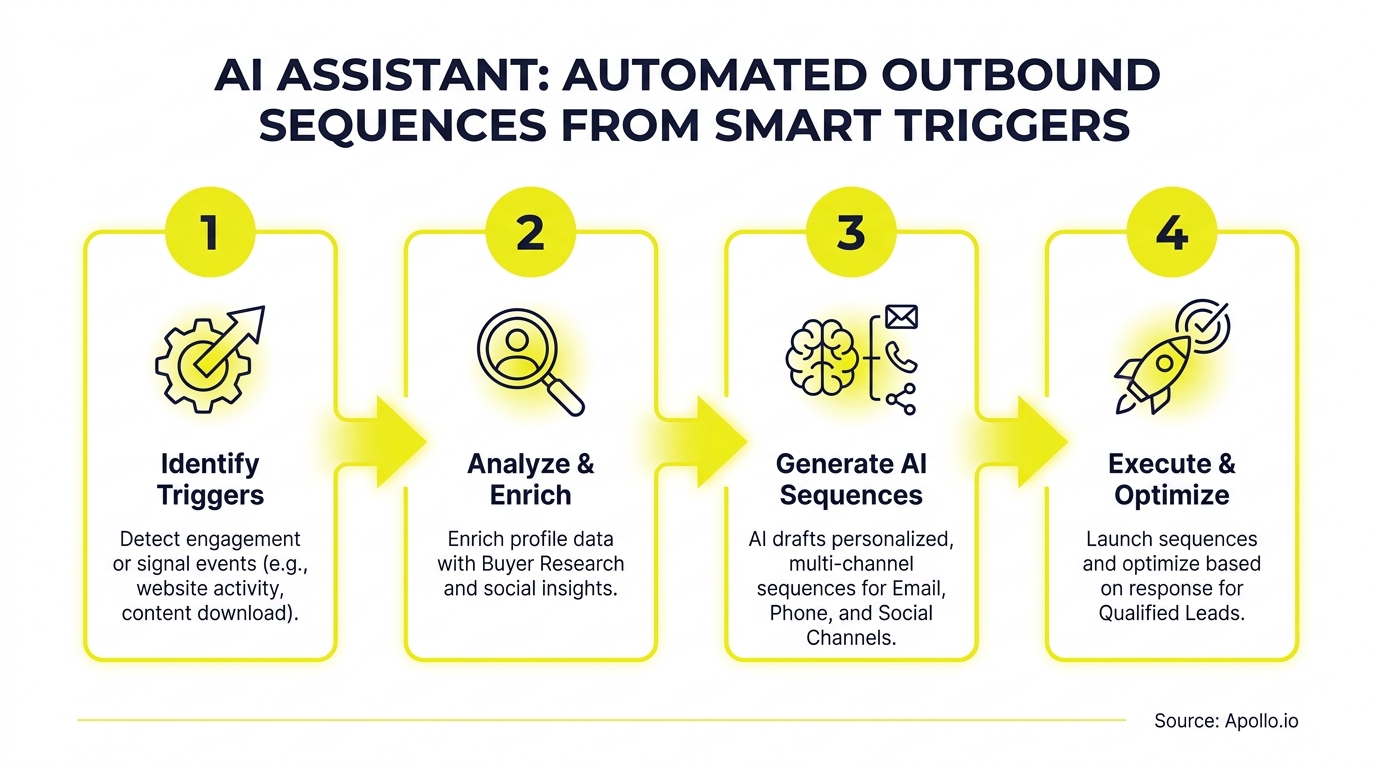
SDRs using a signal-to-sequence workflow follow a repeatable five-step process: detect the trigger, score its quality, enrich the contact, generate the sequence, and approve before sending. Each step can be partially or fully automated depending on the platform and governance rules in place.
Here is how the workflow runs inside Apollo:
- Trigger detected: Apollo's workflow engine identifies the signal (funding, job change, intent spike, CRM activity).
- Account scored: AI Scores evaluate ICP fit against firmographic and behavioral criteria. Low-fit accounts are held, not sequenced.
- Research grounded:AI Research uses Perplexity Sonar to pull live web context about the company and contact, reducing the chance of generic messaging.
- Sequence generated: The AI Sequence Builder produces a full multichannel sequence (email, call, social tasks) personalized to the trigger. Messaging references the actual signal: the funding round, the new hire, the intent topic.
- Approval gate: The rep reviews and approves before the sequence launches. Manual or automatic approval can be configured based on trigger strength tier.
Tory Kindlick, Head of Revenue Ops at RapidSOS, described the experience this way: "Work that would've taken me hours was done before I even got off the train." That efficiency comes from collapsing research, list building, and sequence writing into one conversation with the Assistant.
Spending too much time stitching together signals from separate tools? Apollo's AI sales automation consolidates trigger detection, enrichment, and sequence writing into one platform.

What Governed AI Controls Do Enterprise GTM Teams Require?
Governed AI controls are the guardrails that prevent trigger-based outbound from becoming automated spam: brand voice libraries, approval gates, audit trails, and message consistency rules. Gartner warned in 2025 that more than 40% of agentic AI projects will be canceled by end of 2027 due to escalating costs, unclear business value, or inadequate risk controls.
Governance is now a buying criterion, not an afterthought.
Key governance elements to configure before scaling trigger-based outbound:
- AI Content Center: Define your value proposition, pain points, CTAs, and differentiators once. Every AI-generated sequence draws from this grounded context rather than hallucinating generic copy. Apollo's AI Content Center can be auto-populated from your website URL.
- Approval gates by trigger tier: High-strength triggers (inbound, funding) may auto-enroll. Medium triggers require rep review. Low triggers are held entirely.
- Message review before send: Reps can edit, rewrite with AI, or reject any generated step before it goes out. No sequence sends autonomously without a configured approval rule.
- Sequence cap per account: Set maximum touches per account per quarter to prevent over-sequencing the same contacts.
- Brand voice consistency: The Content Center enforces tone, CTA style, and messaging hierarchy across all AI outputs, keeping sales and marketing aligned.
For AEs managing named accounts, governance also means ensuring that trigger-based sequences don't fire on accounts already in active deal stages. CRM sync rules should suppress sequencing for contacts in pipeline to avoid conflicting outreach. Review CRM strategies that support this kind of deal-stage logic.
Turn Funnel Gaps Into Pipeline Wins
Pipeline forecasting a guessing game? Apollo surfaces in-market buyers the moment they're ready, turning weak lead flow into qualified opportunities. 600K+ companies stopped guessing and started closing.
Start Free with Apollo →How Do SDRs Diagnose Sequences That Get Opens But No Replies?
High open rates paired with low reply rates indicate a trigger relevance problem, not a subject-line problem. If prospects open the email but don't respond, they read the message and found it irrelevant to their current situation.
The fix is upstream: re-evaluate the trigger, not the copy.
Use this diagnostic framework:
| Symptom | Likely Cause | Fix |
|---|---|---|
| High opens, low replies | Trigger is weak or misattributed | Raise trigger quality threshold; reference the signal explicitly in email body |
| Low opens, low replies | Subject line or deliverability issue | A/B test subject lines; check sending domain health |
| Replies but wrong persona | Contact enrichment mismatch | Tighten ICP filters; use AI Scores to enforce minimum fit before enrollment |
| Good replies, poor meeting rate | CTA or value prop misalignment | Update Content Center with sharper pain points and differentiated CTA |
According to SalesO, businesses are generating 30% of their outbound messages using AI, a 98% increase from 2022. Volume is rising sharply. SDRs who diagnose sequences at the trigger level rather than the copy level will stand out in increasingly crowded inboxes. See sequence structure best practices for additional diagnostic benchmarks.
AI Writing vs. Trigger-Based Assistant vs. AI SDR Agent: What's the Difference?
These three categories solve different problems, and conflating them leads to buying the wrong tool.
| Category | What It Does | What It Doesn't Do |
|---|---|---|
| AI Writing Tool | Generates email copy on demand from a prompt | No trigger awareness, no workflow integration, no sequencing |
| Trigger-Based AI Assistant | Detects signals, scores quality, generates and launches sequences grounded in account context | Requires human approval; does not autonomously manage the full sales cycle |
| AI SDR Agent | Autonomously researches, sequences, and follows up with minimal human input | Higher governance risk; buyers still prefer human reps for advancing complex deals |
The trigger-based AI assistant sits in the middle: it handles the research and writing burden while keeping the rep in control of what goes out. This matches Gartner's 2026 recommendation to redesign seller roles around AI-augmented workflows rather than fully automating every seller task. Data from AIPRM shows that by early 2025, 78% of organizations were using AI in at least one business function, but most adoption remains tool-level rather than workflow-level. The trigger-based assistant bridges that gap.
Struggling to move from ad hoc AI use to a repeatable outbound workflow? Apollo's sales engagement platform connects trigger detection, AI sequence writing, and multichannel execution in one place.

Start Running Trigger-Based Outbound with Apollo
Trigger-based sequence writing is the 2026 standard for outbound that earns replies rather than unsubscribes. The winning motion combines a clear trigger quality scoring framework, governed AI controls that keep messaging on-brand, and a diagnostic mindset that fixes relevance before tweaking copy.
Apollo's AI Sales Assistanthandles the full workflow: detecting signals, scoring accounts, enriching contacts, generating multichannel sequences grounded in your Content Center, and routing for approval before sending. SDRs, AEs, and RevOps teams use it to consolidate research, writing, and execution into one platform. As Dr. Jonathan Chenier, Director of Business Development at TransPerfect, put it: "I've been able to generate high-quality messaging in minutes when I provide clear context like our value prop and desired outcome."
Ready to replace static cadences with sequences that respond to real buying signals? Start a free trial of Apollo and see how the AI Sequence Builder and Outbound Copilot work together to turn triggers into booked meetings.
Prove Pipeline ROI From Day One
ROI pressure killing your tool budget before it even gets approved? Apollo delivers measurable pipeline impact fast — with 35% more bookings via AI-powered messaging. 600K+ companies justify the spend. See results before the next renewal.
Schedule a Demo →Don't miss these
Sales
Inbound vs Outbound Marketing: Which Strategy Wins?
Sales
What Is a Sales Funnel? The Non-Linear Revenue Framework for 2026
Sales
What Is a Go-to-Market Strategy? The 2026 GTM Playbook
See Apollo in action
We'd love to show how Apollo can help you sell better.
By submitting this form, you will receive information, tips, and promotions from Apollo. To learn more, see our Privacy Statement.
4.7/5 based on 9,690 reviews
