
Why Are My Emails Bouncing and How Can I Fix It? (2026 Guide)
Your emails are bouncing — and every bounce is a missed conversation, a lost pipeline opportunity, and a hit to your sender reputation. In 2026, the rules have changed: Google, Microsoft, and Yahoo now reject what they used to silently filter. Authentication failures that once resulted in spam placement now return hard bounce codes. If you're seeing spikes in your bounce rate, the fix starts with understanding exactly why it's happening.
For SDRs running outbound sequences or RevOps teams managing large-scale campaigns, bounces aren't just a technical nuisance — they directly damage your domain's ability to reach inboxes. Read our guide on email deliverability and how to dodge spam filters for the full picture. This article gives you the bounce-specific triage framework you need right now.

Get Verified Contacts That Actually Reply
Tired of burning hours verifying emails that bounce anyway? Apollo delivers 97% email accuracy so your team spends time selling, not researching. Nearly 100K paying customers have already made the switch.
Start Free with Apollo →Key Takeaways
- Email bounces split into two types: hard bounces (permanent failures) and soft bounces (temporary failures) — each requires a different fix.
- According to ZeroBounce, a bounce rate above 2% is concerning and above 5% actively harms sender reputation.
- Microsoft now rejects non-compliant bulk senders with a 550; 5.7.515 error — SPF, DKIM, and DMARC are no longer optional.
- B2B contact data decays rapidly, meaning lists verified last quarter may already contain invalid addresses driving up your bounce rate.
- Fixing bounces requires three parallel tracks: list hygiene, authentication alignment, and reputation monitoring.
What Are Hard Bounces vs. Soft Bounces?
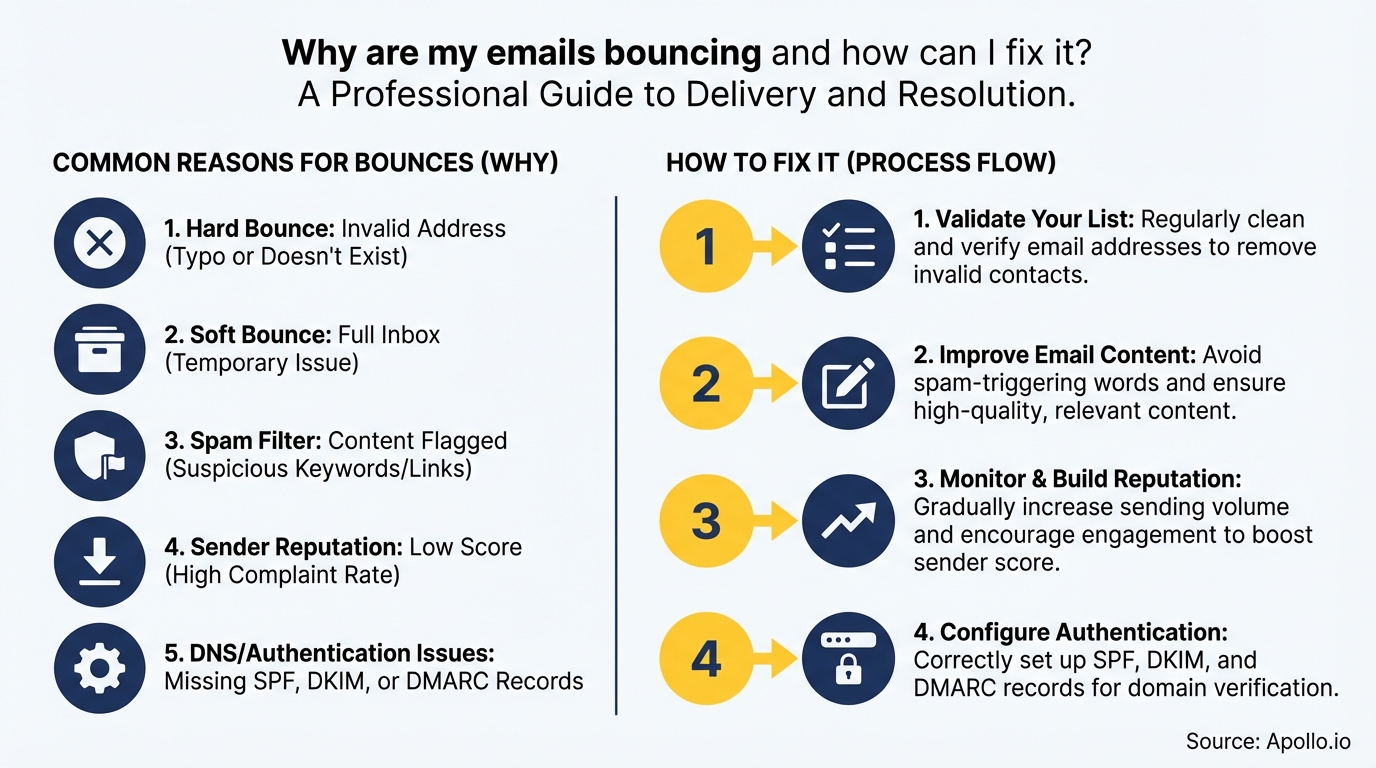
As Verifalia explains, email bounces are categorized as either "hard" (permanent failure) or "soft" (temporary failure), and each type signals a different root cause.
| Bounce Type | Meaning | Common Causes | Action |
|---|---|---|---|
| Hard Bounce | Permanent delivery failure | Invalid address, domain doesn't exist, blocked sender | Remove immediately from all lists |
| Soft Bounce | Temporary delivery failure | Mailbox full, server temporarily down, message too large | Retry after 24–72 hours; suppress after 3 failures |
Hard bounces are the most damaging. Each one signals to mailbox providers that your list quality is poor, which triggers stricter filtering on subsequent sends.
Remove every hard bounce address immediately and never re-queue them.
Why Are My Bounce Rates Too High? The 5 Root Causes
Most bounce problems trace back to one of five root causes. Identifying yours first saves hours of trial-and-error remediation.
- Stale contact data: B2B email addresses decay as people change roles and companies. Data from RevenueBase shows business email addresses experienced a 3.6% decay rate in a single month (November 2024) — far above the traditional 1.5–2.0% monthly baseline. Lists verified last quarter may already be generating bounces today.
- Missing or broken authentication: SPF, DKIM, or DMARC records that are absent, misconfigured, or misaligned with your sending domain cause receiving servers to reject your mail outright.
- Poor sender reputation: High complaint rates, sudden volume spikes, or sending from a cold domain without warming all suppress deliverability and increase rejections.
- Catch-all and role-based addresses: Addresses like info@ or support@ often accept mail at the SMTP level but bounce silently or never reach a human.
- Provider policy violations: Google and Microsoft now enforce hard thresholds. Exceeding their spam-rate or authentication requirements results in direct rejections, not just spam placement.
Tired of bounces from stale contact data? Start free with Apollo's 230M+ verified business contacts and reduce invalid addresses before they hit your sequences.

How Do Google and Microsoft's 2025–2026 Rules Create New Bounces?
The single biggest shift in email deliverability over the past two years is provider policy enforcement. What used to result in silent spam placement now returns explicit rejection codes.
What Is Google's Spam Rate Threshold for Bulk Senders?
Google's bulk sender guidelines require senders to keep user-reported spam rates below 0.1%, with a hard ceiling at 0.3%. Senders exceeding 0.3% lose mitigation eligibility — meaning Google can reject or permanently block their mail.
These rules apply to anyone sending 5,000+ messages per day to Gmail addresses.
What Does the Microsoft 550; 5.7.515 Error Mean?
As of May 5, 2025, Microsoft requires domains sending more than 5,000 emails per day to Outlook.com consumer addresses to comply with SPF, DKIM, and DMARC. Non-compliant mail is rejected with the error: 550; 5.7.515 — does not meet the required authentication level.
This is a hard bounce. If you're using a multi-tool stack (CRM + sequencing platform + ESP), DMARC alignment failures are especially common because the visible From domain may not match your DKIM signing domain or Return-Path.
Audit all three before scaling volume.
How Do SDRs and RevOps Teams Fix Email Bounces Systematically?
For SDRs running daily outbound sequences, a bounce spike can kill deliverability for the entire team's sending domain. For RevOps leaders managing the infrastructure, the fix requires both technical controls and operational processes.
Immediate triage checklist:
- Pull your bounce report and separate hard from soft bounces
- Suppress all hard-bounced addresses across every active sequence
- Check your domain's SPF record includes all current sending services
- Verify DKIM is configured and the
d=domain matches your From address - Confirm DMARC policy is published (start with
p=nonefor monitoring, escalate top=quarantineorp=reject) - Review Google Postmaster Tools for domain reputation score and spam rate trends
- Check Microsoft's SNDS (Smart Network Data Services) for your sending IP reputation
Ongoing prevention for outbound teams:
- Verify contact emails at point of import, not just at list creation
- Re-verify any list older than 60–90 days before sending
- Warm new sending domains gradually before reaching full sequence volume
- Set automatic suppression rules: remove any address after one hard bounce, suppress after three soft bounces
- Monitor bounce rate weekly — anything above 2% warrants immediate investigation
For teams building outbound at scale, pairing verified data with Apollo's multi-channel sales engagement platform keeps sequences running on clean, current contacts while protecting your domain reputation.
Turn Funnel Chaos Into Predictable Pipeline
Pipeline forecasting a guessing game because quality leads never make it past MQL? Apollo surfaces in-market buyers at the right moment, so your funnel fills with opportunities that actually convert. Nearly 100K paying customers have stopped guessing.
Start Free with Apollo →What Is the Difference Between Delivery, Inbox Placement, and a Bounce?
A low bounce rate does not mean your emails are being read. These three metrics measure different things:
| Metric | What It Measures | Healthy Benchmark |
|---|---|---|
| Delivery Rate | % of emails accepted by the receiving server | >98% |
| Inbox Placement Rate | % of delivered emails reaching the inbox (not spam) | >90% (industry avg. ~86%) |
| Bounce Rate | % of emails rejected before or during delivery | <2% (cold email: <5%) |
As The Digital Bloom notes, while the overall email delivery rate remains high, emails frequently fail to reach the inbox, often landing in spam or junk folders. Meanwhile, data from Martal shows cold email campaigns average a bounce rate of 7–8%, compared to under 2% for opt-in campaigns — a gap that underscores why verified data matters so much for outbound sales teams. For a deeper look at the right way to run sales automation, including protecting deliverability at scale, see our full guide.

How to Fix Email Bounces: Quick Reference by Error Code
| Error Code | Meaning | Fix |
|---|---|---|
| 550 5.1.1 | Mailbox does not exist | Remove address; verify list before next send |
| 550 5.7.1 | Message rejected by policy | Check SPF/DKIM/DMARC alignment; review content for spam triggers |
| 550 5.7.515 | Microsoft auth failure (bulk sender) | Publish valid SPF, DKIM, and DMARC for your From domain immediately |
| 421 / 450 | Temporary failure (soft bounce) | Retry after 24 hours; check sending volume and IP reputation |
| 552 / 554 | Message content rejected | Review subject line and body for spam trigger words; reduce link density |
Authentication and alignment issues now account for a growing share of hard bounces. Among high-volume B2B senders sending 100,000+ emails monthly, DMARC implementation increased from 56% in 2023 to 70% in 2024, according to Mailgun's State of Email report — meaning the 30% without it are increasingly exposed to rejection. For teams writing outbound copy, see our guide on how to write sales emails that get responses — great copy only works if it actually arrives.
How Do You Stop Email Bounces Before They Happen?
Prevention beats remediation. Build these controls into your outbound process before campaigns launch:
- Verify contacts at import: Run email verification on every new list before loading it into sequences. Real-time SMTP checks catch invalid addresses that static databases miss.
- Re-verify aged lists: Any contact list older than 60 days should be re-verified. B2B contact decay is rapid — role changes, company exits, and domain migrations all invalidate previously clean addresses.
- Use permission-based practices where possible: Opt-in lists consistently outperform cold lists on bounce rates. Learn more about permission-based email marketing and how to implement it.
- Monitor sending reputation weekly: Use Google Postmaster Tools and Microsoft SNDS to track domain and IP health before problems compound.
- Operate as a bulk sender even if you're not yet at volume: Growth spikes can push teams into stricter enforcement bands overnight. Build authentication and list hygiene practices now.
For demand generation teams managing inbound and outbound together, keeping bounce rates low is foundational to sustainable pipeline. See what else drives demand generation marketing results beyond deliverability fixes.
Fix Bounces, Protect Pipeline, and Scale Outbound Confidently
Email bounces are a symptom of three underlying problems: bad data, broken authentication, and poor reputation management. In 2026, provider enforcement means these problems surface faster as hard rejections rather than quiet spam placement.
The fix is systematic: verify contacts before they enter your sequences, align SPF/DKIM/DMARC with your actual sending infrastructure, and monitor your reputation signals weekly.
Apollo helps B2B GTM teams solve the data side of the equation with 230M+ verified business contacts and built-in email verification, so SDRs, AEs, and RevOps leaders spend less time chasing bounces and more time booking meetings. Start your free trial and build outbound sequences on contact data you can trust.
Prove Pipeline ROI From Day One
ROI pressure killing your tool budget before it even starts? Apollo delivers measurable pipeline impact fast — Leadium 3x'd annual revenue after making the switch. Start your free trial and show results before the next budget review.
Start Free with Apollo →Don't miss these
Sales
Inbound vs Outbound Marketing: Which Strategy Wins?
Sales
What Is a Sales Funnel? The Non-Linear Revenue Framework for 2026
Sales
What Is a Go-to-Market Strategy? The 2026 GTM Playbook
See Apollo in action
We'd love to show how Apollo can help you sell better.
By submitting this form, you will receive information, tips, and promotions from Apollo. To learn more, see our Privacy Statement.
4.7/5 based on 9,690 reviews
