
Which B2B Companies Benefit Most from Agentic GTM
Agentic GTM is moving from experiment to competitive edge in 2026. But not every B2B company is equally positioned to benefit. The winners aren't necessarily the most AI-forward organizations; they're the most process-native and data-disciplined. If your team is exploring what modern B2B go-to-market looks like, understanding which company profiles unlock the most value from agentic workflows is the right starting point.
According to Futurum Group, high-performing sales teams are 1.7 times more likely to use AI agents than underperformers. The gap is widening. The question isn't whether to adopt agentic GTM; it's whether your company has the structural prerequisites to make agents work.

Scale Smarter With Apollo's GTM Engine
Tired of manual research eating your selling time? Apollo's AI surfaces verified contacts and automates outreach so your team scales without the chaos. Nearly 100K paying customers grow pipeline faster.
Start Free with Apollo →Key Takeaways
- Agentic GTM rewards companies that are process-native first, AI-native second: clean data, defined lifecycle stages, and repeatable plays matter more than cutting-edge tooling.
- High-velocity inbound workflows (qualification, routing, scheduling) are the earliest and lowest-risk entry point for agentic GTM across most B2B segments.
- Enterprise SaaS, cybersecurity, fintech, and vertical SaaS companies with RevOps functions are best positioned due to complex buying cycles and measurable pipeline metrics.
- Digitally mature B2B suppliers are significantly more likely to use agentic AI extensively and have achieved measurably stronger sales growth than less mature competitors.
- RevOps leaders who treat agent governance like rep governance (audit trails, playbook compliance, QA) will outperform those who treat agentic AI as a set-and-forget tool.
What Is Agentic GTM and How Does It Differ from Standard AI?
Agentic GTM uses AI systems that plan, decide, and execute multi-step go-to-market workflows autonomously, not just generate content or surface recommendations. As defined by Aggentic.ai, agentic AI refers to systems capable of planning, making decisions, and acting autonomously across multiple steps to achieve a goal, often utilizing various tools and data sources.
Standard AI assistants answer questions or draft copy. Agentic systems route inbound leads, send follow-up sequences, update CRM fields, schedule meetings, and escalate exceptions, without a human initiating each step.
The distinction matters because most "AI-powered GTM" tools on the market today are assistants, not agents. Validating true agentic capability means looking for multi-step execution, decision branching, and real system-of-record updates.
| Capability | AI Assistant | Agentic GTM |
|---|---|---|
| Content generation | Yes | Yes |
| Multi-step workflow execution | No | Yes |
| CRM field updates | No | Yes |
| Lead routing decisions | No | Yes |
| Exception escalation | No | Yes |
Which B2B Company Types Benefit Most from Agentic GTM?
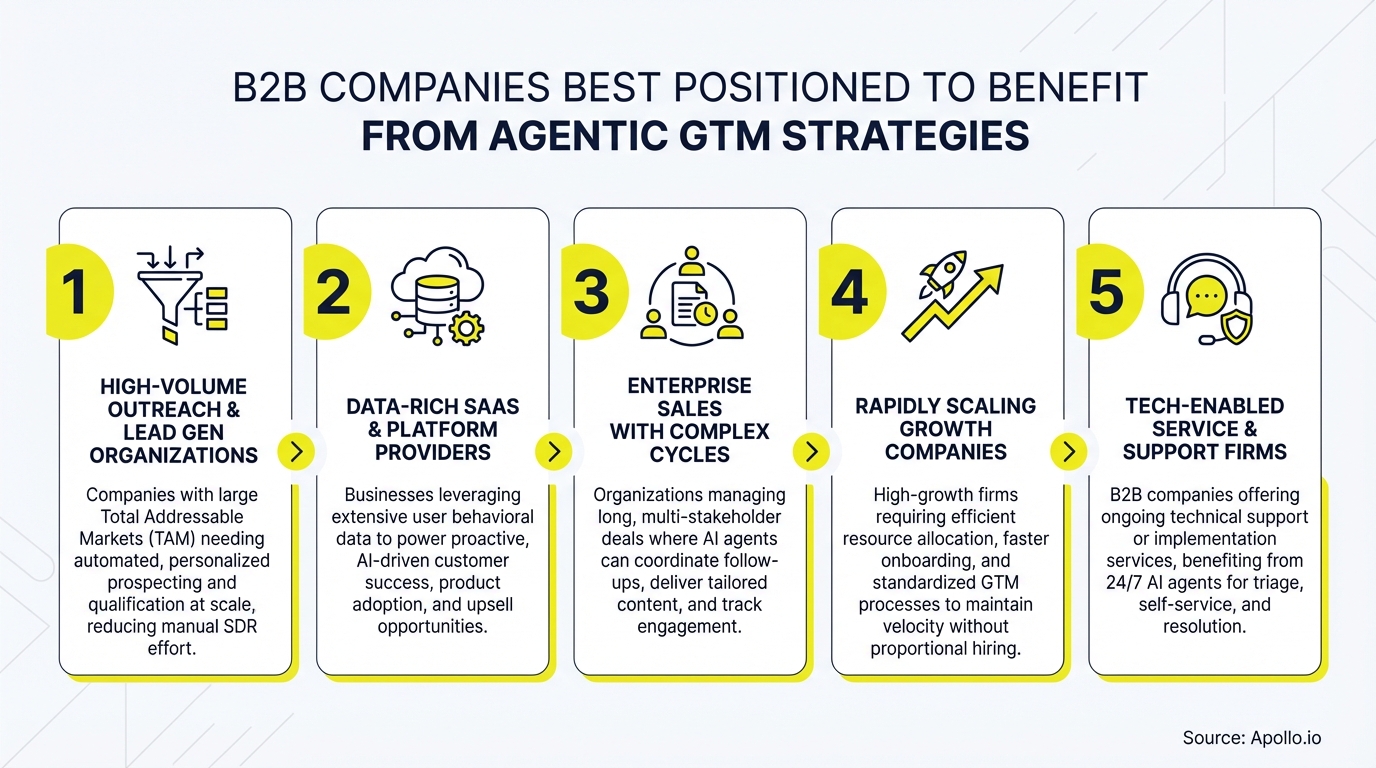
The B2B segments best positioned for agentic GTM share four structural traits: high-volume pipeline activity, defined qualification criteria, clean CRM data, and measurable stage-to-stage conversion metrics. Research from MarketBetter.ai indicates that digitally mature B2B suppliers are significantly more likely to use AI extensively, including agentic AI, and have achieved 110% more annual sales growth than their less mature competitors.
The segments with the strongest fit in 2026:
- Enterprise and mid-market SaaS: Complex buying cycles with multiple stakeholders, high demo velocity, and repeatable sales plays make agents effective at research, personalization, and follow-up orchestration.
- Cybersecurity: Long sales cycles, compliance-sensitive buyers, and multi-thread account engagement benefit from agents that maintain consistent outreach cadences and surface relevant signals.
- Fintech and financial services SaaS: High deal values, defined qualification criteria (AUM, headcount, tech stack), and regulatory awareness create clear agent decision trees.
- Vertical SaaS and PLG-to-sales hybrids: Product usage signals feed directly into agent-triggered outreach, creating high-relevance, low-friction conversion workflows.
- B2B companies with high inbound volume: Speed-to-lead is measurable and improvable; autonomous qualification and scheduling deliver immediate ROI.
Struggling to prioritize which inbound leads agents should act on first? Apollo's lead scoring software helps GTM teams define and automate qualification criteria before deploying agents.

What Structural Prerequisites Make a Company "Agentic-Ready"?
Agentic readiness is determined by data discipline and process maturity, not company size or AI budget. As Convertr.io notes, true AI readiness requires unified data, connected systems, and cross-functional alignment.
The four readiness signals that predict agentic GTM success:
- Clean, unified CRM data: Agents act on the data they're given. Duplicate records, missing fields, and inconsistent stage definitions produce compounding errors at agent speed.
- Defined lifecycle stages and SLAs: Agents need routing rules with clear logic. If your team debates what "qualified" means, agents will route incorrectly at scale.
- Standardized playbooks: Bespoke, rep-driven motions are hard to encode. Consistent messaging, objection handling, and follow-up sequences are prerequisites for agent execution.
- RevOps governance: Permissioning, audit trails, and approval workflows prevent agents from creating forecasting chaos or compliance risk.
Companies adopting a RevOps model that unifies customer-facing functions under a shared system of data, accountability, and visibility are better equipped to leverage AI for consistent outcomes, according to Qobra. If your B2B data enrichment foundation isn't solid, agentic workflows will amplify bad data, not fix it.
Turn Funnel Guesswork Into Real Pipeline
Tired of watching marketing leads stall before they ever reach your pipeline? Apollo surfaces in-market buyers and arms your team with the intelligence to act at the right moment. Top revenue teams run on Apollo.
Schedule a Demo →How Do RevOps Leaders Govern Agentic GTM Effectively?
RevOps leaders govern agentic GTM by treating agents like new reps: with onboarding, QA, performance reviews, and escalation paths. As Salesforce's AI Foundry initiative demonstrates, stress-testing agent performance and defining agent-to-agent interaction rules is becoming a core GTM competency, not just an IT concern.
Practical governance framework for RevOps teams:
- Permissioning: Define exactly which actions agents can take autonomously vs. which require human approval (e.g., agents can send sequences but cannot update close dates).
- Audit trails: Every agent action should be logged with timestamps, decision rationale, and outcome tracking.
- Holdout testing: Run agent-assisted and non-agent cohorts simultaneously to measure real lift before full deployment.
- Escalation rules: High-value accounts, legal edge cases, and multi-stakeholder deals should surface to a human rep automatically.
- Playbook compliance scoring: Review agent-executed outreach the same way you'd review rep calls: message quality, timing, and conversion rate.
How Can SDRs and AEs Use Agentic GTM to Hit Quota Faster?
SDRs and AEs benefit most from agentic GTM when agents handle research, routing, and follow-up, freeing reps to focus on conversations that require judgment. For SDRs, the highest-impact agentic use cases are inbound qualification, sequence enrollment, and meeting scheduling.
For AEs managing enterprise deals, agents accelerate pre-meeting research, multi-thread follow-up, and deal status updates across long sales cycles.
The inbound workflow is the first domino. Salesforce's acquisition of Qualified in late 2025 positions autonomous qualification and scheduling as the near-term, low-risk wedge for agentic GTM, specifically targeting B2B firms with high web demand capture and SDR handoff workflows.
HubSpot's expansion of Breeze agents to Pro/Enterprise customers reinforces this, particularly for mid-market teams with standardized funnel stages.
Spending hours on manual outreach when agents could handle the first three touches? Apollo's AI sales automation lets SDRs and AEs run agentic sequences while staying focused on high-value conversations. For AEs building pipeline across complex accounts, explore enterprise sales solutions built for 2026.
What Are the Biggest Risks of Agentic GTM Adoption?
The biggest risks are agent-washing (buying AI tools that are assistants, not agents), data amplification errors, and governance gaps that create compliance or forecasting problems. Gartner predicts that over 40% of agentic AI projects will be canceled by end of 2027, largely due to unclear ROI definitions and insufficient data foundations.
Risk mitigation checklist before deploying agentic GTM:
- Confirm the tool executes multi-step workflows autonomously, not just generates recommendations.
- Audit CRM data completeness before connecting agents to any system of record.
- Define success metrics before launch: meetings booked, response rates, stage conversion, not just "AI usage."
- Start with inbound qualification before outbound orchestration; lower stakes, faster feedback loops.
- Build in human review for the first 30 days of any new agent workflow.
As LeanData observes, AI rewards teams that invest in strong foundations and favor systems over individual tools. Consolidating your GTM stack is often the prerequisite that makes agentic deployment safe and scalable. "Having everything in one system was a game changer," noted the team at Cyera.

How Do You Build an Agentic GTM Strategy That Drives Real ROI?
B2B companies best positioned for agentic GTM are not the ones with the largest AI budgets; they're the ones with the cleanest data, most defined processes, and strongest RevOps governance. Enterprise SaaS, cybersecurity, fintech, and high-velocity inbound teams have the structural prerequisites to see measurable returns in 2026.
Everyone else should focus on building the foundation first.
The playbook is clear: start with inbound qualification and speed-to-lead, instrument your CRM with clean data and defined stages, govern agents like you govern reps, and expand agentic workflows as proof points accumulate. Teams that treat agentic GTM as workflow automation, not just content generation, will compound their advantages over competitors still running manual sequences.
Apollo consolidates prospecting, engagement, data enrichment, and pipeline management into one platform, giving GTM teams the unified foundation that agentic workflows require. Explore the best B2B marketing tools for 2026 or see how Apollo fits into your agentic GTM stack. Ready to build your pipeline on a unified platform? Request a Demo and see how Apollo's AI-powered platform supports every stage of your agentic GTM motion.
Prove Pipeline ROI From Day One
ROI pressure killing your next budget approval? Apollo delivers measurable pipeline impact fast — so you walk into every review with proof, not promises. Leadium 3x'd their revenue. You're next.
Start Free with Apollo →Don't miss these
Sales
Inbound vs Outbound Marketing: Which Strategy Wins?
Sales
What Is a Sales Funnel? The Non-Linear Revenue Framework for 2026
Sales
What Is a Go-to-Market Strategy? The 2026 GTM Playbook
See Apollo in action
We'd love to show how Apollo can help you sell better.
By submitting this form, you will receive information, tips, and promotions from Apollo. To learn more, see our Privacy Statement.
4.7/5 based on 9,690 reviews
