
Which Software Provides the Best Technographic Data? (Best by Use Case, 2026)
Technographic data tells you what software, infrastructure, and tools a company runs. For SDRs building prospect lists, RevOps leaders segmenting accounts, or AEs crafting personalized pitches, knowing a prospect's tech stack is a critical targeting signal.
But "best" depends entirely on your workflow. The right tool for website-stack detection is different from the right tool for enterprise software install intelligence or ABM orchestration.
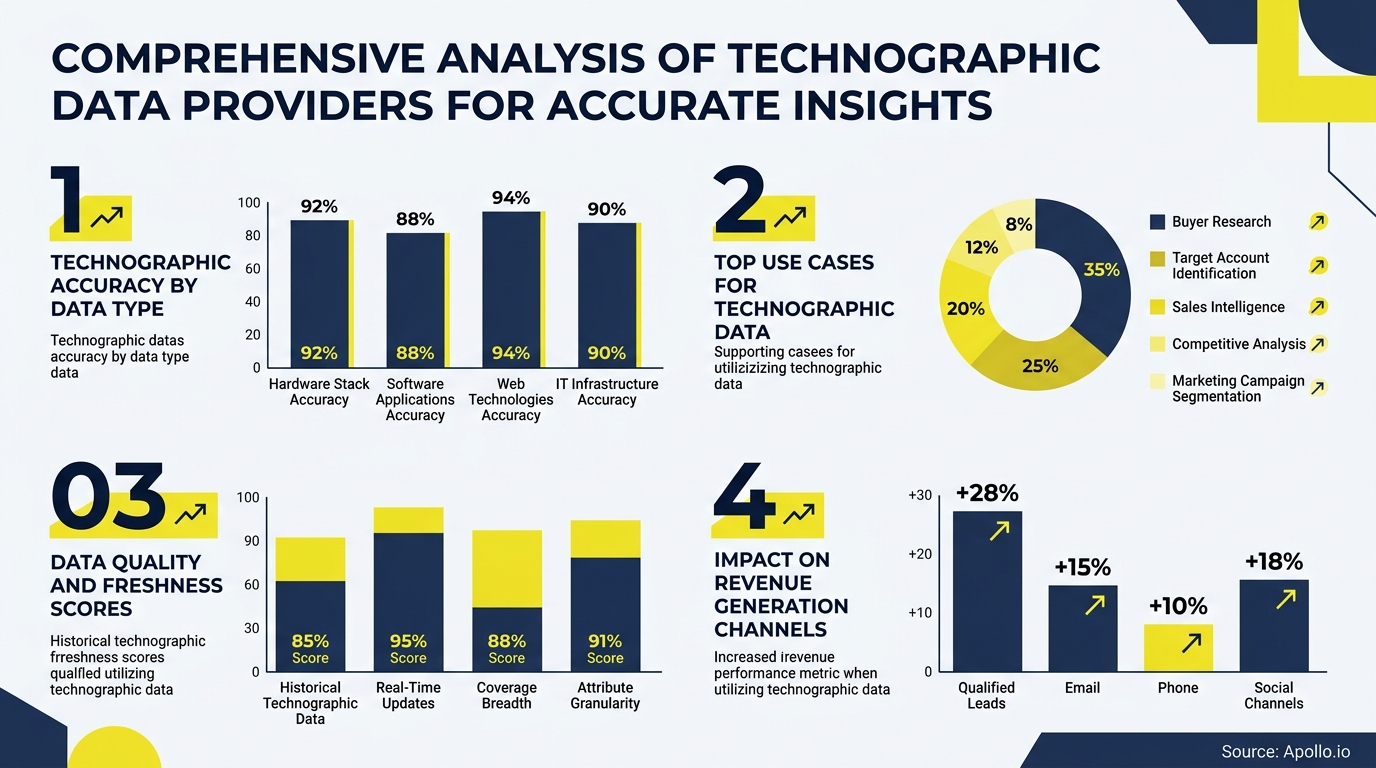
According to Landbase, companies using technographic data are 50% more likely to exceed revenue goals compared to those relying solely on firmographic data. The challenge is matching the right provider to your actual use case. This guide maps the top technographic data platforms to four specific buyer workflows so you can make a precise, defensible choice.

Research Less, Close More With Apollo
Tired of burning hours hunting down contact info that's already outdated? Apollo surfaces verified contacts instantly so your team sells instead of searches. Join 600K+ companies building pipeline faster.
Start Free with Apollo →Key Takeaways
- No single platform is "best" for all technographic use cases. The right choice depends on whether you need public website detection, verified enterprise installs, ABM activation, or contact-plus-tech pairing.
- HG Insights leads for behind-the-firewall enterprise software install intelligence, while BuiltWith is strongest for website and ecommerce tech stacks.
- ZoomInfo and Demandbase bundle technographics into broader GTM workflows, making them stronger when you need data activation alongside raw coverage.
- A Gartner survey found 73% of B2B buyers actively avoid irrelevant outreach, meaning more technographic data only helps if it's paired with relevant activation.
- The market is shifting from static technographic lists to AI-ready data fabrics. Providers that combine tech installs with intent, spend, and buyer signals are pulling ahead.
- Apollo combines verified contact data with technographic filters, letting GTM teams prospect, enrich, and activate in one unified platform.
What Is Technographic Data (And What It Is Not)?
Technographic data is structured information about the technology products a business currently uses or has used. It is not firmographic data (company size, industry, revenue) and not intent data (research behavior), though all three are often used together.
There are four distinct technographic data types, and confusing them leads to buying the wrong tool:
- Public website signals: Technologies detected from public HTML, scripts, cookies, and headers (e.g., "this site runs Shopify + HubSpot"). Fast to collect, limited to front-end stacks.
- Verified enterprise installs: Behind-the-firewall detection of software deployments across company locations, including install dates, usage intensity, and IT spend. Requires multi-source triangulation.
- ABM technographic activation: Technographics embedded in account scoring, ad targeting, and sales prioritization workflows rather than exported as a raw list.
- Contact + tech pairing: Technographic filters applied alongside verified contact data to find the right person at the right account using the right stack.
For more on how data quality shapes your entire outbound motion, see the best B2B marketing tools for 2026.
Which Software Provides the Best Technographic Data by Use Case?
The best technographic data software depends on your primary workflow. Here is a direct mapping of top providers to their strongest use cases, based on verified coverage data and 2026 product positioning.
| Use Case | Best Provider | Why It Fits |
|---|---|---|
| Enterprise software install intelligence | HG Insights | 120M+ technology installations across 9M+ companies, 20,000+ products, 7,000+ vendors; includes install verification dates, deployment locations, and usage intensity |
| Website and ecommerce tech-stack detection | BuiltWith | 116,984+ internet technologies tracked, 2,500+ ecommerce technologies, 26M+ ecommerce websites, trend data back to 1985 |
| Lightweight public website detection | Wappalyzer | 8,028 web technologies across 106 categories; fast browser-level detection from HTML, scripts, headers, cookies; smaller directory than BuiltWith |
| ABM orchestration with technographic signals | Demandbase | 42,000+ technologies tracked, 136M+ domains, 810K+ intent keywords; in April 2026, launched Demandbase AI with MCP access to technographic data via ChatGPT, Claude, Copilot, and Gemini |
| Broad sales-intelligence + contact workflows | ZoomInfo | 300M+ company-technology pairings across 30M+ companies, derived from 20+ source types; repositioned as a GTM intelligence platform in 2025 with GTM Studio |
| Prospecting + technographic filtering + outreach | Apollo | 230M+ people, 30M+ companies, 65+ filters including technographic attributes; unified platform for find, enrich, and engage without additional tools |
As noted by Enginy.ai, ZoomInfo is a leading choice for sales execution and all-in-one data when teams need technographics integrated into contact workflows. For ABM and predictive analytics use cases, Bright Data's analysis highlights 6sense as a strong option.
What Is the Difference Between Install Intelligence and Website Technographics?
Install intelligence and website technographics answer different questions. Website technographics detect front-end technologies visible in a site's public code.
Install intelligence identifies behind-the-firewall software deployments that cannot be detected by crawling a website.
- Website technographics: "This company's website runs Salesforce, Google Analytics, and Intercom." Useful for identifying marketing stacks and ecommerce platforms.
- Install intelligence: "This company has 450 Workday seats deployed across three regions, with a contract renewal in Q3." Requires triangulation from job postings, vendor documents, support tickets, and partner data.
For B2B tech vendors selling into IT, security, or infrastructure, install intelligence from HG Insights is more actionable than website-detection data. For digital marketing agencies or SaaS tools targeting marketing teams, BuiltWith or Wappalyzer may be sufficient.
In 2025, HG Insights further blurred this line by acquiring TrustRadius and launching its Revenue Growth Intelligence Fabric, combining tech installs, IT spend, contracts, and buyer review signals in one platform.

How Do SDRs and RevOps Teams Evaluate Technographic Data Quality?
SDRs and RevOps leaders should evaluate technographic providers on five dimensions beyond raw coverage numbers.
| Evaluation Dimension | What to Ask | Why It Matters |
|---|---|---|
| Coverage | How many companies and technologies are tracked? | Determines if your ICP is represented |
| Signal method | Public crawl, job postings, partner data, or first-party? | Affects accuracy for front-end vs. back-end stacks |
| Verification and freshness | How often is data re-verified? Are install dates provided? | Stale data leads to irrelevant outreach |
| Activation outputs | Can data flow to CRM, sequences, or ad platforms directly? | Raw data with no activation path adds manual work |
| Integration burden | Does it require IT support to connect to your stack? | Complex integrations slow adoption and reduce ROI |
A Gartner survey of 632 B2B buyers found 73% actively avoid suppliers that send irrelevant outreach. More technographic data only improves results when it's accurate, fresh, and connected to your engagement workflow.
SDRs working with stale install data end up pitching prospects who already replaced the tool they're targeting.
Struggling to filter prospects by tech stack without juggling multiple platforms? Search Apollo's 230M+ contacts with 65+ filters including technographic attributes and build targeted lists in minutes.
Turn Funnel Gaps Into Pipeline With Apollo
Quota slipping because marketing leads never convert? Apollo surfaces in-market buyers with intent signals so your team reaches the right prospects before they go cold. Nearly 100K paying customers trust Apollo to build predictable pipeline.
Start Free with Apollo →How Does Apollo Fit Into the Technographic Data Landscape?
Apollo combines technographic filtering with verified contact data and built-in sales engagement, making it the strongest choice when teams need to find accounts by tech stack, enrich records, and launch outreach without switching platforms.
For SDRs, AEs, and RevOps leaders already managing too many tools, Apollo's value is consolidation. "Having everything in one system was a game changer" (Cyera). Instead of exporting a technographic list from one tool, enriching it in a second, and loading it into a third for sequencing, Apollo handles all three steps in one workspace.
Apollo's data enrichment platform appends technographic, firmographic, and contact attributes to existing records, keeping CRM data current without manual updates. For teams building outbound programs, this connects directly to lead generation workflows that rely on clean, segmented account data.
Apollo reported 500% year-over-year growth for its AI GTM system, reflecting the broader market shift toward unified GTM platforms rather than standalone data products.
Which Technographic Data Tool Is Right for Your Team in 2026?
The right technographic data tool depends on your primary workflow, not the largest coverage number on a vendor's homepage.
- Enterprise tech vendors targeting IT buyers: HG Insights for verified install intelligence, IT spend, and competitive displacement signals.
- Digital agencies and ecommerce-focused teams: BuiltWith for broad internet technology coverage and historical trend data.
- Teams needing quick website-level detection: Wappalyzer for fast, lightweight public web signals.
- ABM teams running account-based advertising and intent workflows: Demandbase for technographics embedded in account scoring and AI-accessible GTM plays.
- Revenue teams needing technographics plus contact data and GTM activation: ZoomInfo or Apollo depending on budget, stack complexity, and whether you want a dedicated data platform or a unified GTM workspace.
- SDRs, AEs, and RevOps leaders who want to consolidate prospecting, enrichment, and engagement: Apollo for all-in-one GTM execution without the integration burden.
The market trend is clear: static technographic lists are giving way to AI-ready data fabrics. Platforms that combine tech installs with intent, spend, and buyer signals, then surface them in sales workflows, are replacing point solutions. For teams under pressure to do more with less, that consolidation argument is increasingly hard to ignore. As sales software that scales becomes a priority, the integration and activation layer matters as much as raw data coverage.

Start Prospecting With Technographic Precision
Technographic data is only as valuable as your ability to act on it. The best platform for your team is the one that gets relevant account and contact data into your reps' hands fastest, with the least integration overhead.
Apollo gives B2B GTM teams a unified workspace to filter accounts by tech stack, enrich records with verified contact data, and launch multi-channel sequences without stitching together multiple vendors. For teams that want fewer tools and more pipeline, that's a compelling starting point.
Start Your Free Trial and explore Apollo's technographic filters, 230M+ verified contacts, and built-in sales engagement in one platform.
Ramp Reps Faster, Hit Quota Sooner
ROI pressure killing your tool adoption? Apollo gets new reps producing pipeline from day one with one unified platform — no siloed knowledge, no slow ramp. Nearly 100K paying customers prove the value fast.
Start Free with Apollo →Don't miss these
Sales
Inbound vs Outbound Marketing: Which Strategy Wins?
Sales
What Is a Sales Funnel? The Non-Linear Revenue Framework for 2026
Sales
What Is a Go-to-Market Strategy? The 2026 GTM Playbook
See Apollo in action
We'd love to show how Apollo can help you sell better.
By submitting this form, you will receive information, tips, and promotions from Apollo. To learn more, see our Privacy Statement.
4.7/5 based on 9,690 reviews
