
Which Prospecting Tool Has the Most Accurate Data?
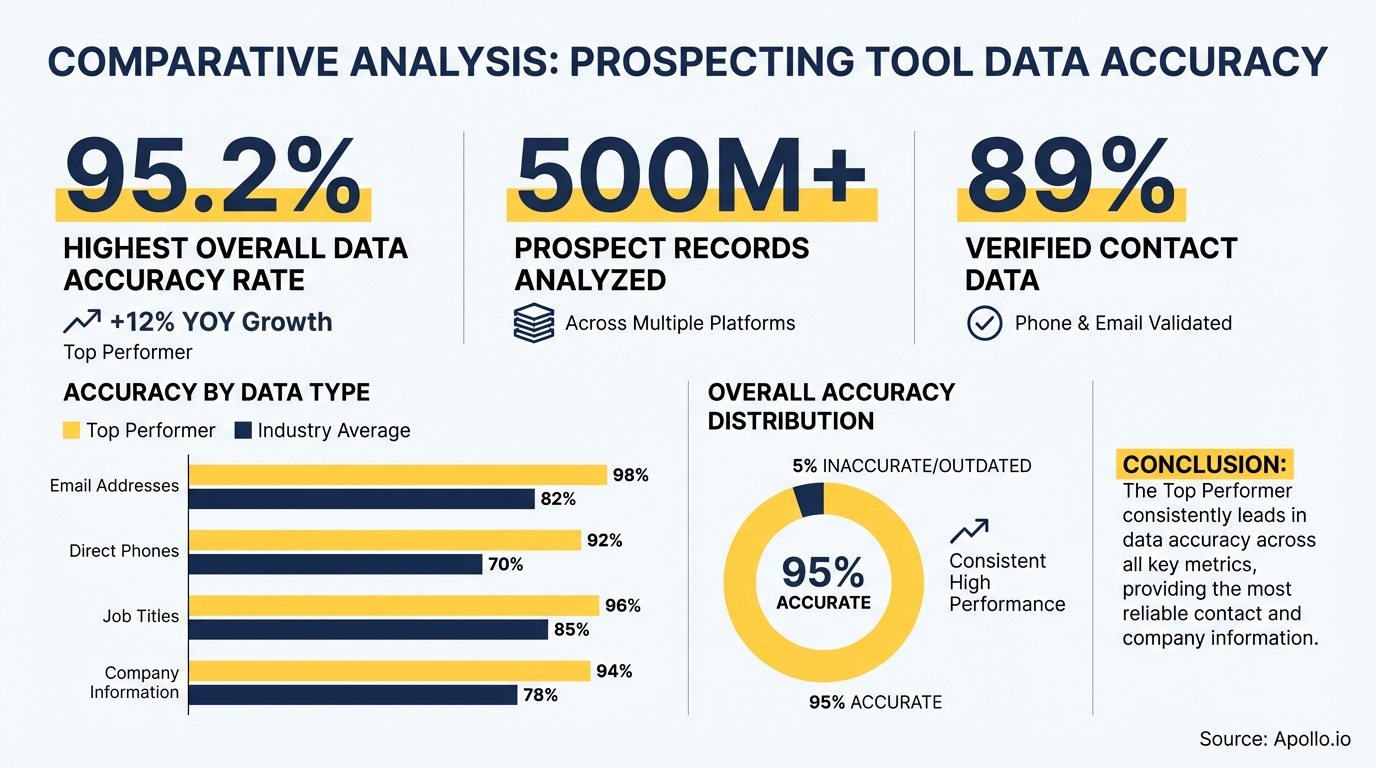
Asking which prospecting tool has the most accurate data is the wrong question. The right question is: accurate for which fields, for which ICP, verified how? According to Wifitalents, 94% of businesses suspect their customer data is inaccurate in some way. That stat alone tells you accuracy is a process problem, not just a vendor problem. Before you compare tools, you need a framework for what accuracy actually means in your GTM motion. Start by exploring what sales intelligence tools actually do and how they source, verify, and refresh data.

Get Verified Contacts, Skip the Guesswork
Tired of burning hours chasing bad emails and dead-end numbers? Apollo delivers 97% email accuracy so your team spends time selling, not searching. Nearly 100K paying customers trust Apollo to keep their pipeline moving.
Start Free with Apollo →Key Takeaways
- No single prospecting tool is universally most accurate. Accuracy depends on field type (email, mobile, title, firmographic) and your specific ICP.
- Data freshness and verification method matter more than database size. A smaller, continuously verified database outperforms a massive stale one.
- Waterfall enrichment (combining multiple sources) consistently outperforms single-provider reliance for contact coverage and accuracy.
- AI amplifies data quality problems. Bad inputs produce misdirected personalization, wasted sequences, and misrouted leads at scale.
- Apollo combines a 230M+ contact database with 97% email accuracy and built-in enrichment, consolidating what used to require 3-5 separate tools.
Why Is Prospecting Data Accuracy So Hard to Measure?
Prospecting data accuracy is hard to measure because different fields decay at different rates and fail in different ways. Job titles change frequently due to reorgs.
Mobile numbers are harder to verify than work emails. Firmographic data (headcount, revenue, tech stack) can lag by months.
Accuracy is not a single score; it is a field-by-field outcome tied to your ICP, region, and use case.
This is why most vendor accuracy claims are misleading. A tool may verify emails in real time but have stale mobile data.
Another may have strong North American coverage but weak EMEA firmographics. To evaluate tools fairly, score them by field type against your actual prospecting targets.
What Is a Field-Level Data Accuracy Scorecard?
A field-level data accuracy scorecard rates a prospecting tool's performance on each data type your team actually uses.
Here is a practical template for SDRs, RevOps leaders, and AEs to use when evaluating vendors:
| Data Field | What to Test | Pass Threshold |
|---|---|---|
| Work Email | Deliverability rate on a 200-record sample | 90%+ deliverable |
| Direct Dial / Mobile | Connect rate on live calls over 2 weeks | Field-dependent; track vs. baseline |
| Job Title / Seniority | Manual spot-check vs. professional profile | 85%+ match |
| Company Headcount | Cross-reference vs. recent public filings | Within 20% of actual |
| Tech Stack / Firmographic | Check against known customers for fit | Consistent with ICP pattern |
Run this scorecard on a 200-record sample before committing to any tool. Pull contacts matching your ICP exactly and test deliverability, connect rates, and title accuracy over two weeks.
This is the only way to get a real accuracy number for your use case.
Struggling to find qualified leads that actually match your ICP? Search Apollo's 230M+ contacts with 65+ filters to build a verified list in minutes.

How Do SDRs and RevOps Teams Evaluate Data Quality in Practice?
SDRs evaluate data quality through bounce rates, connect rates, and how quickly bad records surface in sequences. RevOps leaders evaluate it through CRM hygiene metrics, enrichment match rates, and duplicate contact volume.
Both perspectives matter, and they often reveal different failure modes in the same tool.
Research from Regie.ai found that organizations using enriched, signal-augmented CRM data generate 44% more sales-qualified leads than those relying solely on basic contact information. For RevOps leaders, this means enrichment is not a nice-to-have. It is a pipeline lever.
For AEs managing named accounts, buying committee completeness is the accuracy metric that matters most. A single verified contact at a target account is less valuable than five verified stakeholders mapped across departments.
Evaluate tools on multi-contact coverage per account, not just individual record accuracy.
You can also review which data enrichment tools drive revenue in 2026 for a broader comparison of enrichment approaches.
Turn Funnel Guesswork Into Real Pipeline
Pipeline forecasting a guessing game because quality leads dry up before they reach your AEs? Apollo surfaces in-market buyers at the right moment so every stage stays full. Nearly 100K paying customers finally forecast with confidence.
Start Free with Apollo →Why Does the Waterfall Enrichment Model Outperform Single-Source Tools?
Waterfall enrichment outperforms single-source tools because no one provider has complete, fresh data for every contact type and region. The waterfall model routes each enrichment request through multiple data sources in sequence, filling gaps the primary source misses.
Data from Databar.ai shows that leading prospecting platforms aggregating data from multiple specialized providers typically achieve 80%+ prospect discovery rates, compared to 40-50% from single-source tools. That gap in coverage directly translates to missed pipeline.
The practical implication: the question "which prospecting tool has the most accurate data" is increasingly a workflow question, not a brand question. The best-performing teams combine a primary database with enrichment and real-time verification layers. Apollo's waterfall enrichment routes contacts through multiple verified sources automatically, so your sequences start with the best available data rather than a single provider's snapshot.
How Does AI Change the Stakes for Data Accuracy?
AI amplifies data quality problems because errors in contact data scale instantly across automated sequences, lead scoring models, and routing logic. A bad job title in a manual outreach workflow affects one email.
The same bad title fed into an AI personalization engine affects every email in that segment.
A Dun & Bradstreet survey reported in early 2025 found that 54% of organizations had concerns about the trustworthiness and quality of the data they use for AI, while 88% said they are implementing AI. That gap between AI adoption and data confidence is exactly where prospecting tools are differentiated today.
Vendors that can demonstrate verification workflows, data lineage, and freshness SLAs will win GTM buyers who are scaling AI-assisted outreach.
For sales leaders building AI-assisted prospecting workflows, the governance checklist is simple:
- Does the vendor publish email deliverability benchmarks? (Apollo: 97% email accuracy)
- How often is each field type refreshed?
- Does the tool flag stale records before they enter sequences?
- Can you enrich CRM records continuously, not just on import?
Explore how AI and automation work together in B2B prospecting to understand how data quality feeds into AI-powered outreach at scale.

Which Prospecting Tool Has the Most Accurate Data for Your ICP?
The prospecting tool with the most accurate data for your ICP is the one that performs best on your field-level scorecard, for your target titles, in your target geographies. There is no universal winner.
However, platforms that combine large verified databases with continuous enrichment, waterfall sourcing, and AI-powered verification consistently outperform static databases.
Here is how to run a bake-off in 30 days:
- Pull 200 contacts from each tool matching your exact ICP (title, industry, headcount, geography).
- Run email deliverability checks on all records before loading them into sequences.
- Track connect rates on direct dials over two weeks.
- Spot-check 20 records per tool for title accuracy and company data currency.
- Score each tool by field using the scorecard above.
Apollo enters that bake-off with 230M+ contacts, 97% email accuracy, and built-in prospecting tools that let SDRs search, filter, enrich, and sequence from one workspace. As Cyera put it: "Having everything in one system was a game changer." That consolidation removes the accuracy degradation that happens when data moves between disconnected tools.
Start With Better Data, Not More Tools
The answer to "which prospecting tool has the most accurate data" is this: the one you test rigorously against your ICP, with a field-level scorecard, before your sequences go live. Database size is a distraction.
Verification method, freshness cadence, and waterfall coverage are what actually determine whether your outreach reaches real people in real roles.
Apollo consolidates prospecting, enrichment, sequencing, and AI-powered outreach in one platform, with 97% email accuracy and waterfall enrichment built in. Teams like Census report cutting costs in half by replacing multiple tools with Apollo.
Predictable Revenue noted: "We reduced the complexity of three tools into one."
Ready to test data accuracy against your ICP? Schedule a Demo and see how Apollo's verified contact database performs on your exact prospecting criteria.
Prove Pipeline ROI From Day One
ROI pressure killing your tool budget before it even starts? Apollo delivers measurable pipeline impact fast — Leadium 3x'd annual revenue after switching. Start free with no commitment.
Start Free with Apollo →Don't miss these
Sales
Inbound vs Outbound Marketing: Which Strategy Wins?
Sales
What Is a Sales Funnel? The Non-Linear Revenue Framework for 2026
Sales
What Is a Go-to-Market Strategy? The 2026 GTM Playbook
See Apollo in action
We'd love to show how Apollo can help you sell better.
By submitting this form, you will receive information, tips, and promotions from Apollo. To learn more, see our Privacy Statement.
4.7/5 based on 9,690 reviews
