
Which Platform Finds the Most Email Patterns in 2026?
The answer is not as simple as picking the platform with the largest database. Raw contact counts and verified, usable email patterns are entirely different metrics, and confusing them costs sales teams real pipeline. If you want emails that reach inboxes, you need to evaluate coverage, verification transparency, and deliverability risk together. Understanding email lookup strategies that balance reach with accuracy is the foundation of any effective prospecting motion.

Prospect Smarter, Not Harder With Apollo
Tired of burning hours on manual research just to hit dead ends? Apollo delivers verified contacts instantly so your reps spend time selling, not searching. Join 600K+ companies building pipeline faster.
Start Free with Apollo →Key Takeaways
- No single platform wins on every metric: the best choice depends on whether you start from a domain, a contact list, or an AI-agent workflow.
- Waterfall enrichment, not a single database, is now the standard approach for maximizing verified email coverage.
- Deliverability thresholds have tightened significantly, making "emails found" a vanity metric without verification transparency behind it.
- Pattern confidence (sourced vs. guessed) is a critical buying criterion that most platform comparisons ignore.
- Apollo combines a large contact database with built-in waterfall enrichment and engagement in one unified platform, reducing the need for multiple tools.
What Are Email Patterns and Why Does the Definition Matter?
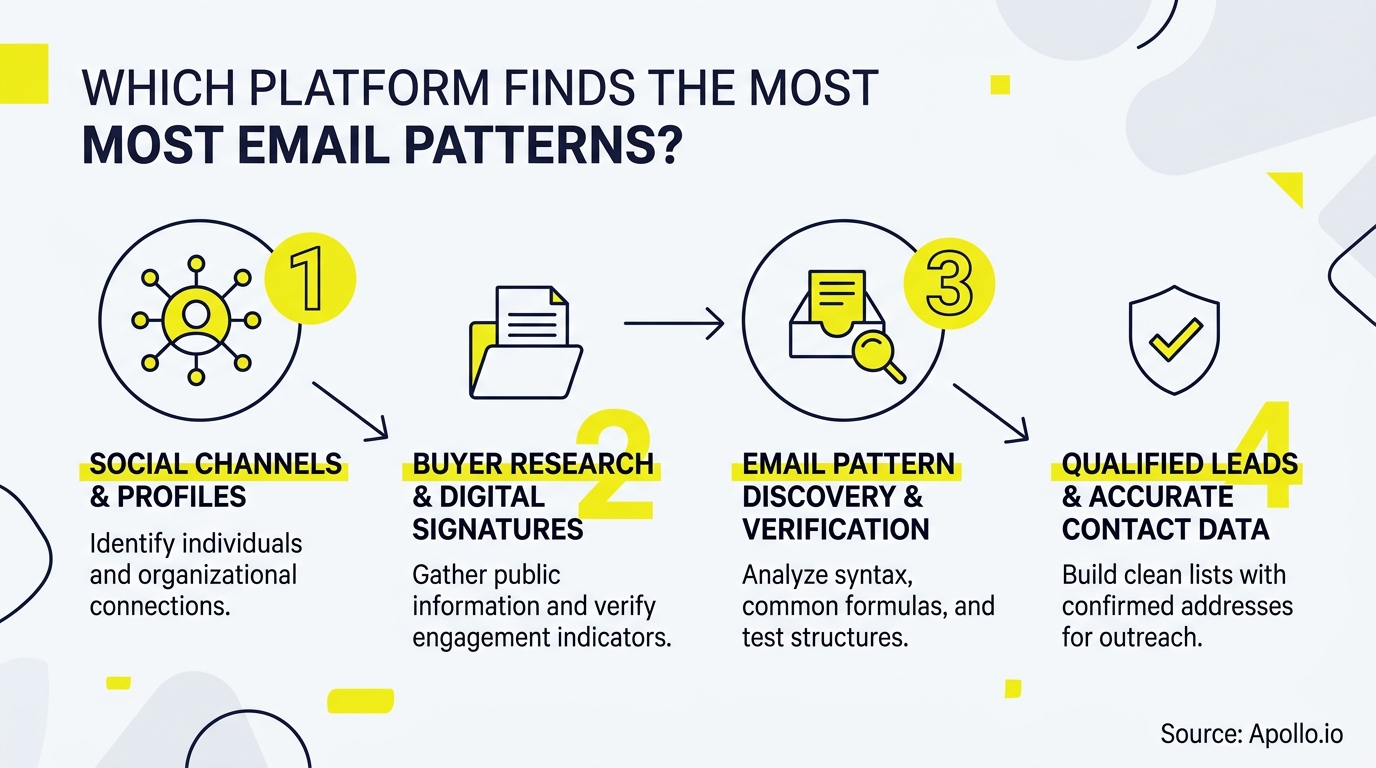
Email patterns are structural formats a platform uses to predict or confirm a professional's business email address, such as firstname.lastname@company.com or f.lastname@company.com. The critical distinction is between three different things platforms actually measure: profiles in a database, indexed email addresses crawled from public sources, and verified patterns confirmed deliverable. These are not interchangeable. A platform with 300 million profiles may have fewer verified patterns than a smaller tool with aggressive domain-crawling and real-time verification. Verifying email addresses before outreach is the step most teams skip, and the one that determines whether your data translates into pipeline.
How Do the Leading Platforms Compare on Email Pattern Coverage?
Each major platform takes a different approach to email pattern discovery, and the methodology matters as much as the number.
| Platform | Primary Approach | Pattern Transparency | Best Starting Point |
|---|---|---|---|
| Apollo | Large B2B contact database + waterfall enrichment across multiple sources with built-in validation | 97% email accuracy; waterfall flags unverified results | Contact list, ICP filters, CRM enrichment |
| Hunter | Domain-first crawling; labels results as sourced or guessed | High: explicitly marks guessed patterns and removes unsourced data after six months | Company domain lookup |
| ZoomInfo | Broad profile database with intent signals; AI-agent data layer via GTM.AI | Moderate: verification built in, but pattern labeling less explicit | Enterprise account lists, intent-driven prospecting |
According to LexMatcher's email finder comparison, Hunter is specifically cited as "Best for email format identification and single-domain lookups," reflecting its domain-crawling strength. For broader B2B prospecting at scale, Apollo's combination of database depth and waterfall enrichment addresses different use cases than domain-only tools.
Struggling to find qualified leads with verified contact data? Search Apollo's 230M+ contacts with 65+ filters and built-in verification.
Why Does Pattern Confidence Matter More Than Raw Count?
Pattern confidence refers to whether a platform can show a public source for an email or only a predicted format, and it directly determines your deliverability risk. Google's sender guidelines require spam complaint rates below 0.10%, with 0.30% as an absolute ceiling.
Each CAN-SPAM violation carries penalties up to $53,088. A platform that serves high volumes of guessed, unverified patterns can push you past those thresholds fast.
A Forrester Total Economic Impact study found Apollo achieved a 2.37% cold-to-meeting conversion rate, outpacing the industry average of 0.5-1.5%. That gap reflects what happens when verified, accurate contact data powers outreach. Poor pattern quality produces the opposite result: bounces, spam flags, and damaged sender reputation. For practical guidance on protecting inbox placement, see why emails land in spam and how to fix it.
Turn Funnel Guesswork Into Pipeline Clarity
Tired of watching marketing leads stall before they ever reach your pipeline? Apollo surfaces high-intent prospects and delivers verified contacts so your team works deals, not dead ends. Nearly 100K paying customers stopped guessing.
Start Free with Apollo →How Do SDRs and RevOps Teams Choose the Right Platform?
SDRs and RevOps leaders should choose based on their workflow starting point, not just database size. The right platform depends on where your prospecting motion begins.
- SDRs prospecting from ICP filters or account lists: Apollo's search with 65+ filters and waterfall enrichment delivers broad coverage in a single workspace, eliminating the need to export lists into separate verification tools.
- RevOps enriching a CRM: Apollo's enrichment layer checks its own database first, then pulls from additional sources with built-in validation, keeping records current without manual intervention.
- Teams starting from a company domain: Hunter's domain-pattern approach with explicit sourced/guessed labeling offers strong transparency for targeted, single-company lookup workflows.
- Enterprise teams needing intent signals alongside contact data: ZoomInfo provides broad company and contact assets alongside buyer intent, with its GTM.AI layer increasingly making that data accessible to AI agents.
RevOps leaders managing multiple tools often find the consolidation argument compelling. As Cyera's team noted, "Having everything in one system was a game changer." Apollo combines prospecting, enrichment, engagement, and pipeline management in one platform, reducing the complexity of maintaining separate data, verification, and outreach tools. Learn how to build on that foundation with sales emails that actually get responses.

Is Waterfall Enrichment Now the Real Answer to Finding the Most Patterns?
Waterfall enrichment, not a single platform's database, is the current standard for maximizing verified email coverage. Apollo made waterfall enrichment the default approach in its 2025 updates: the system checks Apollo's database first, then queries selected third-party sources, with validation applied at each step.
This multi-source approach addresses a core limitation of any single database, that no provider has complete coverage across all industries, geographies, and company sizes.
The implication for buyers: asking "which platform finds the most email patterns" is increasingly the wrong question. The better question is which platform finds the most verified, deliverable patterns within your ICP. Bulk email best practicesreinforce this point: volume without deliverability produces negative returns. California's DELETE Act, which requires data brokers to process deletion requests every 45 days starting August 1, 2026, will also accelerate data decay across all providers, making real-time verification even more valuable than static database size.
Tired of managing separate tools for finding, verifying, and emailing contacts? Apollo's data enrichment consolidates your tech stack with 230M+ verified business contacts.
Frequently Asked Questions About Email Pattern Platforms
Which platform literally finds the most email patterns?
No independent third-party study has definitively ranked platforms by verified pattern count using a normalized methodology. The answer depends on whether you measure profiles, indexed emails, or verified deliverable patterns, and those numbers differ significantly across providers.
Apollo's 230M+ contact database combined with waterfall enrichment provides broad coverage; Hunter leads on domain-pattern transparency; ZoomInfo offers enterprise-scale contact and intent assets.
What is the difference between a sourced and a guessed email pattern?
A sourced pattern has a publicly traceable origin, such as a company website, press release, or professional directory. A guessed pattern is predicted by applying a known domain format to a name without direct public evidence.
Guessed patterns carry higher bounce risk. Platforms that label this distinction explicitly give buyers the information needed to decide which results to send versus verify further.
Does a larger database always mean more usable emails?
No. A larger database produces more usable emails only when paired with active verification and freshness management.
U.S. labor churn continuously invalidates work emails as professionals change roles and companies. A smaller, actively verified dataset can outperform a larger, stale one on actual deliverability.

Which Platform Should You Choose in 2026?
The platform that finds the most usable email patterns for your team is the one that matches your workflow, verifies results at the point of discovery, and keeps your sender reputation intact. For most B2B GTM teams, that means combining a large verified database with built-in enrichment and engagement, rather than stitching together separate tools for each step.
Apollo serves SDRs, AEs, RevOps, and revenue leaders from startups through enterprise as a unified platform: prospecting, enrichment, waterfall data verification, sequencing, and pipeline management in one workspace. As Predictable Revenue's team put it, "We reduced the complexity of three tools into one." For email campaigns that close deals, the foundation is verified contact data that actually reaches inboxes.
Ready to find verified contacts and run outreach from a single platform? Schedule a Demo and see how Apollo's database, waterfall enrichment, and engagement tools work together.
Prove Pipeline ROI Before Next Quarter
ROI pressure killing your tool budget? Apollo delivers measurable pipeline impact from day one — no lengthy onboarding, no guesswork. Leadium 3x'd annual revenue. Your CFO wants proof. Apollo provides it.
Start Free with Apollo →Don't miss these
Sales
Inbound vs Outbound Marketing: Which Strategy Wins?
Sales
What Is a Sales Funnel? The Non-Linear Revenue Framework for 2026
Sales
What Is a Go-to-Market Strategy? The 2026 GTM Playbook
See Apollo in action
We'd love to show how Apollo can help you sell better.
By submitting this form, you will receive information, tips, and promotions from Apollo. To learn more, see our Privacy Statement.
4.7/5 based on 9,690 reviews
