
What Is the Expected SDR Ramp Time When Switching to a New Outbound Platform in 2026?
Most sales leaders ask the wrong question when evaluating a platform switch. Instead of "how long to implement?", the right question is:how long until meetings return to baseline? Switching outbound platforms introduces two separate ramp clocks, and conflating them is the most common reason transitions stall. Before evaluating top sales engagement platforms, understanding the full ramp timeline protects quota and pipeline continuity.

Research Less. Pipeline More With Apollo.
Tired of watching selling time disappear into manual research and dead-end contact data? Apollo surfaces verified prospects instantly so your team stays focused on closing. Join 600K+ companies building predictable pipeline.
Start Free with Apollo →Key Takeaways
- SDR ramp time on a new outbound platform involves two distinct phases: implementation readiness and rep proficiency recovery, each with its own timeline.
- The industry baseline for SDR-to-quota is 3.1 to 3.2 months, and a platform switch adds friction on top of that baseline, not in place of it.
- Deliverability warmup is now a hard gating item, requiring 14 to 21 days before sending at volume, making it the most commonly missed step in migrations.
- AI-assisted onboarding tools can meaningfully reduce ramp time, with onboarding time dropping by approximately 40% when AI manages list-building and outreach setup.
- Platform consolidation, not just training hours, is the fastest lever for shortening total ramp time in 2026.
What Is the Baseline SDR Ramp Time Before Any Platform Switch?
The industry average ramp-up time for SDRs is 3.1 to 3.2 months before consistently hitting quota, according to SalessSO's SDR ramp-up benchmarks. In SaaS specifically, that number has grown: ramp time ballooned to 5.7 months in 2025, a 32% increase from 4.3 months in 2020, per SalessSO's 2025 benchmarks report.
A platform migration does not restart this clock from zero, but it does extend it. The disruption compounds existing ramp complexity rather than replacing it. RevOps leaders evaluating a switch should model the sales acceleration formula with migration friction factored in.
What Are the Two Layers of Ramp Time in a Platform Migration?
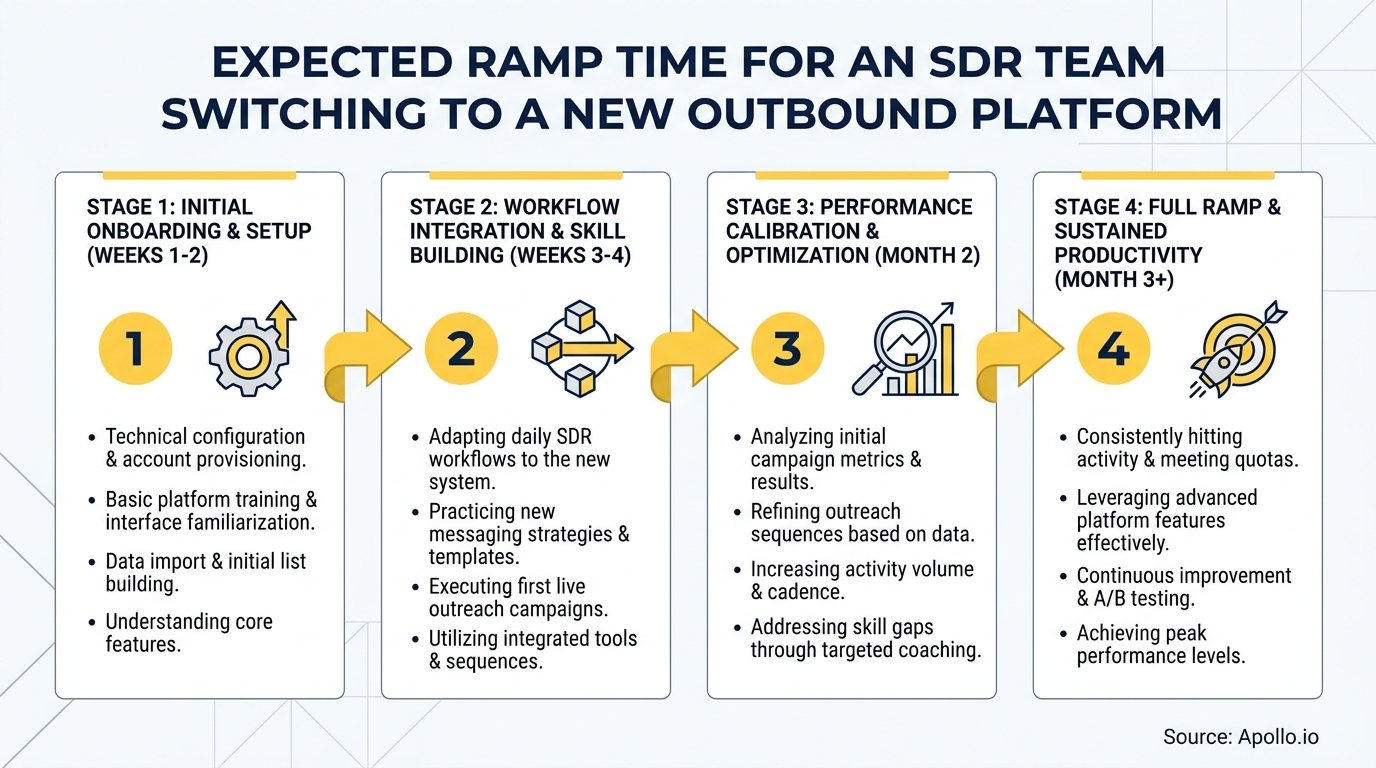
A platform migration has two distinct ramp clocks that must be managed separately:implementation readiness and rep proficiency recovery.
| Ramp Layer | What It Covers | Typical Timeline |
|---|---|---|
| Implementation Readiness | CRM integration, data migration, sequence templates, routing rules, mailbox warmup | 4 to 8 weeks |
| Rep Proficiency Recovery | SDRs hitting prior activity levels and conversion rates on the new platform | 6 to 12 weeks post-go-live |
Implementation readiness must reach a "systems-ready" threshold before rep proficiency ramp can begin. Running these in parallel without clear separation causes both timelines to slip.
As of early 2026, mailbox warmup has become a hard gating item requiring 14 to 21 days before sending at volume. Teams that skip this step see deliverability collapse in week 2, the most common reason platform switches fail early.
How Do SDRs Lose Productivity During a Platform Switch?
SDRs lose productivity during a platform switch because new workflows add friction to an already non-selling-heavy workday. A platform migration that adds extra admin steps effectively taxes the majority of the workweek.
For SDR teams operating in outbound motions, this friction shows up as lower sequence enrollment rates, inconsistent follow-up cadences, and reduced call volume during the transition window. The cost compounds when multiplied across a full team.
Three factors most commonly extend rep proficiency ramp:
- Interface relearning: New UX patterns disrupt muscle memory built in the previous tool.
- Sequence rebuilding: Migrating or recreating proven sequences takes time away from active prospecting.
- CRM sync gaps: Data mismatches between the new platform and CRM cause reps to double-enter or skip logging activities.
Struggling to keep outreach consistent during a transition? Apollo's multi-channel sales engagement platform is designed to reduce this friction with pre-built sequence templates and native CRM sync.
How Can RevOps Leaders Accelerate SDR Ramp Time?
RevOps leaders accelerate SDR ramp time by front-loading governance decisions, deliverability prep, and cross-functional alignment before go-live. The fastest migrations treat ramp as a GTM ops design problem, not a training problem.
A practical migration readiness checklist for RevOps teams:
- Weeks 1 to 2: Assign RACI ownership across RevOps, IT, and sales management. Define data definitions and field mappings before migration begins.
- Weeks 2 to 4: Begin mailbox warmup (14 to 21 days minimum). Migrate or rebuild top-performing sequences. Complete CRM integration testing.
- Week 4 to go-live: Run parallel sends on a small cohort. Validate deliverability metrics before full team cutover.
- Post-go-live weeks 1 to 6: Track activity-level KPIs weekly. Flag reps below pre-switch baseline. Provide targeted coaching, not blanket retraining.
Research from CareerTrainer.ai found that sales enablement tools can reduce ramp-up time by 17% on average. Embedding enablement resources directly in the platform workflow, rather than in a separate LMS, captures that reduction faster. For cross-functional teams, shared dashboards tracking sequence enrollment, reply rates, and meeting-booked rates give every stakeholder visibility into ramp progress without waiting for end-of-month reviews.
Turn Weak Leads Into Real Pipeline
Tired of watching marketing leads stall before they ever reach sales? Apollo surfaces verified, in-market prospects so your funnel fills with buyers — not dead ends. Nearly 100K paying customers have replaced guesswork with predictable pipeline.
Start Free with Apollo →How Does AI Shorten SDR Ramp Time After a Platform Switch?
AI shortens SDR ramp time by automating the most time-consuming non-selling tasks during the transition period, letting reps focus on conversation skills rather than setup work. According to DevCommX, new SDR onboarding time can drop by approximately 40% when AI systems manage tasks like list-building and outreach setup.
In 2026, AI coaching has entered ramp-time benchmarks as a measurable accelerator. AI-assisted onboarding tools surface personalized coaching cues based on rep activity patterns, reducing the dependency on manager-led review cycles that create ramp bottlenecks in larger teams.
Key AI capabilities that accelerate post-migration ramp:
- Automated list-building and contact enrichment so reps start sequencing immediately
- AI-generated messaging suggestions calibrated to ICP and persona signals
- Activity-level anomaly detection to flag reps falling behind pre-switch baselines
Apollo's AI sales automation handles prospect research, sequence enrollment, and follow-up triggers natively, so SDRs spend their first weeks on calls and conversations, not configuration. Teams using Apollo have reported that having everything in one system was a game changer (Cyera).

What KPIs Should Sales Leaders Track During Platform Migration Ramp?
Sales leaders should track activity recovery KPIs weekly during migration ramp, not just go-live completion. The goal is measuring time-to-baseline, not time-to-go-live.
| KPI | What It Measures | Target Threshold |
|---|---|---|
| Sequence enrollment rate | Reps actively adding contacts to sequences | Return to pre-switch level by week 4 |
| Email deliverability rate | Inbox placement vs. spam | 95%+ before scaling volume |
| Meetings booked per rep | Pipeline-generating activity | Return to pre-switch baseline by week 8 |
| Reply rate per sequence step | Message quality and timing effectiveness | Monitor for regression vs. prior platform |
Sales leaders managing platform transitions should also review the inbound vs. outbound balance during the migration window. Temporarily increasing inbound lead routing to compensate for outbound ramp dip protects pipeline without pausing prospecting motions entirely.
How Does Platform Consolidation Reduce SDR Ramp Time?
Platform consolidation reduces SDR ramp time by eliminating tool-switching overhead, the time reps spend moving between separate prospecting, sequencing, dialing, and CRM tools during the workday. Fewer tools means less relearning and fewer integration failure points during a migration.
In 2025 and 2026, vendors increasingly market consolidation as the primary ramp-time lever. The case is straightforward: a rep switching from a three-tool stack to a unified platform has one interface to learn, one data model to trust, and one integration to validate.
Predictable Revenue described this outcome directly: "We reduced the complexity of three tools into one."
Apollo consolidates prospecting, workflow automation, multi-channel sequences, dialing, and data enrichment in a single workspace for 600K+ companies. That consolidation removes the parallel ramp burden of learning multiple tools simultaneously, which is where most migration timelines quietly expand.
What Is the Realistic Total Ramp Timeline for an SDR Team Switching Platforms in 2026?
The realistic total ramp timeline is 10 to 16 weeks from decision to meetings-back-at-baseline, assuming a well-managed migration with dedicated RevOps ownership. Teams without formal migration governance typically run 20 to 30% longer.
| Phase | Duration | Milestone |
|---|---|---|
| Pre-migration planning | 1 to 2 weeks | RACI assigned, data definitions locked |
| Implementation + warmup | 4 to 6 weeks | Integrations live, mailboxes warmed, sequences rebuilt |
| Rep proficiency recovery | 6 to 8 weeks | Activity metrics return to pre-switch baseline |
Switching to a consolidated GTM platform compresses this timeline compared to migrating to another single-point tool. When reps do not need to relearn a separate prospecting tool, a separate dialer, and a separate sequencer, weeks of proficiency recovery disappear from the schedule. For teams evaluating options, the enterprise sales solutions comparison covers how unified platforms compare on implementation speed and total ramp cost.

Ready to Shorten Your SDR Ramp Time?
Ramp time on a new outbound platform is a GTM ops problem, not just a training problem. The teams that recover fastest separate implementation readiness from rep proficiency, prioritize deliverability before volume, and choose platforms that consolidate the stack rather than add to it.
Apollo gives SDR teams, RevOps leaders, and AI-assisted outbound workflows in one workspace, with 230M+ verified contacts, native sequencing, dialing, and workflow automation built in. Fewer tools to ramp, faster time to meetings.
Start Your Free Trial and see how Apollo compresses your platform switch from months to weeks.
Prove Pipeline ROI From Day One
ROI pressure killing your tool budget before it even gets approved? Apollo delivers measurable pipeline impact fast — with real customer results like 3x revenue growth and 4x more meetings. Start free with no commitment.
Start Free with Apollo →Don't miss these
Sales
Inbound vs Outbound Marketing: Which Strategy Wins?
Sales
What Is a Sales Funnel? The Non-Linear Revenue Framework for 2026
Sales
What Is a Go-to-Market Strategy? The 2026 GTM Playbook
See Apollo in action
We'd love to show how Apollo can help you sell better.
By submitting this form, you will receive information, tips, and promotions from Apollo. To learn more, see our Privacy Statement.
4.7/5 based on 9,690 reviews
