
What's the Expected Productivity Gain When an SDR Team Moves From Fragmented Tools to a Unified Platform?
Your SDRs are part-time sellers. Salesforce's 2026 State of Sales report found that sellers spend roughly 40% of their time actually selling, with the rest consumed by admin, research, and tool-switching. The good news: that recoverable time is exactly where a unified platform delivers its ROI. Understanding what drives real sales productivity starts with quantifying what fragmentation costs you today.

Apollo Turns Research Hours Into Pipeline
Tired of your reps burning half their day verifying contact info instead of selling? Apollo delivers accurate, ready-to-work leads instantly. Join 600K+ companies building predictable pipeline from day one.
Start Free with Apollo →Key Takeaways
- SDR teams that consolidate tools AND redesign workflows can achieve materially higher productivity than those that simply swap software without changing processes.
- The biggest time sinks for SDRs (CRM updates, manual research, context switching) are the first to shrink on a unified platform.
- RevOps governance and SDR-to-AE handoff SLAs determine whether platform consolidation translates into pipeline, not just activity metrics.
- A CFO-ready ROI case for unification includes tool consolidation savings, headcount leverage, and cycle-time reduction as separate line items.
- Apollo consolidates prospecting, engagement, enrichment, and AI automation into one workspace, removing the integration overhead that quietly kills SDR throughput.
What Is the Expected Productivity Gain for SDR Teams on a Unified Platform?
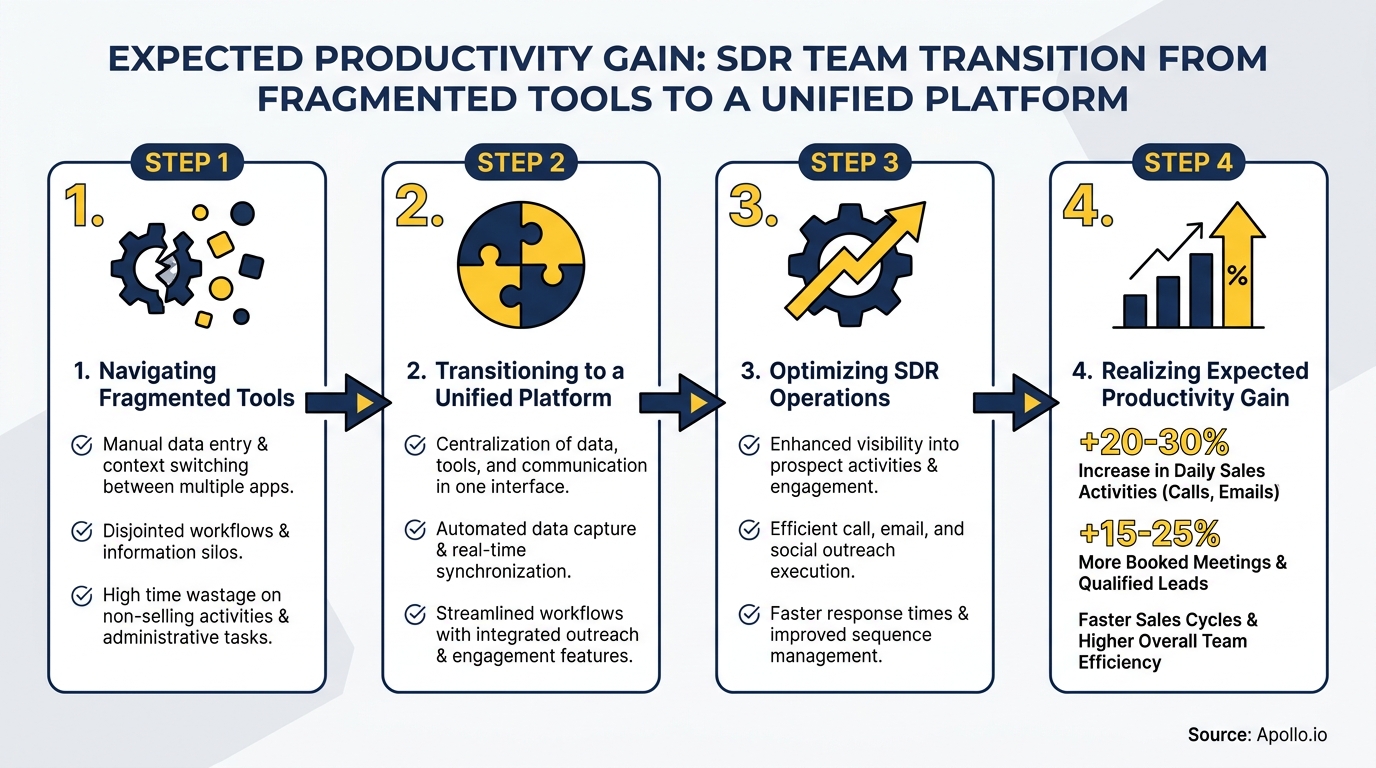
SDR teams that migrate to a unified platform and redesign their workflows alongside the migration can expect meaningful productivity improvement. Teams that simply switch tools without process change see more modest gains.
The distinction matters enormously when building a business case for RevOps leaders and CFOs.
The productivity math breaks into two scenarios:
| Migration Approach | Expected Productivity Improvement | What Drives It |
|---|---|---|
| Tool swap only (no process redesign) | Modest improvement | Reduced login friction, fewer integrations to maintain |
| Consolidation + workflow redesign | Significant improvement | Reclaimed selling time, auto-logging, governed handoffs, AI automation |
Research from Everstage shows that automation has helped top-performing B2B sales organizations free up approximately 20% of sellers' capacity and improve overall productivity by up to 30%. That figure assumes automation is embedded inside a unified workflow, not bolted on as a separate point tool.
Where Does SDR Time Actually Go? The Fragmentation Tax
Fragmented stacks create a hidden productivity tax measured in context switches, not just wasted hours. Every time an SDR exits a sequencing tool to check a data enrichment platform, re-enters notes into a CRM, and re-opens a dialer, they lose momentum and introduce data inconsistency.
The time-bucket breakdown for a typical fragmented SDR workflow:
- CRM updates and admin: Data from TryKondo's B2B Sales Report shows reps spending nearly 18% of their week on CRM updates and administrative tasks alone.
- Manual research and data lookup: Pulling contact details, firmographics, and intent signals from separate tools before each sequence.
- Handoff documentation: Writing AE briefing notes manually because context doesn't flow between tools.
- Reporting and forecasting: Exporting data across platforms to build pipeline views that should be automatic.
Struggling to eliminate manual research from your SDR workflow? Search Apollo's 230M+ contacts with 65+ filters and surface the right prospects without leaving your workspace.
According to SalesO's SDR productivity research, adopting unified platforms and automation can significantly reclaim this lost selling time. The key word is "significantly" because the recapture isn't uniform. Teams with clean data governance and defined routing rules reclaim more capacity than those that simply reduce their tool count.

How Do SDRs and RevOps Leaders Build the CFO-Ready ROI Case?
A CFO-ready ROI case for platform consolidation has four distinct line items, each defensible with sourced benchmarks. RevOps leaders should model all four before presenting to finance.
| ROI Line Item | How to Quantify It | Benchmark Reference |
|---|---|---|
| Tool consolidation savings | Sum annual licenses replaced by unified platform | "We cut our costs in half" (Census, Apollo customer) |
| Selling time recaptured | Hours/week × rep count × OTE hourly rate | Salesforce 2026: ~40% of time currently spent selling |
| Pipeline velocity improvement | Meetings booked per rep before vs. after; cycle time delta | Apollo AI Research Agent: 46% more meetings booked |
| Integration maintenance reduction | RevOps hours/month maintaining point-tool connections × loaded cost | SyncGTM 2026: top RevOps teams operate with fewer tools than average |
For risk-adjusted NPV, apply a 70% probability weight to selling-time recapture (behavior change takes time) and 90% to hard consolidation savings (licenses are contractual). Payback period for most mid-market SDR teams falls within the first year when tool consolidation savings are included. You can explore how teams model these decisions in Apollo's sales tech stack playbook.
Turn Funnel Gaps Into Qualified Pipeline
Pipeline forecasting a guessing game because quality leads never make it past MQL? Apollo surfaces in-market buyers at the right moment, so your reps stop chasing dead ends and start closing. Nearly 100K paying customers run predictable revenue on Apollo.
Schedule a Demo →What Does a Unified Platform Rollout Blueprint Look Like for SDR Teams?
A successful SDR platform rollout follows three phases: governance setup, pilot execution, and full deployment. Skipping governance is how teams end up with "tool overload 2.0," where a unified platform becomes just as chaotic as the fragmented stack it replaced.
Phase 1: Governance (Weeks 1-2)
- Define the single data model: standardize lifecycle stages, contact statuses, and owner fields before any rep touches the platform.
- Set routing rules: territory logic, round-robin assignments, and re-engagement triggers configured upfront.
- Establish permissions: SDR write access to sequences and contact records; AE read access to SDR activity history.
Phase 2: Pilot (Weeks 3-6)
- Run 2-3 SDRs on the unified platform against a fragmented-stack control group.
- Measure: meetings booked, emails sent, time-to-first-touch, and CRM data completeness.
- Identify workflow gaps before full rollout.
Phase 3: Full Deployment + Enablement (Weeks 7-10)
- Roll out with recorded workflow walkthroughs, not just feature training.
- Assign a RevOps owner for the first 90 days to handle routing exceptions and data issues.
Spending too much time on manual outreach across disconnected tools? Automate your multi-channel sequences with Apollo and keep prospecting, engagement, and enrichment in one workspace.
How Do SDR-to-AE Handoffs Improve on a Unified Platform?
SDR-to-AE handoffs improve on a unified platform because context travels with the record. On fragmented stacks, AEs receive a calendar invite and a Slack message.
On a unified platform, they receive full engagement history, enriched firmographics, conversation notes, and intent signals automatically attached to the opportunity.
Post-implementation KPIs to track handoff quality:
- Handoff-to-meeting rate: Percentage of SDR-qualified meetings that AEs actually accept and run.
- Time-to-first-AE-touch: Hours between SDR qualification and AE outreach (target: under 4 hours).
- Data completeness at handoff: Percentage of records with all required fields populated at the point of transfer.
- No-show rate: Drops when AEs have pre-meeting context and can confirm with personalized notes.
For SDR teams operating at scale, these KPIs become the dashboard that proves platform ROI to leadership, not just rep-level activity counts. "Having everything in one system was a game changer," noted the team at Cyera, an Apollo customer, describing exactly this kind of end-to-end visibility.
Why Is Governance the Difference Between Productivity Gain and Tool Overload 2.0?
Governance is the difference between a unified platform that compounds productivity gains and one that simply rearranges the same chaos under a new interface. AI features, in particular, require clean, consistent data to function.
Agentic workflows that auto-route leads, trigger follow-up sequences, or surface intent signals break down immediately when lifecycle stages are inconsistent or contact ownership is undefined.
The 2026 RevOps priority shift confirms this. Top teams are cutting tool count and standardizing data definitions simultaneously.
Tool consolidation without data governance delivers the lower end of productivity improvement. Consolidation with governed data models, defined SLAs, and closed-loop reporting is what drives the higher end of the range.
This is why the "unify first, automate second" principle has become the dominant GTM architecture for teams that want AI to actually execute work, not just suggest it. See how leading teams approach this in Apollo's breakdown of AI sales tools that close deals.
How Does Apollo Help SDR Teams Consolidate and Capture These Gains?
Apollo is an all-in-one GTM platform that replaces the fragmented stack of separate prospecting, sequencing, enrichment, and dialing tools with one unified workspace. SDRs prospect from a 230M+ contact database, launch multi-channel sequences, enrich records automatically, and log calls, all without switching applications.
The consolidation impact is direct. "We reduced the complexity of three tools into one," said Collin Stewart of Predictable Revenue. For RevOps leaders, fewer integrations mean fewer data inconsistencies, less maintenance overhead, and cleaner handoff records for AEs.
For founders and sales leaders under budget pressure, tool consolidation savings fund the platform investment itself.
Apollo also layers AI automation on top of that unified data foundation: the AI Research Agent books 46% more meetings by surfacing context-rich insights before outreach, and AI-powered messaging drives a 35% increase in bookings. These gains are only achievable because the underlying data is unified, governed, and enriched in one place. Explore how sales automation done right compounds these results over time.

Conclusion: Platform Consolidation Is a Revenue Decision, Not a Tech Decision
The expected productivity gain for SDR teams moving from fragmented tools to a unified platform is significant when consolidation is paired with workflow redesign and governance. Tool swaps alone deliver modest results.
The teams that capture the full opportunity treat platform consolidation as a revenue operations decision: they define the data model first, pilot with measurement, and track handoff quality as a primary KPI alongside meetings booked.
The 2026 RevOps trend is clear: leading teams are cutting tools, not adding them. The productivity ceiling is set by how much non-selling time you can reclaim, and the floor is set by how well you govern the platform after launch.
Ready to see what a unified GTM platform delivers for your SDR team? Schedule a Demo with Apollo and see prospecting, engagement, enrichment, and AI automation working together in one workspace.
Prove Pipeline ROI Before Next QBR
ROI pressure killing your tool budget before it even gets approved? Apollo delivers measurable pipeline impact fast — 46% more meetings with AI, real results leadership can't argue with. Start free today.
Start Free with Apollo →Don't miss these
Sales
Inbound vs Outbound Marketing: Which Strategy Wins?
Sales
What Is a Sales Funnel? The Non-Linear Revenue Framework for 2026
Sales
What Is a Go-to-Market Strategy? The 2026 GTM Playbook
See Apollo in action
We'd love to show how Apollo can help you sell better.
By submitting this form, you will receive information, tips, and promotions from Apollo. To learn more, see our Privacy Statement.
4.7/5 based on 9,690 reviews
