
What's the Difference Between Sales Automation and Sales AI Agents?
Most B2B GTM teams use sales automation to handle repetitive tasks like sequencing, lead routing, and CRM logging. Sales AI agents go further: they perceive context, make decisions, and execute multi-step actions without a human defining every rule. The gap between the two is widening fast, and in 2026, choosing the right approach directly impacts quota attainment.
According to Cirrus Insight, 75% of organizations globally already use some form of sales automation. The next frontier is agentic AI, and The Future of Commerce reports that 82% of organizations plan to integrate AI agents into their business operations within one to three years.

Scale Pipeline Without the Manual Grind
Tired of your reps burning hours on research instead of closing deals? Apollo delivers verified contacts and scalable outreach playbooks so your whole team hits quota faster. Join 600K+ companies building predictable pipeline.
Start Free with Apollo →Key Takeaways
- Sales automation executes predefined, rule-based workflows. Sales AI agents reason, decide, and act autonomously across multiple steps.
- The performance gap is significant: sellers who partner effectively with AI tools are 3.7x more likely to meet quota, per Gartner research.
- Governance is the key differentiator when deploying agents: only 13% of IT leaders say they have the right governance structures in place.
- SDRs and RevOps teams get the fastest ROI from automation; AEs and revenue leaders unlock bigger gains from agentic systems.
- Apollo combines automation and AI agent capabilities in one platform, consolidating your tech stack without sacrificing power.
What Is Sales Automation vs. Sales AI Agents?
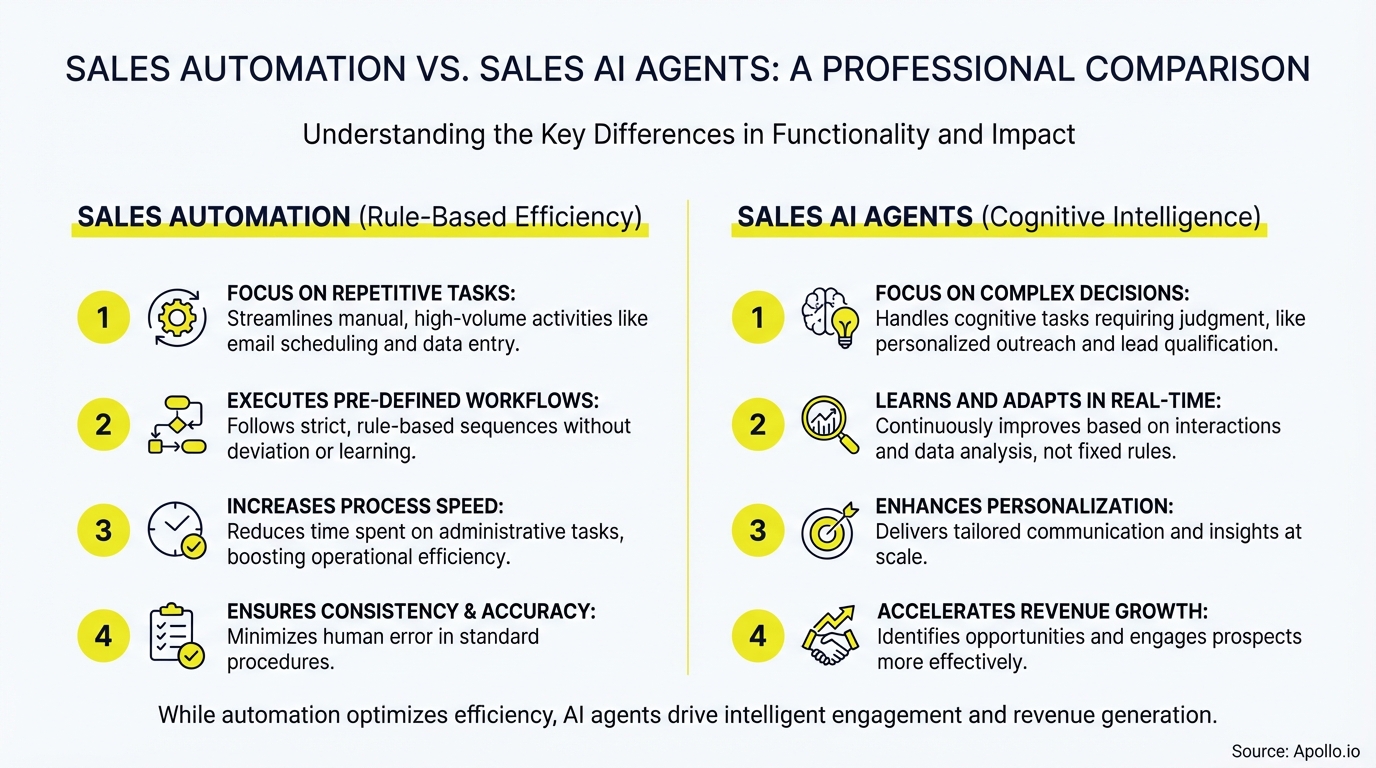
Sales automation is rule-based: if a prospect opens an email, enroll them in step 2. Sales AI agents are goal-based: given a target account, research the buyer, draft a personalized message, check intent signals, and schedule follow-up, adapting at each step based on new information.
| Dimension | Sales Automation | Sales AI Agents |
|---|---|---|
| Logic | Rule-based (if/then) | Goal-based (reason + act) |
| Adaptability | Fixed triggers | Dynamic, context-aware |
| Human input required | Every workflow step defined upfront | Goal set; agent determines steps |
| Best for | Sequencing, routing, logging | Research, personalization, multi-step execution |
| Governance complexity | Low (deterministic) | High (non-deterministic, auditable) |
A helpful way to think about it: automation removes manual steps. Agents replace manual thinking. Both have a place in a modern GTM stack, but they solve different problems.
What Is the Four-Level Taxonomy of Sales AI?
Sales AI capability exists on a spectrum from fully rule-based to fully autonomous. Understanding each level helps RevOps and sales leaders deploy the right tool with the right guardrails.
- Level 1: Rule-Based Automation. Triggered workflows, email sequences, CRM field updates. Zero decision-making. Examples: CRM workflow automation, lead routing rules.
- Level 2: AI Copilots. AI suggests the next best action; a human approves and executes. Examples: AI-generated email drafts, call summary suggestions.
- Level 3: Constrained Agents. AI executes multi-step tasks within defined boundaries (specific tools, personas, data sources). Humans review outputs at key checkpoints.
- Level 4: Autonomous Agents. AI sets sub-goals, selects tools, and executes end-to-end with minimal human intervention. Requires mature governance. Only 15% of IT application leaders are piloting fully autonomous agents, per Gartner.
Most B2B GTM teams in 2026 operate at Levels 1-3. Gartner predicts 40% of enterprise apps will include task-specific AI agents by end of 2026, up from less than 5% in 2025, so the window to build internal capability is now.
How Do SDRs and AEs Use Each Approach Differently?
SDRs benefit most from automation handling volume tasks; AEs unlock bigger gains when AI agents handle pre-meeting research and deal intelligence. The right tool depends on where time is lost in the selling day.
Data from Insight Mark Research shows automation tools save sales representatives 11 to 12 hours per week, primarily from eliminating manual data entry, sequencing setup, and follow-up logging. That time should flow back into actual selling conversations.
- SDRs/BDRs: Use automation for sequence enrollment, task creation, and prospecting workflows. Use AI agents to research accounts, identify buying signals, and personalize outreach at scale.
- AEs: Use automation for CRM updates and meeting scheduling. Use AI agents for pre-call briefings, competitive context, and deal risk flagging.
- RevOps: Use automation for data hygiene and routing. Use AI agents for forecasting inputs and pipeline anomaly detection.
- Revenue Leaders: Agents surface deal health patterns and coaching opportunities that no rule-based workflow can identify.
Spending too much time on manual research before every call? Apollo's AI sales automation platform handles prospect research, personalized messaging, and outreach sequencing in one unified workspace.

Why Does Governance Separate Automation From Agents?
Governance is the defining operational difference between deploying automation and deploying agents. Automation is deterministic: every action is traceable to a rule you wrote.
Agents are non-deterministic: they choose actions, which means you need identity controls, audit logs, and human checkpoints.
A Cloud Security Alliance survey reported by ITPro found 73% of organizations expect AI agents to become vital within the next year, while 68% cannot accurately identify AI agent activity versus human activity. For revenue-critical workflows, that gap is a serious risk.
A practical governance checklist for agent deployments:
- Define what data sources and tools the agent can access (scope boundary)
- Require human approval for any external-facing communication above a defined threshold
- Log every agent action with timestamps and decision context
- Set up alerts for anomalous output volume or unexpected tool calls
- Review agent performance weekly during the first 90 days
Turn Funnel Gaps Into Pipeline Gold
Pipeline forecasting a guessing game because quality leads never convert? Apollo surfaces in-market buyers with intent signals so your team reaches the right prospects before the window closes. Join 600K+ companies building predictable revenue.
Start Free with Apollo →What Is the ROI Model for Each Approach?
Sales automation delivers ROI through cost reduction and time savings. Sales AI agents deliver ROI through pipeline outcomes, quota attainment, and operating model efficiency at scale.
Two frameworks to present to finance teams:
| ROI Driver | Sales Automation | Sales AI Agents |
|---|---|---|
| Primary metric | Hours saved, cost reduction | Quota attainment, pipeline value |
| Typical proof point | Reduced operational costs (automated workflows average 12.2% cost reduction, per Sopro) | Sellers partnering with AI are 3.7x more likely to meet quota (Gartner, 2024) |
| Time to value | Weeks | Months (requires data readiness) |
| Scalability | Linear with workflow volume | Non-linear: agents handle workloads that grow faster than headcount |
McKinsey estimates generative AI could increase sales productivity by approximately 3% to 5% of current global sales expenditures. That is an operating model shift, not an incremental efficiency gain.
Framing agents as a productivity lever rather than a cost center is the right CFO conversation in 2026.
How Do You Choose the Right Starting Point?
Start with automation if your team lacks consistent process discipline or clean CRM data. Move to agents when your data foundation is solid and you need to scale output without scaling headcount.
Three prerequisites before deploying agents:
- Data quality: Agents are only as good as the data they read. Enrich and verify your contact and account data first. Intent data signals further improve agent targeting accuracy.
- Process documentation: Agents replicate your best rep's decision logic. Document that logic before automating it.
- CRM hygiene: Agents writing to a dirty CRM create compounding errors. Run an enrichment pass before deployment.
Apollo consolidates sales automation and AI agent capabilities in a single platform. As Cyera put it: "Having everything in one system was a game changer." You can start with Apollo's workflow automation for sequencing and routing, then layer in AI agents for research and personalization without switching tools or managing multiple vendors.
Struggling to keep your pipeline full while your reps spend time on manual tasks? Apollo's pipeline platform combines automated prospecting with AI-powered outreach so your team focuses on closing, not clicking.

What's the Right Move for Your GTM Team in 2026?
The difference between sales automation and sales AI agents is the difference between following rules and making decisions. Automation scales your current process. Agents evolve it.
For most B2B GTM teams, the practical path is sequential: deploy automation to eliminate manual overhead, then introduce constrained agents where judgment and personalization create the most pipeline value. Build governance from day one, not as an afterthought.
And choose a platform that supports both capabilities so you consolidate your stack rather than add to it.
Apollo gives SDRs, AEs, RevOps, and revenue leaders a unified workspace covering prospecting, sequencing, AI-powered outreach, and deal management. Census said it directly: "We cut our costs in half." Predictable Revenue added: "We reduced the complexity of three tools into one."
Ready to run automation and AI agents from one platform? Try Apollo Free and see how 2M+ users are building pipeline without the bloated stack.
Prove Pipeline ROI With Apollo
ROI pressure killing your next budget approval? Apollo delivers measurable pipeline impact — fast. Leadium 3x'd their annual revenue. See your returns before the next board meeting.
Schedule a Demo →Don't miss these
Sales
Inbound vs Outbound Marketing: Which Strategy Wins?
Sales
What Is a Sales Funnel? The Non-Linear Revenue Framework for 2026
Sales
What Is a Go-to-Market Strategy? The 2026 GTM Playbook
See Apollo in action
We'd love to show how Apollo can help you sell better.
By submitting this form, you will receive information, tips, and promotions from Apollo. To learn more, see our Privacy Statement.
4.7/5 based on 9,690 reviews
