
AI SDR vs. Sales Automation Tool: What's the Difference?
Two tools sit at the center of nearly every modern outbound motion: sales automation platforms and AI SDRs. They sound similar, but they solve fundamentally different problems. Understanding the distinction helps SDRs, RevOps leaders, and sales managers invest budget in the right layer and sequence the two correctly for maximum pipeline impact. Tools like Apollo's AI Sales Assistant bridge both worlds, handling end-to-end GTM workflows from prospect research to sequence launch through natural-language instructions.

Apollo Turns Hours of Research Into Minutes
Tired of burning your selling time on manual lead research and dead-end contact data? Apollo instantly surfaces verified contacts so your reps prospect smarter, not harder. Join 600K+ companies building predictable pipeline.
Start Free with Apollo →Key Takeaways
- Sales automation tools remove repetitive work (logging, routing, scheduling). AI SDRs delegate judgment-based SDR tasks (research, qualification, personalization) to an agentic system.
- The two categories are not mutually exclusive. Most high-performing teams layer AI SDR capabilities on top of a solid automation foundation.
- Operational readiness matters before deploying an AI SDR: clean CRM data, defined ICP, and clear handoff protocols are prerequisites.
- Buyers are shifting evaluation criteria from "workflow steps automated" to "autonomy and outcomes delivered," making the taxonomy distinction more commercially important than ever.
- Apollo consolidates both layers in one platform, reducing tool sprawl and the cost of stitching together point solutions.
What Is the Core Difference Between an AI SDR and a Sales Automation Tool?
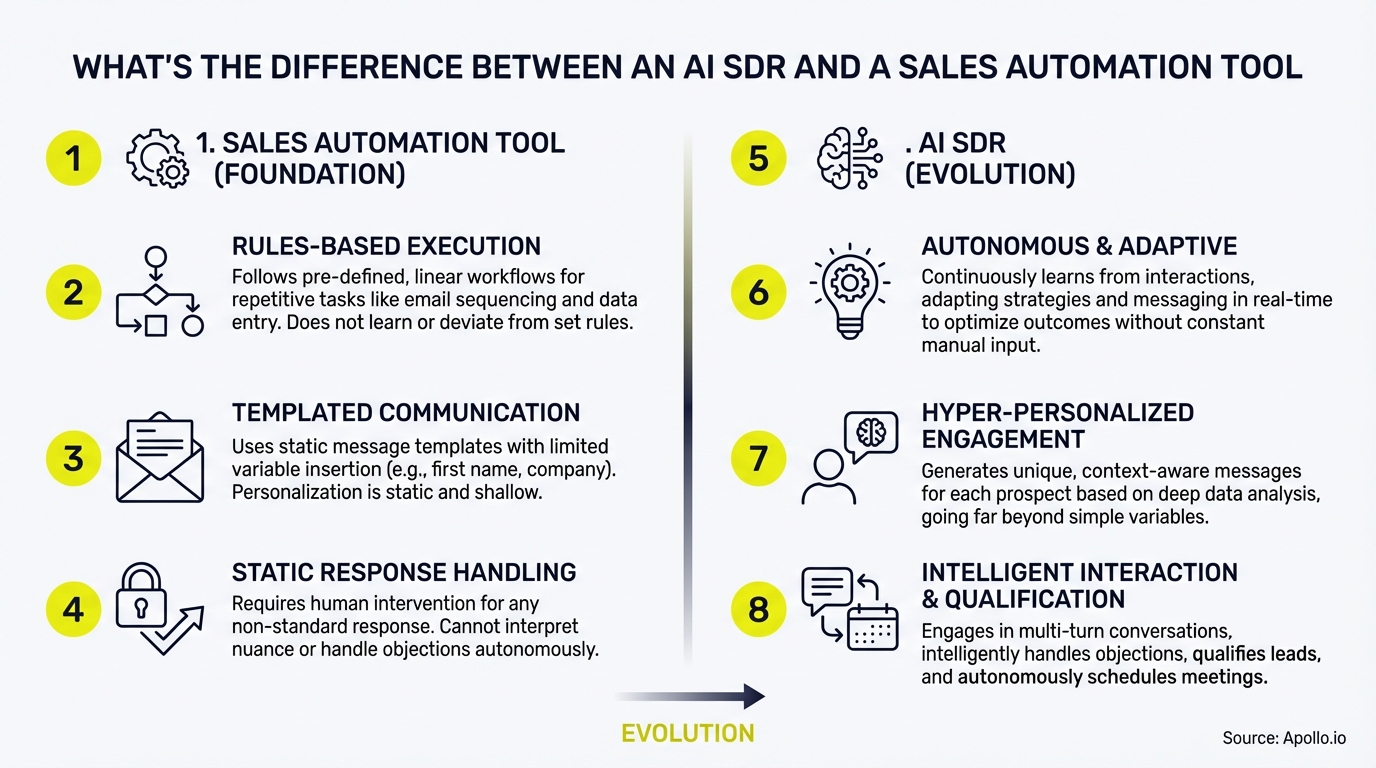
A sales automation tool executes predefined, rule-based tasks without human judgment. An AI SDR uses machine learning and natural language processing to perform judgment-intensive SDR functions, including prospecting, personalized outreach, lead qualification, and meeting booking, at scale.
As noted by MarketsandMarkets, sales automation tools encompass a broad range of technologies designed to streamline repetitive sales tasks such as email scheduling, data entry, and CRM updates. An AI SDR goes further: according to Salestools.io, AI SDRs go beyond simple automation by leveraging machine learning and natural language processing to perform core SDR functions like prospecting, hyper-personalized outreach, lead qualification, and meeting booking at scale, often with human-like performance.
The simplest mental model: automation removes work. An AI SDR delegates work.
How Do These Two Categories Compare Feature by Feature?
The table below maps the primary capabilities of each category to help SDRs and RevOps teams identify which layer addresses their specific bottleneck.
| Capability | Sales Automation Tool | AI SDR |
|---|---|---|
| Email sequencing | Rule-based, template-driven | Dynamic, signal-personalized |
| CRM data entry | Automated logging | Enriched and contextualized |
| Prospect research | Not included | Core function (web + data signals) |
| Lead qualification | Rule-based scoring | AI-driven ICP matching and scoring |
| Outreach personalization | Merge tags / templates | Context-aware messaging per prospect |
| Meeting booking | Calendar links embedded in sequences | Conversational booking within outreach |
| Primary metric | Tasks completed / time saved | Meetings booked / pipeline generated |
Struggling to keep manual outreach consistent at scale? Automate your sequences with Apollo's multi-channel engagement platform and let AI handle personalization in every step.
Turn Funnel Gaps Into Pipeline Wins
Tired of watching marketing leads stall before they ever reach your pipeline? Apollo surfaces in-market buyers the moment they're ready, so your team stops guessing and starts closing. Trusted by 600K+ companies building predictable revenue.
Schedule a Demo →Why Does This Distinction Matter for SDRs and RevOps Teams in 2026?
The distinction matters because the two categories solve different constraints, and buying the wrong one for the wrong problem wastes both budget and time.
Sales automation is the right layer when the bottleneck is administrative volume: logging, routing, scheduling, and follow-up reminders. An AI SDR is the right layer when the bottleneck is top-of-funnel throughput: insufficient research capacity, generic messaging, or too few qualified meetings reaching AEs.
For SDRs specifically, this is a significant operational gap. The global AI SDR market was valued at $3.85 billion in 2024 and is projected to grow to $15.01 billion by 2030, according to Grand View Research, reflecting strong demand for tools that address top-of-funnel quality, not just workflow efficiency. Meanwhile, the global sales automation market reached $16 billion in 2025, per Cirrus Insight, confirming both categories are growing in parallel because they serve distinct needs.
For RevOps leaders, the practical implication is sequencing: automation infrastructure should come first to establish clean data, reliable sequences, and CRM hygiene. AI SDR capabilities then layer on top to add judgment, personalization, and agentic execution.
Deploying an AI SDR on dirty data or undefined ICP criteria generates poor results regardless of how capable the tool is.

What Is the Three-Layer Taxonomy of Sales AI?
The sales AI landscape in 2026 maps to three distinct capability layers, each with different readiness requirements and outcome expectations.
- Layer 1: Traditional Automation. Rule-based execution of defined tasks. No inference or judgment. Examples: sequence triggers, CRM field updates, meeting reminders. Measured by tasks completed and time saved. Learn more about how sales automation works and its core benefits.
- Layer 2: AI-Assisted Selling. AI augments human decisions with recommendations, scoring, and generated content. Reps remain in the loop and choose which actions to take. Apollo's AI Research and scoring fall into this layer.
- Layer 3: AI Agentic / AI SDR. The AI executes multi-step workflows autonomously: researching accounts, selecting prospects, generating personalized messages, and initiating outreach without a rep triggering each step. Buyers in 2026 increasingly evaluate tools by their autonomy level, not just their feature list.
Understanding which layer a tool belongs to prevents misaligned expectations. A Layer 1 tool cannot qualify leads.
A Layer 3 tool requires data and governance infrastructure that a Layer 1 tool assumes you already have.
How Do SDRs and BDRs Use Each Layer to Book More Meetings?
SDRs and BDRs use sales automation tools to eliminate administrative friction and AI SDR capabilities to increase the quality and volume of qualified first touches.
In practice, the workflow looks like this: automation handles sequence enrollment, follow-up timing, and CRM logging so reps are not doing manual data entry.
AI SDR capabilities handle prospect research, ICP scoring, and message personalization so each outreach is contextually relevant rather than templated.
Apollo's Outbound Copilot operates as an embedded agentic layer: it automatically identifies prospects matching your ICP, adds them to sequences, and generates personalized multi-channel messaging grounded in real account signals. Erik Fernando Nieto, BDR at JumpCloud, describes the impact: "Apollo's AI Assistant filters and cleans prospect data for me, so I can find the right people faster and run better searches. It saves me about an hour per prospecting session."
For teams building outbound from scratch, this prospecting resource walks through how to combine data quality, targeting, and automation into a repeatable pipeline-building motion.
What Readiness Prerequisites Does an AI SDR Require?
An AI SDR requires clean, structured data and defined operational parameters before it can produce reliable results.
Deploying an AI SDR without these foundations produces low-quality outputs regardless of the tool's capability. RevOps leaders should verify the following before activating agentic outbound:
- CRM hygiene: Duplicate-free contacts, consistent field standards, and up-to-date account records.
- Defined ICP: Firmographic and behavioral criteria the AI can use to score and filter prospects.
- Handoff protocol: Clear rules for when the AI escalates a conversation to a human rep.
- Governance rules: Volume caps, opt-out handling, and compliance checkpoints built into the workflow.
- Content grounding: A configured AI Content Center with your value proposition, pain points, and differentiators, so AI-generated messages reflect your actual positioning.
Need to build a qualified pipeline before layering in AI SDR workflows? Search Apollo's 230M+ contacts with 65+ filters to establish clean, ICP-matched prospect lists as your foundation.
How Does Apollo Combine Both Layers in One Platform?
Apollo combines sales automation and AI SDR capabilities in a single unified platform, eliminating the need to stitch together separate tools for each layer.
The Apollo AI Sales Automation platform covers Layer 1 through Layer 3 in one workspace: sequence automation, workflow triggers, CRM sync, AI research, lead scoring, AI-generated messaging, and the Outbound Copilot for agentic execution. Teams using Apollo report measurable consolidation benefits. As Tory Kindlick, Head of Revenue Ops at RapidSOS, put it: "Work that would've taken me hours was done before I even got off the train."
For teams evaluating which AI sales tools actually close more deals, the consolidation argument is increasingly important: each additional point solution adds integration overhead, data fragmentation, and contract complexity. Apollo's approach embeds AI directly in the prospecting, sequencing, and analytics workflows where reps already operate, making it the default rather than a separate tool to context-switch into.

What Is the Right Choice for Your Team in 2026?
The right choice depends on where your pipeline bottleneck sits, not on which category sounds more advanced.
Use this decision framework:
- If your reps spend most of their time on administrative tasks (logging, scheduling, routing): start with sales automation. Establish clean sequences, reliable CRM data, and consistent follow-up before adding AI SDR capabilities.
- If your reps have automation in place but still struggle with outreach quality or volume: layer in AI SDR features. Focus on AI research, ICP scoring, and personalized multi-channel messaging.
- If you need both and want to avoid managing two separate vendor contracts: a unified platform that covers automation and agentic AI in one workspace reduces complexity and cost.
The market is moving toward embedded AI over bolt-on AI. Teams that evaluate tools based on autonomy and outcomes, rather than just feature lists, will be better positioned to translate AI investment into measurable pipeline in 2026 and beyond.
Apollo gives SDRs, BDRs, RevOps leaders, and founders a single platform to run both layers. Request a demo to see how Apollo's AI Assistant and Outbound Copilot work together to replace multiple point solutions with one unified GTM workflow.
Prove Pipeline ROI With Apollo
ROI pressure killing your tool adoption? Apollo delivers measurable pipeline impact from day one — no guesswork, no waiting. Teams like Built-In saw +10% win rates and +10% ACV. Start free today.
Start Free with Apollo →Don't miss these
Sales
Inbound vs Outbound Marketing: Which Strategy Wins?
Sales
What Is a Sales Funnel? The Non-Linear Revenue Framework for 2026
Sales
What Is a Go-to-Market Strategy? The 2026 GTM Playbook
See Apollo in action
We'd love to show how Apollo can help you sell better.
By submitting this form, you will receive information, tips, and promotions from Apollo. To learn more, see our Privacy Statement.
4.7/5 based on 9,690 reviews
