
AI Sales Assistant vs. Generative AI Email Tools: What's the Real Difference in 2026?
Most sales teams today have used AI to write a cold email. Far fewer have used AI to research an account, build a prospect list, enroll contacts into a sequence, and log the activity in their CRM, all from a single conversation. That gap is exactly what separates a generative AI email tool from a true AI sales assistant. Understanding the distinction helps SDRs, AEs, and RevOps leaders make smarter tool decisions and avoid the trap of calling a drafting copilot a "sales assistant." Apollo's AI Sales Assistant is one example of an end-to-end GTM assistant that goes well beyond text generation to execute full outbound workflows from natural-language instructions.
According to MarketBetter.ai, as of 2026, 89% of revenue organizations use AI in some form, up from 34% in 2023. The challenge now is using the right kind of AI for each job. For more context on how AI fits across the GTM stack, see which AI sales tools actually close more deals.

Scale Pipeline Without the Chaos
Tired of watching reps burn hours on manual research instead of closing deals? Apollo standardizes your entire prospecting workflow so every rep hits the ground running. Nearly 100K paying customers trust Apollo to scale without the growing pains.
Start Free with Apollo →Key Takeaways
- Generative AI email tools optimize a single task: drafting or refining text. They don't connect to your CRM, prospects, or sequences.
- AI sales assistants execute multi-step workflows: researching accounts, building lists, creating sequences, scoring leads, and logging activity.
- The market is moving fast from "assistants that help" to "agents that do" — the functional gap between these two categories is growing every quarter.
- SDRs and AEs get the most ROI from assistants that are workflow-native and grounded in real account data, not standalone text generators.
- Governance and data grounding are now purchase requirements, not nice-to-haves, especially for teams scaling AI across outbound.
What Is the Core Difference Between an AI Sales Assistant and a Generative AI Email Tool?
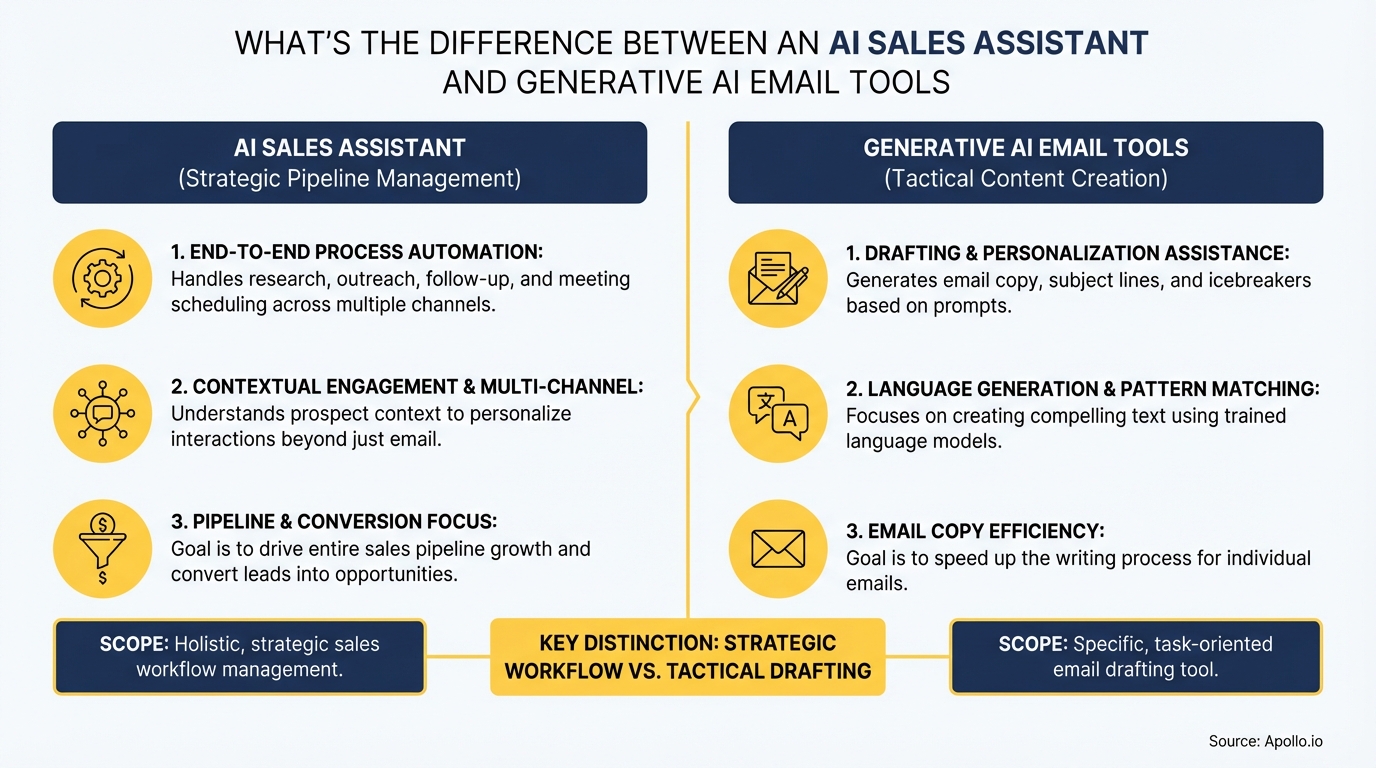
A generative AI email tool produces text based on a prompt. An AI sales assistant executes actions across an entire GTM workflow. The functional difference is scope: one writes, the other works.
| Capability | Generative AI Email Tool | AI Sales Assistant |
|---|---|---|
| Draft cold email copy | Yes | Yes |
| Research accounts and contacts | No | Yes |
| Build and filter prospect lists | No | Yes |
| Create and launch multi-channel sequences | No | Yes |
| Score and prioritize leads | No | Yes |
| Log activity and update CRM records | No | Yes |
| Grounded in live account/contact data | Rarely | Yes |
Generative AI email tools are most often used as standalone text generators: you paste in context, get a draft, copy it somewhere else. AI sales assistants are embedded in the platforms where reps already work, carrying tasks end-to-end without manual handoffs between tools.

Why Does This Distinction Matter for SDRs and AEs in 2026?
SDRs and AEs still spend the majority of their time on non-selling work. Research from SuperAGI reports that AI tools save sales reps an average of 11 to 12 hours per week by automating repetitive tasks like CRM updates, scheduling meetings, and logging interactions. A generative email tool addresses only one of those tasks.
For SDRs managing high-volume outbound, the difference is significant. An email copilot helps you write one better email. A sales assistant helps you find 50 ICP-matched prospects, research each account, build a personalized multi-channel sequence, and enroll contacts automatically, without leaving your prospecting workflow. That's the productivity multiplier that changes quota attainment. Struggling to keep your outbound pipeline full? Explore Apollo's AI sales automation to run full outbound workflows from a single prompt.
Turn Funnel Guesswork Into Qualified Pipeline
Tired of watching marketing leads stall before they ever reach your reps? Apollo surfaces high-intent prospects and keeps your pipeline moving with real-time signals. Nearly 100K paying customers stopped guessing and started closing.
Start Free with Apollo →What Are the Three Maturity Levels of AI in Sales?
AI in sales follows a clear capability progression. Teams typically move through three stages before reaching full agentic execution.
- Stage 1: Email Copilot. Drafts and edits email copy on demand. Standalone, no CRM context, no workflow execution. Entry-level adoption. Measured by time saved on drafting.
- Stage 2: Workflow Assistant. Embedded in sales platforms. Can research prospects, suggest next actions, and personalize messaging using account data. Requires CRM and data integration. Measured by reply rates and pipeline velocity.
- Stage 3: Agentic Sales Assistant. Executes end-to-end GTM workflows autonomously: builds lists, launches sequences, scores leads, prepares for meetings, logs outcomes. Requires deep platform integration, data governance, and approval controls. Measured by meetings booked, pipeline created, and win rate.
Most teams adopting AI in 2026 are somewhere between Stage 1 and Stage 2. The market is accelerating toward Stage 3 fast. For a deeper look at how sales automation fits into this maturity curve, the principles apply directly to AI-assisted workflows.
How Do AI Sales Assistants Handle Data Grounding and Governance?
Data grounding is what separates relevant AI output from generic text. An AI sales assistant draws on real account signals, verified contact data, CRM history, and GTM context to produce outputs that are accurate and actionable, not just plausible-sounding.
Governance matters equally as AI moves from drafting to doing. When an AI can send emails, update records, or trigger sequences, enterprises need controls: approval gates before contacts are enrolled, audit logs of AI actions, permission boundaries by role, and data access scoped to what each rep should see.
Teams evaluating AI sales assistants should ask:
- Is output grounded in verified contact and company data, or generated from general knowledge?
- Can admins set approval requirements before AI-triggered sequences go live?
- Is customer data protected and never used to train external models?
- Does the platform provide audit trails for AI-executed actions?
Apollo's AI, for example, operates under SOC2 and ISO 27001 standards and does not use customer data to train external AI models.
The AI Content Center grounds all messaging in your company's specific value proposition, ICP, and pain points, so outputs reflect your GTM context, not a generic template.

How Do SDRs Get the Most Value From an AI Sales Assistant?
SDRs get the most value when AI is embedded in their prospecting workflow, not bolted on as a separate drafting tool. The highest-impact use cases are list building, account research, and sequence creation, all in one motion.
Apollo's AI Assistant lets SDRs ask in plain English: "Find 30 VP of Sales contacts at Series B SaaS companies in fintech who haven't been contacted in 90 days, research their recent activity, and build a 5-step sequence." The assistant handles each step without manual tab-switching or copy-pasting between tools.
"Apollo's AI Assistant makes building targeted prospecting lists effortless. I can give it very specific prompts, and it stays within those parameters to deliver accurate, high-quality results." — Matt Tumbiolo, Enterprise BDR, Smartling
For AEs preparing for discovery calls, pre-meeting research powered by AI surfaces company priorities, key stakeholders, and past objections in seconds, not minutes of manual prep. Spending hours on manual outreach? Automate your multi-channel sequences with Apollo's sales engagement platform.
What Does the AI Sales Assistant Market Look Like in 2026?
The AI sales assistant software market is growing quickly. Data from Precedence Research shows the global market was valued at USD 3.11 billion in 2025 and is projected to reach USD 26.09 billion by 2035, growing at a CAGR of 23.70%. Cirrus Insight reports that AI usage among sales reps surged from 24% in 2023 to 43% in 2024, a 79% year-over-year increase.
This growth reflects the broader shift from "AI that helps write" to "AI that executes." As sales teams move past the email-copilot stage, the tools they evaluate must demonstrate pipeline impact, not just time saved on drafts. The vendors winning in this market are those with native CRM integration, verified data foundations, and approval controls that let teams scale confidently. See how sales intelligence tools are evolving alongside this shift.
Which Tool Should You Choose?
The right choice depends on what you actually need AI to do. If your team only needs help drafting emails, a generative AI email tool is sufficient.
If you need AI to handle the full outbound motion, from prospecting and research through sequencing and follow-up, you need an AI sales assistant embedded in your GTM platform.
For B2B GTM teams under quota pressure, consolidating around an AI sales assistant that handles the entire workflow is both more productive and more cost-effective than stitching together a drafting tool, a prospecting database, a sequencing platform, and a CRM enrichment layer separately. As Tory Kindlick, Head of Revenue Ops at RapidSOS, put it: "Work that would've taken me hours was done before I even got off the train."
Apollo's AI Sales Assistant is built for teams that need end-to-end execution, not just better copy. It runs on a database of 230M+ contacts, uses real account signals to ground every output, and executes across prospecting, sequences, enrichment, and analytics in one platform. Try Apollo free and see what an end-to-end AI sales assistant can do for your pipeline.
Prove Pipeline ROI Before Next QBR
Budget approval stuck on unclear metrics? Apollo delivers measurable pipeline impact from day one — so you walk into every QBR with proof, not projections. Nearly 100K paying customers already closed the case.
Start Free with Apollo →Don't miss these
Sales
Inbound vs Outbound Marketing: Which Strategy Wins?
Sales
What Is a Sales Funnel? The Non-Linear Revenue Framework for 2026
Sales
What Is a Go-to-Market Strategy? The 2026 GTM Playbook
See Apollo in action
We'd love to show how Apollo can help you sell better.
By submitting this form, you will receive information, tips, and promotions from Apollo. To learn more, see our Privacy Statement.
4.7/5 based on 9,690 reviews
