
What Is the Best Way to Verify Email Addresses Before Sending?
Sending to an unverified list in 2026 is a fast path to a damaged sender reputation. B2B contact data decays continuously, mailbox providers have tightened enforcement, and a single campaign to a stale list can push your spam complaint rate past the thresholds that trigger filtering. Email deliverability starts with knowing your addresses are good before you hit send.

Let Apollo Find Contacts Instantly
Tired of burning hours verifying emails and hunting down phone numbers? Apollo delivers 230M+ accurate business contacts so your reps spend time selling, not searching. Start building real pipeline today.
Start Free with Apollo →Key Takeaways
- Verification is not a one-time project. Email lists degrade continuously, so verify before every major campaign.
- The best approach uses layered checks: syntax, DNS/MX, SMTP, disposable filtering, and catch-all risk scoring.
- Catch-all addresses require a separate risk-routing strategy, not a binary pass/fail decision.
- Google and Microsoft now enforce strict complaint and authentication thresholds that make pre-send verification a compliance requirement, not just a best practice.
- SDRs and RevOps teams that embed verification into their capture-to-send workflow protect sender reputation at scale.
Why Does Email Verification Matter So Much in 2026?
Email verification confirms that an address exists, accepts mail, and is safe to contact before you send. It is distinct from authentication (SPF, DKIM, DMARC), which proves your sending identity.
You need both, but verification directly controls your bounce rate and complaint exposure.
According to Mail Monitor, email lists degrade by 20–25% annually, making regular verification a critical operational control. Research from email-check.app shows the average B2B inbox placement rate fell to 57% in 2025, down from 78% in 2023. That gap is largely explained by poor list hygiene and inadequate pre-send verification.
Microsoft's bulk-sender enforcement, which began May 5, 2025, now rejects messages from high-volume senders (5,000+ emails/day) that fail required authentication checks. Sending to dirty lists accelerates the scrutiny that triggers those rejections.
What Are the Core Email Verification Methods?
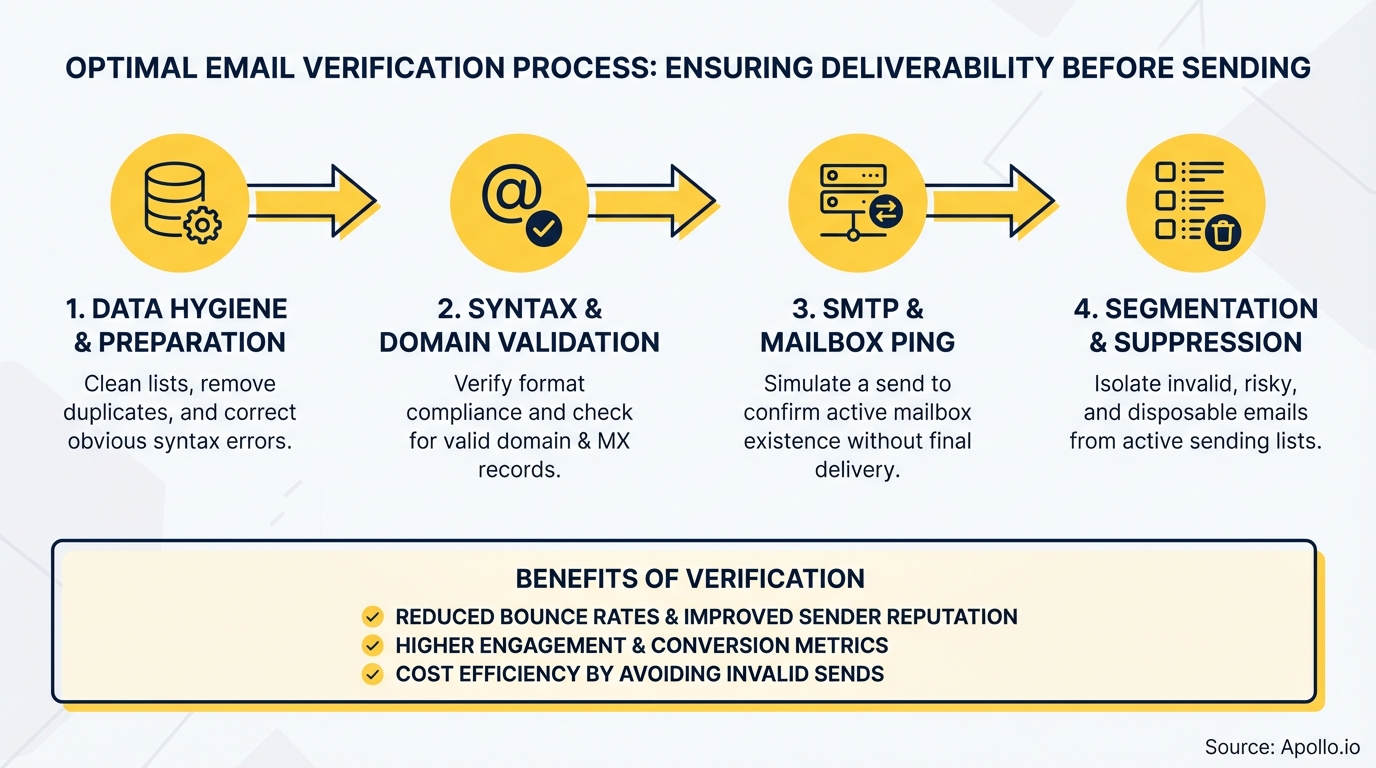
The best verification strategy uses multiple layers in sequence. Each layer catches a different failure mode.
| Verification Layer | What It Checks | What It Catches |
|---|---|---|
| Syntax check | Format rules (@ sign, domain, valid characters) | Typos, malformed addresses |
| DNS/MX check | Whether the domain has valid mail exchange records | Dead domains, non-existent domains |
| SMTP check | Pings the mail server without sending a message | Mailboxes that no longer exist |
| Disposable/role-based filter | Flags temporary inboxes and generic addresses (info@, admin@) | Low-intent or unmonitored inboxes |
| Catch-all risk scoring | Identifies domains that accept all mail regardless of validity | Addresses that appear valid but may not be deliverable |
Data from MailerLite shows that common verification failure categories include catch-all addresses (13.9%), mailboxes not found (12.4%), and role-based or syntax errors. Each of these requires a different handling decision.

How Should You Handle Catch-All and Risky Addresses?
Catch-all addresses are the hardest verification challenge. The domain accepts all incoming mail, so an SMTP check returns a positive result even when the specific mailbox does not exist.
A binary pass/fail approach will route these addresses into your send queue, inflating your bounce rate.
Use a risk-tier routing approach instead:
- Valid: Send normally.
- Invalid: Suppress immediately. Add to your do-not-contact list.
- Catch-all/risky: Route to a throttled, lower-volume sequence. Enrich with an alternative channel (phone, social outreach) before committing to high-frequency email sends. Monitor bounce and reply signals from early sends to reclassify.
- Role-based (info@, sales@): Suppress or treat as low priority. These rarely convert and can inflate complaint rates.
Struggling to find accurate contact data before your outreach even starts? Apollo's data enrichment uses a 97% email accuracy rate across 230M+ verified business contacts to reduce your catch-all exposure from the source.
Turn Funnel Guesswork Into Real Pipeline
Pipeline forecasting a guessing game because quality leads never convert? Apollo surfaces in-market buyers at the right moment so reps pursue deals that actually close. Top revenue teams run on Apollo — start building predictable pipeline today.
Start Free with Apollo →How Often Should SDRs and RevOps Teams Re-Verify Their Lists?
Verification cadence should match how fast your list source decays. B2B contacts change jobs, domains expire, and inboxes close constantly.
A list verified six months ago may already have significant decay.
Recommended re-verification schedules by use case:
- Active outbound sequences (SDRs): Verify at point of import and again before any sequence restart after 60+ days of inactivity.
- Marketing campaigns (monthly sends): Verify the full list monthly. The Digital Bloom reports that 69.6% of senders verify monthly or less frequently, with 7.4% never verifying at all.
- Purchased or enriched lists: Verify immediately before any send, regardless of the source's freshness claims.
- Dormant lists (90+ days): Full re-verification before reactivation. Treat as a new list.
RevOps leaders managing CRM hygiene should implement automatic re-verification triggers: flag contacts when a hard bounce is recorded, when a contact has had no engagement in 180 days, or when a domain change is detected. This keeps your B2B lists continuously clean rather than periodically patched.
What Is the End-to-End Pre-Send Verification Workflow?
The most effective approach treats verification as a continuous control plane, not a one-time cleanup. Here is the operational workflow:
- Capture: Validate syntax and domain at the point of form submission or CRM import using a real-time API check.
- Enrich: Fill gaps and confirm contact details against a verified database before adding to sequences.
- Risk-tier: Classify each address as valid, invalid, or risky. Route accordingly.
- Pre-send check: Run a final verification pass within 24–48 hours of send for any list segment older than 30 days.
- Suppress: Maintain a live suppression list covering hard bounces, unsubscribes, and spam complaints. Sync it across your CRM, sequencer, and marketing automation tools.
- Post-send feedback: Monitor bounce codes, complaint rates, and unsubscribe signals after every send. Any hard bounce should trigger immediate suppression. Any campaign with a complaint rate approaching 0.1% should pause for list review.
For teams running high-volume outbound, the sequence diagnostics approach to improving email deliverability maps directly onto this workflow and provides a practical framework for identifying where your verification gaps are costing you inbox placement.
Spending time manually checking addresses before every campaign? Apollo's sales engagement platform integrates verification, sequencing, and suppression management in one workspace, so SDRs and RevOps teams stop managing separate tools.

What Provider Thresholds Should You Monitor?
Verification protects your sender reputation against specific, measurable enforcement thresholds. Know your targets:
| Provider | Threshold | Consequence |
|---|---|---|
| Google (Gmail) | Spam complaint rate >0.3% | Ineligible for deliverability mitigation (June 2024 onward) |
| Google (Gmail) | Recommended: stay below 0.1% | Sustained deliverability to inbox |
| Microsoft (Outlook/Hotmail) | 5,000+ emails/day without authentication | Rejection with error 550; 5.7.515 (enforcement started May 5, 2025) |
Authentication (SPF, DKIM, DMARC) is now the floor. As noted by verified.email, strategic imperatives for 2025–2026 include prioritizing SPF, DKIM, and DMARC authentication alongside maintaining spam complaint rates below 0.1%. Verification controls the inputs that keep you inside those thresholds.
For a deeper look at how to verify email addresses for B2B sales and integrate those checks into your outbound motion, the step-by-step process covers both the technical and workflow dimensions.
How Do You Build a Verification-First Outbound Motion?
The shift in 2026 is from asking "is this address real?" to asking "will this message be accepted and read?" Verification is now one layer of a broader sendability check that includes relevance, personalization, and timing.
For B2B GTM teams, the practical takeaway is to stop treating verification as a pre-launch checklist item and start treating it as an ongoing operational control. B2B email marketing in 2026 rewards senders who maintain clean, verified, engaged lists over those who blast large, unverified segments.
Pair verification with strong bulk email best practices, one-click unsubscribe headers, and post-send feedback monitoring to build a full deliverability control plane. Teams that do this consistently protect their sender reputation, protect their pipeline, and compete effectively in increasingly filtered inboxes.
Ready to build outbound on a foundation of verified, accurate contacts? Schedule a Demo to see how Apollo's unified GTM platform combines contact verification, enrichment, and sales engagement in one workspace.
Prove Pipeline ROI Before Next Budget Review
ROI pressure killing your tool renewals? Apollo delivers measurable pipeline impact fast — Leadium 3x'd annual revenue, GTM Ops landed 4x more meetings. Start your free trial and show results before your next budget conversation.
Start Free with Apollo →Don't miss these
Sales
Inbound vs Outbound Marketing: Which Strategy Wins?
Sales
What Is a Sales Funnel? The Non-Linear Revenue Framework for 2026
Sales
What Is a Go-to-Market Strategy? The 2026 GTM Playbook
See Apollo in action
We'd love to show how Apollo can help you sell better.
By submitting this form, you will receive information, tips, and promotions from Apollo. To learn more, see our Privacy Statement.
4.7/5 based on 9,690 reviews
