
What's a B2B Contact Database and How Is It Used in Prospecting?
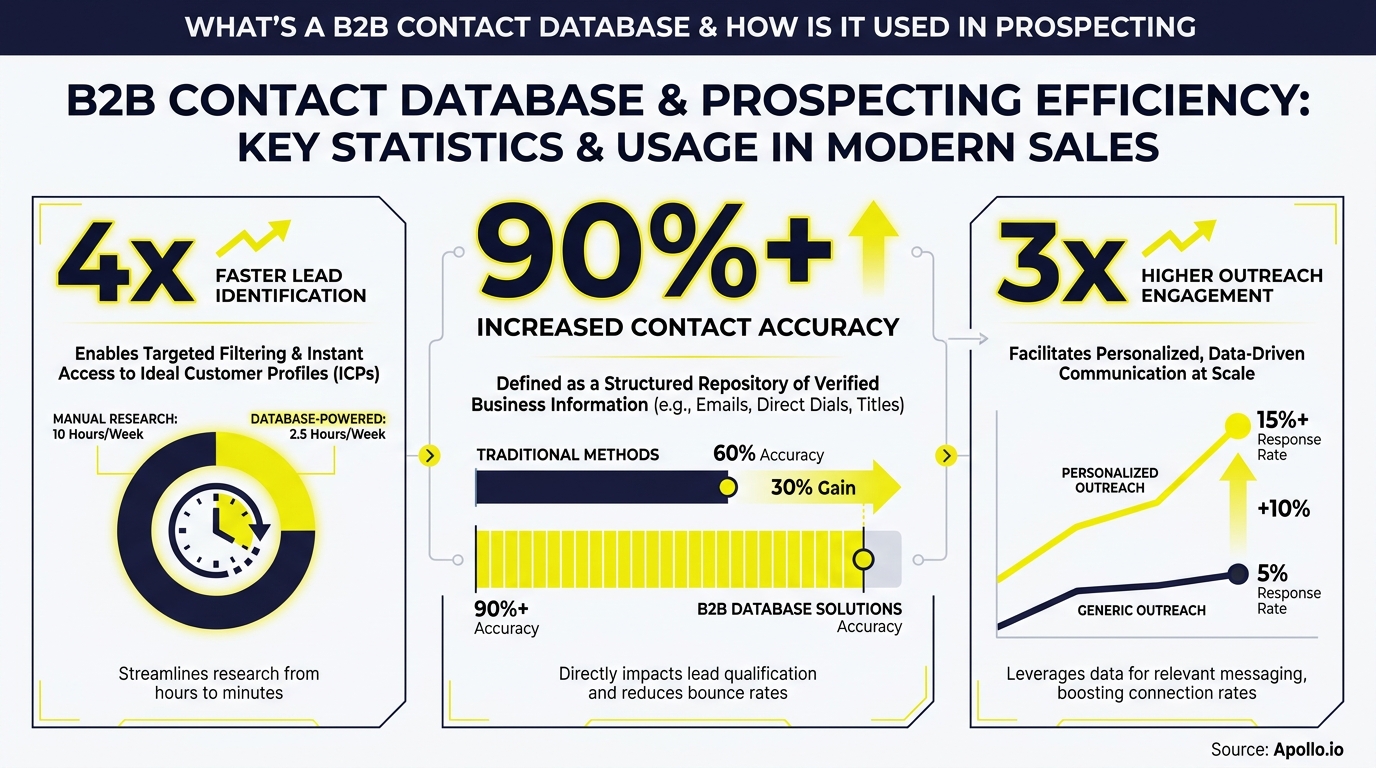
A B2B contact database is a structured repository of business contact information that sales and marketing teams use to identify, reach, and convert potential customers. In 2026, the definition has expanded: a modern contact database bundles verified contact records with buying signals, technographics, and intent data, then feeds that intelligence directly into SDR workflows.
It's not a static list anymore, it's a live prospecting engine.
For SDRs, AEs, and RevOps leaders trying to hit quota without bloating their tech stack, the quality of that database determines pipeline quality. Struggling to find qualified leads? Search Apollo's 230M+ contacts with 65+ filters to build precision lists in minutes. Apollo's sales intelligence and lead database combines data, signals, and activation in one workspace.

Verified Contacts. Zero Wasted Hours.
Tired of burning hours on manual research only to hit dead ends? Apollo delivers 97% email accuracy so your team spends time selling, not searching. Join 600K+ companies building pipeline that actually converts.
Start Free with Apollo →Key Takeaways
- A B2B contact database stores verified business contact and firmographic data used to build targeted prospect lists.
- Data quality is the single biggest lever on outbound ROI: stale or inaccurate records waste rep time and damage deliverability.
- Modern databases layer intent signals, technographics, and buying triggers on top of contact records to enable personalized outreach at scale.
- AI-assisted prospecting tools require clean, structured, deduplicated data to perform, making database hygiene an AI-readiness issue.
- In 2026, privacy regulations and email authentication requirements make vendor due diligence and suppression workflows non-negotiable.
What Does a B2B Contact Database Actually Contain?
A B2B contact database contains structured records on professionals and the companies they work for, organized so teams can filter, segment, and export lists for prospecting campaigns. According to Lonescale, this data typically includes names, job titles, phone numbers, email addresses, company names, industry details, company size, and revenue.
Beyond those core fields, leading databases in 2026 also include:
- Technographics: what tools and software a company uses
- Intent signals: topics a prospect is actively researching (see how intent data powers smarter B2B sales)
- Hiring signals: job postings that indicate budget or growth priorities
- Org chart data: reporting lines and department size
- Funding events: recent investment rounds or acquisitions
As Datarade notes, B2B contact databases are crucial for fueling the sales funnel and accelerating revenue growth by providing accurate lead information. The operative word is accurate: a record is only as valuable as its freshness.
How Is a B2B Contact Database Used in Prospecting?
A B2B contact database is used in prospecting to identify the right accounts and contacts, build segmented lists, and deliver targeted outreach across email, phone, and social channels. The core workflow follows four steps:
- Define your ICP: Filter the database by industry, company size, revenue, geography, job title, and seniority to match your ideal customer profile.
- Build a targeted list: Export or sync contacts that meet your criteria directly into your CRM or sequencing tool.
- Personalize outreach: Use database fields (role, company stage, tech stack, recent trigger) to customize each message. Learn more in our outbound prospecting guide.
- Enrich and maintain: Continuously validate and refresh records to prevent bounce rates from climbing and deliverability from degrading.
For teams building multi-channel campaigns, the database also powers B2B email list building, cold calling prioritization, and account-based marketing segmentation.

Why Does Data Quality Determine Prospecting ROI?
Data quality determines prospecting ROI because inaccurate contact records directly cause wasted rep time, higher bounce rates, and missed pipeline opportunities. Research from SuperAGI found that 61% of marketers report inaccurate data as a major challenge for their organization. Additionally, Landbase reports that a significant 70% of CRM data is outdated, incomplete, or inaccurate.
The downstream effects compound quickly:
| Data Problem | Prospecting Impact |
|---|---|
| Wrong email address | Hard bounce, domain reputation damage |
| Outdated job title | Message irrelevance, low reply rates |
| Missing phone number | Skipped call steps, incomplete sequences |
| Wrong company size/industry | Off-ICP outreach, wasted quota capacity |
| No intent or trigger data | Poor timing, generic messaging |
Tired of dirty data hurting your pipeline? Enrich and verify your records with Apollo's 97% email accuracy to clean your CRM and protect deliverability.
Turn Funnel Guesswork Into Real Pipeline
Marketing leads not converting. Apollo surfaces in-market buyers with real buying signals — so your team hits the right prospects at right moment. 600K+ companies trust Apollo to forecast with confidence.
Start Free with Apollo →How Do SDRs and AEs Use Contact Databases to Book More Meetings?
SDRs use contact databases to cut list-building time and prioritize outreach based on buying signals, while AEs use account-level data to prepare for conversations and map stakeholders before the first call. Both roles benefit when database fields map directly to personalization variables in outreach sequences.
Here's how specific fields translate to message personalization:
- Job title + seniority: Determines pain point framing (tactical for managers, strategic for VPs)
- Tech stack: Enables integration-specific hooks ("You're already using [tool], Apollo connects directly")
- Recent funding: Signals budget availability and growth pressure
- Hiring signals: Indicates team expansion and likely tooling needs
- Intent topics: Shows active research, enabling timely outreach
For AEs managing complex deals, sales prospecting tools that surface org chart data and multi-threading contacts reduce the risk of single-threaded deals. RevOps leaders gain a single source of truth when the database syncs bidirectionally with the CRM, eliminating duplicate records and reconciliation work. As Cyera's team noted: "Having everything in one system was a game changer."
What Makes a B2B Contact Database AI-Ready in 2026?
An AI-ready B2B contact database has standardized field schemas, deduplicated records, confidence scores on key data points, and real-time sync with engagement tools so AI agents can prioritize, sequence, and route prospects without manual intervention. Salesforce's State of Sales (2026) reports that 74% of sales teams with AI are prioritizing data hygiene to support their AI systems.
Key AI-readiness requirements for your contact data:
- Deduplication: One record per contact, merged across sources
- Confidence scoring: Flagging low-certainty fields (e.g., unverified mobile numbers)
- Standardized formats: Consistent job title taxonomy, country codes, revenue bands
- Signal integration: Intent, technographic, and firmographic data in the same record
- CRM sync: Bidirectional updates so AI agents always act on current data
Apollo's AI-powered prospecting tools are built on this foundation, with the AI Research Agent helping teams book 46% more meetings by activating clean, signal-enriched data automatically. Teams using sales automation alongside a verified database eliminate the manual steps that slow outbound cycles.
What Compliance and Privacy Requirements Apply to B2B Contact Databases in 2026?
In 2026, B2B contact databases used in prospecting must satisfy GDPR lawful basis requirements, US state privacy obligations (including California's Delete Act and data broker registries), CAN-SPAM rules, and email authentication standards (SPF, DKIM, DMARC). Regulatory exposure has grown: DLA Piper's GDPR Fines and Data Breach Survey (January 2026) reported approximately EUR 1.2B in GDPR fines in 2025, alongside a 22% annual increase in notified data breaches.
A compliance-ready database workflow includes:
- Suppression lists: Honoring opt-outs and deletion requests within required timeframes
- Audit trails: Logging when records were sourced, enriched, and contacted
- Vendor due diligence: Verifying how your database provider sources and maintains records
- Retention policies: Retiring stale records that exceed defined age thresholds
- One-click unsubscribe: Required for bulk senders under major inbox provider rules
Privacy procurement is now a GTM constraint, not just a legal one. Teams that skip vendor due diligence risk both regulatory fines and deliverability penalties from inbox providers. For guidance on building compliant outreach workflows, see how to build a B2B email list that converts.

Start Prospecting Smarter in 2026
A B2B contact database is the foundation of every outbound motion, from cold email campaigns to AI-assisted SDR workflows. The teams winning pipeline in 2026 are not building bigger lists; they are building verified, signal-enriched, compliance-ready lists that their AI tools can actually use.
Apollo consolidates your contact database, enrichment, sequencing, and AI prospecting into one platform, replacing the fragmented stacks that slow teams down. Predictable Revenue's team put it simply: "We reduced the complexity of three tools into one." With 230M+ contacts, 97% email accuracy, and 65+ search filters, Apollo gives SDRs, AEs, and RevOps teams the data foundation they need to build pipeline at scale.
Start Prospecting — Try Apollo Free
Prove Pipeline ROI Before Next QBR
ROI pressure killing your next tool approval? Apollo delivers measurable pipeline impact from day one — so you walk into budget reviews with numbers, not narratives. 600K+ companies already made the case.
Schedule a Demo →Don't miss these
Sales
Inbound vs Outbound Marketing: Which Strategy Wins?
Sales
What Is a Sales Funnel? The Non-Linear Revenue Framework for 2026
Sales
What Is a Go-to-Market Strategy? The 2026 GTM Playbook
See Apollo in action
We'd love to show how Apollo can help you sell better.
By submitting this form, you will receive information, tips, and promotions from Apollo. To learn more, see our Privacy Statement.
4.7/5 based on 9,690 reviews
