
How SDR Teams Turn a Target Account List Into Verified Contacts
SDR teams that start with a target account list and end with bounced emails and wrong numbers are losing more than time. According to Landbase, B2B contact data experiences rapid decay, with 20-30% becoming inaccurate annually due to job changes, company restructuring, and outdated contact information. That decay rate means a list built in January is already unreliable by Q2. The fix is a structured, repeatable workflow that moves from target account list (TAL) to verified contacts with governance checkpoints at every stage. Learn how to build, segment, and automate your target account list in Apollo before your outreach begins.

Generic Outreach Killing Your Pipeline?
Tired of sending generic outreach because your data is too thin to personalize? Apollo surfaces rich firmographic and technographic context so every message lands. Join 600K+ companies turning research time into revenue.
Start Free with Apollo →Key Takeaways
- B2B contact data decays at a measurable rate each month, making verification a continuous process, not a one-time step.
- The modern SDR workflow runs seven sequential gates: ICP fit, account signals, persona mapping, freshness check, email verification, phone validation, and dedupe/suppress before sequencing.
- Verification must happen at ingest, not after bounces, to protect email deliverability and sender reputation.
- SDRs and RevOps leaders using a unified platform eliminate manual handoffs and enforce consistent data hygiene across every stage.
- Stack consolidation reduces enrichment costs and removes the data-trust gap that undermines pipeline attribution.
What Is the SDR Workflow from Target Account List to Verified Contacts?
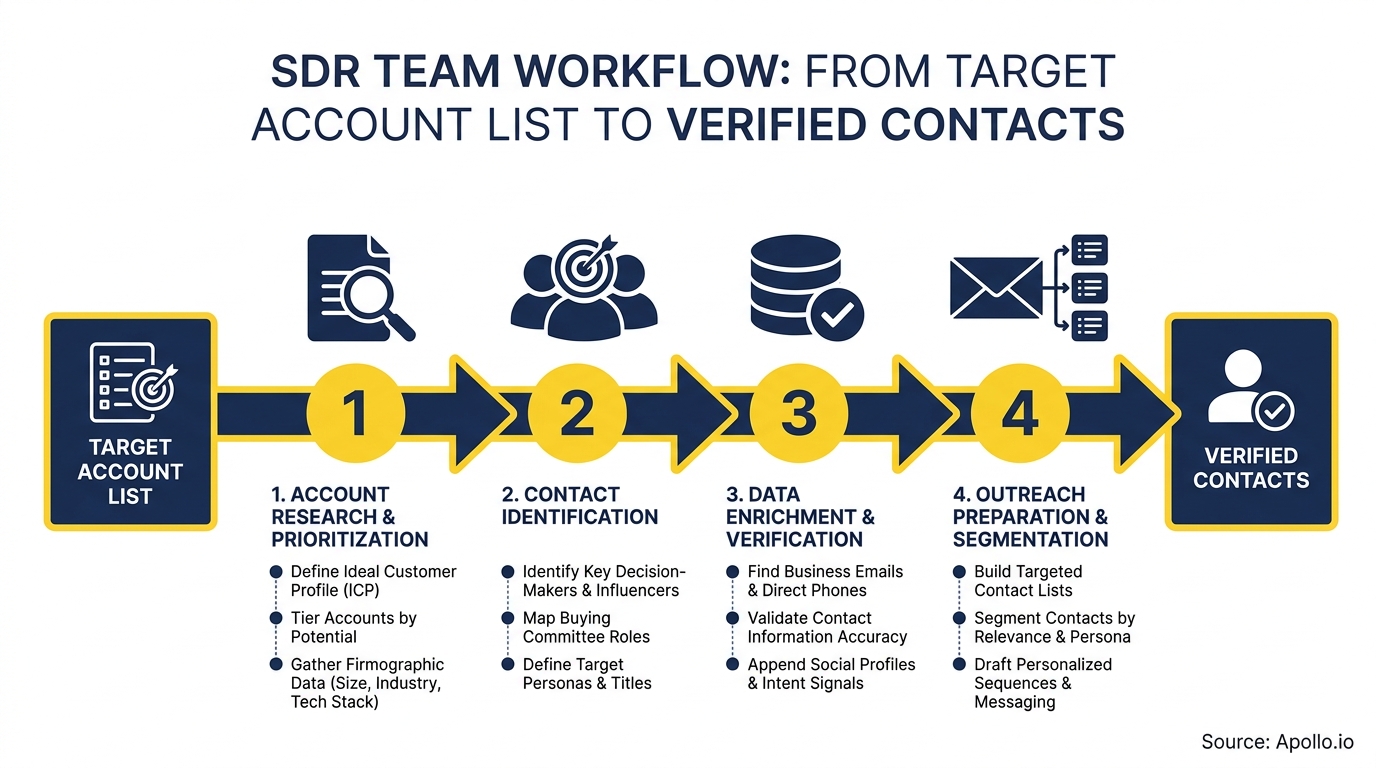
The SDR workflow from target account list to verified contacts is a seven-gate process: account qualification, signal scoring, persona mapping, data enrichment, email verification, phone validation, and dedupe before sequencing. As defined by HG Insights, defining a precise ICP is the foundational first step, enabling sales and marketing teams to focus their efforts on high-value prospects, thereby reducing wasted time and boosting return on investment. Each gate filters the list further so only clean, actionable contacts enter your sequences.
| Gate | Action | Output |
|---|---|---|
| 1. ICP Fit | Score accounts against firmographic criteria | Tier 1/2/3 account segmentation |
| 2. Account Signals | Check intent, hiring, tech, and funding signals | Prioritized account queue |
| 3. Persona Mapping | Identify buying roles and org chart depth | Target persona list per account |
| 4. Data Enrichment | Run enrichment waterfall to fill missing fields | Enriched contact records |
| 5. Email Verification | Verify deliverability before import | Valid / risky / invalid flags |
| 6. Phone Validation | Confirm direct dial or mobile status | Callable contact subset |
| 7. Dedupe and Suppress | Remove CRM duplicates and opt-outs | Sequence-ready contact list |
Why Do SDRs Struggle to Convert Account Lists into Verified Contacts?
SDRs struggle because data decay is faster than most list-build cycles. Data from Cleanlist.ai shows B2B contact data decays at an average rate of 2.1% per month, equating to 22.5% annually. A list of 1,000 accounts built today will have roughly 225 stale records by next year without active revalidation. Manual research compounds the problem: reps burn hours on verification tasks instead of selling, which is why high-performing SDR teams automate enrichment and verification rather than relying on ad-hoc research. Struggling to find qualified leads at scale? Search Apollo's 230M+ contacts with 65+ filters to surface only accounts that match your ICP.

How Do SDRs Build and Qualify a Target Account List?
SDRs build a target account list by applying ICP filters to a contact database, then scoring accounts by buying signals before any contact-level work begins. According to Leadfeeder, a target account list is a curated selection of B2B companies that align with an organization's Ideal Customer Profile and are most likely to convert into customers. Qualify at the account level first to avoid wasting enrichment credits on low-fit companies. Use the ICP framework to set your firmographic and technographic thresholds before pulling any contacts.
- Firmographics: Industry, headcount, revenue range, geography
- Technographics: Current tools in their stack relevant to your solution
- Signals: Recent funding, new executive hires, job postings in relevant departments
- Tier assignment: Tier 1 = high ICP fit + active signal; Tier 2 = high fit, no signal; Tier 3 = monitor only
How Does the Enrichment Waterfall Work for Contact Verification?
An enrichment waterfall chains multiple data sources sequentially so each source fills gaps the previous one missed, maximizing verified field coverage per contact. Start with your primary provider for coverage and scale, then layer in secondary sources for role accuracy and mobile numbers, and finish with a dedicated email verification pass. This approach replaces single-database dependency and is now standard for high-converting prospecting lists. Note that manual data entry for enrichment can lead to error rates as high as 30%, per MarketsandMarkets, which is why automated enrichment pipelines outperform manual research at scale.
- Source 1 (Coverage): Pull contacts matching persona from primary database
- Source 2 (Freshness): Cross-reference for recent role changes and updated emails
- Source 3 (Verification): Run email syntax, MX record, and mailbox-level checks
- Source 4 (Phone): Validate direct dial vs. switchboard vs. mobile
- Output gate: Flag records as Valid / Risky / Invalid before CRM import
Tired of wasting enrichment credits on stale data? Apollo's data enrichment automatically fills and verifies contact records with 97% email accuracy across 230M+ contacts.
Turn Funnel Guesswork Into Real Pipeline
Pipeline forecasting a guessing game because leads stall before they ever become opportunities? Apollo surfaces in-market buyers with precision targeting so your funnel actually converts. Nearly 100K paying customers stopped guessing and started closing.
Start Free with Apollo →How Do RevOps Teams Set Verification Governance and Cadences?
RevOps teams set verification governance by defining field standards, source-of-truth rules, last-verified timestamps, and re-verification triggers at key pipeline stages. Governance turns verification from a one-time list-clean into a continuous data quality standard. Without it, contacts that enter the CRM clean will degrade silently as job churn erodes accuracy quarter over quarter. Use the framework below to operationalize continuous verification for your cross-functional GTM team.
| Trigger | Verification Action | Owner |
|---|---|---|
| Contact created / imported | Full enrichment waterfall + email verify | RevOps / Automation |
| Contact assigned to active rep | Phone validation + recent activity check | SDR / Ops |
| Opportunity stage advance | Re-verify email, confirm title and role | AE / RevOps |
| Quarterly hygiene sweep | Re-enrich all active Tier 1/2 contacts | RevOps |
| Hard bounce detected | Immediate suppression + re-enrichment attempt | Ops / Automation |
How Can SDRs Move Verified Contacts into Sequences Without Losing Data Quality?
SDRs move verified contacts into sequences by enforcing a pre-sequence checklist that blocks any record flagged as Invalid or Risky from entering an active cadence. Verification must happen at ingest, not after bounces, because modern mailbox-provider enforcement penalizes sender domains for high bounce and complaint rates. This is no longer just a conversion issue: it is a deliverability infrastructure issue that affects every email your team sends. Build your lead lists with suppression logic baked in from the start.
- Only import contacts with a Valid email status into active sequences
- Suppress known opt-outs, competitors, and existing customers at the list levelSet sequence-entry rules that require a last-verified timestamp within 90 days
- Monitor bounce rate, complaint rate, and spam placement weekly, not monthly
- Use multi-channel sequences (email, phone, social) to reduce single-channel deliverability risk
Teams like Cyera report that "having everything in one system was a game changer" when prospecting data, verification, and sequencing live on a unified platform. Apollo's sales engagement platform enforces these pre-sequence rules automatically so SDRs never manually gate contacts before launch.
What Tools Do SDR Teams Use to Run This Workflow End-to-End?
The most effective SDR teams in 2026 consolidate prospecting, enrichment, verification, and sequencing into a single platform rather than stitching together four separate tools. Stack fragmentation creates data handoff errors, inconsistent field mapping, and attribution gaps that undermine pipeline credibility. Apollo serves as the unified GTM platform for this entire workflow: find verified business contacts, enrich records, run sequences, and track engagement without leaving one workspace. As Predictable Revenue noted, "We reduced the complexity of three tools into one."
- Contact discovery: 230M+ person database with 65+ ICP filters
- Enrichment: Automated waterfall enrichment with 97% email accuracy
- Sequencing: Multi-channel sequences with built-in suppression and deliverability controls
- Workflow automation:Apollo Workflows trigger enrichment, verification, and routing without manual intervention
- CRM sync: Bi-directional sync keeps contact records current across your stack

Start Running a Verified-Contact Workflow Today
The SDR workflow from target account list to verified contacts is a seven-gate system, not a single list pull. Each gate protects data quality, sender reputation, and pipeline attribution. Teams that automate enrichment, verify at ingest, and enforce re-verification cadences will consistently outperform those running ad-hoc list builds. Apollo consolidates every stage of this workflow into one platform, so SDRs spend time selling instead of manually cleaning data. See how Apollo's verified data has already helped teams like Built In boost ACV and win rates by 10%+.
Schedule a Demo and see how Apollo turns your target account list into a pipeline of verified, sequence-ready contacts.
Prove Pipeline ROI Before Q Ends
Budget approval stuck on unclear metrics? Apollo surfaces measurable pipeline impact so you can justify every dollar spent. Leadium 3x'd annual revenue — your board meeting just got a lot easier.
Start Free with Apollo →Don't miss these
Sales
Inbound vs Outbound Marketing: Which Strategy Wins?
Sales
What Is a Sales Funnel? The Non-Linear Revenue Framework for 2026
Sales
What Is a Go-to-Market Strategy? The 2026 GTM Playbook
See Apollo in action
We'd love to show how Apollo can help you sell better.
By submitting this form, you will receive information, tips, and promotions from Apollo. To learn more, see our Privacy Statement.
4.7/5 based on 9,690 reviews
