
What Should My Sales Cadence Look Like for Launching a New Product?
Launching a new product without a structured sales cadence is one of the fastest ways to waste pipeline. Most teams default to a linear SDR sequence, but modern B2B sales cadencesneed to operate as a full launch operating model: pre-launch enablement, multi-threaded buying committee outreach, and clear sales-marketing handoff rules. Get any of those wrong and your launch stalls before it gains traction.
This guide gives you a concrete framework for building a product launch cadence that maps to how buyers actually buy in 2026, not how reps prefer to sell.

Scale Smarter, Not Harder With Apollo
Tired of manual research eating your selling time? Apollo surfaces verified contacts and automates outreach so your team scales without the chaos. Join 600K+ companies building predictable pipeline.
Start Free with Apollo →Key Takeaways
- A product launch cadence has three distinct phases: pre-launch education, in-evaluation multi-threading, and sales-ready conversion. Skipping phase one is the most common mistake.
- Buying committees now include 13 or more stakeholders. Your cadence needs parallel tracks by persona, not a single lead-based sequence.
- Relevance beats volume. Buyers who receive irrelevant outreach actively disengage, so every touch must deliver new value or move the buyer forward.
- The most effective launch cadences combine self-serve assets with well-timed rep outreach, not one or the other.
- A written sales-marketing SLA with routing rules and pause triggers is the operational layer most teams skip and most regret skipping.
What Does a Product Launch Sales Cadence Actually Look Like?
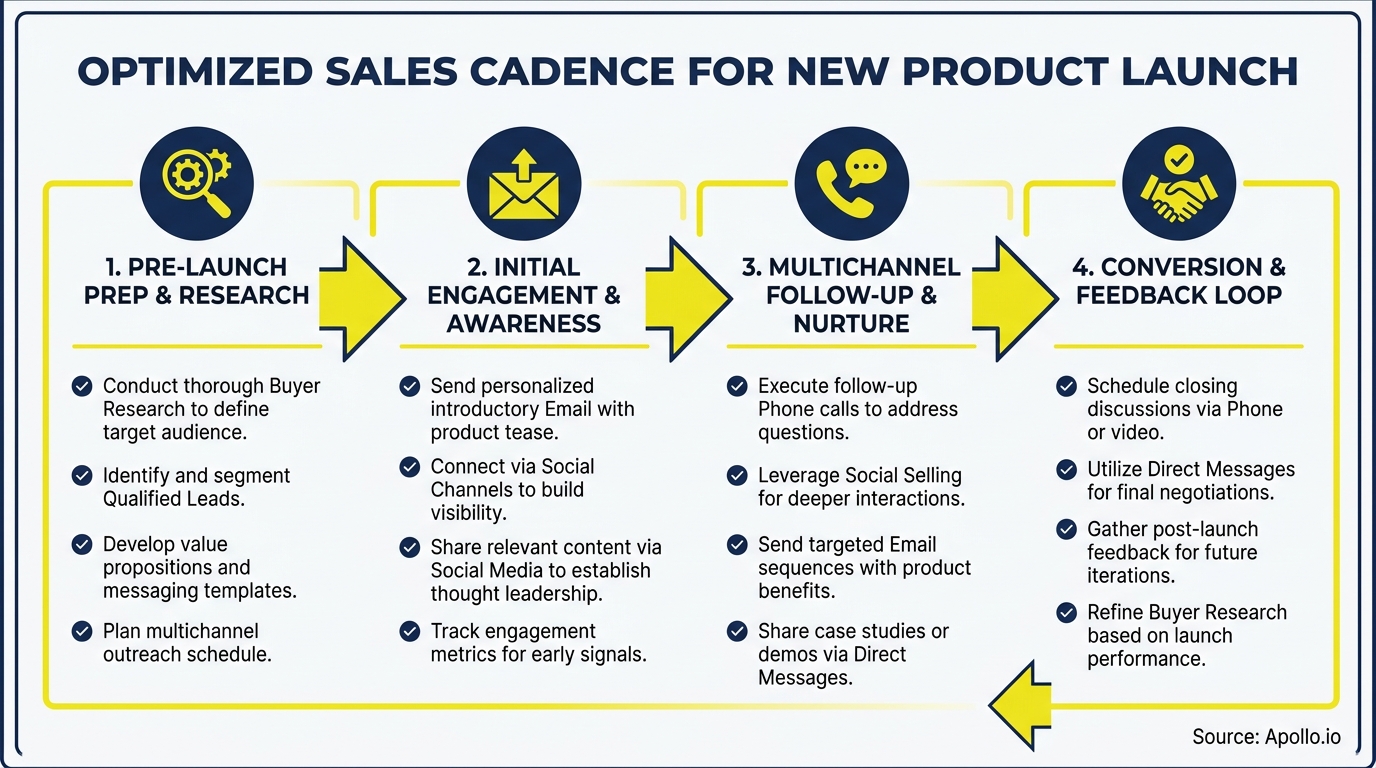
A product launch sales cadence is a structured sequence of multi-channel touches, timed by buyer readiness stage, designed to move prospects from category awareness to sales conversation. It differs from a standard outbound cadence because the product is new, meaning buyers have no prior frame of reference, no peer reviews, and no internal champions yet.
According to Martal, effective B2B cadences typically include 8 to 12 touchpoints over 2 to 4 weeks. For a product launch, the full sequence should span longer, with lighter early-stage touches during pre-launch and more intensive outreach once buyer signals indicate active evaluation. The right structure depends on your deal complexity, ICP, and channel mix.
What Are the Three Phases of a Product Launch Cadence?
A product launch cadence runs across three phases, each with distinct goals, assets, and touch logic.
| Phase | Timing | Goal | Key Assets | Rep Role |
|---|---|---|---|---|
| Phase 1: Pre-Launch Education | 4–6 weeks before launch | Build category awareness; warm the market | Category POV, problem explainer, comparison content, beta invites | Social outreach, warm referrals, executive posts |
| Phase 2: In-Evaluation Multi-Threading | Launch week through week 4 | Engage buying committee; accelerate evaluation | Demo, ROI calculator, security docs, pilot plan, case studies | Persona-specific outreach, multi-threaded sequences |
| Phase 3: Sales-Ready Conversion | Week 4 onward, trigger-based | Convert engaged accounts to pipeline | Custom proposal, implementation roadmap, procurement checklist | AE-led discovery, executive alignment, procurement support |
Phase 1 is where most launch cadences fail. Research by 6sense found that 69% of the purchase process happens before buyers engage sellers, and 85% establish requirements before contacting sales. If reps lead with cold outreach before category education exists, they are interrupting buyers who have no context for the product.
How Should SDRs and AEs Structure Their Outreach Sequences?
SDRs and AEs need different cadence structures for a product launch because their roles in the buying process are distinct.
Data from MySalesCoach suggests cold outbound SDR cadences run 10 to 13 touchpoints over 21 to 27 days, while an AE hybrid cadence may work with 8 to 10 touchpoints over the same period. For a product launch, apply these benchmarks by phase:
- SDRs (Phase 1-2): Email introducing the problem the product solves (day 1), social connection request with a POV post (day 3), follow-up email with a comparison asset or early customer story (day 7), phone call with voicemail referencing the asset (day 10), breakup email with a clear opt-out (day 14–21).
- AEs (Phase 2-3): Personalized email referencing a specific signal (demo request, content download, event attendance), discovery call with a structured agenda, follow-up with a pilot proposal or ROI model, executive alignment email, procurement/legal enablement package.
Critically, Flowd reports that most replies in B2B outreach come on touches 4 to 7, not touch 1. SDRs who give up after two emails are abandoning pipeline at exactly the moment it was about to convert. Build in persistence, but make each touch deliver something new.
Struggling to build and automate these sequences? Apollo's multi-channel sales engagement platform lets SDRs and AEs run coordinated email, phone, and social sequences from one workspace, so nothing falls through the cracks during a launch.

How Do You Build a Buying Committee Cadence for a New Product?
A buying committee cadence maps each stakeholder persona to a distinct message track, proof asset, and trigger condition. Forrester's January 2026 buyer research reports that the typical B2B buying decision now involves 13 internal stakeholders and nine external influencers.
A single SDR sequence targeting one contact cannot move a decision that complex.
| Persona | Primary Concern | Best Proof Asset | Outreach Trigger |
|---|---|---|---|
| Economic Buyer (VP, CFO) | ROI, risk, budget justification | ROI model, board-ready summary | Champion engaged; deal stalled at approval |
| Technical Evaluator (IT, Security) | Integration, compliance, reliability | Security docs, API reference, SLA | Demo completed; technical review scheduled |
| End User (Sales, Ops) | Ease of use, time savings, adoption | Short product demo, peer review, trial access | Champion identified; pilot approved |
| Champion | Internal credibility, career risk | Implementation roadmap, case study | Initial interest shown; revisit if gone quiet |
| Procurement | Contract terms, vendor risk | Compliance checklist, reference customers | Verbal approval received; legal engaged |
McKinsey's May 2026 B2B Pulse confirms that B2B buyers now use an average of 10 channels across the purchase journey. A persona-mapped cadence must coordinate those channels consistently.
Each stakeholder should receive messaging that speaks directly to their concern, not a generic product pitch forwarded by the SDR who sourced the account.
See Apollo's sales cadence examples and best practices for templates you can adapt by persona and launch phase.
Turn Funnel Chaos Into Forecast Confidence
Pipeline forecasting a guessing game? Apollo surfaces in-market buyers before they stall, turning weak leads into real opportunities. Nearly 100K paying customers now forecast with confidence — not crossed fingers.
Schedule a Demo →What Relevance Rules and Opt-Out Logic Should Your Cadence Include?
Every launch cadence needs explicit rules for when to pause, when to break up, and how to let buyers opt out gracefully. Gartner's June 2025 sales survey found that 73% of B2B buyers actively avoid suppliers that send irrelevant outreach.
Volume without relevance does not just fail to convert. It destroys the relationship before it starts.
Build these rules into your cadence before launch:
- Pause triggers: Stop all outreach when a prospect requests more time, enters legal review, has a known internal freeze (budget cycle, reorg), or responds with a future date.
- Relevance rules:Each touch must introduce new information: a new proof asset, a new angle on their stated problem, a new stakeholder reference, or a relevant trigger (funding round, new hire, product announcement).
- Breakup email (touch 10-13):A direct, low-pressure note acknowledging the timing may not be right and offering a clear path to re-engage later. Example: "I don't want to keep filling your inbox if the timing isn't right. I'll close this out on my end. If [problem] becomes a priority, [product] will be here."
- Opt-out link: Every email should include an unsubscribe option. Buyers who opt out cleanly are less damaging to your domain reputation than buyers who mark you as spam.
What Sales-Marketing SLA Should Support Your Launch Cadence?
A sales-marketing SLA defines exactly when marketing passes a lead to sales, what happens if sales does not follow up in time, and when a lead gets recycled back to nurture. Without this, launch pipeline leaks at the handoff.
A Pipeline360 study found that 79% of teams with an agreed lead-management process are satisfied or very satisfied with lead quality, compared to only 41% without one.
Your launch SLA should define at minimum:
- Lead routing triggers: Which actions qualify a contact for SDR outreach (demo request, pricing page visit + email open, event attendance, content download + return visit).
- Response SLA: SDR follows up within a defined window of the trigger firing (commonly same business day for high-intent signals).
- No-response recycling: If SDR makes X attempts with no response in Y days, the contact returns to marketing nurture, not the discard pile.
- Pause rules: Marketing pauses all nurture emails when a contact is in active SDR outreach to avoid conflicting messages.
RevOps leaders find that documenting these rules in the CRM, not just in a slide deck, is what makes them stick. Pair this SLA with sales performance management practices to track whether reps are actually following the defined process during the launch period.
Need to identify and prioritize which accounts to route first? Search Apollo's 230M+ verified contacts with 65+ filters to build your launch target list by ICP fit, intent signal, and buying stage.
How Do You Measure and Optimize a Product Launch Cadence?
Measure your launch cadence at the phase level, not just at the deal level. Each phase has its own leading indicators that tell you whether the cadence is working before pipeline numbers catch up.
- Phase 1 metrics: Content engagement rate, social reach of launch posts, beta sign-up or waitlist conversion, inbound demo requests from targeted accounts.
- Phase 2 metrics: Meeting acceptance rate by persona, multi-thread rate per account (are you reaching more than one stakeholder?), pilot or trial conversion rate.
- Phase 3 metrics: Pipeline created per launch week, average deal size vs. forecast, sales cycle length vs. baseline.
Review cadence performance weekly during the first 30 days of launch. If touch 1 reply rates are low, the subject line or opening hook needs revision. If you are booking meetings but losing deals at proposal stage, the proof assets in Phase 3 need strengthening. For more on building sales productivity measurement into your launch process, use a consistent reporting cadence tied to your CRM data.

Build Your Launch Cadence in One Place
A product launch cadence works best when prospecting, sequencing, and pipeline tracking live in the same system. Fragmented tools create handoff gaps that cost pipeline at exactly the moment launch momentum is highest.
As Cyera's team put it, "Having everything in one system was a game changer."
Apollo consolidates your launch GTM motion into one workspace: verified contact data, multi-channel sequences, AI-assisted personalization, and deal tracking. Explore the full Apollo go-to-market platform to see how it supports every phase of a product launch, from pre-launch prospecting through post-launch pipeline conversion.
Ready to build your launch cadence? Schedule a Demo and see how Apollo's unified platform helps GTM teams launch faster and convert more pipeline from day one.
Prove Pipeline ROI Before Next Quarter
ROI pressure killing your tool adoption? Apollo delivers measurable pipeline impact from day one — no lengthy onboarding, no siloed knowledge. Leadium 3x'd their annual revenue. Start yours today.
Start Free with Apollo →Don't miss these
Sales
Inbound vs Outbound Marketing: Which Strategy Wins?
Sales
What Is a Sales Funnel? The Non-Linear Revenue Framework for 2026
Sales
What Is a Go-to-Market Strategy? The 2026 GTM Playbook
See Apollo in action
We'd love to show how Apollo can help you sell better.
By submitting this form, you will receive information, tips, and promotions from Apollo. To learn more, see our Privacy Statement.
4.7/5 based on 9,690 reviews
