
What Should SDR Teams Look for in an Outbound Sales Tool in 2026?
Picking the wrong outbound sales tool for a 5–10 person SDR team is expensive in ways beyond licensing fees. Reps toggle between disconnected apps, data goes stale, and sequences never reach the inbox.
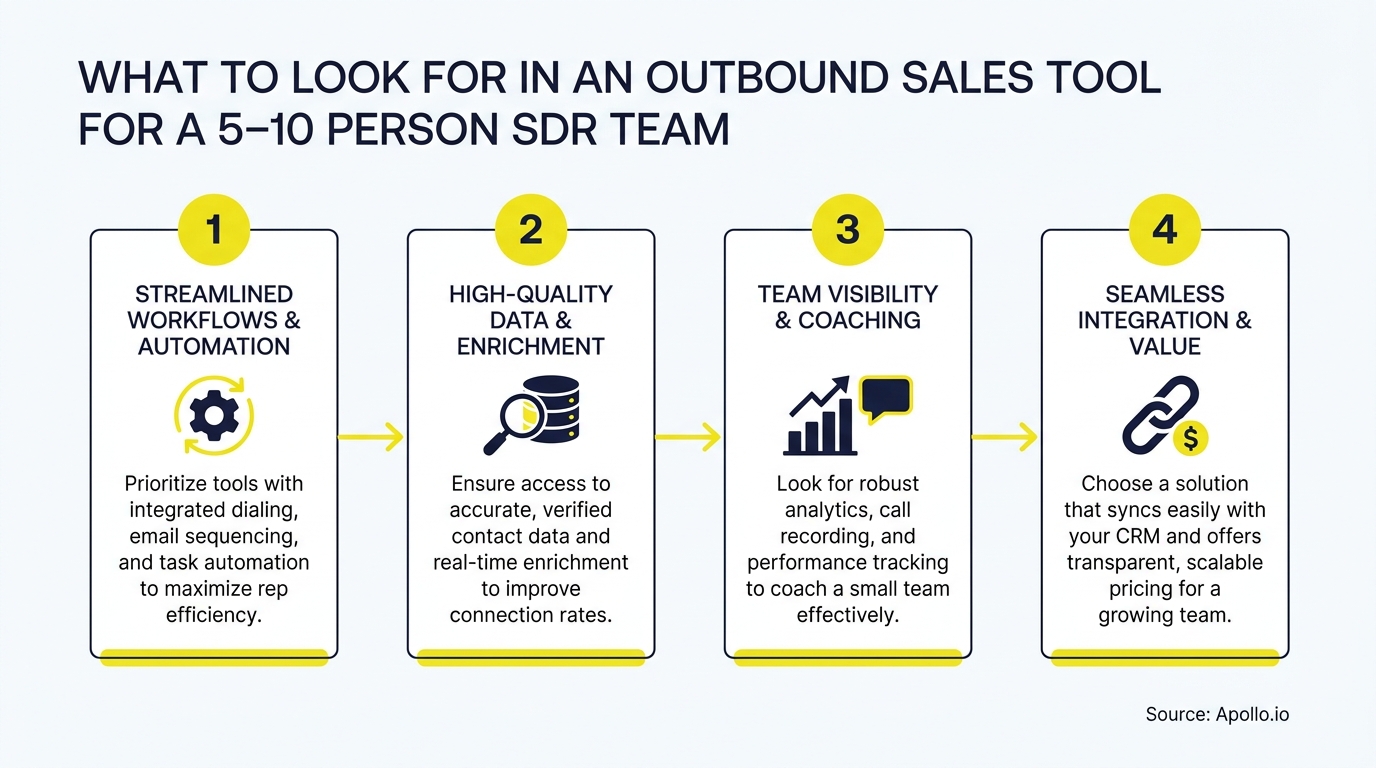
The right tool consolidates your workflow, keeps data clean, and lets SDRs focus on conversations instead of administration. Before you evaluate vendors, you need the right criteria.
This guide gives you a practical scorecard built for lean teams.
If you're building or upgrading your outbound motion, understanding the full SDR sales workflow is a useful starting point before evaluating tools.

Research Less, Close More With Apollo
Tired of your reps burning hours on manual lead research instead of selling? Apollo surfaces verified contacts instantly so your team spends time closing, not digging. Join 600K+ companies building pipeline faster.
Start Free with Apollo →Key Takeaways
- Consolidation beats feature-count: one platform covering data, sequencing, dialer, and analytics reduces adoption friction and admin overhead for small SDR teams.
- Data quality is a first-class evaluation criterion, not an afterthought. Poor contact data directly kills outbound performance.
- Deliverability controls (SPF/DKIM/DMARC alignment, throttling, reputation monitoring) are now table stakes, not premium add-ons.
- AI features are only valuable if they fit the workflow. Prioritize AI that handles research, personalization, and next-step suggestions inside your existing sequences.
- Buying committees now average 13 stakeholders, so your tool must support multi-threaded, account-based outreach, not just single-contact cadences.
Why Does Tool Consolidation Matter for a 5–10 Person SDR Team?
Tool consolidation matters because small SDR teams pay a disproportionate adoption tax when they run fragmented stacks. According to MarketBetter.ai's 2026 SDR Tech Stack Guide, the trend in 2026 is toward platforms that cover 3–4 categories rather than purchasing 8 separate tools. For a team of 5–10 reps, every additional tool means another login, another integration to maintain, and another failure point.
SDRs are not RevOps engineers. When the stack is fragmented, they spend time on data hygiene, context-switching, and manual CRM logging instead of prospecting. Building a sales tech stack that scales requires choosing platforms that bundle sequencing, contact data, dialer, and analytics in one workspace.
Predictable Revenue's team put it simply: "We reduced the complexity of three tools into one." Census echoed that: "We cut our costs in half." For a lean SDR team, consolidation is not a preference, it is a financial and operational requirement.
What Are the Core Criteria for Evaluating an Outbound Sales Tool?
The core criteria for evaluating an outbound sales tool fall into five categories: data quality, sequencing and deliverability, AI capability, account-based workflows, and admin simplicity.
| Criterion | What to Evaluate | Why It Matters for 5–10 SDR Teams |
|---|---|---|
| Data Quality | Email accuracy rate, contact enrichment, deduplication | Bad data wastes rep time and tanks deliverability |
| Sequencing + Deliverability | SPF/DKIM/DMARC support, throttling, spam-rate monitoring | Sequences only work if emails reach the inbox |
| AI Features | Research automation, personalization, next-step suggestions | AI augments per-rep output without adding headcount |
| Account-Based Workflows | Multi-threading, buying-group tracking, role-based messaging | Buying committees average 13 stakeholders per deal |
| Admin Simplicity | Onboarding time, CRM sync reliability, user permissions | Small teams have no dedicated RevOps to manage complexity |
Struggling to find the right contacts for your sequences? Search Apollo's 230M+ contacts with 65+ filters to build precise prospect lists in minutes.
Turn Funnel Chaos Into Predictable Pipeline
Tired of watching marketing leads stall before they ever reach your pipeline? Apollo surfaces high-intent prospects ready to convert — so your forecast is built on real signals, not guesswork. Join 600K+ companies closing with confidence.
Start Free with Apollo →How Should SDRs Evaluate Data Quality in an Outbound Tool?
SDRs should evaluate data quality by testing email accuracy, enrichment depth, and how the platform handles stale or duplicate records. Contact data is the fuel for outbound.
If it's bad, no amount of sequence optimization or AI personalization will produce results.
Key data questions to ask any vendor:
- What is the verified email accuracy rate, and how is it measured?
- Does the platform enrich records automatically, or does a rep trigger it manually?
- How does the tool handle duplicate contacts and data conflicts with your CRM?
- Can you filter prospects by firmographic, technographic, and intent signals in one place?
Apollo's database covers 230M+ people and 30M+ companies with 97% email accuracy. For sales intelligence tools, accuracy at scale separates platforms that generate pipeline from those that generate bounce notifications.

How Do SDRs Use AI Features Without Losing Control of Quality?
SDRs use AI features effectively by keeping humans in the loop on message approval while automating research and scheduling tasks. AI is now the most-adopted tool category in sales, but adoption only drives results when it fits the existing workflow rather than replacing judgment.
A study from Custom Market Insights found that AI SDR tools analyzing behavioral signals for high-intent prospects can drive a 20% increase in lead response rates. The practical application for a 5–10 person team: use AI to surface intent signals, draft first-pass personalization, and suggest follow-up timing, but keep a rep in review before anything sends.
Data from Digital Applied shows per-rep monthly outbound volume rose from a 1,150 human baseline to a 7,400 AI-augmented mean. That volume increase is only valuable if quality stays high. Governance matters: look for tools that provide approved message libraries, sequence-level approval flows, and audit trails before you scale AI outreach.
For a deeper look at which AI capabilities translate to real pipeline, see which AI sales tools actually close more deals.
What Multi-Threading and Account-Based Features Should the Tool Support?
An outbound tool for a 5–10 person SDR team should support contact-level sequencing within an account view, so reps can engage multiple stakeholders simultaneously without duplicating effort.
Forrester's State of Business Buying, 2024 found an average of 13 people involved in a buying decision and 89% of purchases involving 2 or more departments. Single-contact cadences are structurally mismatched to how buyers actually decide. Your tool needs to:
- Show all contacts at an account in one view
- Track which stakeholders have been contacted and at what stage
- Support role-based message variants (economic buyer vs. champion vs. end user)
- Flag when a contact at a target account triggers an intent signal
Sales performance management for SDR teams depends on account-level visibility, not just lead-level activity metrics. Managers need to see account coverage and multi-thread depth, not just emails sent.
How Do SDR Managers Evaluate Deliverability and Security Controls?
SDR managers should evaluate deliverability by confirming the platform supports SPF/DKIM/DMARC alignment, send throttling, bounce-rate monitoring, and compliant opt-out handling. Deliverability is the new sales ops compliance: sequences that land in spam produce no pipeline regardless of message quality.
Security is equally non-negotiable. For a 5–10 person team without a dedicated IT function, look for:
- SOC 2 Type II certification
- SSO (single sign-on) support
- User permission controls and audit logs
- Clear data retention and deletion policies
Spending hours on manual outreach while worrying about inbox placement? Automate your sequences with Apollo's multi-channel engagement platform, which includes built-in deliverability controls and analytics.
What Is the Right Way to Roll Out an Outbound Tool for a Small SDR Team?
The right rollout for a 5–10 person SDR team is phased: start with data and CRM integration in week one, run one sequence template in week two, then layer in AI and dialer features by week four.
Teams that adopt tooling with a structured onboarding plan see faster time-to-value and higher rep adoption. According to Smith Digital, teams using the right SDR toolset are 1.3 times more likely to drive revenue growth than those that haven't adopted structured tooling.
A practical 30-day rollout checklist:
- Week 1: Connect CRM, import contact lists, run a data quality audit (flag duplicates, missing fields, bounced emails)
- Week 2: Build one ICP-focused sequence, configure deliverability settings, train reps on the sequence builder
- Week 3: Activate dialer and call logging, set up account-based views for top target accounts
- Week 4: Enable AI research and personalization features, review sequence performance metrics, iterate on messaging
Cyera's team summarized the consolidation payoff: "Having everything in one system was a game changer." For SDR leaders building repeatable pipeline, that single-system approach is both the starting point and the ongoing standard. Explore outbound sales software that books more meetings to see how a unified platform compares to a fragmented stack.

Which Outbound Sales Tool Should a 5–10 Person SDR Team Use in 2026?
A 5–10 person SDR team should use a platform that combines verified contact data, multi-channel sequencing, a built-in dialer, AI research assistance, and CRM integration in one workspace. Apollo is built for exactly this use case, trusted by nearly 100K paying customers and recognized with the 2026 MarTech Breakthrough Award for Best AI-Powered Sales Solution.
Apollo gives SDR teams 230M+ verified contacts, 65+ search filters, AI-powered sequencing, an integrated dialer, meeting scheduling, and deal management, all without requiring a separate data vendor, a separate engagement tool, or a separate analytics platform. That consolidation is the answer to the tool-sprawl problem every growing SDR team faces.
For sales leaders managing quota pressure and team performance, Apollo for Sales Leaders provides the reporting, coaching tools, and pipeline visibility needed to scale a lean SDR team confidently.
Ready to consolidate your SDR stack and book more meetings? Schedule a Demo and see how Apollo replaces your fragmented tools with one unified outbound platform.
Prove Pipeline ROI From Day One
ROI pressure killing your next tool renewal? Apollo delivers measurable pipeline impact fast — so you walk into budget reviews with real numbers, not estimates. Leadium 3x'd annual revenue. You're next.
Start Free with Apollo →Don't miss these
Sales
Inbound vs Outbound Marketing: Which Strategy Wins?
Sales
What Is a Sales Funnel? The Non-Linear Revenue Framework for 2026
Sales
What Is a Go-to-Market Strategy? The 2026 GTM Playbook
See Apollo in action
We'd love to show how Apollo can help you sell better.
By submitting this form, you will receive information, tips, and promotions from Apollo. To learn more, see our Privacy Statement.
4.7/5 based on 9,690 reviews
