
What to Look for in an Outbound Platform for SDR and RevOps Teams
Most outbound platforms are built for either SDR execution or RevOps reporting. Few do both well. That gap creates a hidden tax: SDRs work from stale data, RevOps leaders can't trust the numbers, and leadership makes forecasting decisions on a foundation that was never designed to hold them. If you're evaluating platforms in 2026, the question isn't just "does it have sequences?" It's whether the platform creates a single source of truth that RevOps can govern and SDRs can actually execute from.

Research Less, Pipeline More With Apollo
Tired of hours lost verifying contact info before a single email goes out? Apollo delivers 97% accurate business contacts so your reps spend time selling, not searching. Join 600K+ companies building pipeline faster.
Start Free with Apollo →Key Takeaways
- The best outbound platforms unify SDR execution and RevOps reporting in one data layer, not two separate tools synced by integration.
- SDR productivity losses are primarily administrative, not effort-based. Platform design directly determines how much time reps spend selling.
- RevOps leaders need governance features (audit trails, field-level validation, dedupe rules) built into the platform, not bolted on later.
- AI capabilities are only as reliable as the data feeding them. Data health is a prerequisite for AI-driven outbound, not an afterthought.
- Stack consolidation reduces reporting fragmentation. Fewer tools means fewer data reconciliation problems and faster time to insight.
Why Do SDR Execution and RevOps Reporting Conflict?
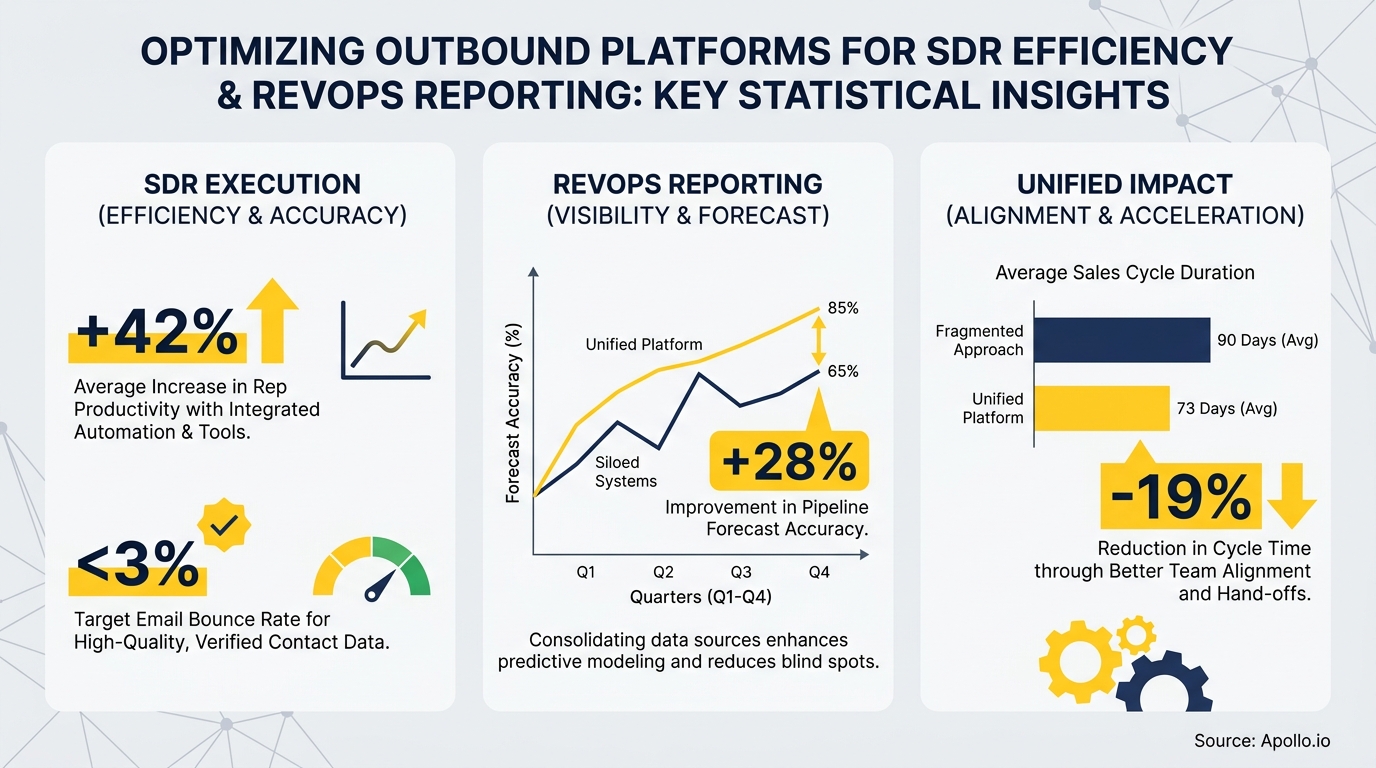
SDR execution and RevOps reporting conflict when they run on separate data models. SDRs log activity in one tool, CRM records live in another, and RevOps tries to reconcile both after the fact.
The result is attribution drift, duplicate records, and reports that no one fully trusts.
According to SalesS0, SDRs dedicate only 28-39% of their time to revenue-generating tasks, with administrative work consuming 41% of their day. A significant portion of that administrative burden comes from data hygiene tasks that a well-architected platform would handle automatically. When your outbound platform and your reporting layer aren't the same system, both teams pay a compounding cost.
The fix isn't better integrations. It's selecting a platform where execution data and reporting data share the same source record from the start. For a deeper look at how sales performance management ties execution to reporting outcomes, the principles apply directly here.
What SDR Execution Features Should You Require?
A platform built for SDR execution must reduce time-to-contact, eliminate manual research, and keep reps in a single workspace. Switching between tools for prospecting, sequencing, and logging kills momentum and inflates the administrative overhead cited above.
Struggling to keep SDRs focused on selling? Apollo's multi-channel sales engagement platform keeps prospecting, sequencing, and reporting in one workspace.
Non-negotiable SDR execution requirements:
- Verified contact data with 65+ filters: SDRs need to build precise lists without leaving the platform. Unverified contacts waste dials and damage deliverability.
- Multi-channel sequences: Email, phone, and social touchpoints managed from one interface, with automatic task creation and completion logging.
- AI-assisted personalization: Signal-driven outbound (job changes, funding events, intent signals) replaces batch-and-blast sequencing. Research by DevCommX shows win rates on deals from AI-initiated outreach are statistically comparable to human-initiated outreach.
- Automated activity logging: Every call, email, and reply should write back to the CRM without manual entry. If reps are logging manually, RevOps data is incomplete by default.
- Deliverability infrastructure: Domain warming, throttling, and bounce management must be platform-native, not outsourced to a third-party tool.
What RevOps Reporting Capabilities Are Non-Negotiable?
RevOps reporting requires governance infrastructure: consistent field definitions, audit trails, dedupe controls, and attribution logic that survives rep turnover and sequence changes. Without these, reporting is descriptive at best and misleading at worst.
Research from JohnnyGrow shows companies that align people, processes, and technology across sales and marketing teams see up to 36% more revenue growth and as much as 28% higher profitability. That alignment starts with shared data, not shared dashboards built on separate data sources.
RevOps leaders should require these platform capabilities:
| Capability | Why It Matters for RevOps |
|---|---|
| Field-level validation rules | Prevents incomplete records from entering the pipeline |
| Automated dedupe | Eliminates double-counting in pipeline and activity reports |
| Audit trails | Enables sequence-level attribution and change tracking |
| CRM sync with conflict resolution | Keeps outbound data and CRM records in agreement |
| Custom report builder | Supports investor-grade metrics with consistent definitions |
| Role-based access controls | Governs who can edit records and override fields |
Turn Funnel Chaos Into Predictable Revenue
Pipeline forecasting a guessing game? Apollo surfaces quality leads and tracks buyer signals so every deal stage is visible and every forecast is defensible. Nearly 100K paying customers stopped guessing and started closing.
Schedule a Demo →How Does Data Quality Affect Both SDR Output and RevOps Accuracy?
Data quality is the single variable that degrades both SDR execution and RevOps reporting simultaneously. Bad contact data wastes SDR dials.
Incomplete CRM records corrupt pipeline reports. Both problems originate at the same point: the moment a contact enters the system without validation.
Prioritize platforms with built-in continuous data enrichment that validates contacts at the point of prospecting, not retroactively. AI readiness depends on data health: agentic AI workflows that research, prioritize, and trigger outreach require clean inputs to produce reliable outputs. A platform that enriches contacts at import and re-validates on a defined cadence removes the data preparation burden from both SDRs and RevOps.
Evaluate platforms on these data health dimensions:

- Email verification rate: Target 95%+ verified deliverability on exported contacts.
- Mobile and direct-dial coverage: Critical for SDR call efficiency.
- Enrichment on CRM records: Existing records should auto-update when contact data changes.
- Duplicate detection at import: Prevents the problem rather than fixing it downstream.
How Can SDRs and RevOps Leaders Evaluate Platform Fit Together?
SDRs and RevOps leaders should evaluate outbound platforms jointly using a shared scorecard that weights both execution speed and reporting integrity. Siloed evaluations produce platforms that optimize for one team at the expense of the other.
For SDR teams running outbound prospecting at scale, the evaluation should include a live workflow test: build a list, enroll contacts in a sequence, complete tasks, and verify that all activity syncs to the CRM without manual steps. For RevOps, the test is attribution: can you trace a booked meeting back to a specific sequence step, rep action, and contact record with a full audit trail?
Shared evaluation criteria:
- Does sequence activity log automatically to CRM without manual entry?
- Can RevOps define custom fields that are required before a contact can be sequenced?
- Are pipeline reports built from the same data SDRs work from, or from a synced copy?
- Does the platform support workflow automation that triggers on CRM events (not just sequence events)?
- Can you see SDR activity, pipeline contribution, and sequence performance in one dashboard?
See how leading sales engagement platforms compare on these dimensions to calibrate your requirements against available options.
What Role Does Stack Consolidation Play in Platform Selection?
Stack consolidation directly reduces RevOps reporting fragmentation. Every additional tool in the GTM stack introduces a data reconciliation problem.
When outbound execution, CRM, and analytics run in separate systems, RevOps spends time reconciling rather than analyzing.
The trend is measurable: GTM teams are actively reducing tool count to improve data coherence. "We reduced the complexity of three tools into one," noted Collin Stewart of Predictable Revenue. "Having everything in one system was a game changer," echoed the team at Cyera. Consolidation isn't just a cost argument. It's a data integrity argument that RevOps leaders should lead. For context on how enterprise sales solutions are evolving toward unified GTM platforms, the consolidation pressure is accelerating across all company sizes.
When evaluating platform consolidation potential, ask:
- Does this platform replace a separate prospecting database, sequencing tool, and dialer?
- Does it include native workflow automation, or does automation require a third-party connection?
- Can RevOps build reports without exporting data to a separate BI tool?

Which Platform Brings SDR Execution and RevOps Reporting Together in 2026?
Apollo is the all-in-one GTM platform built to serve both SDR execution and RevOps reporting from a single data layer. With 230M+ verified contacts, 65+ prospecting filters, multi-channel sequencing, automated workflow execution, and native CRM sync, Apollo eliminates the gap between what SDRs do and what RevOps measures.
RevOps leaders get audit-ready reporting, field-level governance controls, and enrichment that keeps CRM data current. SDRs get verified contacts, AI-assisted personalization, and a workspace that handles logging automatically. "We cut our costs in half," said the team at Census, reflecting the consolidation value that comes from replacing multiple point solutions with one platform.
Apollo serves B2B GTM teams from startups through enterprise, including SDR/BDR teams, AEs, RevOps, and revenue leaders.
The platform won the 2026 MarTech Breakthrough Award for Best AI-Powered Sales Solution and is rated 4.7 out of 5 on G2, with nearly 100K paying customers trusting it for both execution and reporting.
Ready to unify your outbound execution and RevOps reporting? Request a Demo and see how Apollo consolidates your GTM stack into one source of truth.
Prove Pipeline ROI Before Next QBR
Budget approval stuck on unclear metrics? Apollo delivers measurable pipeline impact your leadership can't argue with. Leadium 3x'd annual revenue — see your ROI from day one.
Start Free with Apollo →Don't miss these
Sales
Inbound vs Outbound Marketing: Which Strategy Wins?
Sales
What Is a Sales Funnel? The Non-Linear Revenue Framework for 2026
Sales
What Is a Go-to-Market Strategy? The 2026 GTM Playbook
See Apollo in action
We'd love to show how Apollo can help you sell better.
By submitting this form, you will receive information, tips, and promotions from Apollo. To learn more, see our Privacy Statement.
4.7/5 based on 9,690 reviews
