
Key B2B Data Vendor Questions to Ask About Data Refresh Frequency
Asking a B2B data vendor "how often do you refresh your data?" is the wrong question. A vendor can truthfully answer "monthly" while re-verifying only 5% of records that month.
The right approach is a structured set of field-level, evidence-backed questions that expose what "refresh" actually means, which segments it covers, and how vendors prove it. For RevOps leaders and SDRs whose pipelines depend on accurate routing and deliverability, this distinction is the difference between a productive quarter and a wasted budget.
Before signing any data contract, use this framework to pressure-test every vendor claim. And if you want to see how a platform with continuous data enrichment and 97% email accuracy approaches verification, Apollo is worth benchmarking against.

Research Less, Pipeline More With Apollo
Tired of burning hours verifying contact info that goes nowhere? Apollo delivers 97% accurate business emails and phones so your reps spend time selling, not searching. Start building real pipeline today.
Start Free with Apollo →Key Takeaways
- B2B contact data decays rapidly each year, making refresh frequency a revenue-critical procurement requirement, not an ops footnote.
- "Refresh" means different things to different vendors. Demand field-level SLAs (email, title, phone) and segment-level breakdowns, not a single average cadence claim.
- Ask for auditable evidence: last-verified timestamps per field, re-verification methodology, and coverage reports showing what percentage of the database was checked each month.
- In an AI-driven GTM stack, stale data fed into scoring models, routing engines, and personalization workflows compounds errors at scale. AI readiness is now a refresh requirement.
- Suppression freshness matters as much as contact freshness. Ask how quickly opted-out records are removed and prevented from reappearing on the next ingest.
Why Does Data Refresh Frequency Matter So Much in 2026?
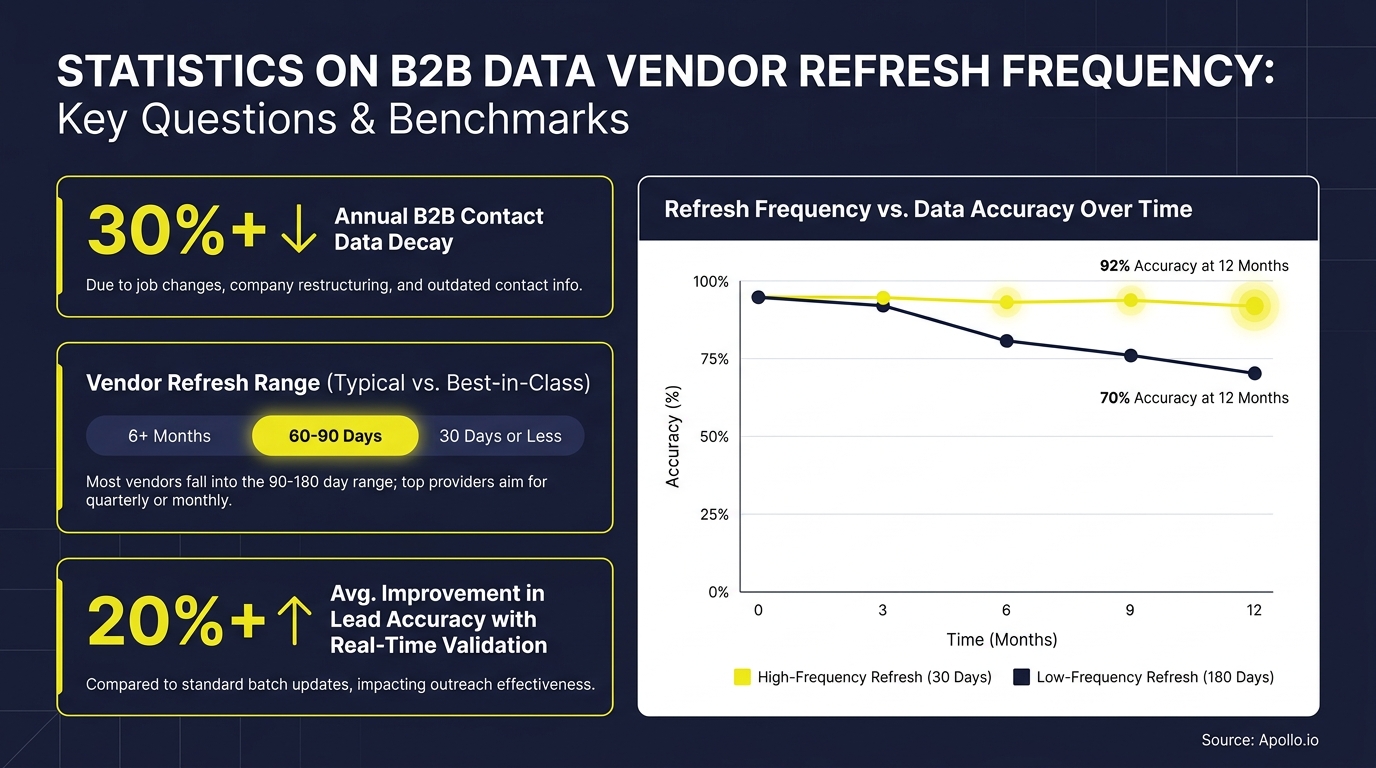
B2B contact data decays faster than most teams assume, turning stale records into a direct pipeline liability. Data from Landbase shows annual B2B data decay rates ranging between 22.5% and 70.3%, depending on segment and field type. More recent findings from RevenueBase indicate email decay reached 3.6% in a single month in November 2024, nearly doubling traditional monthly rates.
For SDRs running high-volume sequences, this decay translates directly into bounce rates, spam flags, and missed quota. For RevOps leaders building automated routing and scoring, stale records degrade model accuracy at the source.
As AI-powered GTM workflows become standard, the cost of feeding bad data into agents and personalization engines scales with usage, not just headcount.
What Is the Difference Between "Refresh" and "Re-Verification"?
"Refresh" often means ingesting new records or appending data from new sources. "Re-verification" means actively checking whether an existing record is still accurate. These are not the same thing, and most vendor claims conflate them.
When a vendor says they "refresh monthly," ask which process they mean:
- Ingestion: Adding net-new contacts to the database
- Deduplication: Merging duplicate records
- Validation: Checking format and syntax of existing fields
- Re-verification: Actively confirming a record's accuracy against live signals
According to ReadyContacts, the most reliable providers update their databases continuously rather than just quarterly or annually. Batch-refresh vendors may claim monthly cadence while only re-verifying a fraction of their database each cycle.
What Questions Should You Ask About Field-Level Refresh SLAs?
Field-level SLAs are the most important and least-asked questions in vendor evaluations. Different fields decay at different rates, and a single average cadence claim hides that variation.
| Field Type | Decay Risk | Questions to Ask |
|---|---|---|
| Business Email | High (job changes, domain changes) | What is your re-verification cadence per email record? Do you provide a "last verified at" timestamp per field? |
| Job Title | High (promotions, lateral moves) | How do you detect title changes? What signal sources trigger a title update? |
| Direct Phone | Medium-High | Are direct dials verified by human, automated calling, or third-party signal? What is your recheck frequency? |
| Company Firmographics | Medium (acquisitions, rebrands) | How quickly do you reflect M&A events? What is your SLA for updating company records post-acquisition? |
| Technographics / Intent | Medium (quarterly changes) | How frequently is intent signal re-scored? What is the lag between a market signal and a record update? |
Also ask for segment-level SLAs: does a "monthly refresh" apply equally to US records and EMEA records? Buyers are increasingly learning that cadence claims may apply only to priority geographies, leaving other segments on quarterly or ad-hoc schedules.
Turn Funnel Guesswork Into Real Pipeline
Pipeline forecasting a guessing game because leads stall before they ever reach your reps? Apollo surfaces in-market buyers the moment they're ready, turning weak top-of-funnel into real opportunities. Join 600K+ companies forecasting with confidence.
Start Free with Apollo →What Evidence Should a Vendor Provide to Prove Their Refresh Claims?
Auditable evidence separates credible vendors from marketing claims. Demand these specific artifacts before signing any contract.
- Last-verified timestamp per field: Each exported record should include a timestamp showing when that specific field was last confirmed accurate, not when the record was created or last touched.
- Coverage report: What percentage of the total database was re-verified in the last 30, 60, and 90 days? Ask for this as a downloadable report, not a verbal claim.
- Verification methodology disclosure: As Martech.org notes, this includes how vendors define and measure accuracy, the percentage of records verified, and the methods used, such as multiple touchpoints or real-time verification systems.
- Sample data audit: Request a sample of 500-1,000 records from your target segment with timestamps. Independently verify a subset before committing to a contract.
- SLA with remediation terms: If refresh SLAs are missed, what credits or remediation does the vendor provide? Vendors confident in their process will commit in writing.
Struggling with stale CRM data degrading your routing and scoring? See how Apollo's continuous data enrichment keeps your records accurate with verified business contacts across 230M+ people.

How Do RevOps Leaders Evaluate AI Readiness in Data Refresh?
RevOps leaders building AI-powered GTM stacks need vendors to meet a higher data freshness bar. When AI agents, lead scoring models, and automated routing consume vendor data, stale records do not just cause one bad email: they corrupt decisions at scale.
Key questions for AI-readiness evaluation:
- Automated CRM sync: Does the vendor push updates directly into your CRM or MAP when a record changes? What triggers an update, and can you control conflict resolution rules?
- Drift alerts: Does the platform notify you when a record's accuracy confidence drops below a threshold, or when a high-value account contact changes roles?
- API freshness: For teams pulling data via API into AI workflows, ask: what is the lag between a record being re-verified and that update being available via API?
- Confidence scoring: Does the vendor provide a confidence or freshness score per record or field, rather than a binary verified/unverified flag?
For teams using a structured data enrichment strategy, these questions determine whether your AI GTM infrastructure runs on reliable inputs or accumulates compounding errors over time.
What Suppression and Compliance Freshness Questions Should You Ask?
Suppression freshness is as operationally critical as contact freshness, and most teams forget to ask about it. Ask vendors these questions about removal and compliance workflows:
- How quickly do you suppress opted-out or deleted contact records after a removal request?
- What prevents a suppressed record from re-entering the database on the next data ingest or append cycle?
- Do you maintain a suppression list that persists across updates, or does suppression reset with each refresh batch?
- How do you handle records affected by state-level privacy regulations and data broker registration requirements?
These questions matter for deliverability and sender reputation as much as for compliance. Vendors who cannot answer them with specificity present operational risk beyond just data quality.
Your B2B Data Vendor Refresh Frequency RFP Checklist
Use this checklist in your next vendor evaluation or contract renewal to move from vague claims to contractual commitments.
- What is your re-verification cadence per field type (email, title, phone, firmographics)?
- Do you provide a "last verified at" timestamp at the field level in exports and via API?
- What percentage of your database is re-verified each month? Can you provide a coverage report?
- Is your refresh cadence consistent across geographies (US, EMEA, APAC) and company size segments?
- What verification methods do you use: automated signals, human verification, third-party confirmation, or a combination?
- Do you offer continuous enrichment with automated CRM sync, or batch delivery only?
- What are your SLA remediation terms if refresh commitments are not met?
- How do you handle suppression to prevent opted-out records from re-entering on the next ingest?
- Can we audit a sample dataset from our target segment before contract signing?
According to industry consensus on Quora, B2B prospect databases should ideally be refreshed every 3 to 6 months at minimum. Any vendor whose process does not meet that baseline for your core segments warrants close scrutiny before you sign.

Conclusion: Stop Accepting Vague Refresh Claims
"We refresh monthly" is not a data quality commitment. It is a marketing statement.
The questions above convert vague vendor claims into auditable, contractual standards that protect your pipeline, your AI workflows, and your sender reputation.
For SDRs, AEs, and RevOps leaders whose performance depends on accurate contact data, the right vendor evaluation framework is the difference between a database that compounds pipeline and one that compounds errors. Apollo maintains 97% email accuracy across 230M+ verified business contacts with continuous enrichment that keeps your CRM current, not just your first import. "Having everything in one system was a game changer," said Cyera's team after consolidating their GTM stack with Apollo.
Ready to benchmark your current vendor against a platform built for data freshness? Get Leads Now and see what verified, continuously enriched B2B data looks like in practice.
Prove Pipeline ROI Before Next QBR
ROI pressure killing your tool budget? Apollo delivers measurable pipeline impact fast — teams like Built-In saw +10% win rates and +10% ACV. Start your free trial and show leadership real numbers.
Start Your Free Trial →Don't miss these
Sales
Inbound vs Outbound Marketing: Which Strategy Wins?
Sales
What Is a Sales Funnel? The Non-Linear Revenue Framework for 2026
Sales
What Is a Go-to-Market Strategy? The 2026 GTM Playbook
See Apollo in action
We'd love to show how Apollo can help you sell better.
By submitting this form, you will receive information, tips, and promotions from Apollo. To learn more, see our Privacy Statement.
4.7/5 based on 9,690 reviews
