
What Is Inbound Sales? Definition, Strategy, and Best Practices
Modern buyers control the sales process. They research solutions independently, engage on their terms, and expect immediate value. B2B sales teams that wait for buyers to raise their hands win deals faster, close at higher rates, and build sustainable pipelines without burning through budgets on cold outreach that no one wants.

Apollo Finds Verified Contacts In Seconds
Tired of spending hours hunting for accurate contact info? Apollo delivers 224M+ verified contacts with 96% email accuracy. Join 550K+ companies who've eliminated manual research.
Start Free with Apollo →Key Takeaways
- Inbound sales responds to prospects who express interest first, creating warmer conversations and higher conversion rates
- AI tools help sales teams respond faster and personalize at scale, with sellers using AI being 3.7x more likely to hit quota
- Modern inbound blends self-service buyer journeys with strategic human touchpoints at critical decision moments
- Sales teams consolidating tools into unified platforms reduce costs and improve response times by eliminating data silos
- SDRs and AEs using inbound methodologies focus on qualification and value delivery rather than cold interruption
What Is Inbound Sales?
Inbound sales is a methodology where sales teams respond to prospects who have already shown interest in your product or service. Unlike outbound sales where reps initiate contact through cold calls or emails, inbound focuses on engaging buyers who downloaded content, visited your website, requested demos, or interacted with your brand.
The prospect raises their hand first, and your sales team provides value at each stage of their buying journey.
This approach aligns with how modern buyers prefer to purchase. Research by Gartner shows that 61% of B2B buyers prefer a rep-free buying experience, favoring self-service research over sales conversations. Inbound sales respects this preference by meeting buyers where they are, providing information when requested, and adding human expertise only when it creates value.
How Does Inbound Sales Work in 2026?
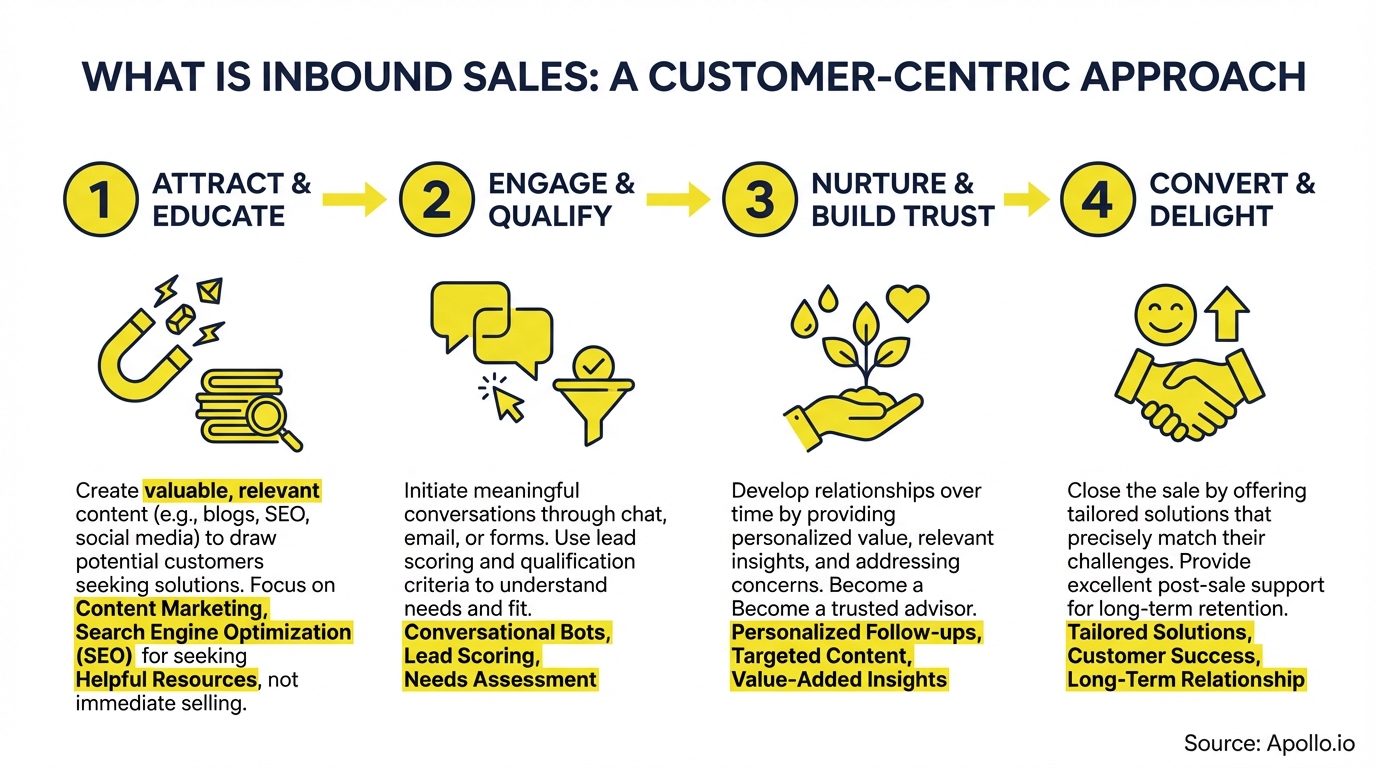
Inbound sales operates through four core stages: Attract, Convert, Close, and Delight. Marketing attracts prospects through content, SEO, and social channels.
Sales converts interested visitors into qualified leads through strategic conversations. Teams close deals by addressing specific buyer needs discovered during qualification.
Post-sale teams delight customers, turning them into advocates who generate referrals.
The 2026 inbound sales process integrates AI at every stage while maintaining human connection at decision points. Gartner research reveals that sellers who effectively partner with AI tools are 3.7 times more likely to meet their sales quotas. Modern inbound teams use AI for lead scoring, response automation, and research while reserving human interaction for consultative selling, negotiation, and relationship building.

| Stage | Activities | AI Role | Human Role |
|---|---|---|---|
| Attract | Content creation, SEO, social media | Content optimization, keyword research | Strategy, brand voice, thought leadership |
| Convert | Lead capture, qualification, nurturing | Lead scoring, automated responses, data enrichment | Discovery calls, needs assessment, personalization |
| Close | Proposals, negotiation, contracting | Pricing optimization, objection handling suggestions | Value articulation, custom solutions, relationship building |
| Delight | Onboarding, support, expansion | Usage monitoring, churn prediction, upsell identification | Strategic consulting, executive relationships, advocacy |
Need to respond faster to inbound leads? Automate your follow-up sequences with Apollo's multi-channel engagement platform.
See Every Deal Stage In Real Time With Apollo
Forecasting unreliable because pipeline data isn't up to date. Apollo gives you real-time visibility into every deal stage so you can predict revenue with confidence. Built-In boosted win rates 10% with Apollo's scoring.
Start Free with Apollo →Why Do SDRs and AEs Use Inbound Sales?
SDRs using inbound sales spend less time prospecting and more time having meaningful conversations with qualified buyers. Instead of making 100 cold calls to book one meeting, inbound SDRs engage prospects who already understand the problem your product solves.
This shift improves conversion rates, shortens sales cycles, and makes quota attainment more predictable.
Account Executives benefit from warmer handoffs and better-educated prospects. Inbound leads arrive with context about your solution, clearer pain points, and often budget approval already in progress. AEs can focus on consultative selling and solution design rather than basic education. Sales development teams report that inbound-qualified leads close at 2-3x the rate of cold outbound prospects.
For Sales Leaders, inbound creates more predictable revenue. When prospects initiate contact, attribution becomes clearer, pipeline forecasting improves, and CAC decreases. Data from Gitnux shows the average B2B SaaS CAC sits at $205, but companies with strong inbound engines often see 30-40% lower acquisition costs due to warmer lead sources and higher conversion rates.
What Are the Benefits of Inbound Sales?
Inbound sales delivers measurable advantages across cost, conversion, and customer quality:
- Higher conversion rates: Prospects who request information convert 5-10x more than cold outbound contacts
- Shorter sales cycles: Educated buyers move through sales funnels faster because they've self-qualified before engaging sales
- Lower customer acquisition costs: Marketing content works 24/7 to attract leads without per-contact costs
- Better customer fit: Self-selecting prospects align better with your ideal customer profile
- Improved sales team morale: Reps prefer consultative conversations over cold rejection
- Scalable growth: Content and SEO compound over time, creating sustainable lead generation
RevOps teams appreciate inbound sales because it generates cleaner data and clearer attribution. When prospects fill out forms, download resources, or request demos, every interaction creates trackable signals.
This visibility enables better forecasting, resource allocation, and performance analysis across the entire revenue organization.
How Do Sales Teams Implement Inbound Sales?
Successful inbound implementation requires alignment between marketing and sales, clear lead definitions, and technology that enables rapid response. Start by defining what constitutes a marketing-qualified lead (MQL) versus a sales-qualified lead (SQL).
Marketing generates MQLs through content and campaigns, while sales qualifies SQLs through discovery conversations.
Technology consolidation matters. Teams running separate tools for marketing automation, CRM, lead enrichment, and engagement create data silos that slow response times. Modern sales tech stacks unify prospecting, engagement, and pipeline management in single platforms. As one customer noted, "Having everything in one system was a game changer" (Cyera). Struggling to manage leads across multiple tools? Build your entire pipeline in Apollo's unified workspace.
Speed matters more than perfection. Research shows that responding to inbound leads within 5 minutes increases conversion by 400% compared to 30-minute response times. Set up automated acknowledgment emails, route leads to available reps instantly, and use AI-powered sales automation to handle initial qualification before human handoff.
What Challenges Does Inbound Sales Face?
Inbound sales creates new operational challenges that teams must address. Lead volume fluctuates based on marketing performance, making capacity planning difficult. High-intent leads require immediate response, but sales teams can't staff for peak demand 24/7. AI-powered routing and automated qualification help balance load, but 74% of B2B buyer teams still experience unhealthy conflict during decision processes, requiring skilled human intervention.
Lead quality varies significantly. Not every download or demo request represents a qualified buyer. Sales teams waste time on tire-kickers, students, and competitors if marketing doesn't implement proper qualification gates. Clear MQL definitions, progressive profiling, and intent data integration help filter noise, but revenue operations must continuously tune scoring models based on closed-won data.
The long-term challenge involves balancing automation with personalization. While Gartner predicts that by 2030, 75% of B2B buyers will prefer sales experiences prioritizing human interaction over AI, current buyers want instant responses. The solution combines AI-powered speed for routine interactions with human expertise for complex decisions, consultative guidance, and relationship building.
Start Building Your Inbound Sales Engine
Inbound sales transforms how revenue teams engage buyers by respecting modern purchasing preferences, leveraging AI for efficiency, and reserving human expertise for high-value interactions. Teams that master inbound methodology see higher conversion rates, lower acquisition costs, and more predictable revenue growth.
The key lies in aligning marketing and sales, consolidating technology platforms, and balancing automation with authentic human connection.

Success requires both strategic planning and operational execution. Define clear lead qualification criteria, implement rapid response protocols, and continuously optimize based on conversion data.
SDRs, AEs, and RevOps leaders must collaborate on shared definitions, unified workflows, and transparent metrics. The result is a sustainable growth engine that compounds over time as content attracts more qualified prospects and refined processes convert them efficiently.
Ready to build your inbound sales engine? Start free with Apollo to access 224M+ verified contacts, AI-powered engagement sequences, and unified pipeline management that eliminates tool sprawl and accelerates your inbound motion.
Prove Apollo's ROI In Your First 30 Days
Budget approvals stuck on unclear metrics? Apollo tracks every touchpoint from first contact to closed deal so you can show leadership exactly what's working. Built-In increased win rates 10% with Apollo's scoring.
Start Free with Apollo →Don't miss these
Sales
Inbound vs Outbound Marketing: Which Strategy Wins?
Sales
What Is a Sales Funnel? The Non-Linear Revenue Framework for 2026
Sales
What Is a Go-to-Market Strategy? The 2026 GTM Playbook
See Apollo in action
We'd love to show how Apollo can help you sell better.
By submitting this form, you will receive information, tips, and promotions from Apollo. To learn more, see our Privacy Statement.
4.7/5 based on 9,690 reviews
