
What Is a Sales Cycle? Definition, Stages, and Best Practices
The sales cycle is the complete journey from first contact with a prospect to closed deal. In 2026, this journey looks radically different from traditional linear models. According to Gartner, 65% of B2B sales organizations have transitioned from intuition-based to data-driven decision making, fundamentally reshaping how teams move prospects through each stage. Modern sales cycles blend human expertise with digital touchpoints, creating hybrid experiences that buyers now expect.
Understanding your sales cycle is no longer optional for hitting quota. For SDRs, BDRs, and Account Executives, mastering each stage means shorter cycles, higher win rates, and predictable revenue. This guide covers the modern B2B sales cycle, backed by research and practical frameworks you can implement today.

Scale Your Team Without The Growing Pains
Struggling with inconsistent processes as your sales team grows? Apollo standardizes workflows and automates lead research so every rep performs like your top closer. Join 550K+ companies scaling smarter.
Start Free with Apollo →Key Takeaways
- A sales cycle is the repeatable process from prospect identification to closed deal, typically spanning 7 distinct stages in 2026
- Data-driven sales cycles close 30% faster than intuition-based approaches, with AI tools accelerating prospecting and follow-up
- Hybrid selling (human + digital) is now the dominant model, with 80% of B2B interactions occurring in digital channels
- SDRs and AEs who track cycle metrics by stage identify bottlenecks early and course-correct faster
- Modern platforms consolidate prospecting, engagement, and pipeline tracking into one workspace, cutting tech stack costs significantly
What Is a Sales Cycle?
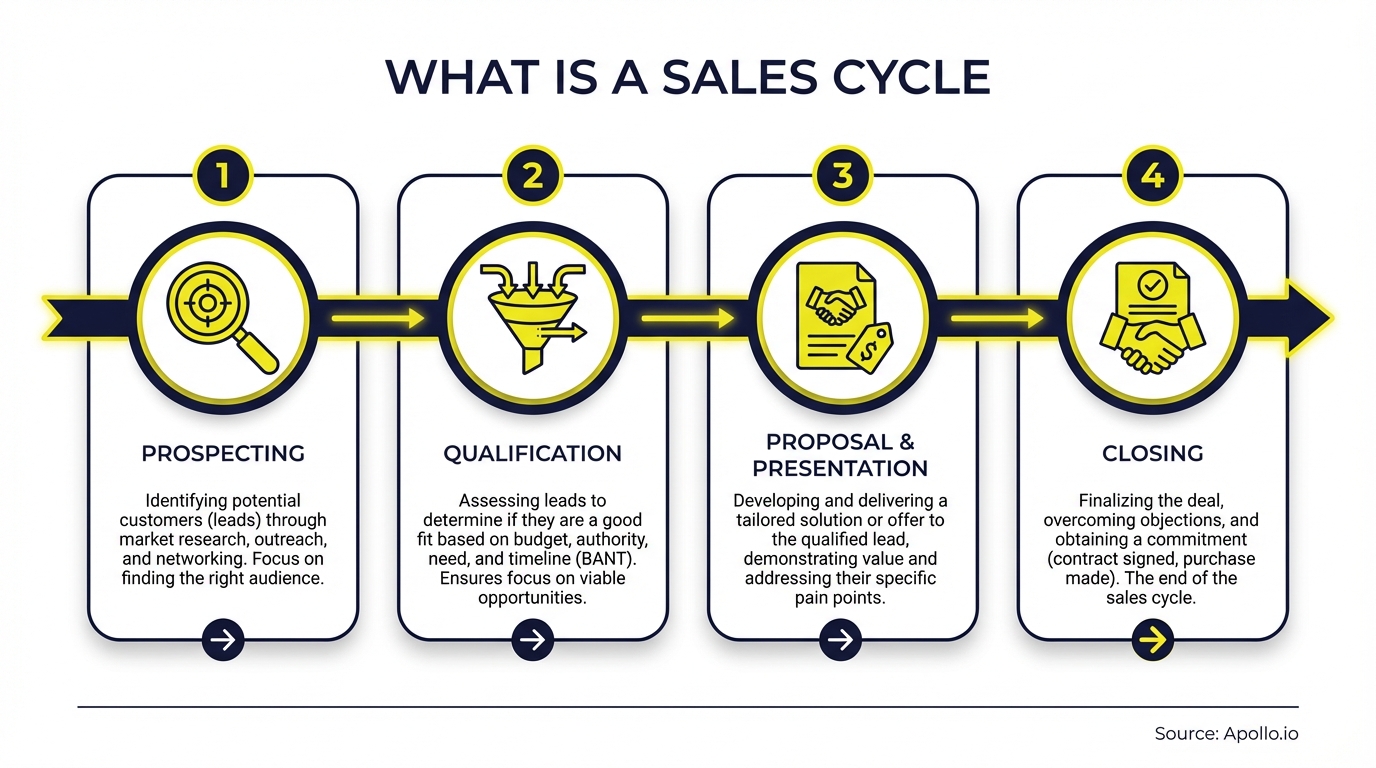
A sales cycle is the structured, repeatable series of steps a sales team follows to convert a prospect into a paying customer. It starts when you identify a potential buyer and ends when they sign the contract (or decide not to buy). Unlike a sales funnel, which visualizes volume at each stage, the sales cycle focuses on the actions reps take to move deals forward.
In 2026, sales cycles are data-driven and hybrid. Research by Gartner shows that 80% of B2B sales interactions now occur in digital channels, blending automated outreach with human conversations. For Account Executives managing complex deals, this means tracking digital engagement signals alongside traditional pipeline metrics.
What Are the 7 Stages of a Sales Cycle?
Modern sales cycles follow seven core stages, each requiring specific actions and metrics. Here's the 2026 framework used by high-performing teams:
| Stage | Key Actions | Success Metrics |
|---|---|---|
| 1. Prospecting | Identify ideal accounts, build target lists, gather contact data | Qualified prospects added, list accuracy rate |
| 2. Initial Contact | Cold outreach via email, LinkedIn, calls; book discovery meetings | Response rate, meeting booking rate |
| 3. Qualification | Run discovery calls, assess fit using BANT or MEDDIC frameworks | Qualification rate, time to qualify |
| 4. Needs Analysis | Deep-dive demos, map pain points to solutions, involve stakeholders | Demo completion rate, stakeholder engagement |
| 5. Proposal | Deliver customized proposals, pricing, ROI calculations | Proposal-to-close rate, negotiation cycles |
| 6. Negotiation | Address objections, finalize terms, align on contract details | Discount rate, legal review time |
| 7. Close | Sign contracts, process payments, hand off to customer success | Win rate, deal velocity, average contract value |
For SDRs focused on stages 1-3, speed matters. Teams using strategic sales development processes cut prospecting time by 40% with verified contact data and automated sequences.
How Do SDRs Shorten the Prospecting Stage?
SDRs shorten prospecting by using verified B2B databases with advanced filters to build targeted lists in minutes instead of hours. In 2026, top-performing SDRs leverage AI-powered search tools that surface ideal prospects based on firmographics, technographics, and intent signals.
This eliminates manual research and ensures every outreach touches a qualified contact.
Struggling to find qualified leads fast? Search Apollo's 224M+ contacts with 65+ filters to build targeted lists in seconds.
Turn Forecast Chaos Into Revenue Certainty
Pipeline forecasting a guessing game? Apollo tracks every deal stage in real-time so you predict revenue with confidence. Built-In increased win rates 10% with Apollo's visibility.
Start Free with Apollo →Why Does Sales Cycle Length Matter?
Sales cycle length directly impacts revenue predictability and team capacity. Shorter cycles mean reps close more deals per quarter, increasing quota attainment and commission earnings.
For Sales Leaders, cycle length is a leading indicator of process efficiency and competitive positioning.
In 2026, average B2B sales cycles range from 30 days (SMB) to 180+ days (enterprise). According to Gartner, 74% of B2B buyer teams experience unhealthy conflict during the decision process, which extends cycles by 20-30%. RevOps teams combat this by mapping stakeholder dynamics early and coaching AEs on consensus-building techniques.
What Factors Impact Sales Cycle Length?
- Deal Size: Larger contracts require more approvals and legal review, extending timelines
- Buyer Complexity: Multiple decision-makers slow consensus and increase back-and-forth
- Product Complexity: Technical solutions need longer evaluation periods and proof-of-concept phases
- Sales Process Maturity: Data-driven teams with defined playbooks close 25-30% faster than ad-hoc approaches
- Market Conditions: Budget freezes, economic uncertainty, and competitive pressure all affect timing
How Do Account Executives Track Sales Cycle Performance?
Account Executives track sales cycle performance using stage-by-stage conversion rates, velocity metrics, and win/loss analysis. Modern AEs monitor average time in each stage, identifying where deals stall.
For example, if prospects consistently get stuck in the proposal stage for 3+ weeks, it signals pricing objections or unclear ROI messaging.

Top AEs use deal management platforms to visualize pipeline health and forecast accurately. They track:
- Stage Duration: Days spent in each phase vs. benchmark averages
- Conversion Rates: Percentage of deals advancing from one stage to the next
- Deal Velocity: Speed from opportunity creation to closed-won
- Activity Metrics: Calls, emails, meetings per stage correlated with win rates
For Revenue Operations teams, this data feeds into forecasting models and territory planning. Founders building outbound motions use cycle metrics to calculate CAC payback periods and set realistic growth targets.
What Role Does Technology Play in Modern Sales Cycles?
Technology accelerates every stage of the sales cycle through automation, intelligence, and integration. In 2026, sales teams operate in unified platforms that combine prospecting, engagement, and pipeline management.
This consolidation cuts costs and eliminates data silos that slow deals.
Modern sales tech stacks include:
- Prospecting Tools: B2B databases with verified contacts and advanced filtering
- Engagement Platforms: Multi-channel sequences (email, LinkedIn, calls) with AI-powered personalization
- Conversation Intelligence: Call recording, transcription, and AI-generated next steps
- Deal Management: Pipeline visibility, forecasting, and automated task management
- Analytics: Real-time dashboards tracking cycle metrics and rep performance
Teams using consolidated tech stacks report significant efficiency gains. As one customer noted, "We reduced the complexity of three tools into one" (Predictable Revenue). Another shared, "We cut our costs in half" (Census).

Can't see where deals are getting stuck? Get complete pipeline visibility with Apollo's deal tracking and stage-by-stage analytics.
How Is the Sales Cycle Evolving in 2026?
The 2026 sales cycle is hybrid, data-driven, and increasingly buyer-led. Gartner research shows that 61% of B2B buyers prefer a rep-free buying experience, pushing teams to offer self-service options alongside human touchpoints. This doesn't eliminate sales reps but rather shifts their role to high-value moments: discovery, negotiation, and relationship building.
Key trends reshaping sales cycles:
- AI-Powered Prospecting: Tools identify ideal prospects and surface intent signals automatically
- Digital-First Engagement: 80% of interactions happen in digital channels, requiring omnichannel strategies
- Self-Service Buying: Buyers research solutions independently, entering the cycle later with specific requirements
- Data-Driven Decisions: 65% of organizations now use data analytics to guide every stage of the cycle
- Human-AI Balance: By 2030, 75% of buyers will prefer experiences that blend AI efficiency with human expertise
For Sales Leaders, this means investing in platforms that support both automated workflows and personalized human interactions. AI-powered sales processes handle repetitive tasks while freeing reps to focus on relationship building and strategic problem-solving.
Conclusion: Mastering Your Sales Cycle in 2026
The sales cycle remains the foundation of predictable revenue, but the tactics for executing each stage have evolved dramatically. In 2026, winning teams combine data-driven insights with human expertise, operating in unified platforms that eliminate tech stack bloat.
They track metrics obsessively, identify bottlenecks early, and course-correct fast.
For SDRs, mastering prospecting and initial contact means hitting meeting quotas consistently. For Account Executives, understanding stage-by-stage conversion rates and deal velocity translates to faster closes and higher earnings.
For Sales Leaders and RevOps teams, optimizing the entire cycle drives forecasting accuracy and sustainable growth.
The future belongs to teams that blend AI automation with authentic human connection. Start by mapping your current cycle, measuring performance at each stage, and investing in tools that consolidate your workflow.
As Cyera's team noted, "Having everything in one system was a game changer."
Ready to streamline your sales cycle with data-driven insights and all-in-one workflow automation? Start Your Free Trial and discover how Apollo helps teams close deals faster with 224M+ verified contacts, AI-powered engagement, and complete pipeline visibility in one platform.
Prove Apollo's ROI In Your First 30 Days
Budget approval stuck on unclear metrics? Apollo tracks every dollar's impact—time saved, pipeline generated, deals closed. Built-In increased win rates 10% and ACV 10% with measurable Apollo insights.
Start Free with Apollo →Don't miss these
Sales
Inbound vs Outbound Marketing: Which Strategy Wins?
Sales
What Is a Sales Funnel? The Non-Linear Revenue Framework for 2026
Sales
What Is a Go-to-Market Strategy? The 2026 GTM Playbook
See Apollo in action
We'd love to show how Apollo can help you sell better.
By submitting this form, you will receive information, tips, and promotions from Apollo. To learn more, see our Privacy Statement.
4.7/5 based on 9,690 reviews
