
What Enrichment Fields Matter Most for Mid-Market B2B SDR Teams Building Prospect Lists?
Most SDR prospect lists fail before the first email sends. The culprit is rarely the wrong accounts — it's missing or stale enrichment fields that block personalization, break sequences, and waste quota capacity. According to Cleanlist, B2B data decays at 2.1% per month, meaning roughly 1 in 4 records become inaccurate within a year. For mid-market SDR teams building prospect lists that convert, knowing which fields to prioritize — and which to skip — is the difference between a productive quarter and a stalled pipeline.

Generic Outreach Killing Your Pipeline?
Tired of sending the same bland message to every prospect because your data is too thin to personalize? Apollo enriches every contact with firmographic and technographic context so your outreach actually lands. Join 600K+ companies turning richer data into more replies.
Start Free with Apollo →Key Takeaways
- A Minimum Viable Enrichment (MVE) set of 8-10 fields covers most mid-market SDR sequencing needs — more fields don't automatically mean better results.
- Firmographic and contact fields get you in the door; technographic and signal fields get you the meeting.
- Data freshness matters as much as completeness — stale titles and companies kill connect rates.
- Buying-group enrichment (mapping multiple stakeholders per account) is critical for mid-market deals with multiple decision-makers.
- Enrichment governance — refresh cadence, ownership, and validation rules — determines whether your data stays usable over time.
What Is a Minimum Viable Enrichment (MVE) Framework?
A Minimum Viable Enrichment (MVE) framework defines the smallest set of verified data fields an SDR needs to qualify a prospect, personalize outreach, and execute a sequence without manual research. Rather than enriching every possible attribute, MVE prioritizes fields by their direct impact on deliverability, personalization, and routing.
For mid-market B2B outbound, the MVE covers three layers:
- Identity fields: Verified work email, first name, last name, direct phone or mobile number
- Firmographic fields: Company name, industry vertical, employee count, annual revenue, HQ location
- Role fields: Job title, seniority level, department or function
According to DemandScience, firmographic data is crucial for ensuring sales teams focus on well-qualified leads and deliver relevant messages. Without these baseline fields, SDRs can't segment, route, or personalize at scale. Building a strong data enrichment strategy starts by locking in these MVE fields before layering advanced signals.
Which Enrichment Fields Should SDRs Prioritize in 2026?
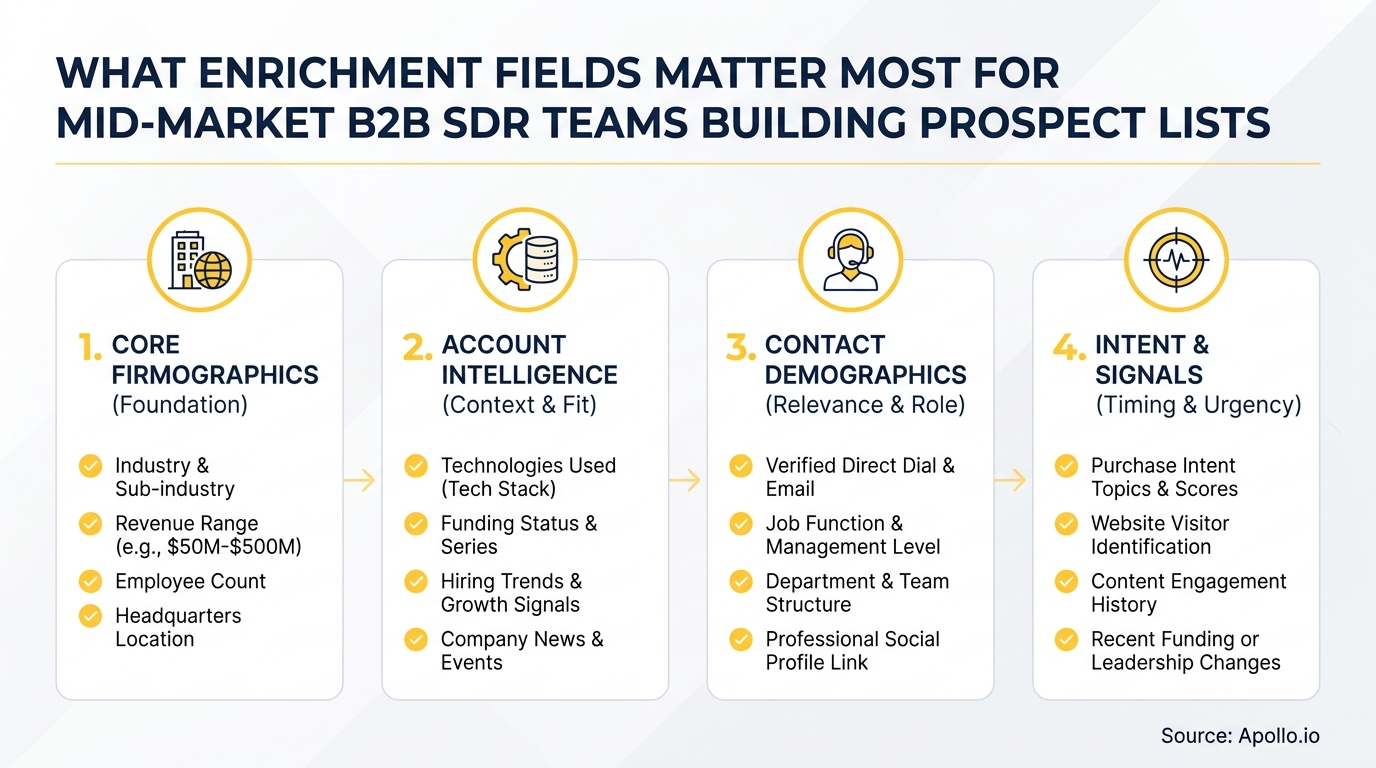
The highest-priority enrichment fields for mid-market SDR teams fall into four categories, ranked by their operational impact on list-building and outreach.
| Field Category | Key Fields | SDR Use Case |
|---|---|---|
| Contact Identity | Work email, direct phone, mobile | Deliverability, connect rates |
| Firmographic | Industry, revenue, employee count, HQ location | ICP qualification, territory routing |
| Technographic | CRM, MAP, data warehouse, security stack | Competitive displacement, stack-fit messaging |
| Signal / Timing | Job change date, hiring velocity, funding round, product launch | Trigger-based outreach, timing relevance |
Technographic fields have become a primary segmentation layer for mid-market outbound. Research from Landbase shows that 70% of companies consider technographic data crucial for their GTM strategies. For SDRs running competitive displacement or integration plays, knowing a prospect's installed CRM or data warehouse often matters more than their revenue band.
Struggling to find contacts with the right fields already populated? Search Apollo's 230M+ contacts with 65+ filters to build prospect lists pre-enriched with firmographic, technographic, and signal data.
Turn Funnel Guesswork Into Real Pipeline
Tired of watching marketing leads die before they ever reach your pipeline? Apollo surfaces high-fit prospects with verified contact data so every rep works a list worth calling. 600K+ companies stopped guessing and started closing.
Start Free with Apollo →How Do SDRs Use Technographic Fields to Personalize Outreach?
Technographic enrichment lets SDRs craft messages around a prospect's existing tech stack rather than sending generic value propositions. According to iTechSeries, Forrester research indicates that 75% of B2B customers expect personalized offerings based on their technology use.
A simple field-to-message mapping looks like this:
- CRM field (e.g., Salesforce): Reference native integration in opener — "We plug directly into your Salesforce workflow..."
- Data warehouse field (e.g., Snowflake): Lead with data-pipeline angle — "Teams on Snowflake use us to sync enriched contact records automatically..."
- Security/compliance stack: Address procurement friction proactively — "We're SOC 2 Type II certified, which tends to matter for teams already running [Tool]..."
SDRs who map enrichment fields directly to personalization tokens before building sequences spend less time manually researching each prospect and more time on high-volume, relevant outreach. This is a core practice in modern outbound prospecting.

Why Is Buying-Group Enrichment Critical for Mid-Market Accounts?
Buying-group enrichment means mapping multiple contacts per account across different roles — champion, economic buyer, technical evaluator, and legal or procurement — rather than targeting a single contact per company. Mid-market deals routinely involve 3-6 stakeholders, and single-threaded outreach leaves SDRs exposed when one contact goes dark.
Fields required for effective buying-group coverage:
- Department / function: Identify Finance, IT, Security, and Operations alongside primary buyer
- Seniority level: Map VP and Director contacts alongside individual contributors
- Reporting structure hints: Title hierarchy signals (e.g., "Head of" vs. "Senior Manager") clarify decision authority
- Account-level relationship tags: Track which contacts are already sequenced or responded
For RevOps leaders, buying-group fields also feed accurate pipeline attribution. Without them, deal progression data is incomplete and handoffs between SDRs and AEs lose context. Pairing buying-group enrichment with B2B data enrichment for smarter routing ensures every stakeholder gets the right message at the right time.
How Should SDRs Govern and Refresh Enrichment Data?
Enrichment governance means defining who owns data quality, how often records refresh, and what validation rules prevent bad data from entering sequences. Without governance, enrichment investments decay quickly — and data that was accurate at import becomes a liability within months.
A practical governance cadence for mid-market SDR teams:
- Monthly: Re-verify email validity status and flag job-change signals for top-priority accounts
- Quarterly: Audit firmographic accuracy (revenue, headcount) against current company data; deduplicate records
- On trigger: Auto-refresh records when a job-change, funding event, or hiring spike is detected
- At sequence entry: Validate required MVE fields are populated before a contact enters any active sequence
Waterfall enrichment — chaining multiple data providers to fill gaps left by a single source — has become standard operating procedure for teams serious about coverage. Apollo's waterfall enrichment pulls from multiple verified sources automatically, reducing the manual work of managing provider-by-provider lookups.
Ownership matters too. RevOps should own field definitions and validation rules.
SDR managers own sequence-entry quality gates. Data vendors are accountable for source attribution and refresh frequency documentation.
What Enrichment Fields Support Signal-Based and AI-Ready Outreach?
Signal-based targeting shifts the question from "who fits our ICP" to "who fits our ICP and is moving right now." The enrichment fields that power this shift are timing and intent signals layered on top of the MVE baseline.
Key signal fields for 2026 outbound:
- Job change date: New executives in relevant roles are high-intent prospects within the first 90 days
- Hiring velocity: Rapid headcount growth in target departments signals budget and expansion
- Funding round and date: Post-funding windows create buying urgency across categories
- Last verified date: Field-level metadata that tells SDRs how fresh each data point is
- Opt-out / suppression flags: Compliance fields that protect deliverability and reduce legal risk
These fields also determine AI-readiness. Automated sequences, AI-written openers, and predictive scoring all depend on structured, validated inputs. Poorly normalized fields — inconsistent industry codes, missing seniority tags, mixed-format revenue figures — degrade AI output quality before a single message sends. Explore how AI and automation tools use enriched data to accelerate prospecting at scale.

Start Building Smarter Prospect Lists Today
The SDR teams that consistently hit quota in 2026 are not the ones with the largest contact databases — they are the ones with the most complete, fresh, and actionable enrichment fields powering every sequence. Prioritize your MVE baseline first, layer technographic and signal fields next, and put governance in place to keep data accurate over time.
Apollo gives SDR teams, RevOps leaders, and AEs a unified platform to prospect, enrich, and engage without stitching together multiple tools. "Having everything in one system was a game changer," noted the team at Cyera. Trusted by nearly 100K paying customers including Anthropic, Smartling, and Redis, Apollo consolidates your sales tech stack into one workspace.
Request a Demo and see how Apollo's 230M+ verified contacts and 65+ enrichment filters help your SDR team build prospect lists that actually convert.
Prove Pipeline ROI With Apollo
Budget approval stuck on unclear metrics? Apollo surfaces measurable pipeline impact so you can justify every dollar — fast. Teams like Leadium 3x'd their annual revenue after making the switch.
Start Free with Apollo →Don't miss these
Sales
Inbound vs Outbound Marketing: Which Strategy Wins?
Sales
What Is a Sales Funnel? The Non-Linear Revenue Framework for 2026
Sales
What Is a Go-to-Market Strategy? The 2026 GTM Playbook
See Apollo in action
We'd love to show how Apollo can help you sell better.
By submitting this form, you will receive information, tips, and promotions from Apollo. To learn more, see our Privacy Statement.
4.7/5 based on 9,690 reviews
