
What Does a Well-Structured SDR Commission Plan Look Like for a Mid-Market Outbound Team?
A well-structured SDR commission plan for a mid-market outbound team balances a salary-heavy pay mix with quality-gated variable pay tied to outcomes, not just activity. Getting this right matters more than ever: with quota attainment under persistent pressure, a poorly designed plan drives busywork, inflates pipeline with junk, and burns out your best reps. Understanding how SDR sales roles operate is the foundation before you touch a spreadsheet.
The 2026 shift in outbound is clear: pay for held meetings and accepted opportunities, not booked ones. Here is exactly how to build that plan.

Apollo Turns Hours of Research Into Minutes
Tired of your reps burning the day verifying emails and hunting down phone numbers? Apollo delivers 230M+ contacts with 97% email accuracy so your team sells instead of searches. Start hitting quota faster.
Start Free with Apollo →Key Takeaways
- Mid-market SDR plans should use a 65/35 or 70/30 base-to-variable split, with variable pay gated on meeting quality, not booking volume.
- OTE benchmarks for outbound SDRs targeting mid-market accounts typically fall between $70K and $110K, skewing higher for competitive markets.
- Paying on booked meetings alone incentivizes spam; structure payouts around AE-accepted opportunities and qualified pipeline created.
- Ramp guarantees, payout floors, and quarterly calibration reviews protect both reps and the business when attainment is uneven.
- Embedding qualification frameworks (MEDDPICC or SPICED) into your definition of a qualified meeting closes the loop between SDR behavior and downstream revenue.
What Are the Right OTE and Pay Mix Benchmarks for Mid-Market SDRs?
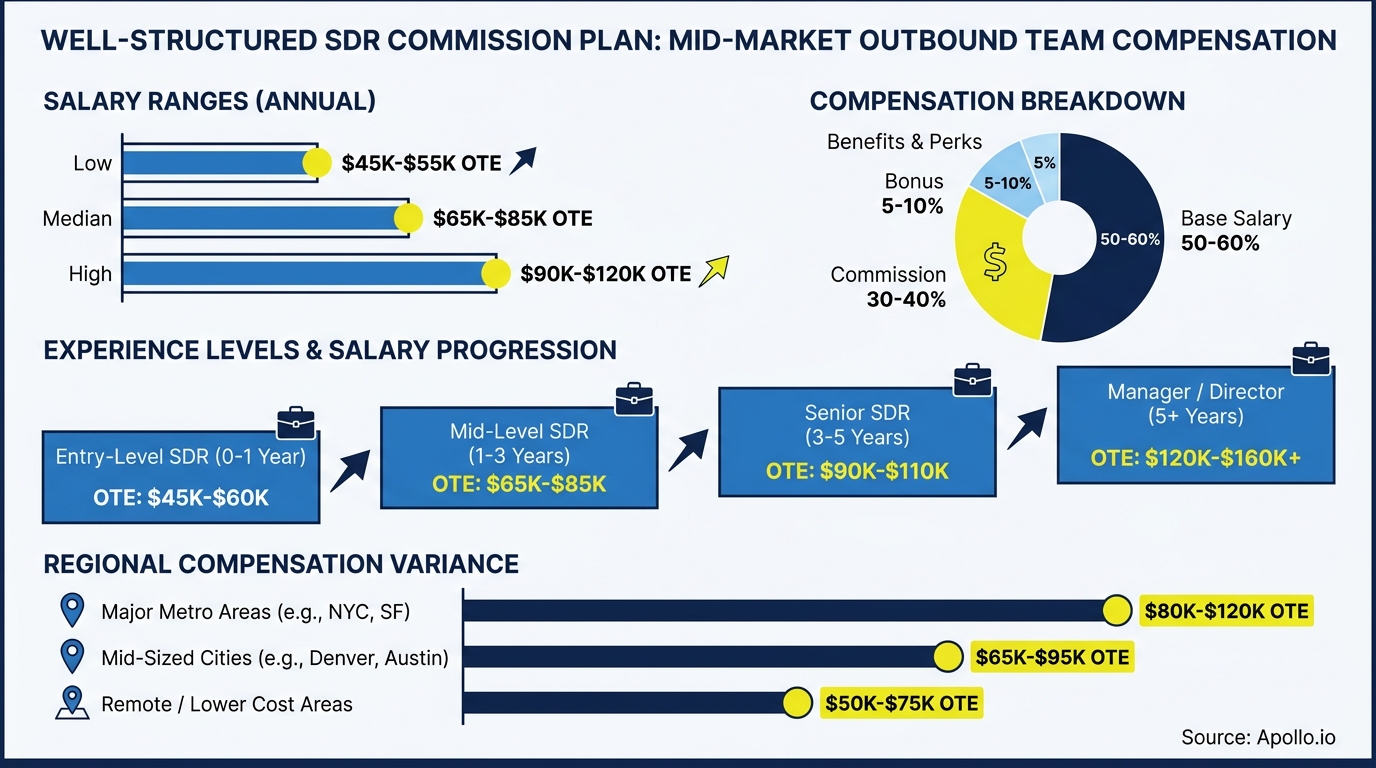
The standard mid-market outbound SDR pay mix sits at 65% base and 35% variable, with OTE ranging from $70K to $110K depending on market and deal complexity. According to Everstage, OTEs for SDRs generally fall in that $70K–$110K range, with 30–40% composed of variable compensation. For strong outbound performers in competitive markets, SaleSso reports compensation regularly hitting $70,000–$90,000, with top-tier talent exceeding $100,000.
As noted by RevEngine on Substack, SDR and BDR splits lean more heavily toward base salary than closing roles, typically landing around 60–70% base and 30–40% variable. Early-stage or less mature outbound motions often push further toward 70/30 for stability.
| Pay Mix | Best Fit | OTE Range |
|---|---|---|
| 70/30 (Base/Variable) | New SDR teams, early-stage ICP definition | $65K–$85K |
| 65/35 | Established mid-market outbound motion | $75K–$100K |
| 60/40 | Senior SDRs, high-volume pipeline targets | $90K–$115K |
How Should Mid-Market SDR Plans Define a Qualified Meeting?
A qualified meeting for mid-market outbound SDRs is one that is held, involves a decision-influencer at an account matching your ideal customer profile, and passes a documented qualification framework before the AE accepts it. Paying on booked meetings alone creates perverse incentives: SDRs fill calendars with unqualified contacts to hit numbers.
Outbound Kitchen identifies "Opportunities Created" as the most common and balanced SDR compensation metric, especially when data quality is variable and clear qualification criteria can be defined. Build your definition around these gates:
- Held: The meeting actually occurred (no show = no credit).
- ICP match: Company size, industry, and tech stack align with your defined profile.
- Decision-influencer present: At least one person with budget authority or buying influence attended.
- MEDDPICC/SPICED criteria met: Pain identified, metrics discussed, and next steps defined before AE handoff.
- AE-accepted: The receiving AE formally marks the opportunity as accepted in CRM within 48 hours.
Struggling to get SDRs targeting the right accounts in the first place? Search Apollo's 230M+ contacts with 65+ filters to build ICP-matched prospect lists that set your team up for qualified meetings from the start.
What Payout Structures Protect SDRs and the Business?
A sound payout structure for a mid-market SDR plan combines a per-opportunity flat rate, a ramp guarantee during onboarding, and an accelerator for overperformance. Bentega.io identifies a flat rate of $100–$200 per qualified meeting as one of the most common commission models. For pipeline-weighted plans, some teams also add a small percentage of sourced closed-won revenue (typically 1–2%) to create long-term alignment.
Key structural guardrails to include:
- Ramp guarantee: Pay 75–100% of target variable for months 1–3, regardless of quota attainment, so new hires aren't penalized for pipeline build time.
- Payout floor: Set a minimum threshold (e.g., 50% of quota) below which no variable is paid, preventing windfalls from lucky one-off months.
- Accelerator: At 100%+ attainment, increase per-opportunity payout by 1.25–1.5x to reward top performers without uncapped risk.
- Clawback window: If an accepted opportunity is disqualified within 30 days, recoup the payout or offset against the next period.
This structure connects directly to sales performance managementbest practices: build plans that are predictable for reps and defensible to finance.
How Do SDRs Align Comp Plans with AE Handoff and Pipeline Quality?
SDRs earn more when their pipeline converts, so handoff SLAs and AE collaboration mechanics belong inside the compensation design. A mid-market outbound plan should include defined handoff rules that both SDR and AE sign off on quarterly.
Recommended handoff SLA elements:
- SDR submits meeting summary with MEDDPICC/SPICED fields completed in CRM before the meeting occurs.
- AE reviews and accepts or rejects the opportunity within 48 hours with a documented reason.
- Dispute resolution: RevOps arbitrates any rejection within 5 business days.
- Monthly SDR/AE pipeline review to track accepted-to-closed conversion rates by SDR.
For teams operating in pods (SDR + AE + marketing support), consider adding a small team kicker: 5–10% of variable comp tied to the pod's collective pipeline target. This reduces gaming and encourages multi-threading, which is increasingly important as mid-market deals involve more buying-committee members. Learn more about building cross-functional teams that drive revenue outcomes.
Want to give SDRs real-time pipeline visibility so they can prioritize follow-through? Track and manage your outbound pipeline with Apollo to connect SDR activity directly to revenue outcomes.

What Governance Cadence Keeps an SDR Comp Plan Effective?
SDR comp plans require quarterly calibration, not annual set-and-forget. The core governance cadence for a mid-market outbound team should include these four touchpoints:
| Cadence | Action | Owner |
|---|---|---|
| Monthly | Review attainment distribution; flag floor/accelerator triggers | RevOps |
| Quarterly | Recalibrate quota, update qualification definitions, approve exceptions | Sales Leader + RevOps |
| Semi-annual | Benchmark OTE vs. market; adjust pay mix if needed | HR + Finance |
| Ad hoc | SPIFF design for strategic segments or intent-qualified accounts | Sales Leader |
SPIFFs work well for time-bound pushes: target a specific vertical, a new product line, or an intent-signal segment. Keep SPIFF duration to 30–60 days and tie the bonus to AE-accepted opportunities only, not bookings. This aligns with the sales acceleration framework of building repeatable, measurable incentive systems rather than one-time contests.
Turn Weak Funnels Into Quota Wins
Pipeline forecasting a guessing game because marketing leads never convert? Apollo surfaces high-intent prospects so your team works deals worth closing. Nearly 100K paying customers stopped guessing and started growing.
Start Free with Apollo →What Does a Sample Mid-Market SDR Commission Plan Look Like?
Below is a representative plan structure for a mid-market outbound SDR with a $90K OTE target. Numbers are illustrative and should be calibrated to your market and pipeline economics.
| Component | Detail |
|---|---|
| Base Salary | $58,500 (65% of OTE) |
| Variable Target | $31,500 (35% of OTE) |
| Primary Metric | AE-Accepted Opportunities (qualified per MEDDPICC gate) |
| Quota | X accepted opportunities per quarter (set so ~60–70% of reps can attain) |
| Base Payout Rate | Flat per accepted opportunity (variable ÷ quota) |
| Accelerator | 1.35x per opportunity above 100% quota |
| Ramp (Months 1–3) | 75% of variable guaranteed regardless of attainment |
| Clawback | Opportunity disqualified within 30 days = credit reversed next period |
| Team Kicker (optional) | 5% bonus if pod hits collective pipeline target |
For teams exploring revenue-based models, QuotaPath notes that SDR commission rates commonly fall between 2–5% when earning a percentage of closed-won revenue from sourced deals. This model works best when deal cycles are short enough for SDRs to see the connection between their work and the payout.
How Should RevOps Leaders Present This Plan to Finance?
RevOps leaders should present SDR comp plans to finance using a three-scenario model: low attainment (50% of reps at quota), target attainment (70% at quota), and high attainment (90% at quota). Show the total variable payout exposure at each scenario, including accelerator cost at the high end.
Key inputs for the finance presentation:
- Expected attainment distribution based on historical data or market benchmarks
- Pipeline coverage ratio: how much sourced pipeline is needed per $1 of closed revenue
- Cost per accepted opportunity vs. cost per closed deal (to show ROI of the SDR motion)
- Ramp cost in Q1 as a one-time investment, not ongoing overhead
This framing connects comp design directly to forecasting accuracy and revenue predictability, which finance teams respond to better than headcount-cost arguments alone.

Start Building a Pipeline Your SDR Plan Can Actually Reward
A well-structured SDR commission plan for a mid-market outbound team uses a 65/35 pay mix, gates variable pay on AE-accepted opportunities with documented qualification criteria, and governs the plan through quarterly calibration rather than annual updates. The quality-first model aligns SDR behavior with downstream revenue outcomes and protects both reps and the business when attainment is uneven.
The plan only works if SDRs have the tools to find and engage the right accounts efficiently. Apollo consolidates prospecting, outreach, and pipeline tracking into one unified platform, so your SDRs spend time on qualified conversations, not tool-switching. Start Prospecting with Apollo and give your SDR team the foundation to earn every accelerator on the plan.
Prove Pipeline ROI With Apollo
Budget approval stuck on unclear metrics? Apollo delivers measurable pipeline impact from day one — 46% more meetings with AI, real results leadership can't ignore. Nearly 100K paying customers closed the ROI gap fast.
Start Free with Apollo →Don't miss these
Sales
Inbound vs Outbound Marketing: Which Strategy Wins?
Sales
What Is a Sales Funnel? The Non-Linear Revenue Framework for 2026
Sales
What Is a Go-to-Market Strategy? The 2026 GTM Playbook
See Apollo in action
We'd love to show how Apollo can help you sell better.
By submitting this form, you will receive information, tips, and promotions from Apollo. To learn more, see our Privacy Statement.
4.7/5 based on 9,690 reviews
