
What Does a Clean CRM Data Strategy Look Like for Mid-Market Companies?
Your CRM holds 10,000+ contacts, but how many are actually usable? According to Digital Applied, dirty CRM data costs companies an estimated 12% of revenue annually. For a mid-market company, that's not a data problem — it's a revenue problem. A clean CRM data strategy fixes this with governance, enrichment, and continuous monitoring, not a one-time cleanup project.
If your team relies on Salesforce or HubSpot, the good news is that the right CRM integration strategy can automate most of the heavy lifting. But tooling alone won't save you without a structured approach to data quality.

Research Less, Close More With Apollo
Tired of burning hours verifying contact info that still bounces? Apollo delivers 97% email accuracy so your team spends time selling, not searching. Start building pipeline that actually converts.
Start Free with Apollo →Key Takeaways
- Dirty CRM data is a revenue problem, not just an ops problem — governance and ownership must come first.
- At 10,000+ contacts, data decay is continuous; manual quarterly cleanups can't keep pace.
- A clean CRM strategy covers four pillars: accuracy, completeness, deduplication, and freshness.
- AI-readiness requires governed, observable data — not just deduplicated records.
- RevOps and SDR teams see the biggest productivity gains when enrichment is automated and ongoing.
Why Does CRM Data Quality Matter So Much at 10,000+ Contacts?
At 10,000+ contacts, data decay compounds faster than most teams realize. Research from Cleanlist.ai shows B2B data decays at an average rate of 22.5% per year — meaning roughly 2,250 of your contacts go stale every 12 months. One analysis found that a 10,000-contact database with a 35% annual decay rate generates 116 hours of wasted selling time per rep per year, per this breakdown on Medium.
For SDRs and AEs, that waste translates directly to missed quota. For RevOps leaders, it means unreliable forecasts and broken automations.
The scale of 10,000+ contacts doesn't just amplify the problem — it makes manual fixes impossible without a repeatable system.
Tired of stale contacts killing pipeline? Keep your CRM fresh with Apollo's 230M+ verified business contacts.
What Are the Four Pillars of a Clean CRM Data Strategy?
A clean CRM data strategy for mid-market teams rests on four measurable pillars: accuracy, completeness, deduplication, and freshness. Each requires a defined KPI target, not just a vague goal.
| Pillar | Definition | Target KPI (Mid-Market) |
|---|---|---|
| Accuracy | Fields contain correct, verified values | >90% verified contacts |
| Completeness | Required fields are populated | >85% fill rate on critical fields |
| Deduplication | No duplicate records for same person or company | <2% duplicate rate |
| Freshness | Records enriched or validated within a defined window | 100% enriched within 90 days |
Nearly 25% of CRM administrators reported that less than half of their data is accurate and complete, according to Validity's State of CRM Data Management report. Setting explicit KPI thresholds — and measuring them monthly — is what separates teams that maintain clean data from those doing reactive cleanups every quarter.
Learn how data enrichment and cleansing work together to hit these targets systematically.

How Does Governance Work for a Mid-Market Data Team?
CRM data governance means assigning clear ownership for every data decision — not just deploying a deduplication tool. The most common failure point: nobody is accountable.
Without a named data owner, issues accumulate until they become revenue-impacting.
For a mid-market team with 1-2 ops admins, a lightweight RACI is enough:
- Responsible: RevOps admin — runs weekly data quality checks, resolves duplicates, enforces field standards.
- Accountable: VP of Sales or Revenue Leader — reviews monthly data health scorecard, approves policy changes.
- Consulted: SDR/BDR team leads — flag inaccurate records during prospecting, validate contact changes.
- Informed: Marketing ops — receives enrichment reports to ensure campaigns target accurate segments.
Governance also means defining SLAs: new contacts enriched within 48 hours, duplicates resolved within one business week, and a monthly data quality report shared with leadership. Without SLAs, clean data stays aspirational.
Turn Funnel Guesswork Into Real Pipeline
Tired of watching marketing leads stall before they ever reach your pipeline? Apollo surfaces high-intent prospects so your team works deals that actually close. 600K+ companies trust Apollo to forecast with confidence.
Start Free with Apollo →What Does the Data Workflow Look Like in Practice?
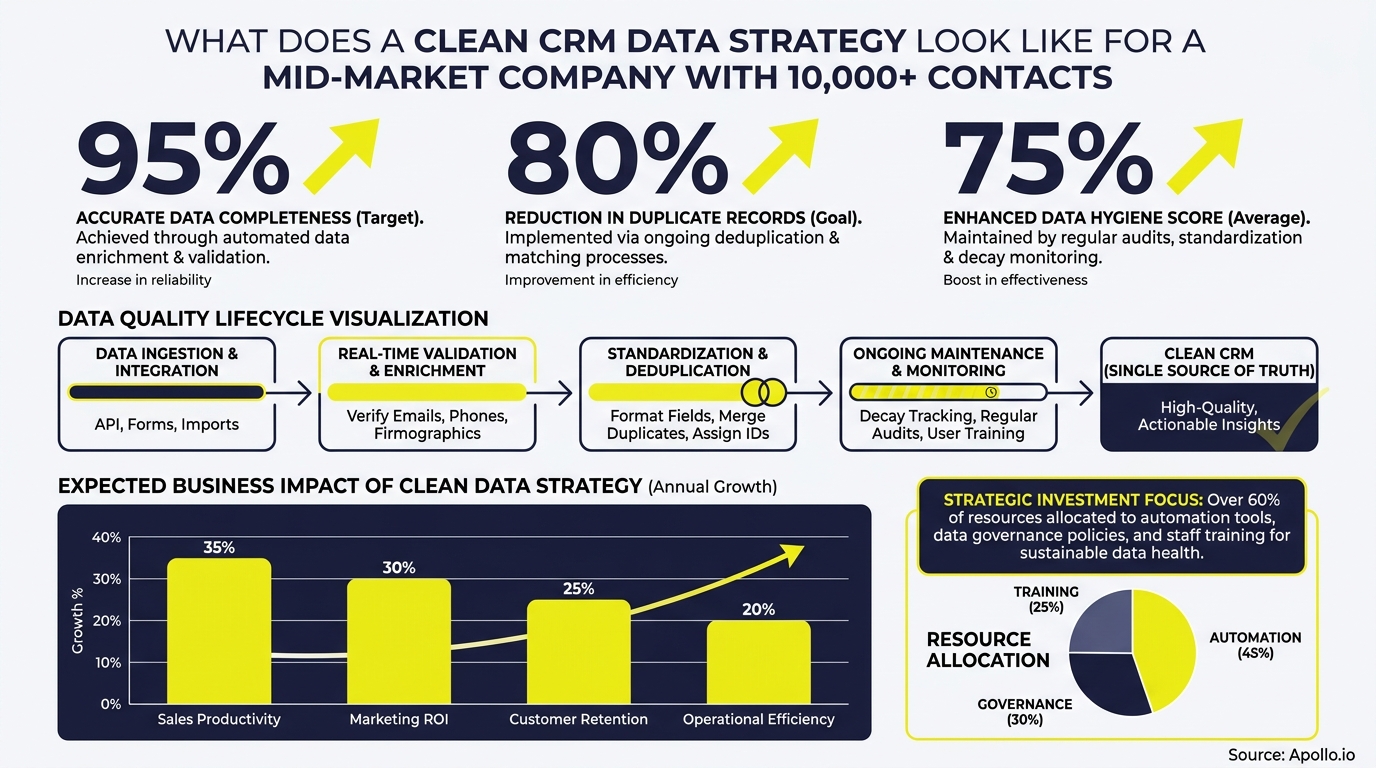
A clean CRM data workflow follows five sequential steps: capture, validate, enrich, deduplicate, and monitor. Each step should be automated where possible — manual processes break down at 10,000+ records.
- Capture: Standardize form fields and import templates. Enforce required fields at the point of entry (e.g., company name, email, job title).
- Validate: Run email syntax and domain checks on every new record. Flag invalid formats before they enter the database.
- Enrich: Append missing fields — phone, title, company size, industry — using a continuous enrichment tool. See how a solid data enrichment strategy drives this step.
- Deduplicate: Schedule automated deduplication scans weekly. Use fuzzy matching on name and email, not just exact-match logic.
- Monitor: Track fill rates, decay rates, and accuracy scores in a live dashboard. Review weekly, not quarterly.
The trend in 2026 is moving away from quarterly spreadsheet cleanups toward continuous monitoring with in-app data quality dashboards. Tools like Apollo's Data Health Center give RevOps teams real-time visibility into CRM hygiene without manual reporting overhead.
How Do RevOps Leaders Make the CRM AI-Ready?
AI-ready CRM data goes beyond deduplication — it requires governed, observable, policy-driven records that AI agents can reliably act on. Gartner predicts organizations will abandon 60% of AI projects not supported by AI-ready data through 2026.
For RevOps leaders, this means three specific upgrades:
- Semantic consistency: Standardize picklist values, naming conventions, and field definitions across all objects. AI models misfire when "VP Sales" and "VP of Sales" are treated as different roles.
- Data lineage: Track where each contact originated (inbound form, outbound prospecting, event). This source-of-truth field enables segmentation, suppression, and AI personalization.
- Enrichment coverage: Ensure key firmographic and contact fields are populated before feeding records into any AI workflow. Sparse records produce generic, low-converting AI outputs.
For AEs and SDRs relying on AI-assisted outreach, the quality of CRM data directly determines the quality of AI-generated messaging. Enriching contacts with verified titles, company size, and industry before sequences launch is now a baseline requirement — not a nice-to-have.
Struggling with sparse contact records before launching AI sequences? Enrich your CRM automatically with Apollo's contact enrichment tool.
What Does a 90-Day CRM Data Cleanup Roadmap Look Like?
A 90-day roadmap breaks the work into three focused sprints — each with a clear deliverable — so a 1-2 person RevOps team can execute without a major project budget.
| Phase | Focus | Key Deliverables |
|---|---|---|
| Days 1–30 | Audit and baseline | Data quality scorecard, RACI assignment, duplicate scan, field fill-rate report |
| Days 31–60 | Cleanse and enrich | Deduplication run, enrichment of top 5,000 contacts, SLA documentation, validation rules live |
| Days 61–90 | Automate and monitor | Continuous enrichment workflow active, monthly data health dashboard, governance review cadence set |
After Day 90, the goal is a self-sustaining system: new contacts are enriched automatically, duplicates are flagged before they accumulate, and leadership reviews a monthly data health score. For teams using Salesforce or HubSpot, connecting Apollo for continuous enrichment via native CRM integration automates most of this workflow with minimal admin overhead.
How Do You Turn Clean CRM Data Into a Revenue Story for Leadership?
Executives care about revenue impact, not fill rates. Translate data quality metrics into dollar terms by connecting CRM defects to pipeline loss.
A simple framework: if your team works 10,000 contacts and your duplicate rate is 15%, that's 1,500 records generating duplicate outreach — inflating pipeline numbers and burning rep capacity on contacts already worked.
Use this data health dashboard structure in monthly leadership reviews:
- Contact accuracy rate — % of contacts with verified email and phone
- Pipeline coverage reliability — % of open opportunities with complete account data
- Enrichment lag — average days between contact creation and enrichment completion
- Duplicate rate trend — month-over-month change in duplicate records
Research from Teamgate found that 37% of CRM users report revenue loss due to poor data quality. Framing data quality as a revenue protection initiative — not an ops project — gets leadership investment and sustained attention. Pairing your enrichment program with contact data enrichment ROI tracking makes that case concrete.

Build a CRM Data Strategy That Scales
A clean CRM data strategy for a mid-market company with 10,000+ contacts combines four things: defined quality pillars with measurable KPIs, clear governance ownership, an automated capture-to-monitor workflow, and a leadership-facing revenue narrative. None of these require a large team or a platform replacement — just a structured approach and the right enrichment tooling.
Apollo consolidates prospecting, enrichment, and CRM sync into one platform, so RevOps teams stop managing three separate tools to keep data clean. As Cyera put it: "Having everything in one system was a game changer."
Ready to build a data strategy that actually holds at scale? Start Your Free Trial and see how Apollo keeps your CRM clean, enriched, and AI-ready.
Prove Pipeline ROI From Day One
ROI pressure killing your tool budget before it even starts? Apollo delivers measurable pipeline impact fast — 600K+ companies see results without the guesswork. Start free and show leadership the numbers.
Start Free with Apollo →Don't miss these
Sales
Inbound vs Outbound Marketing: Which Strategy Wins?
Sales
What Is a Sales Funnel? The Non-Linear Revenue Framework for 2026
Sales
What Is a Go-to-Market Strategy? The 2026 GTM Playbook
See Apollo in action
We'd love to show how Apollo can help you sell better.
By submitting this form, you will receive information, tips, and promotions from Apollo. To learn more, see our Privacy Statement.
4.7/5 based on 9,690 reviews
