
Account-Based Marketing Data Enrichment: Key Fields to Capture
Most ABM teams are enriching only a fraction of the signals available to them. A 2024 benchmark found practitioners using roughly 7–8 out of 23 measurable signals, leaving huge gaps in targeting precision, personalization, and routing.
If your ABM program still runs on firmographics alone, you're competing with one hand tied behind your back.
This guide covers the typical data fields to enrich for account-based marketing, organized by field group, with practical guidance on governance, signal prioritization, and how RevOps and marketing leaders can operationalize enrichment at scale in 2026.

Build Pipeline on Verified Data
Tired of your reps burning hours chasing bad contact info instead of closing deals? Apollo surfaces verified, accurate contacts so your team spends time selling. Join 600K+ companies building predictable pipeline.
Start Free with Apollo →Key Takeaways
- ABM enrichment in 2026 spans four core field groups: firmographics, technographics, buying committee contacts, and intent signals.
- Data quality is a growth constraint, not just an ops issue. Poor data quality costs companies an average of $12.9 million annually, according to Martal.
- Identity fields (canonical domain, parent/child hierarchy, match confidence) must be enriched before intent signals become actionable.
- Stale enriched fields corrupt ABM targeting. A governance workflow with re-verification cadence is essential, not optional.
- As of a 2025 analysis, The Smarketers reports 76% of B2B companies have adopted ABM, making enrichment quality a direct competitive differentiator.
What Are the Four Core ABM Data Field Groups?
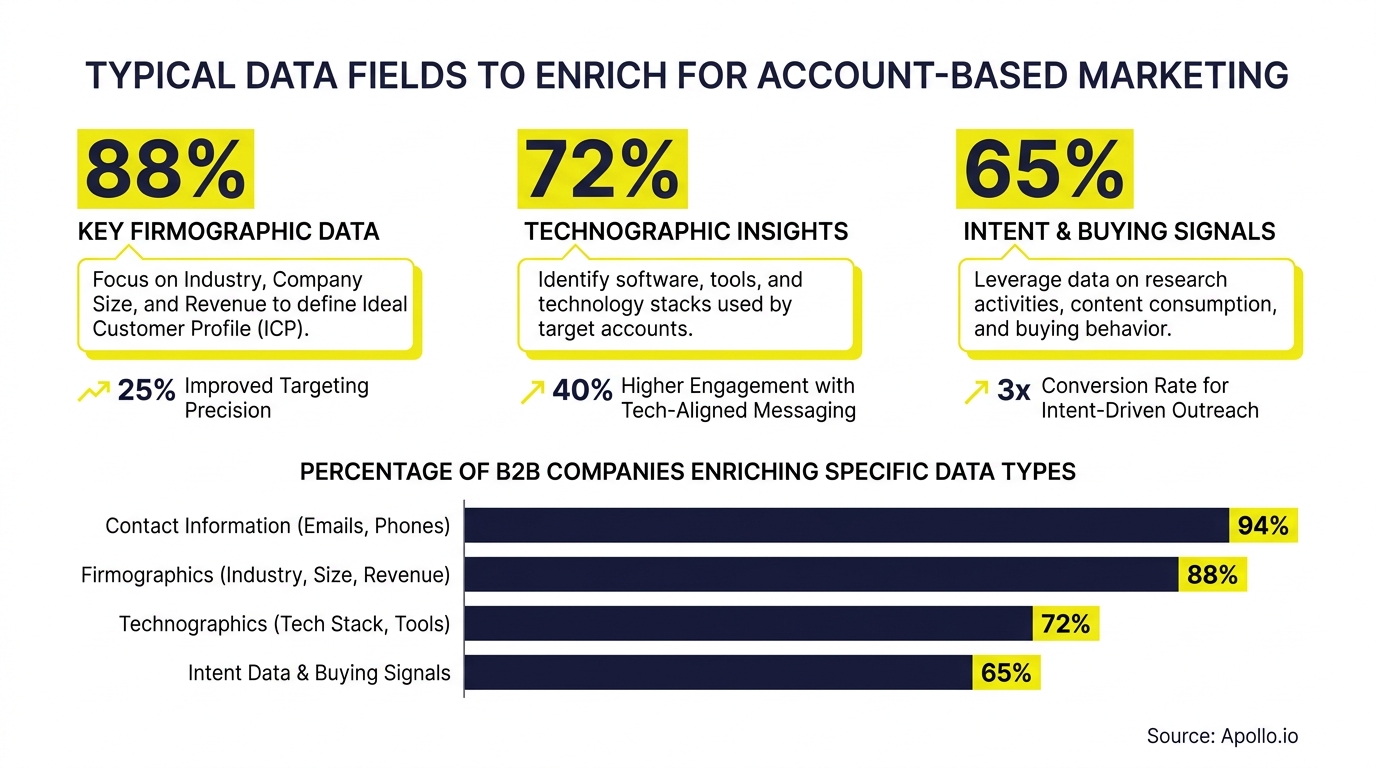
The four core ABM data field groups are firmographics, technographics, buying committee contacts, and intent signals. These four categories form the foundation of a modern ABM enrichment stack and are referenced consistently across 2026 playbooks.
| Field Group | Key Fields | Primary Use |
|---|---|---|
| Firmographics | Industry, employee count, revenue, HQ location, company hierarchy | ICP fit scoring, segmentation, routing |
| Technographics | Tech stack, software tools, platforms deployed | Competitive displacement, integration fit |
| Buying Committee | Job title, seniority, department, direct contact info, role in purchase | Personalized outreach, multi-threading |
| Intent Signals | Researching solutions, surging topics, competitor evaluation, content downloads | Prioritization, timing, content matching |
According to Datalane, technographic fields such as specific software, platforms, and technologies deployed are among the most actionable for ABM personalization. Similarly, SyncGTM highlights company hierarchy as a critical structural field for enterprise account mapping.
What Are the Most Important Firmographic Fields to Enrich?
The most important firmographic fields for ABM are industry, employee count, annual revenue, headquarters location, and company hierarchy. These fields determine whether an account fits your ICP and how it should be routed and prioritized.
- Industry vertical: The specific sector a company operates in, used for segmenting campaigns and tailoring messaging.
- Employee count and revenue: Proxy indicators for deal size, complexity, and product fit.
- Company hierarchy: Parent/subsidiary relationships that determine the correct account owner and prevent duplicate outreach.
- Canonical domain: The authoritative web domain used to match anonymous intent signals to named accounts. This field must be accurate before intent data is layered in.
- Funding stage and recent rounds: Trigger events that signal buying readiness, especially for growth-stage targets.
A sales professional wrote on Redditthat tiering enrichment by account priority reduces costs substantially: using one tool for firmographics and funding alerts on all accounts, then triggering contact-level enrichment only when a rep actively works an account. This approach keeps enrichment budgets manageable without sacrificing coverage on top-tier targets.
Struggling to keep account records accurate and current? Apollo's CRM enrichment tool keeps firmographic and contact data fresh automatically, so your team always works from a clean foundation.

What Intent and Engagement Fields Should ABM Teams Enrich?
ABM intent fields to enrich include actively researching solutions, surging topics, competitor evaluation signals, website visits, and content downloads. These fields shift targeting from static fit to dynamic timing, telling you not just who to target but when.
- Actively researching solutions: Identifies when accounts are in-market, per Influ2.
- Surging intent topics: Topic-level spikes that indicate a buying committee is actively evaluating a category.
- Competitor evaluation signals: Awareness that a target is also reviewing alternatives, per Forbes Agency Council.
- Website visits and content downloads: First-party engagement signals that confirm active interest, highlighted by Recotap.
- Recency and engagement timestamps: Fields that indicate how recently an account engaged, preventing outreach to cold signals.
Intent fields are only actionable after identity fields are solid. Without a clean canonical domain and reliable account-to-visitor matching, intent data produces noise rather than prioritization.
Identity resolution is the prerequisite, not a parallel workstream.
Turn Funnel Guesswork Into Closed Deals
Pipeline forecasting a guessing game because marketing leads never convert? Apollo surfaces high-intent prospects already showing buying signals. Top GTM teams use Apollo to build pipeline that actually closes.
Schedule a Demo →What Buying Committee Fields Do RevOps Teams Need to Enrich?
RevOps teams need to enrich buying committee fields including job title, seniority level, department, functional role in the purchase decision, direct email, phone, and job change alerts. These fields enable multi-threading and ensure outreach reaches decision-makers, not just generic contacts.
- Job title and seniority: Determines message framing (executive vs. practitioner).
- Department and function: Aligns content to the stakeholder's domain (IT, Finance, Marketing).
- Role in the buying process: Champion, economic buyer, technical evaluator, or blocker — each requires a different engagement approach.
- Job change alerts: When a champion moves to a new company, that's an immediate outreach trigger. Apollo's job change alerts and enrichment surface these signals automatically.
A Reddit user shared a firsthand perspectiveon a common pitfall: when a contact changes jobs, some enrichment tools do not remove the old company ranking data from CRM records. This leaves stale fields like Fortune 500 status attached to contacts who have moved to unqualified companies, corrupting segmentation and ABM targeting. Building a re-verification cadence into your enrichment workflow is essential to prevent this.
How Does Data Governance Protect ABM Enrichment Quality?
Data governance protects ABM enrichment quality by defining re-verification schedules, field-level provenance, and suppression logic that prevent stale or inaccurate data from corrupting targeting. Without governance, enriched fields degrade over time and silently undermine campaign performance.
Key governance fields to track alongside your enrichment data:
- Last verified date: When was this field last confirmed accurate?
- Data source / provenance: Which vendor or system provided this value?
- Match confidence score: How reliably was this contact or account matched to the record?
- Suppression flags: Is this account currently in a sales cycle, a customer, or on a do-not-contact list?
A March 2026 analysis framed B2B enrichment vendors as a potential third-party risk, emphasizing that buyers increasingly demand field-level provenance and re-verification cadence as part of vendor selection, not just data delivery. Enrichment programs that treat governance as a secondary concern create both targeting errors and organizational risk. Learn more about building a resilient data enrichment strategy that accounts for quality and governance from the start.
How Should Marketing Leaders Prioritize Which Fields to Enrich First?
Marketing leaders should prioritize enriching identity and firmographic fields first, then technographics, then buying committee contacts, and finally intent signals — because each layer depends on the accuracy of the one before it.
A practical sequencing framework:
- Foundation (enrich immediately): Canonical domain, industry, employee count, company hierarchy, HQ location.
- Fit scoring (enrich during ICP refinement): Revenue range, tech stack, funding stage, growth signals.
- Contact layer (enrich when account is tiered): Buying committee titles, seniority, department, direct contact info.
- Signal layer (enrich continuously): Intent topics, engagement timestamps, competitor evaluation signals, job change alerts.
Enriching in this sequence prevents a common error: purchasing intent data before account identity is clean, which results in signals that cannot be matched to the correct account record. RevOps leaders who enforce this sequencing get more actionable output from every enrichment investment. Explore how data enrichment tools that drive revenue in 2026 support this layered approach.
Working across too many disconnected tools to manage enrichment, engagement, and pipeline tracking? Apollo consolidates your enrichment and outreach into one unified platform, so your GTM team works from a single source of truth instead of juggling multiple subscriptions.

Conclusion: Build Your ABM Enrichment Stack on Signal and Governance
The typical data fields to enrich for account-based marketing span four groups: firmographics for fit, technographics for relevance, buying committee contacts for multi-threading, and intent signals for timing. But enrichment quality determines whether those fields help or hurt your ABM program.
The teams winning in 2026 treat enrichment as a layered, governed process — not a one-time data import. They enrich identity fields first, layer in intent only after account matching is reliable, and build re-verification workflows that catch stale data before it corrupts targeting.
Apollo gives B2B GTM teams — SDRs, AEs, RevOps leaders, and marketing managers — a unified platform to enrich accounts, find buying committee contacts, and activate outreach without stitching together multiple tools. As Cyera put it: "Having everything in one system was a game changer."
Request a Demo and see how Apollo's enrichment and prospecting platform can sharpen your ABM targeting from day one.
Prove Pipeline ROI With Apollo
ROI pressure killing your next budget approval? Apollo delivers measurable pipeline impact your leadership can't ignore. Teams like Built-In gained +10% win rates and +10% ACV — results that justify every dollar.
Start Free with Apollo →Don't miss these
Sales
Inbound vs Outbound Marketing: Which Strategy Wins?
Sales
What Is a Sales Funnel? The Non-Linear Revenue Framework for 2026
Sales
What Is a Go-to-Market Strategy? The 2026 GTM Playbook
See Apollo in action
We'd love to show how Apollo can help you sell better.
By submitting this form, you will receive information, tips, and promotions from Apollo. To learn more, see our Privacy Statement.
4.7/5 based on 9,690 reviews
